- Date
Best Generative Engine Optimization Tools: What to Compare in 2026
 Andrii Romasiun
The best generative engine optimization tool depends on what you need to change. An AI visibility tracker shows whether a brand appears in sampled answers. A content tool helps you produce or improve pages. Website analytics shows what happens when someone clicks through. You may need more than one of these, but they should answer different questions.
If you already use RankPine for content, its AI visibility add-on is a natural option to evaluate. If you only need monitoring, compare standalone products such as Otterly, Peec, Profound, and Scrunch before adding a writing subscription.
GEO Tools Compared
| Tool | Main use | Pricing reference | Important buying question |
|---|---|---|---|
| RankPine AI visibility | Monitor answers and turn gaps into content topics | $49/site/month add-on; requires a paid writing plan | Do you also need the content workflow? |
| Otterly | Standalone AI search monitoring | Lite: $29/month for 15 prompts | Are the required engines included or add-ons? |
| Peec AI | Brand and competitor visibility analysis | Check current plan and model selection | Which markets and models will you actually monitor? |
| Profound | AI visibility and agent workflows | Check current package | What workspace, usage, and reporting limits apply? |
| Scrunch | Monitoring plus website audit workflows | Core advertised at $250/month | Are the required audit and model features included? |
| Swetrix | Visits, events, funnels, and revenue after a click | Traffic-based plans | Is attribution configured for the outcome you care about? |
The price of one saved prompt is not a universal unit. Providers can differ in check frequency, models, regions, failed-check handling, and historical retention. Compare a concrete configuration rather than dividing every plan by its headline prompt count.
RankPine: Connect AI Visibility With Content Decisions
RankPine's AI visibility add-on checks 25 saved prompts daily across ChatGPT, Gemini, and Google AI Mode. It keeps sampled answers and citations and lets you compare your brand with up to ten competitors. See the AI visibility documentation for supported markets and retention.
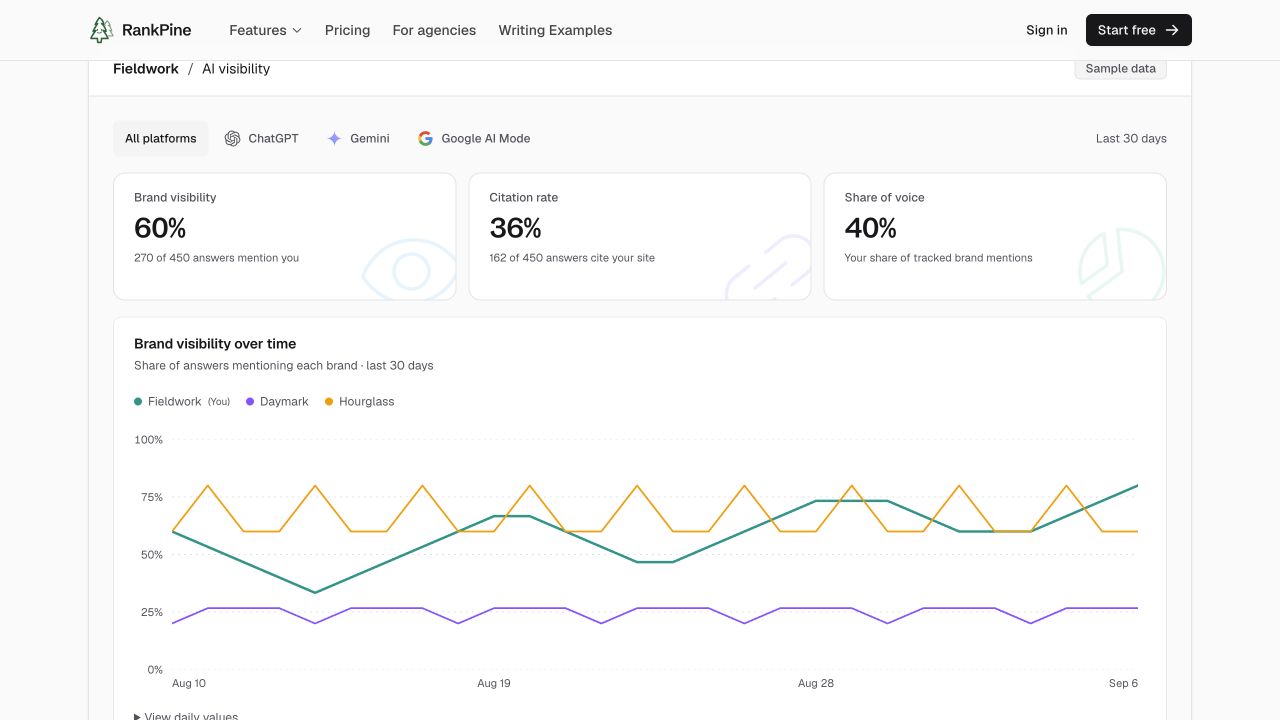
Public demo captured September 24, 2026. Fieldwork and the chart values are sample data, not customer performance.
The useful workflow is to open a question where a competitor appears, read the answer and sources, and decide whether an existing page needs work or a new topic is justified. Avoid turning every missing mention into another article.
The add-on costs $49/site/month separately from the writing plan. For one website on the $99 monthly writing plan, the combined list price is $148/month before taxes or other add-ons. The writing trial does not include paid AI visibility checks.
Best fit: a team that wants research, publishing, and a repeatable AI-answer review in the same workspace. Limitation: three supported platforms are not coverage of every AI product, model, country, or real user session.
Otterly: A Small Standalone Monitoring Plan
Otterly's pricing page lists Lite at $29/month for 15 prompts. The listed core coverage includes ChatGPT, Google AI Overviews, Perplexity, and Microsoft Copilot, with other engine coverage offered as add-ons.
It is worth evaluating if your immediate question is whether AI answers mention you and you already have a content process. Check how the exact engines and prompt allowance you need affect the bill.
Peec AI: Competitor and Source Analysis
Peec AI provides AI search visibility reporting with model and plan choices. In a demo, work through one important buyer question: which competitors appear, which sources are cited, and how the result differs by market.
Choose based on the decisions the report supports. A visibility score without the saved answer or useful source context can leave your team with a number but no clear next action. Verify current pricing directly because model selection changes the comparison.
Profound: Broader AI Visibility Workflows
Profound combines AI visibility work with agent workflows. Evaluate its package against the number of brands or client workspaces, the research questions you need answered, and the reporting process your team uses.
For a larger organization, export, access controls, support, and repeatable reporting may matter as much as the initial prompt allowance. Request a demonstration using your category instead of relying on a generic visibility chart.
Scrunch: Monitoring and Website Audits
Scrunch advertises a Core plan at $250/month with 125 unique prompts and five site audits per month, plus an enterprise offering. Its audit workflow makes it relevant when your team wants help diagnosing the website alongside monitoring answers.
Check which recommendations are observations, which require implementation, and which can be acted on automatically. You still need to validate changes against your website and editorial requirements.
Choose a Prompt Set Before Choosing a Plan
Begin with a small set of questions from actual customer conversations. For a fictional analytics business, a useful starting set could include:
- “What analytics tools suit a small SaaS business?”
- “Which analytics tools support self-hosting?”
- “How does Product A compare with Product B?”
- “Does Product A support revenue tracking?”
These questions test discovery, a specific requirement, a buying comparison, and a factual product claim. A branded question alone can overstate visibility because it gives the model your name.
Keep wording, region, and platform stable when comparing periods. Record changes to the prompt set so a newly added easy question does not look like an improvement in your content.
What GEO Metrics Can and Cannot Tell You
| Metric | What it describes | What it does not prove |
|---|---|---|
| Brand visibility | Share of sampled answers mentioning a brand | Share of all customer conversations |
| Citation rate | Share of sampled answers citing your site | Number of visits to your site |
| Share of voice | Your share under the provider's mention formula | Your market share or sales share |
| Referral visits | Measured arrivals from identifiable AI sources | Every AI-influenced visit |
| Paid conversions | Recorded purchases under your attribution setup | That an AI mention caused the purchase |
A failed check should be reported as a failure, not as an answer that did not mention you. When reviewing a trend, look at completed checks and the underlying answers as well as percentages.
No tool can guarantee inclusion in an AI answer. Google's AI features guidance says its existing SEO practices remain relevant and no special AI markup is required. For page-level work, use our ChatGPT visibility guide.
Measure the Visits After the Mention
Use Swetrix to inspect identifiable AI referrals, their landing pages, and the events or revenue that follow. Keep this separate from answer monitoring. A browser analytics tag does not observe every answer a person reads or every crawler request to your server.
Do not label all Google traffic as AI Overviews traffic. A Google referrer can represent several search experiences, and an ordinary referrer alone cannot distinguish them. Likewise, direct traffic is not proof of an earlier AI recommendation.
For a practical measurement setup, see tracking ChatGPT referrals and SEO ROI.
What to Buy First
If you have no repeatable publishing process, begin by fixing that workflow. If you already publish useful pages but cannot see how AI answers represent you, trial a monitoring product with a defined prompt set. If you get visits but cannot connect them to customer actions, implement conversion measurement before buying another visibility dashboard.
For the combined content-and-monitoring workflow, explore RankPine AI visibility. Check the separate writing-plan requirement before choosing it.