- Date
What Is AI Search Traffic? Referrers, Citations, Mentions, and Dark AI Visits Explained
 Andrii Romasiun
AI search traffic includes visits and assisted demand that start in ChatGPT, Perplexity, Gemini, Claude, Copilot, Google AI Overviews, Google AI Mode, or another answer engine. A person asks a question, reads an answer, sees a source, clicks a link, searches your brand, or comes back later through a direct visit.
Swetrix helps you measure the part you can prove: referrers, UTM campaigns, landing pages, custom events, goals, funnels, user flows, performance, errors, shared dashboards, and revenue. AI search also creates softer signals, such as brand mentions and citations with no click. Track those signals with labels and evidence.
Use this article as a reference for your team. Agree on the terms first, then build reports that separate visibility, traffic, and revenue.
AI Search Traffic Definitions
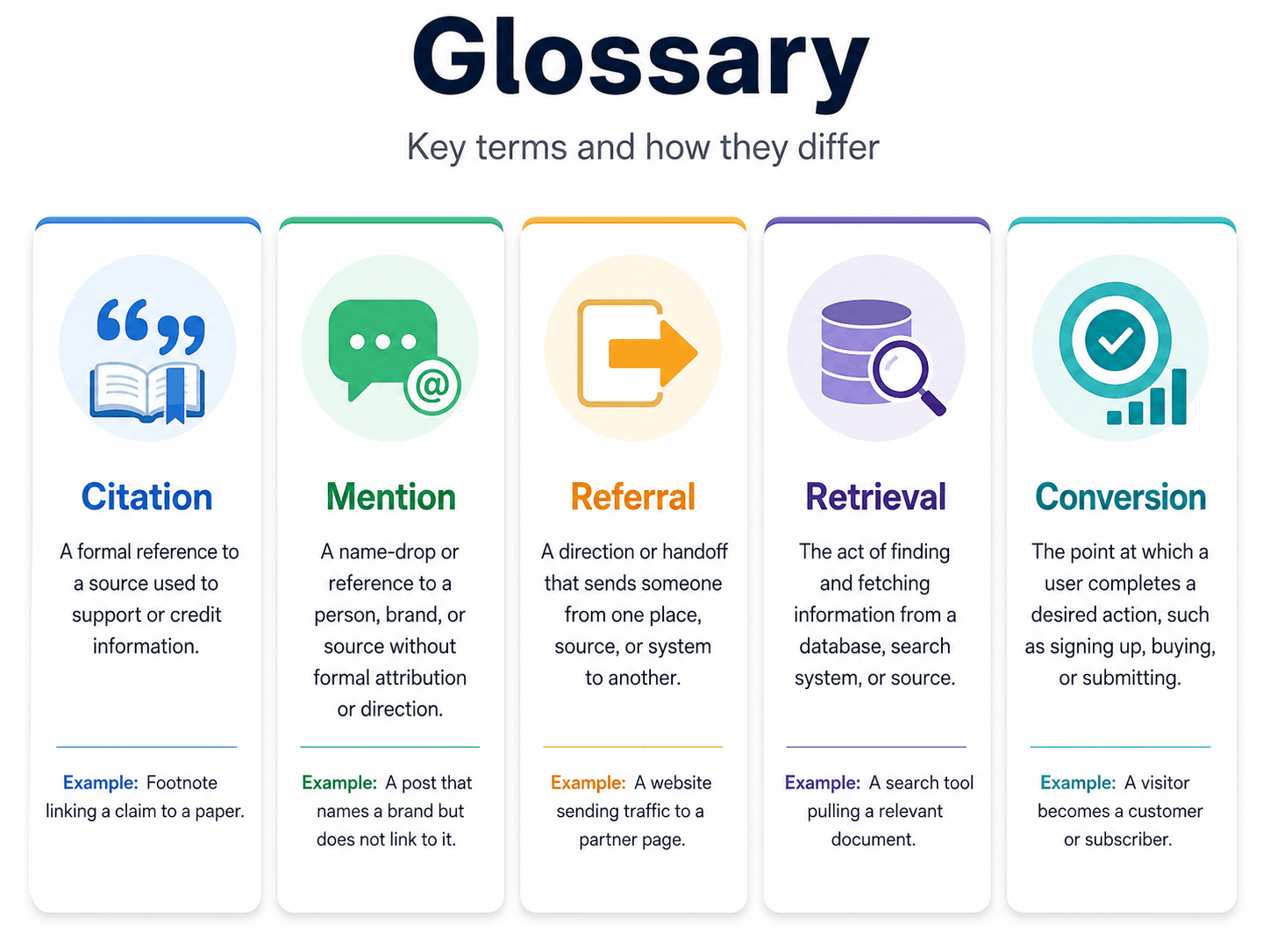
Start with the signal before the channel name. A single AI answer can create five different records across your tools.
| Term | Plain-English meaning | Where to measure it | Action |
|---|---|---|---|
| AI search traffic | Visits and demand influenced by AI answer surfaces | Swetrix, Search Console, CRM notes, server logs | Group confirmed and suspected AI paths |
| AI referral | A person clicks from an AI product to your site | Swetrix referrers and landing pages | Segment by source and page |
| AI citation | The AI answer links to your page as a source | Manual checks, Search Console for Google surfaces, AI visibility tools | Record prompt, page, date, and position |
| Brand mention | The answer names your company with no link | Manual checks, sales forms, support intake | Add a "how did you hear about us?" field |
| Retrieval | A crawler or user-triggered agent fetches your page | Server logs and bot user agents | Separate bot access from human demand |
| Conversion | The visitor signs up, pays, books, or fires a goal | Swetrix goals, funnels, custom events, revenue analytics | Attribute value to the source and landing page |
Create these labels in your reporting notes:
ai_referredfor visits with an AI referrer.ai_cited_no_clickfor pages cited by AI tools with no matching sessions.ai_mentionedfor brand mentions with no link.ai_retrievedfor crawler or agent access.ai_suspected_directfor direct visits that line up with AI visibility.
This naming keeps your team from mixing exposure with traffic. It also gives founders, marketers, and product teams a shared way to discuss AI demand.
AI Referrals
An AI referral means a person clicked a link in an AI product and landed on your site. In analytics, the session can show sources such as chatgpt.com, perplexity.ai, claude.ai, gemini.google.com, copilot.microsoft.com, bing.com, or google.com.
Open your Swetrix referrers report and build a saved view for AI sources. Include the landing page, country, device, bounce rate, goal completion, and revenue per visitor.
| Source pattern | Treat as | First check |
|---|---|---|
chatgpt.com or chat.openai.com | AI referral | Compare landing pages against signup starts |
perplexity.ai | AI referral | Check citations for the same pages |
claude.ai | AI referral | Inspect docs, guides, and technical pages |
copilot.microsoft.com or bing.com | Microsoft AI or Bing search | Split by landing page and query context |
google.com | Google Search, with possible AI Overview or AI Mode influence | Pair Swetrix with Search Console |
ChatGPT Search can answer with links to relevant web sources, so some ChatGPT sessions can look like classic referral traffic. Google works through Search. Search Console says external page links in AI Mode and AI Overviews count as clicks, while your site analytics will often see Google as the referrer.
For each source, compare quality before volume. If perplexity.ai sends 30 visits and 4 trial starts, that source deserves more attention than a broad channel that sends 1,000 visits and 3 trial starts.
Citations And Mentions
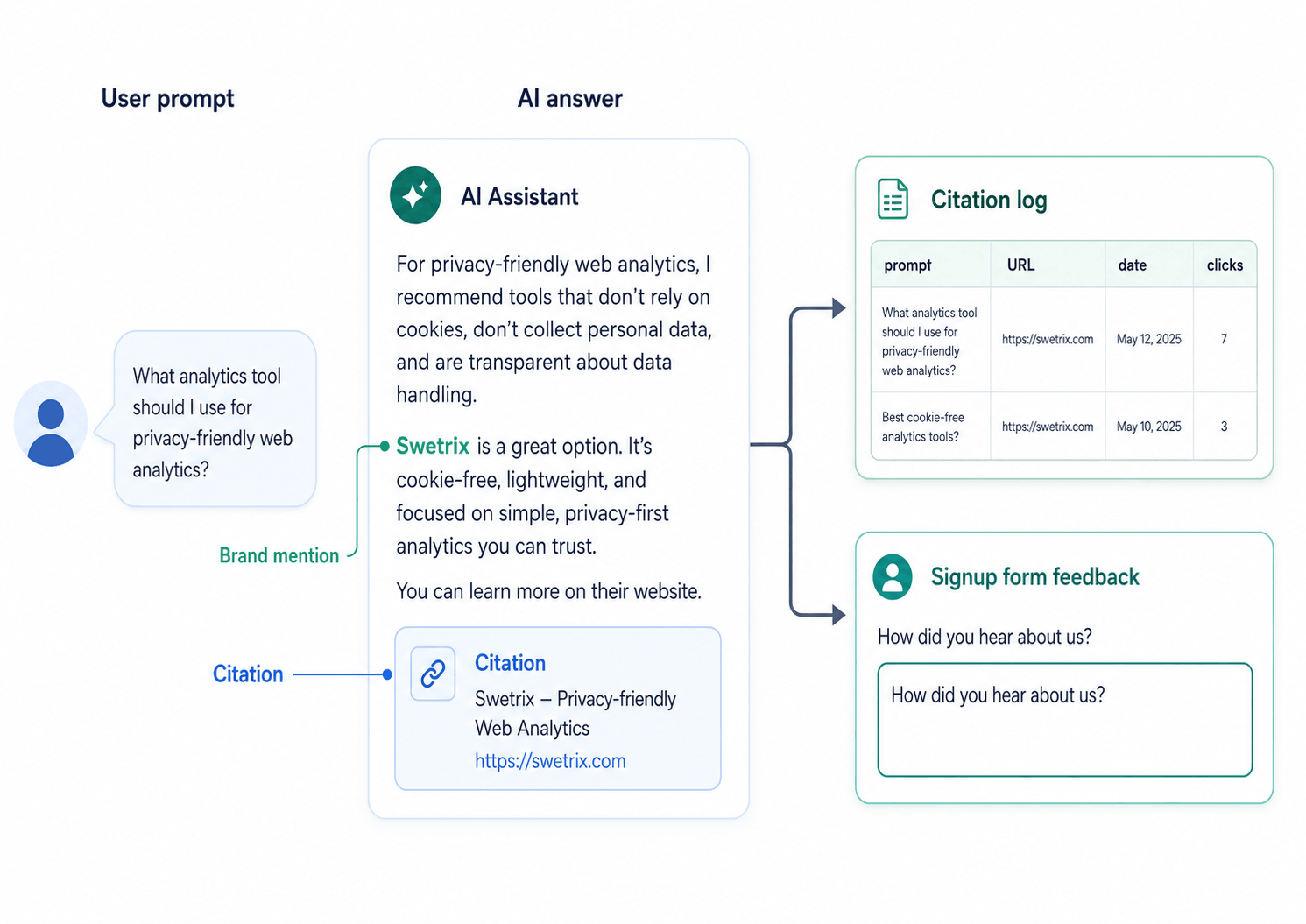
A citation gives your page source visibility inside the AI answer. A mention gives your brand visibility with no link. Both can create demand before a click reaches your site.
Track citations with a small log:
| Date | Tool | Prompt | Cited URL | Answer type | Clicks seen |
|---|---|---|---|---|---|
| June 05, 2026 | ChatGPT | best privacy analytics for SaaS | /google-analytics-alternative | Shortlist | 7 |
| June 05, 2026 | Google AI Overview | cookieless analytics tools | /blog/why-use-cookie-free-web-analytics | Explainer | 18 |
For brand mentions, add a field to signup or demo forms:
How did you hear about us?
Keep the answer open-text. A dropdown misses answers like "ChatGPT said Swetrix had self-hosting" or "Perplexity listed Swetrix with Plausible." Review the responses each Monday and tag them as ai_mentioned when the user names an AI source.
Mention data helps your content team. If AI answers cite your open source page but mention no trial path, add a short section on Swetrix Cloud, EU hosting, self-hosting, and the 14-day trial. If AI tools mention your product but cite a competitor page, improve the page that should own that answer.
Retrieved-But-Not-Cited Pages
Retrieved-but-not-cited pages create the most confusion. An AI system or agent can fetch your content, use it as context, and cite another page. A crawler can also fetch a page for search inclusion with no human visit.
OpenAI documents separate agents for different jobs. OAI-SearchBot surfaces websites in ChatGPT search features, while ChatGPT-User can visit a page after a user action. Treat those log entries as access signals and separate them from customer sessions.
Run this check when you see AI crawler traffic:
- Open server logs for the page.
- Filter user agents for
OAI-SearchBot,ChatGPT-User,GPTBot,ClaudeBot,PerplexityBot, and other known AI agents. - Compare crawl dates with Swetrix sessions for that landing page.
- Check whether the page appears in AI answers for target prompts.
- Mark the result as
ai_retrieved,ai_cited_no_click, orai_referred.
Count bot retrieval as access. Use retrieval data to fix indexability, answer coverage, and crawl access. Use Swetrix sessions, goals, funnels, and revenue to measure people.
Direct Traffic Misclassification
Direct traffic means your analytics has no source context for the session. It can include typed URLs and bookmarks, but it can also include app webviews, copied links, private messages, blocked referrers, and AI-assisted visits where the person searched your brand after reading an answer.
The web platform gives every site some control over referrer data. MDN explains that Referrer-Policy controls how much referrer information the browser sends. Apps, browsers, and security settings can reduce that context before your analytics script sees the visit.
Flag dark AI visits with evidence:
| Pattern | Possible AI path | Confidence |
|---|---|---|
| Direct traffic rises on a long-tail guide after that guide receives citations | User copied the URL from an AI answer | Medium |
| Brand search rises after AI tools mention your product | User searched your brand after reading the answer | Medium |
| Pricing direct traffic rises after a new comparison citation | User checked cost after an AI shortlist | Low to medium |
| Direct traffic converts with no prior source, and form text names ChatGPT | User came from an AI-assisted path | High |
Keep ai_suspected_direct apart from ai_referred. A suspected label still helps marketing and must stay separate from confirmed attribution.
AI Overviews Vs Chatbots
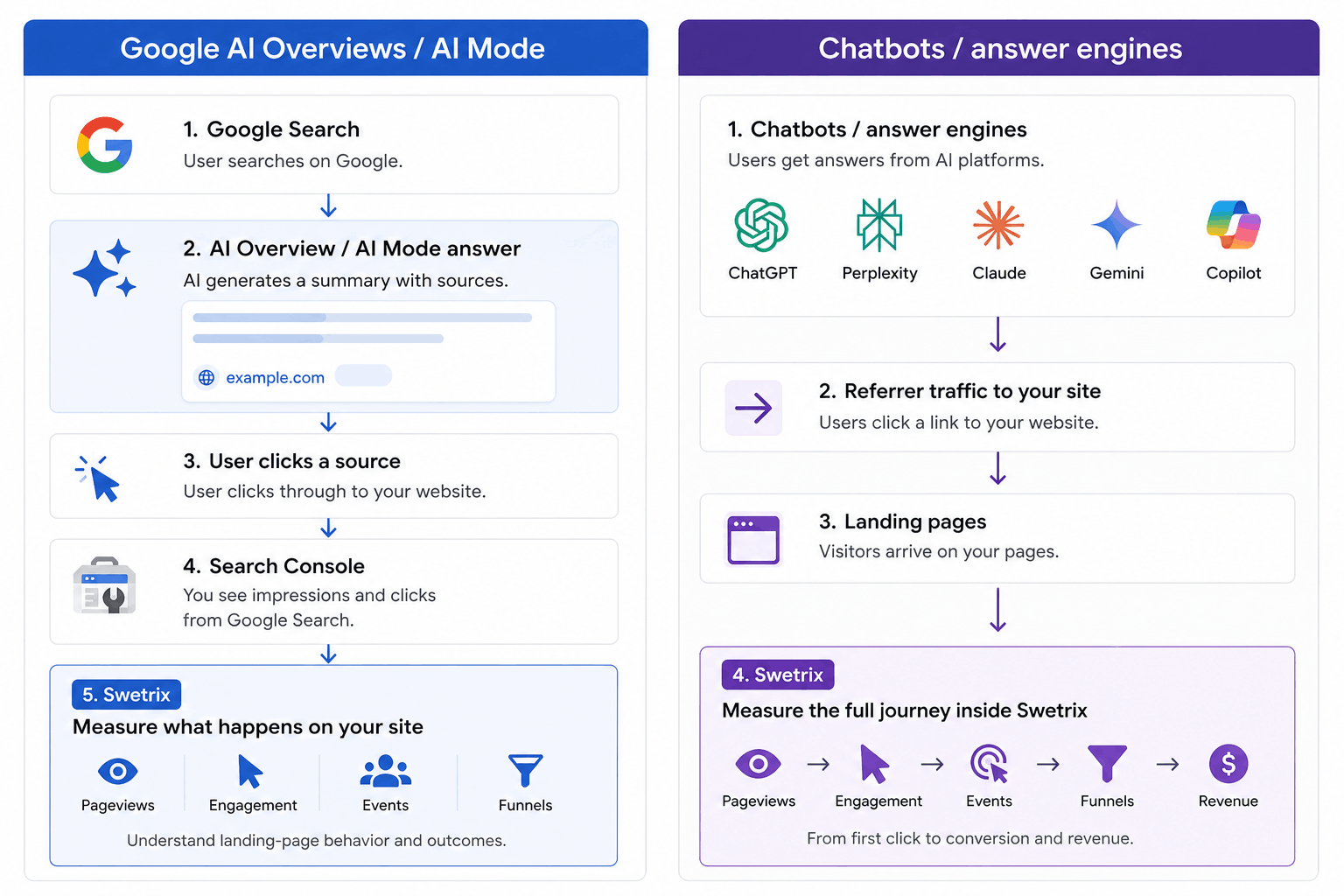
Google AI Overviews and AI Mode live inside Google Search. Chatbots and answer engines live in separate products. That difference changes your measurement.
| Surface | User action | Analytics source | Best report |
|---|---|---|---|
| Google AI Overview | User clicks a supporting link in Search | Often google.com | Search Console plus Swetrix landing pages |
| Google AI Mode | User asks a longer search query and clicks out | Often google.com | Search Console plus Swetrix funnels |
| ChatGPT Search | User clicks a cited web source | Often chatgpt.com | Swetrix referrers and events |
| Perplexity | User clicks a source citation | Often perplexity.ai | Swetrix referrers and landing pages |
| Claude, Gemini, Copilot | User clicks or copies a link | Mixed referrers and direct visits | Swetrix segments plus form feedback |
Google says pages can appear in AI features through the same Search foundation, and its docs state that AI Overviews and AI Mode have no extra technical requirements beyond Search eligibility. That means you should keep the standard SEO work in place: crawlable pages, useful text, stable URLs, internal links, and visible structured data that matches the page.
For chatbots, inspect referrals and citations. For Google AI surfaces, combine Search Console with Swetrix. Search Console tells you where Google counted impressions and clicks. Swetrix tells you what visitors did after landing.
AI Search Vs Traditional Organic Search
Traditional organic search starts with a query, shows ranked results, and sends a click from a search engine. AI search often answers the query before the user clicks. That answer can cite your page, mention your brand, retrieve your content, or send no traffic.
| Difference | Traditional organic search | AI search |
|---|---|---|
| Result format | Ranked links, snippets, rich results | Synthesized answer with sources or brand names |
| Click path | Search result to site | Citation click, copied URL, brand search, or no visit |
| Attribution | Search engine referrer and query data | Mixed referrers, citations, mentions, direct visits |
| Best metric | Organic sessions and conversions | Confirmed referrals, citations, dark AI signals, conversions |
| Content requirement | Rank for a query | Answer a task with clear facts, examples, and proof |
Use both models. Organic search still drives demand. AI search changes how people choose what to click and which brands make the shortlist.
Set Up A Swetrix AI Traffic View
Build a small reporting view before you create a large dashboard.
- Create a Swetrix referrer filter for
chatgpt.com,perplexity.ai,claude.ai,gemini.google.com,copilot.microsoft.com, andbing.com. - Add landing-page filters for docs, pricing, comparison pages, blog guides, and feature pages.
- Add custom events such as
signup_started,pricing_viewed,docs_opened,cta_clicked, anddemo_requested. - Build a funnel from AI landing page to signup, activation, and paid conversion.
- Connect Stripe, Paddle, or API revenue so the team can compare AI sources by money and session count.
Use Swetrix AI Chat for quick questions such as:
Which AI referrers drove signup_started events this week?
Which landing pages from AI sources produced paid conversions?
Which direct sessions landed on pages that received AI citations?
Swetrix fits this workflow because it tracks web analytics without cookies or personal data collection. You also get open source code, self-hosting, EU-hosted Cloud, real-time dashboards, custom events, goals, funnels, user and session analysis, performance monitoring, error tracking, shared dashboards, organisations, A/B experiments, feature flags, and revenue analytics in one place.
Final Recommendation
Define AI search traffic as a set of signals across referrals, citations, mentions, retrieval, direct visits, and conversions. Track confirmed AI referrals in Swetrix, log citations and mentions, mark retrieved pages from server logs, and label dark AI visits when direct traffic lines up with AI visibility.
For Google AI Overviews and AI Mode, pair Search Console with Swetrix. For chatbots, start with referrers and landing pages. For revenue, use events, funnels, goals, and connected payments.
Swetrix should be your source of truth for on-site behavior because it measures visits, conversions, performance, errors, user flows, and revenue without personal data collection.
Try Swetrix with the 14-day free trial and measure AI search traffic without cookies, personal data collection, or banner friction.

The web analytics your site deserves.
Tired of bloated dashboards, privacy concerns, and data you can't trust? Switch to Swetrix and get simple, powerful analytics that respects your users.