- Date
How to Rank in ChatGPT: 9 Steps to Improve Search Visibility
 Andrii Romasiun
To improve your chances of appearing in ChatGPT Search, make your pages accessible, answer the questions buyers actually ask, and publish facts that can be checked against credible sources. Then track a consistent set of questions and the referral visits you receive.
“Rank in ChatGPT” is convenient shorthand, but there is no single permanent results page to win. Answers can vary with the prompt, conversation, search use, location, and product changes. A mention, a linked citation, and a customer visit are three separate outcomes.
1. Check Access for ChatGPT Search
OpenAI's crawler documentation distinguishes search discovery from training and user-triggered retrieval. OAI-SearchBot serves search discovery; GPTBot has a different purpose. ChatGPT-User handles user-triggered actions and does not determine Search eligibility.
Inspect your effective crawler rules, CDN behavior, and important page responses. A page that returns an error or requires sign-in cannot provide the same publicly accessible evidence as a working article.
Use server or CDN logs to investigate actual requests. A user-agent string alone is not proof of the requester's identity, and a successful fetch is not proof that a page was cited. Our AI crawler checks guide covers the diagnostic workflow.
2. Write Down Your Buyers' Questions
Choose questions with a plausible connection to your product. “What is marketing?” is much less useful to a specialist software company than a question about the exact workflow it supports.
Create a small record for each question:
| Field | Example for a fictional analytics product |
|---|---|
| Buyer question | Which analytics tools support self-hosting? |
| Audience | Technical founder evaluating deployment options |
| Best existing page | Self-hosting guide |
| Missing evidence | Setup requirements, limitations, and a current screenshot |
| Next step | Read installation instructions |
Use real sales objections and support questions where possible. Search volume can help prioritize web content, but a keyword-volume estimate is not a measurement of how often people ask ChatGPT that question.
3. Inspect the Answers and Sources
Run the questions and record the date, platform, market, wording, brands mentioned, and cited URLs. Read the actual sources. Work out whether the answer needs a product page, a comparison, documentation, or an independent source.
Avoid treating one answer as a stable ranking. Repeat the same checks over time, or use a tool that preserves answers and makes its sampling method clear. Our GEO tools comparison explains what to compare.
4. Improve the Page That Should Answer the Question
Before creating another article, look for a page you can improve. Add the missing information where a reader expects it.
For a comparison, that might mean the current price, who each product suits, migration steps, and a limitation that matters. For a setup question, it might mean prerequisites, commands, an error explanation, and a screenshot of the resulting state.
Write the direct answer early, then support it. Keep important information in readable page content. Headings and tables should help people find answers; they are not a special citation formula.
5. Add Evidence That Is Yours
A useful first-hand example can distinguish your page from a summary of other summaries. Consider a documented test, a real workflow, a support pattern you can discuss without exposing customers, or a small dataset with its method explained.
If you publish a number, state its denominator, period, and limitations. If a screenshot uses demo data, label it. Do not present a generated chart or a marketing preview as customer results.
For tool reviews, distinguish “we read the documentation” from “we ran these tasks ourselves.” A reader should be able to tell what your conclusion rests on.
6. Keep Third-Party Information Accurate
Check the places buyers already use to learn about your category: relevant directories, partner pages, communities, and independent reviews. Correct outdated descriptions and make documentation easy to verify.
When contacting a publisher, offer a factual correction or a useful product example. There is no reliable promise that getting onto one list will place you in a particular number of AI answers. Give publishers concrete examples and accurate product details they can use in their coverage.
7. Maintain the Content
A page can become less useful when pricing, integration support, or setup instructions change. Update those details when there is a substantive change, preserving the URL where the topic remains the same.
Separate the publication date from a review note. Changing a date without reviewing the page gives the reader a false signal of freshness.
An llms.txt file may help agents navigate documentation, but it is not a substitute for accessible, accurate pages.
8. Build a Sustainable Publishing Process
Choose a cadence your team can review. A useful content plan covers distinct customer questions, links to the relevant product or documentation page, and avoids several articles competing to answer the same question.
RankPine can help with the research, drafting, and publishing work. Its separate AI visibility add-on samples answers so you can investigate missed mentions and decide what to improve. Publishing more articles is not evidence that those articles will be selected as sources.
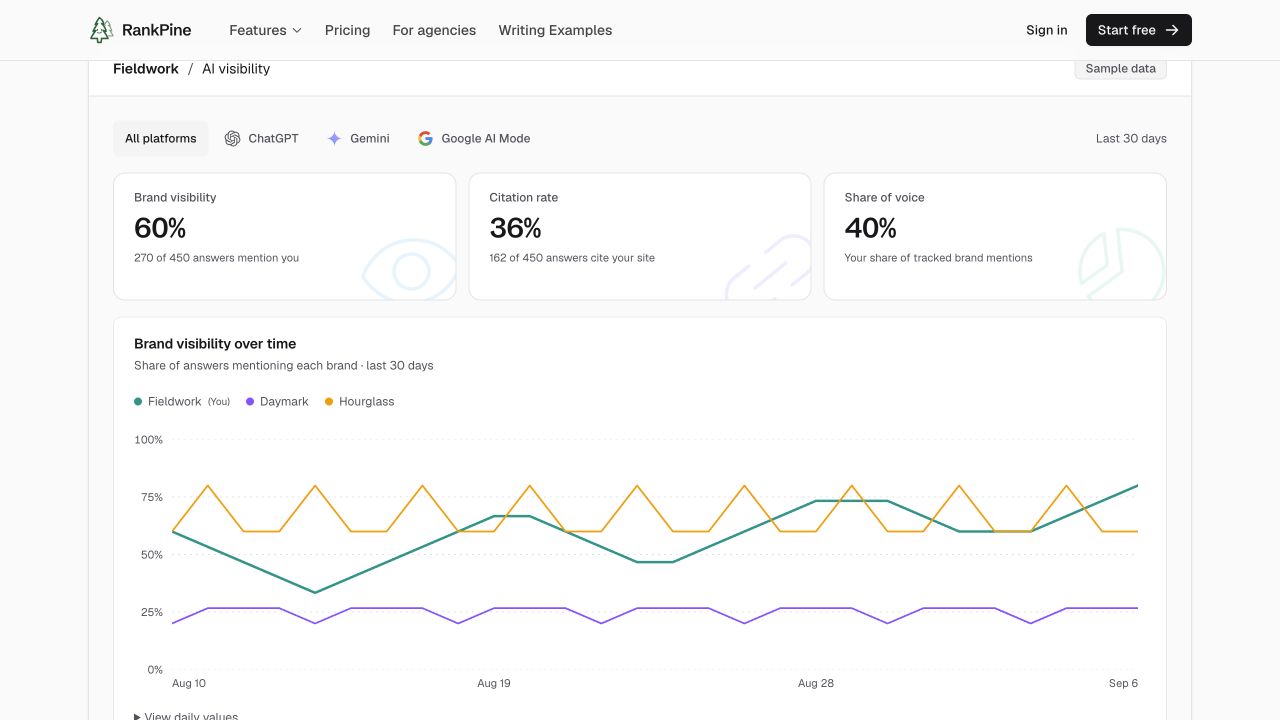
Public RankPine demo with sample data, captured September 24, 2026.
For the publishing side, start with a topic you know well. Check whether the draft represents your product accurately, adds useful evidence, and gives the reader a sensible next step before enabling a recurring schedule.
9. Measure Referrals and Customer Actions
In Swetrix, inspect identifiable ChatGPT referrals and their landing pages, then examine relevant goals or revenue events. Keep citations, referral visits, and paid conversions in separate columns.
Some visits lose referrer information. Some people see a recommendation and return through a branded search. Do not silently reclassify direct traffic as ChatGPT traffic to fill those gaps.
Use the ChatGPT referral guide for setup and SEO ROI guide for connecting content costs to outcomes.
A Practical First Month
In week one, choose five to ten buyer questions, record a baseline, and check the relevant pages are accessible. In week two, improve one page with missing evidence. In week three, publish one genuinely distinct follow-up if the question needs it. In week four, repeat the checks and inspect referrals and customer actions.
Treat that month as a diagnostic cycle. A citation change is an observation, not proof that your edit caused it, and no change is a reason to investigate rather than immediately publish ten more pages.
If content production is the part you cannot sustain, try RankPine with one topic from your own business. Use the writing trial to judge article quality; AI visibility checks are a separate paid add-on.