- Date
Best AI SEO Tools in 2026: Choose by Workflow
 Andrii Romasiun
AI SEO tools can help with research, article production, content analysis, website changes, and monitoring AI answers. Choose the workflow first. A writing assistant, a technical automation platform, and an AI visibility tracker solve different problems.
RankPine is our best overall AI SEO tool for content production. It handles the recurring work from topic research to publication, with editing and image creation built in. For content analysis with an editor involved, compare Surfer. For research and wider SEO operations, consider a suite such as Semrush. For standalone AI-answer monitoring, compare Otterly and the other products in our GEO tools guide.
AI SEO Tools Compared
| Workflow | Candidate | What to test |
|---|---|---|
| Research and planning | Semrush | Whether the opportunities fit your product and current pages |
| Article production | RankPine | Topic relevance, source quality, review time, and CMS output |
| AI-assisted drafting | Koala | Control over inputs, model allowance, and editing effort |
| Content analysis | Surfer | Whether recommendations improve the answer for readers |
| Website optimization | Alli AI | Change review, implementation, and rollback process |
| Technical diagnosis | Screaming Frog | Useful crawl findings and a repeatable review process |
| AI visibility | Otterly or RankPine's add-on | Saved answers, citations, sampling, and platform coverage |
| Outcome measurement | Swetrix | Verified events and attribution after the visit |
Screaming Frog and Swetrix are supporting parts of this workflow; you do not need every product in an SEO stack to be an AI generator. For the broader operations category, see SEO automation tools.
Research: Ground the Plan in More Than a Prompt
A language model can help brainstorm questions and organize a topic list. That does not make its suggested search volumes or ranking difficulty measured data.
Use a research source such as Semrush, your Search Console data, and actual customer questions to evaluate candidates. Before creating a page, check whether an existing article already answers the same intent.
A low-volume question can still be valuable if it concerns a buying decision. Equally, a high-volume term can be irrelevant to your product. The editorial decision is which reader you can help and what useful next step you can offer.
Best Overall: RankPine for AI SEO Content
RankPine connects topic research, planning, drafting, images, and publishing. Its editing passes cut AI filler, improve the draft, and verify cited claims. Images follow your chosen style, so the article arrives with both the text and visuals ready to review.
Its monthly writing plan is $99/site for 30 articles. Compare the cost per accepted article after review, not just the $3.30 allocation of the software fee. Source checks, product expertise, and your publishing standard still need an owner.
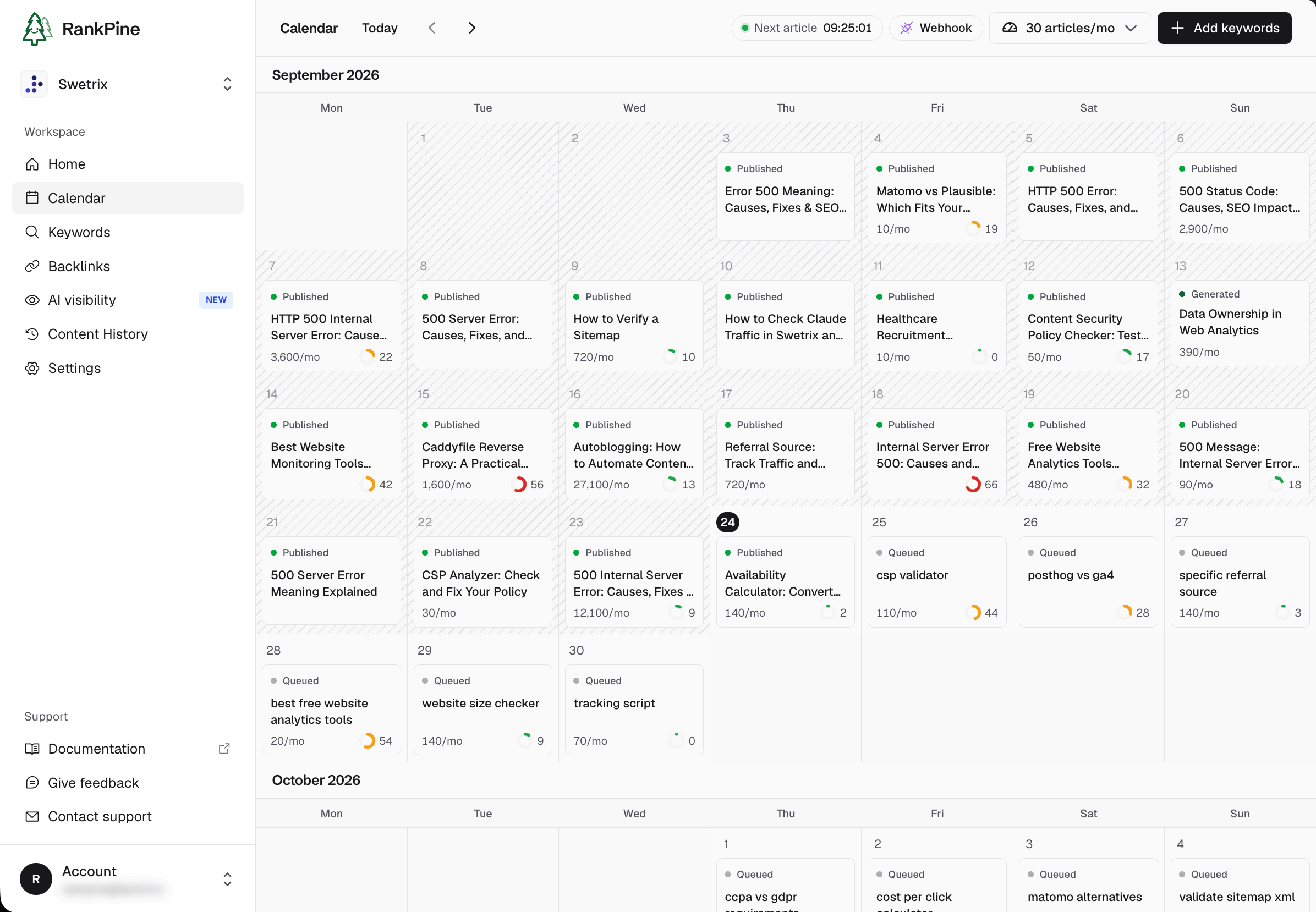
RankPine content calendar for Swetrix, September 2026.
Evaluation task: give it your website, inspect the proposed keywords, and review one article about a topic you understand. Then test the publishing integration you intend to use. Start a RankPine trial if that matches your bottleneck.
For a writing-focused alternative, Koala is another candidate. Compare the input controls and effective usage allowance for your selected settings. See autoblogging explained for how drafting differs from managing the whole publishing process.
Content Analysis: Surfer With an Editor in the Loop
Surfer offers content optimization workflows. Use its recommendations to investigate missing coverage and improve a draft, rather than treating a score as a direct predictor of rankings.
A useful trial starts with an existing page. Record which recommendations you accept and why. Reject additions that repeat a keyword without answering a question or make a claim you cannot support.
Technical Work: Diagnose Before Applying Changes
Alli AI is relevant when you want website optimization workflows that can apply changes. Screaming Frog helps collect and inspect crawl findings.
Choose based on the actual task. If you need to understand a redirect problem, a crawler and a competent reviewer may be sufficient. If you want software to change many pages, test a limited set and understand the approval and reversal process first.
AI-written descriptions of technical problems are useful only when they correspond to actual findings on your site.
AI Visibility: Measure Answers Separately From Rankings
Otterly is a standalone option for monitoring saved prompts. RankPine offers AI visibility as a separate $49/site/month add-on requiring a paid writing subscription.
Decide which platforms and markets matter before comparing plans. A sampled brand mention is different from a citation to your website, and neither proves a person clicked through. Preserve the answers behind the metrics and account for failed checks.
Avoid buying two trackers with largely overlapping coverage unless you have a specific reason to compare their methods.
Measurement: Keep the Business Outcome Visible
Use Swetrix to examine observed traffic, landing pages, and configured conversion events. Search Console covers Google's search-performance data. Combine those views carefully rather than expecting their totals to match exactly.
A tool that generates more articles has improved throughput. To establish business value, you need to know whether those pages reach relevant people and whether they take the intended next step. The SEO ROI guide explains costs and attribution with a worked example.
Three Sensible Starting Setups
A small business with no publishing routine: use Search Console, one production workflow, and analytics. Add other tools when you can name the missing task.
A team with writers already in place: evaluate research and content-analysis tools before replacing the production process. Measure accepted edits and time saved.
An agency managing several sites: compare client access, per-site pricing, approval controls, exports, and reporting. Run the trial on one representative client before expanding across the portfolio.
These are workflow suggestions, not fixed-price bundles. Your site's technical needs and existing team determine the useful stack.
A Short Evaluation Checklist
Before subscribing, check where the data comes from, what the product actually outputs, which integrations are native, how usage is counted, and what happens when a task fails. Record how much work remains for a person.
For generated articles, verify product facts and cited claims. For technical changes, inspect the result. For monitoring, read the saved answer. For ROI, confirm the conversion event corresponds to a real action.
If you need help sustaining content production, start creating content with RankPine. Keep the trial focused on useful output and the time it saves.