- Date
What Is Autoblogging? How It Works in 2026, and the 6 Best Autoblogging Tools
 Andrii Romasiun
Autoblogging is the practice of publishing blog posts automatically, with software handling some or all of the pipeline: picking topics, writing the article, adding images, and pushing the result live to your CMS on a schedule. Modern tools may use AI to research keywords and draft content, with either automatic publication or a review step before publishing.
The term covers different workflows, from republishing licensed feeds to drafting original articles. Assess the content, permissions, and review process before enabling a publishing schedule.
Autoblogging Then vs. Now
Earlier autoblogging workflows often aggregated or republished feeds. AI writing added another production method, but the quality and permission questions remain. Neither automated generation nor manual writing makes an article useful by itself.
Here are common differences to check, rather than guarantees about every product:
| Approach | Source material | Review requirement |
|---|---|---|
| Feed aggregation | Existing feed entries | Permissions, attribution, and value added |
| AI-assisted drafting | Generated text and supplied sources | Accuracy, originality, and useful examples |
| Scheduled publishing | Approved posts already in your CMS | Correct timing, formatting, and links |
A tool can combine these approaches. Its automation method alone does not establish whether the resulting content is useful.

How a Modern Autoblogging Pipeline Works
A serious autoblogging tool runs a loop that looks like a small content team:
- Niche research. It studies your product, competitors, and audience to understand what you should be visible for.
- Keyword planning. It builds a topic list — ideally from real search-volume data and your own Google Search Console queries, not from an LLM guessing what people might type.
- Drafting. An article per topic, structured for the query's intent.
- Editing. The step that separates tools: filler removal, fact-checking against sources, flow rewrites, brand-voice enforcement.
- Illustration. Generated or stock images, alt text, featured image.
- Publishing. Straight to WordPress, Ghost, Webflow, Notion, or a webhook into anything custom.
- Feedback. Rank and impression tracking that adjusts next month's plan.
A calendar makes the proposed topics and publishing states visible before you commit to a schedule:
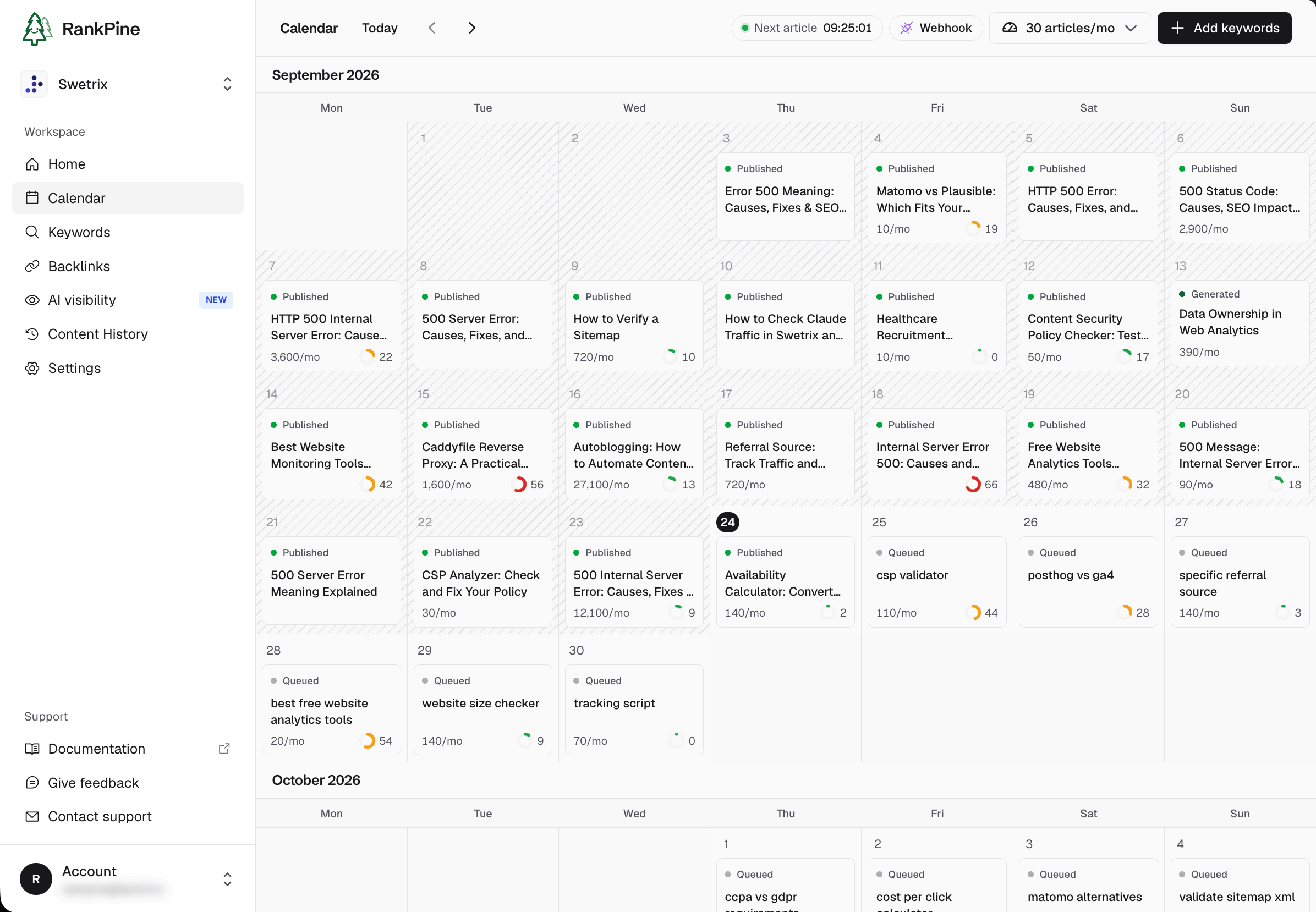
RankPine content calendar for Swetrix, September 2026.
Use this list to identify which steps your selected tool handles and which still belong to you.
Is Autoblogging Against Google's Guidelines?
The production method alone does not decide the answer. Google's own guidance on AI-generated content has been consistent since 2023: it rewards quality content "however it is produced." Automation is explicitly fine. What's not fine is spelled out in the spam policy Google added in March 2024: scaled content abuse — producing many pages whose purpose is ranking rather than helping anyone, regardless of whether a human or a machine wrote them.
Google's guidance on generative AI content emphasizes accuracy, quality, and relevance. An editing pass is useful, but it is not a guarantee of search-policy compliance or rankings.
Does Autoblogging Actually Work?
It can reduce production work, but the commercial result depends on topic selection, useful content, distribution, and conversion. There is no dependable rule that a new site will reach a particular traffic level after a fixed number of months.
Run a small publishing pilot. Record which drafts you accept, the editing time, search impressions and clicks, and resulting customer actions. Compare the full cost with your previous workflow using our SEO ROI guide.
The 6 Best Autoblogging Tools in 2026
For broader options, see our SEO autopilot software comparison. These six cover different production styles.
1. RankPine — best overall autoblogging tool
RankPine covers the whole publishing process, from finding topics in search data to sending the finished article to your CMS. Its editing passes remove AI filler, improve the writing, and check claims against sources. It also creates images to match your chosen style. That combination of content quality and automation makes it the best overall pick. The writing plan is $99/site per month for 30 articles.
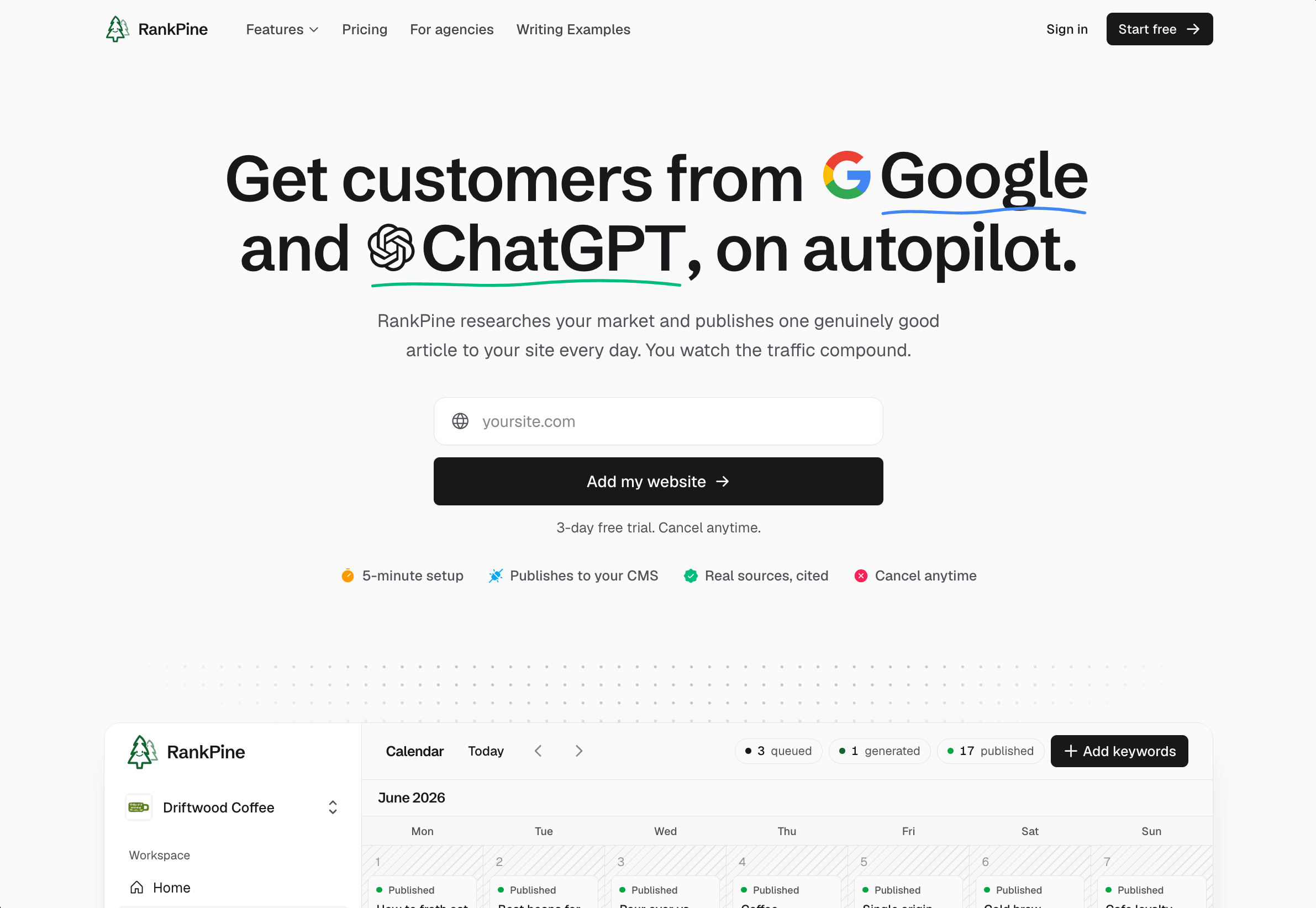
Best for: small teams and agencies that want regular, well-edited articles without managing each production step. Try it with your own website and inspect a draft before enabling automatic publication.
2. SEObot — a smaller starting allowance
SEObot's official pricing starts at $49/month for nine articles, with 20 articles at $99 and 50 at $199.
Best fit: a team that wants a lower initial monthly bill and fewer articles. Check the publishing cadence and editorial work left to you.
3. Autoblogging.ai — article generation
Autoblogging.ai focuses on generating articles. Test a representative topic and inspect sources, product claims, and the work needed to prepare the draft for your site.
Best fit: someone evaluating a generation workflow. Confirm current credit usage, publishing options, and plan limits directly.
4. Koala — an AI writing workflow
Koala offers AI writing tools. Evaluate it when you want direct control over topics and drafting, and confirm the current publishing options for your website.
Best fit: a writer or editor who expects to stay involved. Compare the effective allowance for your selected model and settings rather than a headline word count alone.
5. Emplibot — blog and social distribution
Emplibot combines blog production with social distribution. Check the supported website and social destinations against your own workflow.
Best fit: a business that wants to repurpose articles as well as publish them. Test the final formatting and review process on each destination.
6. Outrank — recurring articles and CMS publishing
Outrank lists a $99/month plan with 30 articles and publishing integrations. It is a close alternative to evaluate if you want a recurring production workflow.
Best fit: teams comparing end-to-end content tools. Use the same topic and review standard when testing it against another product. Our Outrank alternatives guide explains the comparison and switching process.
Side by side
| Tool | Workflow to evaluate | Main check |
|---|---|---|
| RankPine | Research through publishing | Topic relevance and review time |
| SEObot | Automated article production | Allowance and cadence |
| Autoblogging.ai | Article generation | Sources and editing effort |
| Koala | AI-assisted writing | Model limits and publishing process |
| Emplibot | Blog plus social | Supported destinations |
| Outrank | Recurring content and publishing | Review controls and CMS output |
How to Autoblog Without Publishing Slop
Whichever tool you pick, the difference between an asset and a liability comes down to five habits:
- Start from search data. Use search data, customer questions, and business relevance. Missing volume does not prove a specific customer question is worthless.
- Keep an editing standard. Either the tool has one built in, or you are the editing pass. Budget for whichever is true.
- Give articles a job. Each post targets one query and links to the money page it feeds. Orphan content compounds to nothing.
- Stay in your lane. Fifty posts about your actual niche beat five hundred about anything with volume. Topical authority is the whole game.
- Read one at random every week. If you'd be embarrassed to see it under your name on Hacker News, fix the pipeline, not the post.
How to Tell If Your Autoblog Is Earning Its Keep
Publishing on autopilot without measuring is how people end up paying $99/month for a diary nobody reads. The loop only closes when you can see, per article, three numbers: does it get impressions (Search Console), does it get visitors (analytics), and do those visitors do anything (events and funnels).
The first is free. For the second and third we use Swetrix — cookieless analytics that shows each article's traffic by source, including visitors arriving from ChatGPT and Perplexity rather than Google, and follows them to signup with custom events. Cookieless measurement avoids dependence on analytics cookies, but blockers, missing referrers, and implementation gaps can still affect the data. Once that's wired, the monthly review takes ten minutes: sort articles by conversions, feed the winning topics back into the plan, prune the duds. That feedback loop — not the publishing itself — is what makes autoblogging compound. There's a full walkthrough in how to measure content marketing ROI.
Autoblogging FAQ
Is autoblogging the same as scraping? No. Automation can schedule your own content or generate drafts. Republishing someone else's material introduces separate permission and licensing questions.
Will Google penalize a site just because an article uses AI? Google's guidance focuses on content quality and abuse, rather than treating the production method alone as a quality guarantee. Review the sources and value of each page.
How much does autoblogging cost? Compare the subscription plus review and publishing time per accepted article. Included output and usable output can differ; our SEO cost guide shows the calculation.
Can I use autoblogging with WordPress? Several tools offer WordPress publishing. Confirm your exact setup, draft behavior, image handling, and required permissions before connecting a recurring schedule.
Start with a topic you can judge well. Try RankPine on your own site, review the first article, and compare the work saved with the editing it still needs.