- Date
2026 Guide To Privacy Regulations For Websites By Country
 Andrii Romasiun
A visitor lands on your homepage from Berlin, while another clicks a link from California. Your analytics dashboard records both sessions. Before the page finishes loading, your tracking setup triggers strict legal requirements across two continents. Master privacy regulations for websites by country in 2026 to avoid massive fines and boost user experience using cookieless analytics.
The Global State of Privacy in 2026
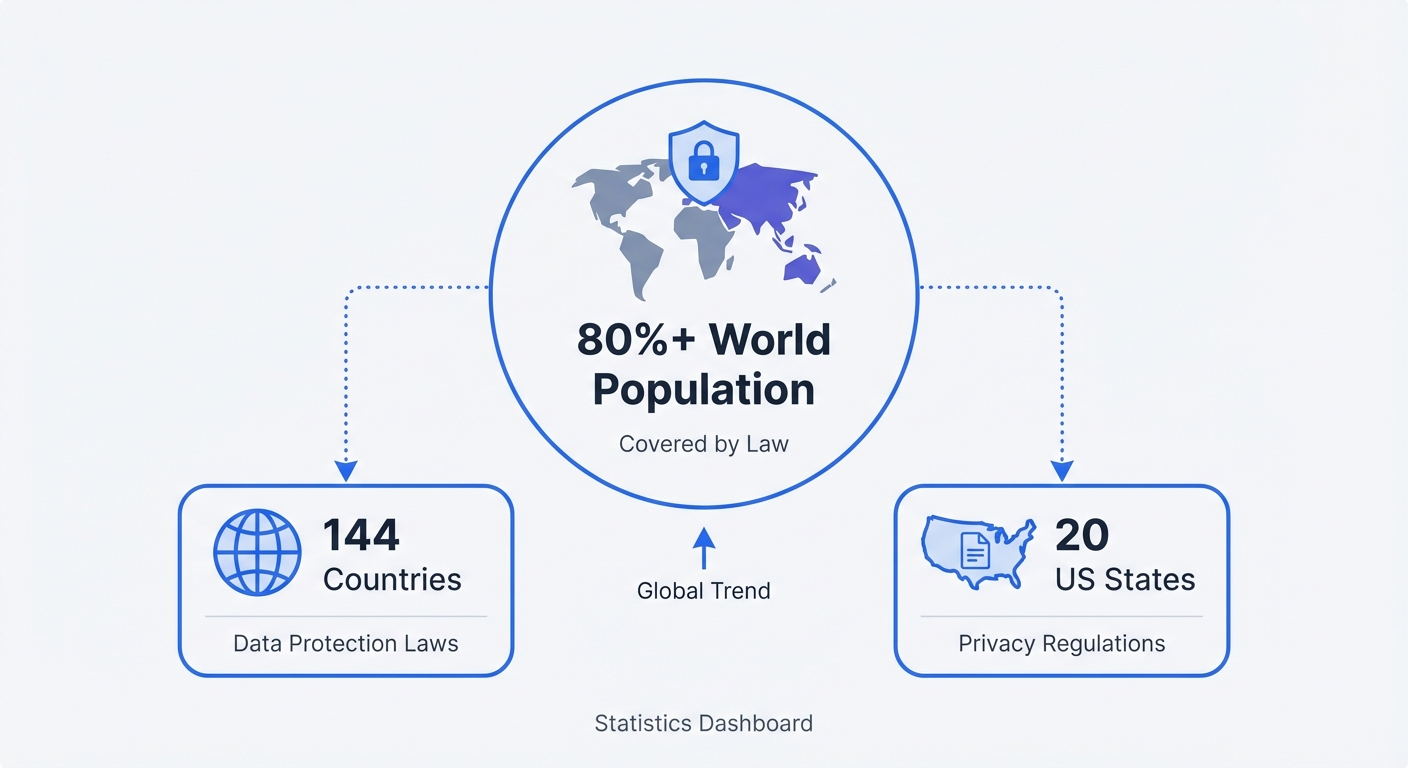
144 Countries and Counting
National data privacy laws govern 144 countries as of early 2026. These regulations cover 82 percent of the global population, meaning over 6.6 billion people hold statutory rights over their personal data. Governments transformed privacy from a theoretical best practice into a strict compliance mandate.
This broad coverage requires technical action from website operators. Pull your analytics report for user locations. Identify the top five countries driving traffic to your domain to match those locations against current regulatory frameworks.
The Extraterritoriality Principle
Website owners often wonder which privacy laws apply to their domains. Jurisdictional frameworks operate on the extraterritoriality principle. The physical location of the user dictates the rule, making your business headquarter location irrelevant.
When a visitor browses from Paris, the GDPR applies. Traffic from Sacramento triggers the California Privacy Rights Act (CPRA). International liability applies even if an Ohio-based local business receives incidental traffic from Europe.
Map your traffic sources to specific regulatory zones. Create a user flow diagram to track where European or Californian users enter your site. Block non-compliant tracking scripts on those specific landing pages.
The Financial Risk of Ignoring Compliance
Rising Fines and Record Penalties
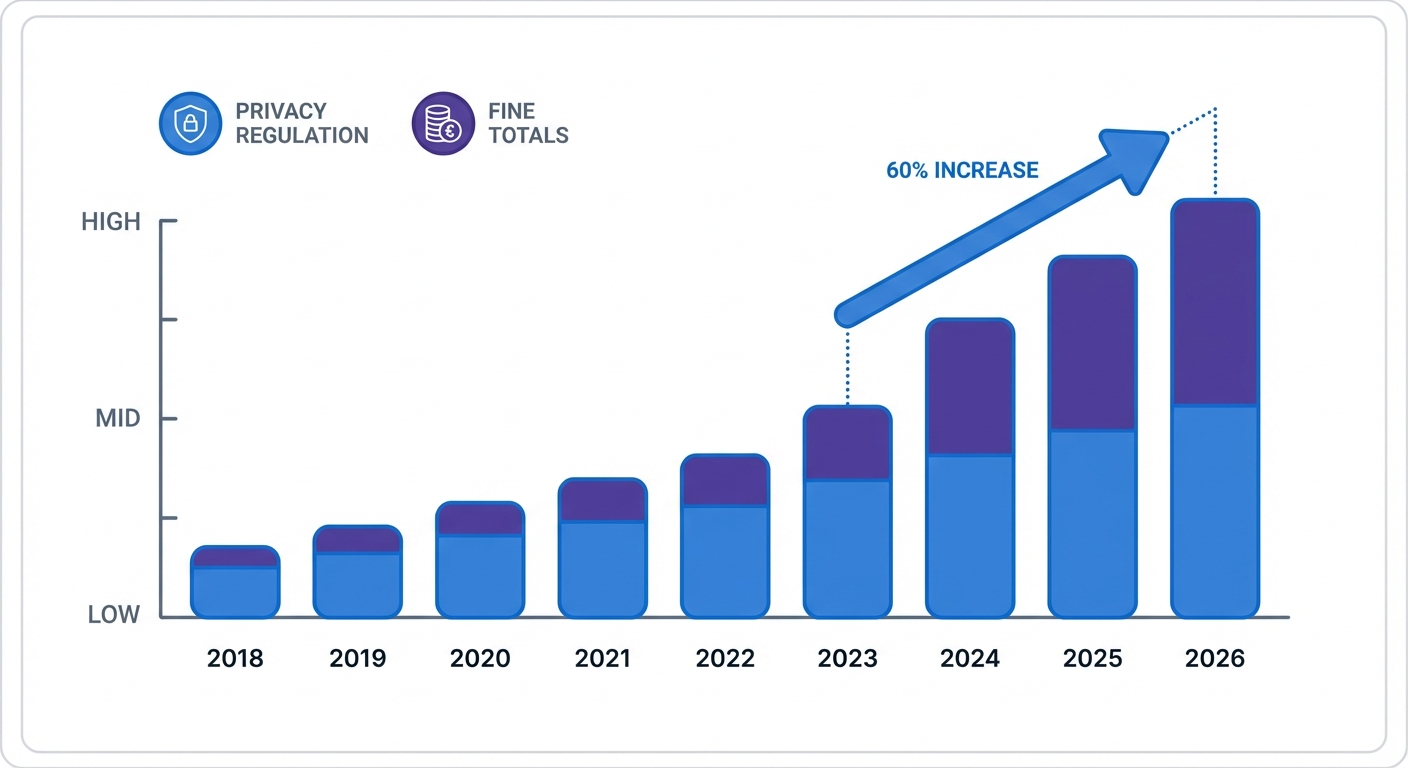
Data protection authorities issued €7.1 billion in total GDPR fines since 2018. Enforcement accelerated in recent months, with regulators imposing 60 percent of this total since January 2023. In 2025 alone, European authorities collected €1.2 billion. Agencies receive 443 data breach notifications per day.
Meta received a record €1.2 billion fine for unlawful US-EU data transfers. European courts ruled that US cloud providers cannot guarantee data privacy for European citizens due to American surveillance programs. Routing EU user data through American servers violates the Schrems II ruling.
Audit your data transfer paths to ensure European user data remains on European servers. Check the data center locations of your hosting provider and analytics vendors.
Why 'Legitimate Interest' Is Dead
Marketers spent years exploiting "legitimate interest" as a legal loophole for tracking users without consent. Regulators closed this gap. An insufficient legal basis for data processing caused 90 percent of GDPR fines by monetary value in 2025, costing companies €1.03 billion.
Consider a common tracking failure where a user visits a landing page. The tag manager immediately fires a script that places a persistent cookie in the browser before the consent banner appears. The user ignores the banner and leaves, resulting in a GDPR violation for the site owner.
Secure explicit, verifiable consent to deploy tracking cookies. Remove pre-checked consent boxes on your forms to force a deliberate click. Implement strict tag sequencing in your container to block scripts until visitors hit the accept button.
Key Privacy Regulations for Websites by Country
Europe: GDPR and the AI Act
The European Union directs global data protection enforcement. The GDPR mandates explicit consent for non-essential data collection. The new EU AI Act reaches full enforcement on August 2, 2026, imposing penalties of up to €35 million or 7 percent of global turnover on high-risk systems.
Platforms categorizing biometric data or using predictive AI face strict regulation. Website owners deploying AI chatbots to profile visitors for targeted advertising fall under high-risk or limited-risk categories.
Draft clear disclosures detailing your AI interactions. Document your training data sources if your site uses AI-driven personalization, and add an AI disclosure section to your privacy policy.
USA: The 20-State Patchwork
The United States operates without a federal privacy law, leaving state legislatures to dictate the rules. Twenty US states enforce comprehensive data privacy laws as of January 1, 2026. Indiana, Kentucky, and Rhode Island activated their frameworks at the start of the year.
Texas enacted the TDPSA to bring 30 million more Americans under comprehensive privacy rights. Maryland, Nebraska, and Connecticut enforce Age-Appropriate Design Code laws restricting data collection from minors.
Update your privacy policy to address state-specific consumer rights. Build a dedicated "Do Not Sell or Share My Personal Information" link into your footer.
Global Privacy Control (GPC) Mandates
Browsers transmit automated signals reflecting user preferences. Twelve US states mandate compliance with Global Privacy Control (GPC) signals in 2026. Oregon and Texas joined California, Colorado, and Connecticut in enforcing this technical standard.
The Global Privacy Control operates at the network level. When a user enables GPC, the browser attaches a specific header to every HTTP request:
Sec-GPC: 1
Your web server must read this header. If the value equals 1, your backend must disable all tracking scripts and data sharing mechanisms for that session without requiring the user to click a manual opt-out link.
Test your site using a GPC-enabled browser like Brave. Inspect the network requests to verify your tracking scripts remain blocked when the header is active.
| Region | Key Regulation | Enforcement Focus | Maximum Penalty |
|---|---|---|---|
| European Union | GDPR, EU AI Act | Cross-border transfers, AI profiling | €35M or 7% global turnover |
| United States | 20 State Laws | GPC mandates, minor data protection | $7,500 per violation |
| United Kingdom | UK GDPR | Cookie consent, international transfers | £17.5M or 4% global turnover |
The Analytics Dilemma: Cookies vs. Compliance
The Problem with Traditional Web Analytics
Many website owners ask if a privacy policy is required when using analytics alone. Tool selection dictates the legal requirements. Traditional platforms collect IP addresses and deploy persistent cookies, both of which regulators classify as Personal Identifiable Information (PII) under the GDPR and CCPA.
An IP address identifies a specific internet connection. Internet Service Providers map IP addresses to physical billing addresses, prompting regulators to treat them as personal data because they trace back to an individual.
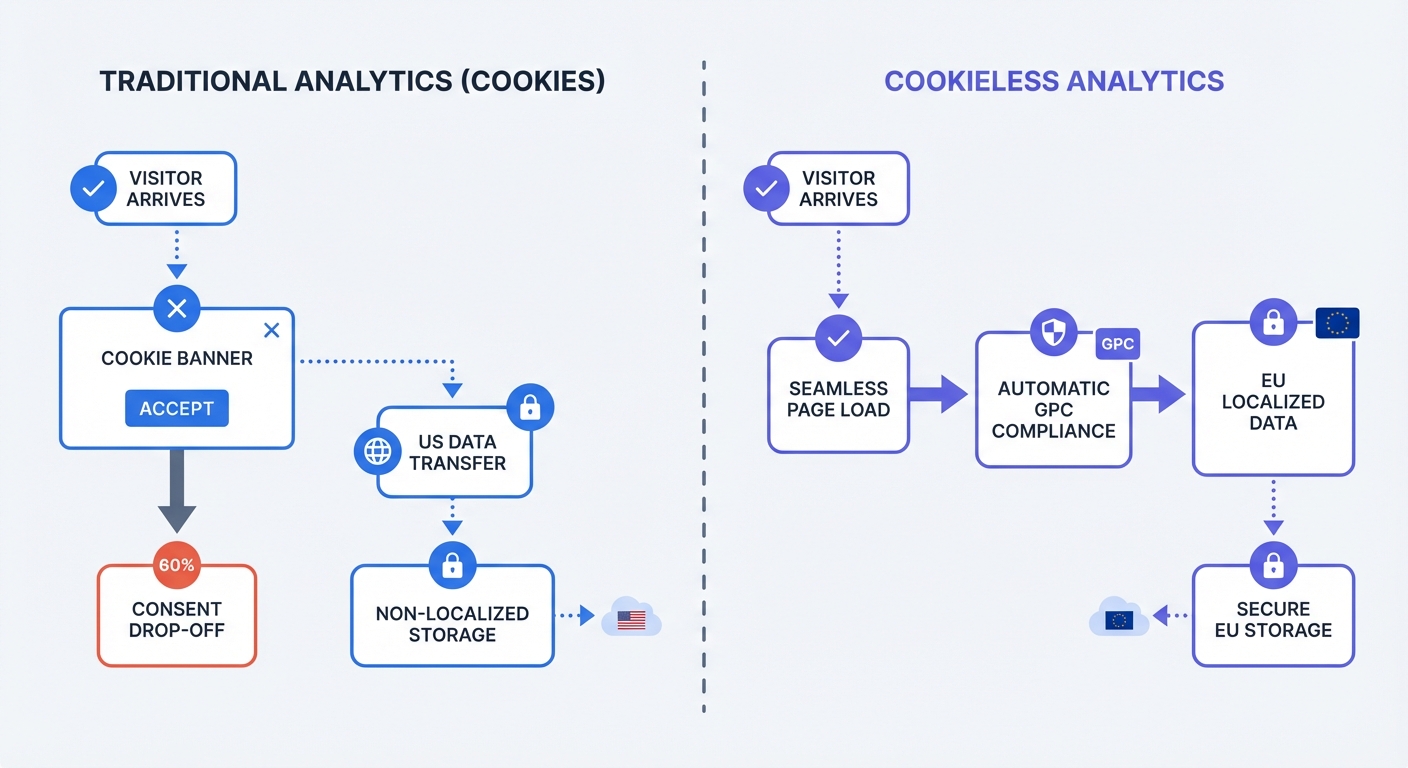
Routing EU user IP addresses to the United States creates cross-border transfer liability. Relying on American-based analytics forces you to maintain complex legal disclosures and risk regulatory audits.
Cookie Banner Requirements
Deploying non-essential tracking cookies requires a consent banner. Marketing, retargeting, and traditional analytics cookies fall into this category.
Cookieless tracking mechanisms operate outside the strict consent requirements of the ePrivacy Directive. Switching analytics providers eliminates the need for cookie banners, improves page speed, and increases conversion rates by letting visitors navigate without pop-ups blocking the content.
Open your browser developer tools and check the 'Application' or 'Storage' tab. List every cookie your site loads before a visitor clicks accept. Delete any tracking scripts firing without prior consent.
Achieving Compliance Without Sacrificing Data
The Cookieless Analytics Advantage
Compliance strategies fail when they destroy data visibility. Websites lose attribution data when users reject cookie banners. Modern analytics platforms measure traffic without compromising user privacy.
Swetrix provides a cookie-free, open-source Google Analytics alternative. The architecture ignores PII and utilizes 1st-party data methodologies.
Instead of storing a persistent cookie, these tools generate a daily hash based on the user's IP, user agent, and a rotating daily salt. The hash resets at midnight, enabling you to track unique daily visitors without storing cross-session behavior.
All Swetrix data stays localized on EU servers. This setup avoids Schrems II risks and cross-border transfer violations. The system never monitors individual behavior across domains, meeting GPC mandates by design.
Actionable Steps for 2026 Compliance
Modernizing your infrastructure requires technical and legal alignment. Implement these changes to secure your website data pipelines:
- Practice data minimization. Stop collecting device identifiers or detailed browsing histories. Configure your tracking setup to capture the bare minimum required for web traffic source attribution. Use UTM parameters to measure campaign success without tracking individual users.
- Map your third-party vendors. Regulators scrutinize supply chains. Document every plugin, tag, and external script running on your domain. Remove inactive plugins that load external resources.
- Generate dynamic privacy policies. Static text written in 2024 exposes you to liability in 2026. Deploy services like Termageddon or Enzuzo to update your disclosures as new state laws activate.
- Enforce strict data retention limits. Store data only as long as required. Establish defined rules for deleting old analytics data. Follow data retention policy best practices to reduce your risk profile.
- Adopt privacy by design. Build compliance into your tech stack. Swap invasive tools for privacy-first alternatives, such as replacing Google reCAPTCHA with a privacy-focused reCAPTCHA alternative.
Compliance shields your revenue from regulatory penalties. Clean data provides better insights than invasive tracking scripts. Analyze your traffic patterns while respecting user boundaries to build trust and prove to visitors that their personal information remains secure.
Stop fighting cookie banners and regulatory audits. Swetrix delivers accurate, cookieless analytics that respect user privacy by default. Keep your data localized on EU servers, abandon persistent tracking, and improve your page load speeds. Start your 14-day free trial to experience compliance without compromise.