- Date
What Is First Party Data and Why It Matters for Your Business
 Andrii Romasiun
First-party data is simply the information you collect directly from your own audience. It's the data people share with you willingly as they interact with your website, app, or product.
Think of it as a conversation. You're not buying information from a stranger or spying from a distance; you're listening to what your customers are telling you directly.
Understanding First Party Data in Simple Terms
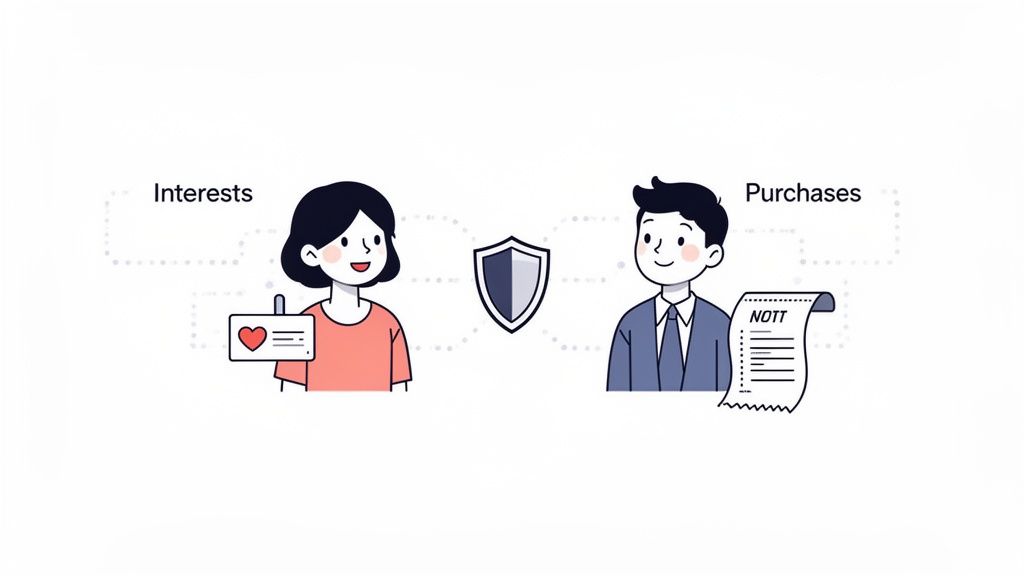
Let’s stick with a simple analogy. Say you own a small online bookstore. A customer creates an account, adds a few sci-fi novels to their wishlist, and buys a fantasy series. All of that information—their email, their genre preferences, their purchase history—is your first-party data.
You collected it yourself, straight from the source. It’s accurate, relevant, and you own it completely.
This direct-from-the-source approach is becoming the gold standard, especially as the old way of tracking people across the web with third-party cookies disappears. People are more protective of their privacy than ever. In fact, a whopping 77% of consumers say that how a company uses their data directly influences whether they’ll buy from them.
The Defining Traits of First Party Data
The real power of first-party data comes from the trust it's built on. It’s not just about what you gather but how you gather it—transparently and with consent.
This direct line to your audience gives you clean, reliable insights for everything from personalizing a user's experience to making smarter business decisions. For example, using a 1st-party cookie to understand how someone navigates your site gives you a clear picture of what they're interested in, without following them around the internet.
To make it even clearer, here’s a quick summary of what makes first-party data unique.
First Party Data at a Glance
The table below breaks down the core characteristics that set first-party data apart from other types of data.
| Characteristic | Description |
|---|---|
| Source | Collected from your own properties, like your website, app, CRM, or physical locations. |
| Accuracy | Top-notch. The information comes straight from the user, so you know it's reliable. |
| Cost | You don't pay to acquire it, but you do invest in the tools and systems to collect and manage it well. |
| Privacy | It’s much easier to stay compliant with rules like GDPR because you're in full control of how it's collected. |
| Ownership | You own it. This data is a valuable, one-of-a-kind asset for your business. |
Ultimately, this isn't just about data. It's about a fundamental shift toward building better, more respectful relationships with the people who matter most: your customers.
First-Party Data vs. Its Counterparts
To really get why first-party data is so valuable, it helps to see it next to its cousins: second and third-party data. Let's use a simple analogy. Say you're trying to find a great new restaurant.
You could ask the head chef at your go-to local bistro for a recommendation. They know what you like, what's fresh, and what their trusted colleagues are cooking up. This is first-party data. It’s direct, reliable, and super relevant because it comes from a relationship you already have.
Another option is to ask a friend who tried a new place last week. Their recommendation is probably solid because you trust them, but it’s based on their experience, not yours. This is second-party data—it's just someone else's first-party data shared with you. It's useful, but it's not a direct connection.
Finally, you could scroll through a random review site online. You'll find a ton of information, but it's completely out of context. Who are these people? Are their tastes anything like yours? Are the reviews even legit? This is third-party data. It’s pulled together from all sorts of unknown sources, so you can never be sure about its quality or accuracy.
Second-Party Data: A Trusted Hand-Off
Second-party data sits in a unique middle ground. It's essentially another company's first-party data that they've decided to share or sell directly to you through a partnership.
Imagine a high-end airline partnering with a luxury hotel chain. The airline could share anonymized data about its first-class flyers' travel destinations, giving the hotel chain a direct line to potential guests. It's far more reliable than third-party data because you know exactly where it came from.
The catch? It's not easy to scale. You have to find the right partners, and their audience needs to be a perfect match for yours.
Third-Party Data: The Massive, Murky Pool
Third-party data is collected by companies that have zero direct relationship with the people they're tracking. These data aggregators scrape information from thousands of different websites and apps, bundle it up, and sell it to the highest bidder.
For a long time, this was the engine behind programmatic advertising, letting advertisers target people based on what they thought they were interested in. But the problems are huge: the data is often inaccurate, and the way it's collected has created a major privacy backlash.
The ground is shifting under our feet. The percentage of marketers who rely on third-party data plummeted from 75% in 2022 to just 61% by 2024. Meanwhile, a whopping 84% of marketers now say first-party data is one of their top three most important sources. You can dig deeper into these data collection trends on qrcodechimp.com.
This isn't just a fleeting trend. It’s a direct response to people demanding more transparency and control over their own information. Third-party data might offer scale, but it sacrifices the precision and trust that businesses need to build real relationships with their customers.
To make these differences crystal clear, let's break them down side-by-side.
First vs Second vs Third Party Data
| Attribute | First Party Data | Second Party Data | Third Party Data |
|---|---|---|---|
| Source | Collected directly from your own audience (website, app, CRM). | Shared directly from a trusted partner (their first-party data). | Purchased from large data aggregators who have no direct relationship with the user. |
| Accuracy | Highest. You collected it yourself, so you know it's accurate and relevant. | High. It comes from a trusted, known source. | Lowest. Often inaccurate, outdated, or based on flawed assumptions. |
| Transparency | Fully transparent. You know how, when, and where it was collected. | Mostly transparent. You trust the partner's collection methods. | Opaque. Collection methods are hidden and often questionable. |
| Scale | Limited to your own audience size. | Limited to the scale of your partner's audience. | Massive. Aggregated from millions of sources. |
| Competitive Edge | High. This data is unique to your business. | Medium. Shared with you, but potentially other partners too. | None. Your competitors can buy the exact same data sets. |
| Cost | Free to collect (though requires investment in tools and time). | Varies. Can be part of a trade or purchased through a direct deal. | Expensive. Purchased from data marketplaces on a large scale. |
Seeing it laid out like this, the choice becomes obvious. While second and third-party data had their place, the future is built on the trust and accuracy that only first-party data can provide. It's the ethical and effective foundation for any modern business.
How to Collect First-Party Data Ethically and Effectively
Knowing what first-party data is is one thing, but collecting it in a way that builds trust—not breaks it—is the real challenge. Effective collection isn't about finding clever ways to grab information. It’s about creating a clear and fair value exchange.
When customers hand over their information, they're doing it because they expect something worthwhile in return. That "something" could be a better shopping experience, access to exclusive content, or just a website that works the way it should. The secret ingredient here is transparency—being completely honest about what you’re collecting and why.
This image really helps break down the core differences between the main data types based on where they come from and how much you can trust them.
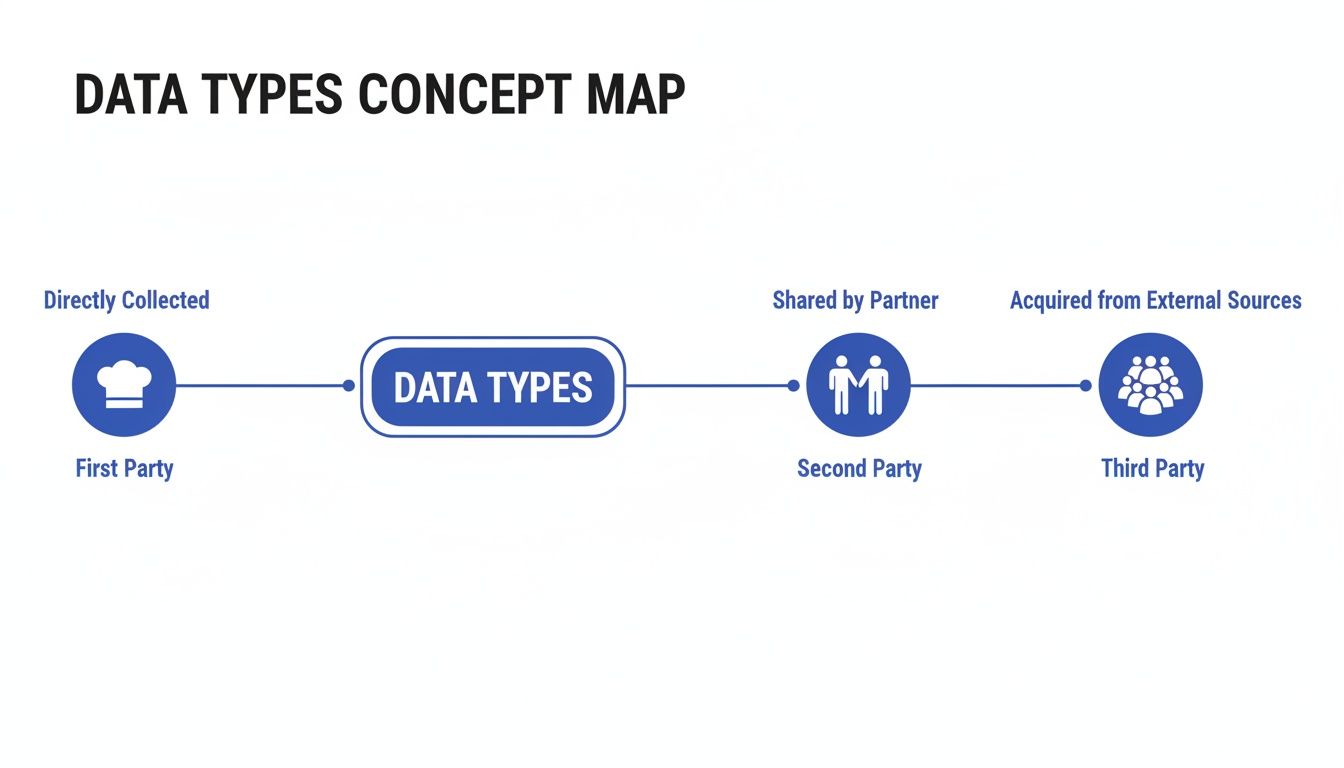
As you can see, first-party data is rooted in a direct relationship you have with your audience. It's worlds apart from third-party data, which is often a mishmash of information aggregated from sources you’ve never even heard of.
Key Channels for Ethical Data Collection
The best strategies for gathering data don’t feel like data collection at all. They’re just a natural part of the user’s experience. Forget intrusive pop-ups and think more about organic touchpoints where people are already interacting with you.
Here are some of the most reliable channels for getting high-quality, first-party data:
- Website Analytics: Privacy-focused tools like Swetrix let you see what people are doing on your site—which pages they love, where they get stuck—all without creepy cookies. This behavioral data is pure gold for making your website better for everyone.
- CRM Interactions: Every single support ticket, sales call, or live chat is a direct line to your customer’s thoughts. This is where you learn about their biggest headaches and what they really need from your product.
- Newsletter Sign-Ups: When someone subscribes to your email list, they’re literally giving you permission to show up in their inbox. This gives you a direct line of communication and a chance to learn their preferences so you can send them stuff they actually care about.
- Customer Surveys & Feedback: Just ask! Directly asking your audience for their opinions is one of the most powerful things you can do. You get brutally honest insights, and they feel heard and valued. It’s a win-win.
The golden rule of ethical data collection is pretty simple: be the kind of company you'd want to do business with. If a tactic feels sneaky or disrespectful to you as a consumer, that’s a red flag. It’s time to find a better, more transparent way.
Creating a Clear Value Exchange
For any of this to work, you have to answer the user’s unspoken question: “What’s in it for me?” If you ask for their email, give them a fantastic piece of content in return. If you run a survey, follow up by sharing the (anonymized) results or, even better, by actually implementing their suggestions. We dive deeper into this give-and-take in our guide on how to track website visitors ethically.
This kind of mutual respect turns data collection from a sterile transaction into a real relationship. By putting user privacy first and delivering genuine value, you aren’t just gathering data points. You’re building a loyal community that actually trusts your brand, and that's worth more than any dataset you could ever buy.
Turning Your First-Party Data Into Business Growth
Collecting first-party data is really just the first step. The real power is unleashed when you actually put it to work. Think of it like this: you've just gathered the best, freshest ingredients from your garden. They're great on their own, but the magic happens when you start cooking and combine them into an amazing meal. Activating your data is the "cooking" part—it's how you turn raw insights into real business results.
This isn't about staring at dashboards full of abstract numbers. It's about making smarter decisions that fuel growth. You can finally stop guessing what your audience wants and start building experiences based on what they've already told you with their actions.
Personalize the Customer Journey
Let's be clear: personalization is way more than just sticking a {{first_name}} tag in an email. With good first-party data, you can shape entire user experiences based on what someone has done before. Say a visitor keeps looking at pages about a specific product feature. On their next visit, you could dynamically show them a case study or a testimonial related to that very feature.
An e-commerce store, for example, could look at a customer's purchase history and use it to showcase complementary products right on the homepage. This makes their shopping experience better and has a direct impact on your bottom line. In fact, research shows that businesses that get this right see a 2.9x lift in revenue and a 1.5x increase in cost savings.
Build a Better Product with Real User Insights
Your first-party data is a direct line into how people actually use your product. Are they using that new feature you spent months building? Are they getting stuck or seeing errors on a certain page? Finding the answers is crucial for creating a product people genuinely love.
With a privacy-first analytics tool like Swetrix, you can track custom events to measure these specific interactions.
- Feature Adoption: You could track a custom event like
newFeatureClickedto see if people are even noticing your latest update. - User Drop-Off: By setting up conversion funnels, you can get a clear visual of where users are abandoning key processes, like signing up or checking out.
- Error Identification: Monitoring session recordings can show you precisely where users are running into friction or bugs, helping your dev team squash them faster.
This kind of feedback loop is priceless. It allows you to iterate and improve based on real-world behavior, not just internal assumptions.
"Your most unhappy customers are your greatest source of learning." - Bill Gates. First-party data gives you an unvarnished look at user friction, turning potential frustrations into your most valuable opportunities for improvement.
Measure What Truly Matters for Marketing
One of the oldest struggles in marketing is attribution—figuring out which channels are actually bringing in valuable customers. Third-party data often gives you a fuzzy, incomplete picture, but first-party data brings crystal-clear clarity. When you can track a user all the way from their first touchpoint (like a blog post they read) to their final conversion (making a purchase), you can measure your campaign ROI with confidence.
For instance, within a tool like Swetrix, you can set up goals to track how many newsletter subscribers came from a specific social media campaign versus organic search. This lets you double down on what’s working and, just as importantly, stop wasting money on what’s not. It’s not just about driving more traffic; it's about attracting the right kind of traffic that turns into loyal, happy customers.
Why First Party Data Is Your Competitive Edge

As the era of third-party cookies comes to a close, your first-party data is shifting from a nice-to-have marketing asset to a core pillar of your entire business. It's the clean, high-octane fuel for your growth engine. While many companies are scrambling to figure out what's next, those with a solid first-party data strategy are already pulling ahead.
This direct, permission-based information is your key to building real relationships, innovating with confidence, and making decisions based on truth, not assumptions. You're no longer renting opaque, aggregated profiles from data brokers. Instead, you're operating with genuine signals from your actual customers—the only sustainable way to grow in a privacy-first world.
The Fuel for Intelligent Systems
Modern AI and machine learning models are powerful, but they have a simple rule: garbage in, garbage out. Feeding them messy, unreliable third-party data is like putting dirty fuel in a sports car. You’ll get poor performance, faulty predictions, and biased outcomes.
First-party data is the premium, refined fuel these systems crave. It's become a critical business imperative, especially for large language models that need high-quality, representative, and bias-free consumer data to function properly. Third-party sources are often riddled with gaps and guesswork, but your own data comes straight from your audience. This provides the clean, granular information needed to train better algorithms and sharpen predictive analytics. That's why 75% of B2B marketers are already doubling down on first-party data. You can explore more about AI and the rising importance of this data on researchworld.com.
When you build your strategy on genuine customer signals, you ensure your AI-powered personalization is based on reality, not guesswork. This direct data is the key to reducing algorithmic bias and building fairer, more effective systems.
Building a Lasting Advantage
Investing in a first-party data foundation isn't a short-term tactic; it's a long-term strategic play that pays dividends over time. You’re essentially building a competitive moat around your business—one that competitors relying on purchased data simply can't cross. Every interaction you have with a customer deepens your understanding and strengthens that advantage.
This creates a powerful, self-improving cycle with benefits across the entire organization:
- Smarter Innovation: You can see which features people use and what they ask for, allowing you to build products your customers actually want.
- Deeper Relationships: Personalization based on real behavior fosters trust and loyalty, which directly boosts customer lifetime value.
- Resilient Strategy: Your business becomes far less vulnerable to sudden policy changes from ad platforms or new privacy regulations.
Ultimately, understanding what is first party data and making it a priority is about more than just marketing or compliance. It's about building a smarter, more resilient, and genuinely customer-focused business from the ground up. The companies making this investment today are the ones who will be leading the pack tomorrow.
Building Your Privacy-First Data Strategy
Making the switch to a first-party data model isn't as daunting as it sounds. You don’t need a huge budget or a team of data scientists to get started. It really just boils down to one thing: a commitment to building direct, honest relationships with your audience.
The first step on this journey is picking the right tools—ones designed with user privacy at their core from day one.
A privacy-first analytics platform like Swetrix is a fantastic place to start. It helps you collect meaningful, actionable insights through methods like cookieless tracking and custom event monitoring, all while keeping user consent front and center. You get a crystal-clear view of how people interact with your site without ever crossing a line.
Taking Control of Your Data
For businesses that want total ownership over their information, self-hosting your analytics is a real game-changer. When you self-host, all that valuable customer data lives on your own servers, giving you the final say on security and control. If that sounds like the right move for you, our guide to self-hosted web analytics walks you through the entire process.
Ultimately, a business built on trust is not just an ethical choice—it’s the smartest strategy for sustainable growth. By respecting customer data, you build loyalty that lasts far longer than any marketing trend.
Adopting this privacy-first mindset changes how you see data collection. It’s no longer just a technical chore; it becomes a fundamental part of your brand's identity. You're actively showing customers that you value their trust above everything else, and that's the kind of foundation that builds lasting success.
Frequently Asked Questions About First-Party Data
As you start weaving first-party data into your strategy, a few questions are bound to come up. Let's tackle some of the most common ones to help you move forward with confidence.
Is First-Party Data Compliant With GDPR and CCPA?
Yes, but with one huge caveat: you absolutely must collect it with explicit user consent. First-party data is inherently more privacy-friendly because it comes from your direct relationship with the user. Regulations like the GDPR and CCPA demand a clear, legal reason for processing data, and that’s precisely what you get when a user signs up for an account or subscribes to your newsletter.
The name of the game is total transparency. You have to be crystal clear about what data you’re collecting and exactly how you intend to use it. This is where using a privacy-first analytics tool can make life a lot easier, as it helps ensure you only gather what’s necessary and nothing more.
A cornerstone of data privacy is "purpose limitation"—collecting data only for a specific, explicit, and legitimate reason. First-party data fits this principle like a glove because you’re gathering information to directly improve that user's experience.
Can Small Businesses Realistically Use First-Party Data?
Absolutely. In fact, you could argue it's a small business’s greatest superpower. You don't need a mountain of complex data to find game-changing insights. Simply analyzing website behavior, past purchases, or feedback from a simple survey can give you a profound understanding of your audience—often in a way larger, more detached competitors can't.
This direct line to your customers helps you make smarter, faster decisions about your products and marketing. It lets you skip the high costs and serious privacy risks that come with buying third-party data, effectively leveling the playing field. You get to compete on real insights, not just a bigger budget.
How Is First-Party Data Different From Zero-Party Data?
It’s a subtle difference, but an important one. It all comes down to how the information is shared.
First-party data is what you gather by observing a user's behavior. Think about the pages they visit on your site, the items they add to a cart, or how long they watch a video. It's collected implicitly based on their actions.
Zero-party data, on the other hand, is information a customer intentionally and proactively gives you. This is the gold standard of customer insight. Examples include their preferences from a brand quiz, details they add to their user profile, or direct answers to a survey question.
Think of it this way: first-party data is watching what someone does, while zero-party data is them telling you exactly what they want. Both are incredibly valuable and are collected directly from the user.
Ready to build your business on a foundation of trust and privacy? Swetrix provides cookieless web analytics that turns your first-party data into actionable insights, all while respecting your users. Start your 14-day free trial today.