- Date
The Best GDPR Compliant Web Analytics Tools In 2026
 Andrii Romasiun
When a user clicks a promotional link on their phone during a morning commute, they land on your website and immediately click "Decline" on the massive cookie banner blocking the text. As a result, your legacy analytics script stops loading, the session disappears from your dashboard, and the eventual purchase registers as direct traffic. Standard analytics platforms force you to choose between breaking privacy laws and losing half your marketing data.
You fix this blind spot by switching to the best GDPR compliant web analytics tools. Cookieless platforms track aggregate traffic using legitimate interest instead of explicit consent. Because they never store personal identifiers, you capture 100% of your visitors, measure campaign performance accurately, and remove the banner without risking regulatory penalties. Swetrix provides an open-source, privacy-first solution that restores your data accuracy while keeping user trust intact.
Why You Need GDPR-Compliant Analytics in 2026
The €7.1 Billion Fine Total
Regulatory bodies are actively penalizing poor data practices. Total GDPR fines crossed €7.1 billion through mid-2025, with over 60% of that total issued since January 2023 to signal a massive acceleration in enforcement. Ireland holds the highest single-country fine total at €3.5 billion, targeting multinational tech companies that process data illegally.
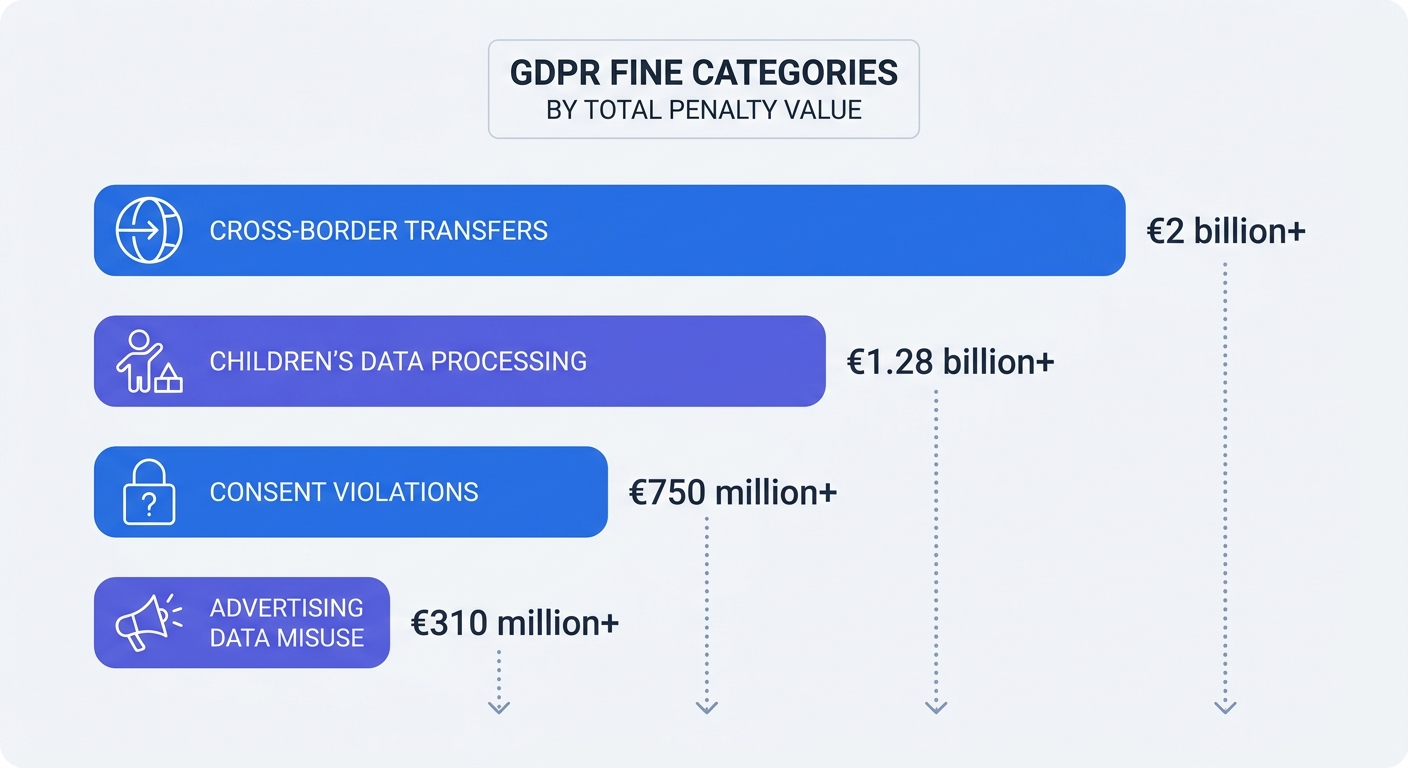
Cross-border data transfers account for more than €2 billion of these penalties, so if your analytics provider moves European visitor data to servers in the United States, your company absorbs that legal risk. Other top fine categories include children's data processing at €1.28 billion, consent violations at €750 million, and advertising data misuse at €310 million.
Data breaches take an average of 194 days to discover across all sectors, though the healthcare sector faces a longer timeline of 213 days and experienced a 64% increase in compromised records recently. To limit this exposure, audit your marketing stack by opening your browser's developer tools, loading your homepage, and checking the network tab. Filter for third-party analytics requests to map where those IP addresses resolve geographically. If the data leaves the European Union, you must execute a Data Processing Agreement with that vendor or find a replacement tool that keeps data local.
How Consent Banners Kill Data Accuracy
Traditional analytics platforms rely on persistent client-side identifiers to track users across multiple days and domains. Because GDPR classifies these cookies and browser fingerprints as personal data, you must ask for explicit permission before loading the tracking script.
When users deny consent, they vanish from your reports, creating a data blackout that ruins attribution models. Your traffic source data breaks while backend sales continue to register. For example, if a site receives 10,000 visitors and experiences a typical 40% consent opt-in rate (though this varies significantly by industry and region), 6,000 visitors disappear. Consequently, your conversion rate artificially spikes or plummets depending on who opted in, rendering the metrics useless for budget decisions.
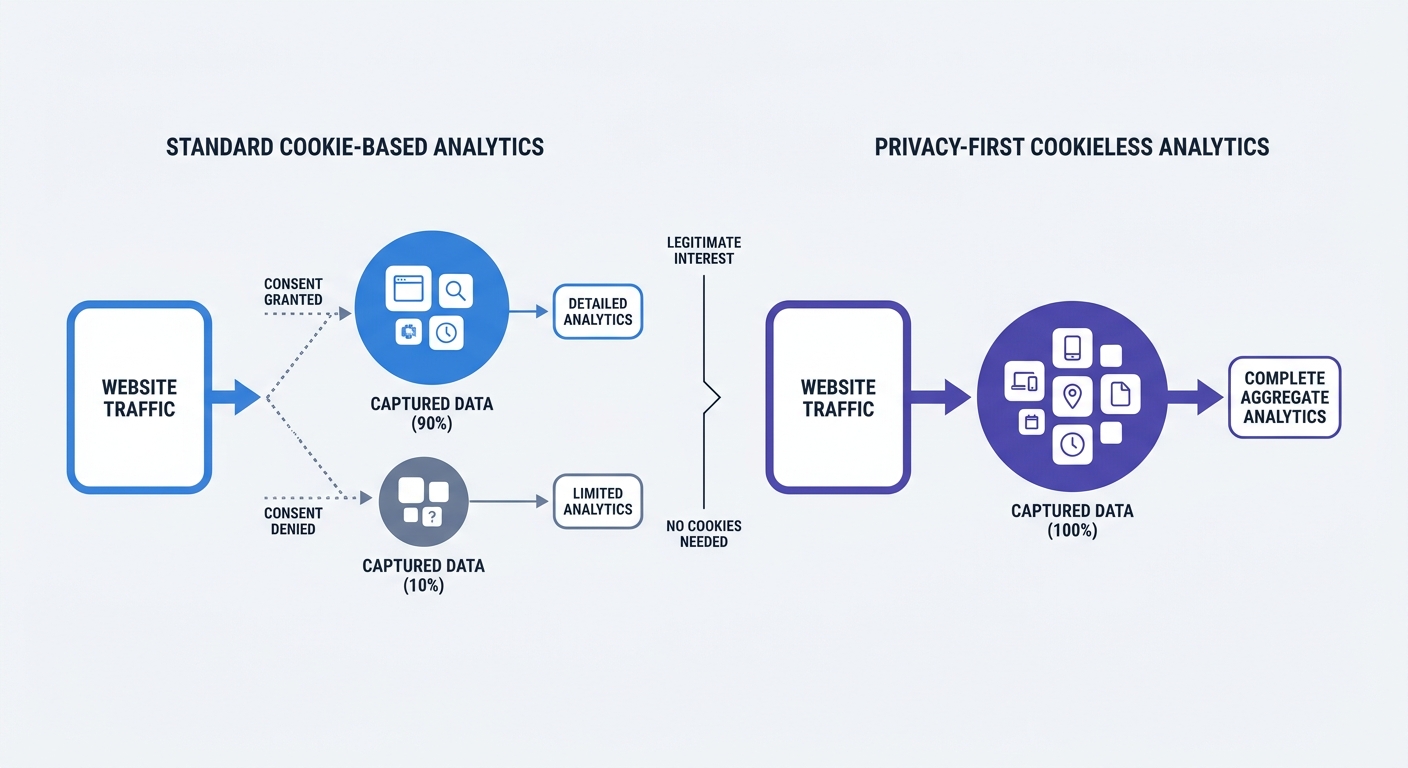
Privacy-first analytics solve this structural flaw by dropping individual identifiers and focusing on aggregate trends, allowing the tools to process data under the legal basis of legitimate interest. You see the traffic volume from a new campaign, the bounce rate on your landing page, and the completion rate for your checkout flow without triggering a consent banner. To test your current setup, check your analytics platform for an IP anonymization toggle; if the platform drops a cookie after you enable it, you still require explicit consent.
Evaluating the Best GDPR Compliant Web Analytics Tools
Cookieless Tracking and Data Minimization
Compliance requires more than a marketing claim on a pricing page, as the platform must engineer privacy into the data collection process itself. Look for tools that use server-side cookieless hashing techniques rather than client-side storage.
When a visitor arrives, the server combines their IP address and User Agent string with a dynamic, daily-rotating cryptographic salt to generate a hash that identifies a unique session for a brief period, usually 30 minutes.
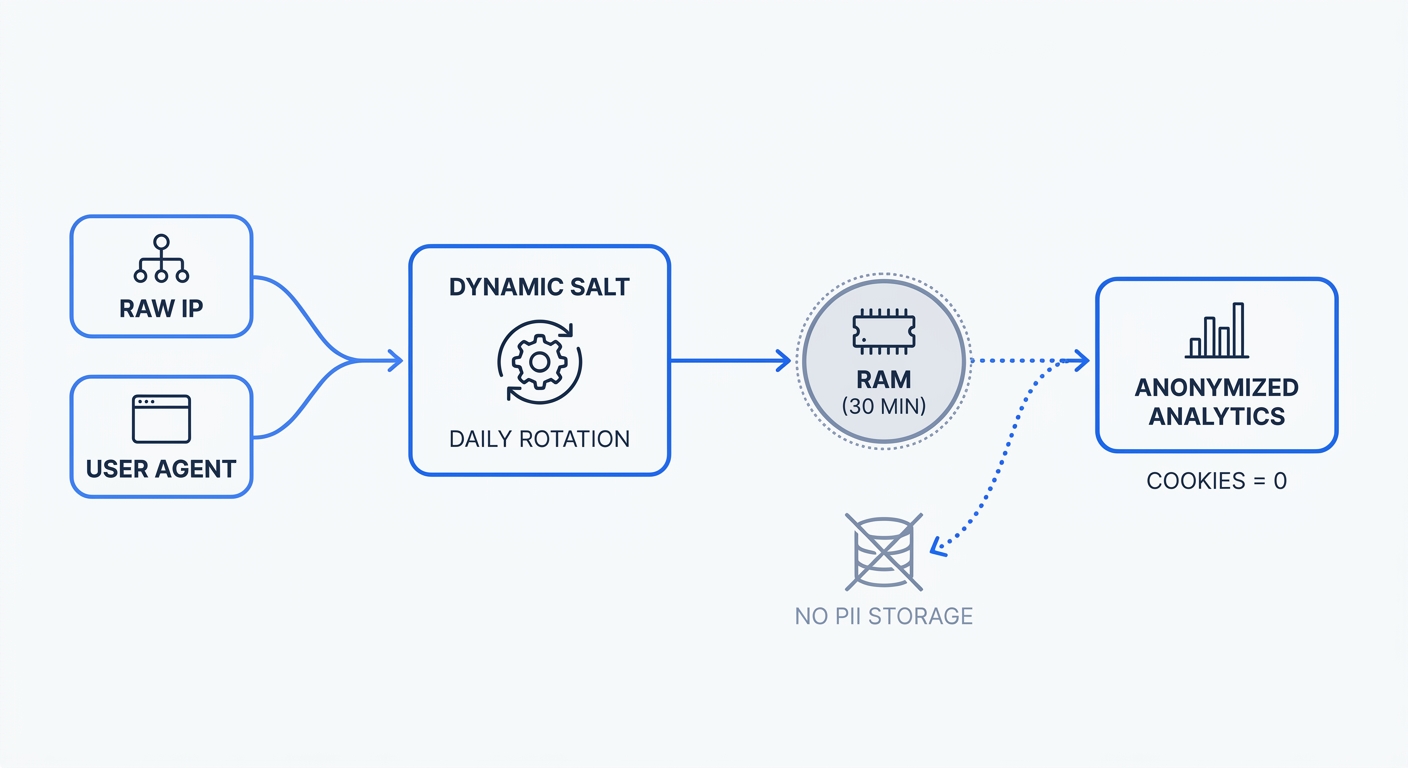
Once the salt rotates at midnight, reversing the hash to expose the original IP address becomes cryptographically impossible. Ensure any tool you evaluate processes these hashes in RAM and never writes raw personally identifiable information to a database. Under GDPR, an IP address is classified as personally identifiable information, meaning analytics tools must discard it, mask it, or irreversibly hash it immediately to maintain compliance.
Collect only the metrics necessary for operational intelligence. Pageviews, referrers, custom events, and UTM campaign tags provide enough data to optimize marketing spend. Leave session replays and granular location tracking off unless your privacy policy justifies them and you have a mechanism to collect consent.
EU Data Hosting vs. US Privacy Frameworks
The EU-U.S. Data Privacy Framework (DPF) stabilized transatlantic data transfers legally following its adoption. In September 2025, the General Court dismissed an action for annulment against the DPF, technically enabling the use of U.S.-hosted tools like Google Analytics again.
Despite this stabilization, relying on U.S. cloud tools carries administrative overhead. You must monitor framework compliance continuously, execute complex vendor agreements, and prepare for future legal challenges. Many organizations remain wary of American cloud tools and prefer domestic hosting to bypass cross-border data transfer risks.
You bypass this friction by choosing vendors that natively host their infrastructure within the European Union, as a platform running on servers in Germany or France removes cross-border transfer concerns. Alternatively, choose an open-source analytics platform and self-host the infrastructure on your own European cloud instances. This approach grants you absolute data sovereignty, ensuring nobody touches the traffic logs except your internal engineering team.
Top 3 GDPR Compliant Analytics Platforms
Swetrix: The Best Open-Source Alternative
Swetrix provides a 100% open-source, cookieless alternative engineered for European privacy standards. By hashing incoming visitor data on the fly and keeping session mappings in RAM, the platform never stores raw IP addresses. This architecture ensures GDPR compliance out of the box, allowing you to track conversions and monitor AI search traffic accurately without installing a cookie banner.
Data sovereignty is built into the infrastructure. The Swetrix Cloud tier hosts all data in Germany, nullifying the cross-border transfer risks that trigger heavy regulatory fines. If your organization requires absolute control, use Swetrix's Docker capabilities to self-host the web analytics on your own hardware. For those avoiding maintenance, the cloud pricing scales predictably, starting at $19 per month for 100,000 events.
Alongside standard traffic metrics, the platform integrates real-user performance monitoring and error tracking into the primary dashboard. This consolidation prevents you from needing three separate tools to measure marketing ROI and website health.
Google Analytics 4: Proceed with Extreme Caution
Google Analytics 4 replaced Universal Analytics with promises of better privacy controls, including mandatory IP anonymization. However, the platform relies heavily on the EU-U.S. Data Privacy Framework to justify moving European visitor data to American servers. Historical rulings by data protection authorities across Europe previously declared Google Analytics setups illegal due to the potential for state surveillance of transferred data.
Running GA4 legally in 2026 demands strict configuration. You must execute a formal Data Processing Agreement, configure the platform to block all transmission of personally identifiable information, and deploy a rigid consent management platform. Because GA4 drops users from the dataset when they decline cookies, missing conversions will force you to rely on Google's machine learning models to estimate the gaps in your traffic reports.
Secondary Alternatives: Matomo and Plausible
Matomo and Plausible offer secondary options for privacy-conscious teams. Matomo provides a customizable suite that rivals the complexity of Google Analytics, including features like heatmaps and form analytics. Because it defaults to dropping cookies, you must manually configure Matomo to run in cookieless mode to bypass consent banners. Furthermore, this heavy feature set demands significant server resources if you choose to self-host.
Plausible takes a minimalist approach, delivering a lightweight script and a single-page dashboard focusing on top-level metrics. It uses a daily-rotating salt to anonymize users, keeping the setup compliant without banners. However, Plausible lacks integrated error tracking and performance monitoring, requiring you to purchase and maintain separate software to monitor your website's technical health.
Here is how the platforms compare on core privacy features:
| Feature | Swetrix | Google Analytics 4 | Matomo | Plausible |
|---|---|---|---|---|
| Cookieless by Default | Yes | No | No | Yes |
| Default EU Data Hosting | Yes (Germany) | No (US/Global) | Optional | Yes (Germany) |
| Open-Source | Yes | No | Yes | Yes |
| Built-in Error Tracking | Yes | No | No | No |
| Consent Banner Required | No | Yes | Yes (Unless Configured) | No |
How to Transition to Privacy-First Analytics
Removing Intrusive Cookie Banners Legally
Many marketing teams assume cookie banners are mandatory for all websites, but the legal requirement targets the storage of persistent identifiers on a user's device. If you switch to an analytics tool that uses anonymized, cookieless tracking and does not track users across distinct domains, you can legally operate under legitimate interest.
Regulatory proposals aim to curb consumer consent fatigue by reducing the volume of low-risk pop-ups, which means removing your banner improves user experience and page load speed simultaneously.
Start by opening your website's source code and auditing your current script tags. Identify and delete legacy pixels from Facebook, LinkedIn, or older analytics tools that drop cookies regardless of user consent. Next, update your site's privacy policy to state clearly that you use privacy-preserving analytics to measure aggregate traffic without collecting personal data. Once the legacy scripts are gone and your cookieless tracking is active, take the consent banner down.
Setting Up Custom Event Tracking APIs
Marketing requires visibility into specific user actions like newsletter signups, button clicks, and checkout completions. You can track these conversions without cookies by replacing client-side tracking pixels with server-side API calls.
Configure your backend to fire an event to your analytics platform when a transaction completes. Because the server handles the communication, the visitor's browser remains free of tracking scripts, ensuring ad blockers cannot intercept the conversion data.
Follow these steps to deploy server-side event tracking:
- Generate an API key inside your privacy-first analytics dashboard.
- Identify the backend function that processes your target conversion, such as a successful payment webhook or a database user creation script.
- Add an HTTP POST request to that function targeting the analytics API.
- Include the event name, project ID, and any relevant metadata in the JSON payload.
- Test the integration by triggering the event locally and verifying the data appears in your dashboard.
Map out your core user journey and replace every client-side interaction pixel with a corresponding server-side event. This architecture ensures your conversion metrics remain accurate regardless of browser privacy settings.
Preparing for the AI Act and Future Compliance
The New Dual-Layer Penalty Structure
The regulatory environment continues to tighten beyond basic data collection. When full enforcement of the European Union AI Act begins in August 2026, it introduces a dual-layer penalty structure for data violations. Platforms that integrate high-risk AI systems face fines up to €35 million or 7% of global turnover, vastly exceeding original GDPR maximums.
Under the 2026 AI Act, data violations involving high-risk AI systems trigger a dual-layer penalty structure that overrides standard GDPR maximums, making careful vendor selection a financial imperative.
Analytics platforms incorporating AI features for automated forecasting or generative insights face stricter scrutiny, requiring vendors to prove their training data and processing pipelines comply with these new mandates. Review your vendor agreements closely and ask your analytics provider to detail how they isolate your visitor data from their machine learning models. If the provider uses your traffic logs to train third-party AI features without explicit user consent, your company bears the compliance risk.
Proactive Privacy Engineering
Marketing compliance strategies have shifted from reactive legal auditing to proactive technical architecture, as relying on lawyers to review data breaches after they happen costs too much and damages brand reputation. Ninety-four percent of organizations report that their customers will not buy from them if their personal data is not properly protected.
To prevent these breaches, build governance rules directly into your deployment pipelines by implementing automated Data Protection Impact Assessments (DPIA) into your engineering workflow. Before your team deploys any new analytics script or marketing tag, configure the system to validate what data it collects, where it sends it, and how long it retains it.
Block any script that attempts to read the local storage or access the browser fingerprint without prior validation, and document these processes in a centralized compliance ledger. Engineering privacy at the code level protects your revenue from regulatory fines while maintaining trust with your audience.
Stop losing marketing data to ad blockers and declined consent forms. Swetrix provides an open-source, cookieless web analytics platform that restores your conversion tracking while respecting user privacy. The platform delivers real-time dashboards, performance monitoring, and server-side custom events without the legal risk of cross-border data transfers. Start your 14-day free trial at swetrix.com/signup today to track your traffic accurately.