- Date
Best Website Analytics for Real Estate Agents and Brokers
 Andrii Romasiun
According to the National Association of Realtors, 97% of home buyers begin their property search online. Digital campaigns push massive traffic to your listings. Standard analytics platforms fail to measure this impact because ad blockers and browser privacy settings strip away data before it reaches your dashboard. You need the best website analytics for real estate to track long buyer journeys, boost conversions, and stay GDPR-compliant without relying on cookies. Swetrix provides this framework. Our privacy-focused platform captures every listing view and traffic source without violating user trust.
Why Real Estate Needs Specialized Analytics
The Shift to Digital Property Searching
Real estate marketing happens on the internet. Buyers browse Zillow or local broker sites on their phones during their commute. Industry data indicates that 89% of home buyers utilize mobile devices during their property search.
Track this influx to justify your marketing spend. Start by opening your current analytics dashboard. Compare your total ad clicks from Facebook and Google to the total sessions recorded on your site. Finding a gap larger than 10% signals lost data. Advertising platforms report clicks, yet website tracking tools miss the arrivals.
Brokerages employ dedicated data science teams to shift market forecasting from intuition to structured big data. Build this structured data by measuring exact user behavior on your site. Count every visitor, track every property search, and record every scroll.
Why Standard Analytics Fall Short
Traditional tools like Google Analytics depend on client-side cookies. Users install ad blockers that block these tracking scripts. Safari and Firefox deploy Intelligent Tracking Prevention (ITP) to delete third-party cookies by default. When browser extensions block an analytics script, the visit never registers in your reports.
A localized Google Ads campaign costing $1,000 might generate 500 clicks but show 300 sessions in your dashboard. This data loss prevents marketers from measuring cost-per-acquisition. Swetrix solves this discrepancy. Our open-source platform uses cookie-free tracking to measure traffic. Marketers capture pageviews, bounce rates, and traffic sources without triggering browser privacy defenses.
Privacy Laws and International Buyers
GDPR Compliance for US Real Estate
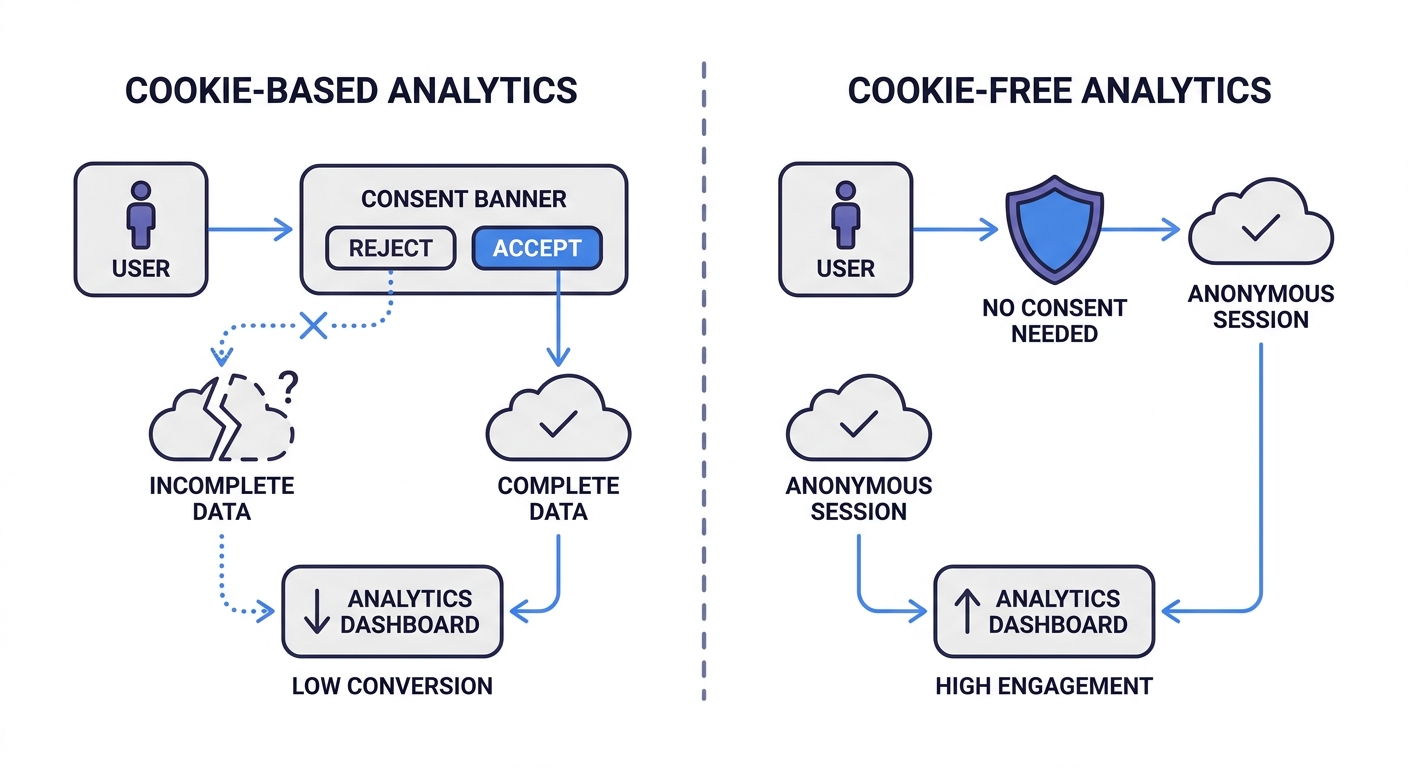
High-end real estate markets attract international investors. If your US-based brokerage receives website traffic from European residents, you fall under GDPR jurisdiction. California's CPRA and Canada's PIPEDA enforce parallel restrictions for North American visitors. Privacy laws require a consent banner before websites load tracking scripts. Visitors must click "Accept" for you to measure their behavior.
Review your current privacy policy and cookie banner setup. Verify that tracking scripts remain paused until the user grants permission. Many websites load analytics scripts before receiving consent, risking severe regulatory fines.
The Cookie-Free Analytics Advantage
Mandatory cookie banners degrade data accuracy. Visitors click "Decline" or ignore the prompt. Once a user opts out, standard analytics go blind. Visibility into property views and origin sources disappears.
Switch to a privacy-first platform to regain this data. Swetrix operates without cookies or tracking pixels. We hash IP addresses and use anonymous session identifiers to build analytics reports. Marketers do not collect Personally Identifiable Information (PII) using this method. Because no cookies drop on the user's device, you remove the consent banner from your site. Bypassing the banner keeps your brokerage compliant while restoring visibility into your website traffic.
Tracking Multi-Touch Buyer Journeys
Mapping the Long Sales Cycle
Buying a home takes weeks or months of consideration. A prospect discovers your agency through a Facebook ad, reads a neighborhood guide on their phone a week later, and submits a contact form via a direct desktop visit days after that. Marketers using standard analytics credit the direct desktop visit and ignore the Facebook ad. This last-click attribution model undervalues top-of-funnel marketing.
Configure your analytics to map session logic across multiple days. Swetrix pieces together fragmented buyer journeys using anonymous identifiers. Marketers use the platform to reveal the path from initial discovery to the final signed contract. Analyze your top conversion paths to see which social channels introduce buyers to your brand.
Implementing UTM Tracking
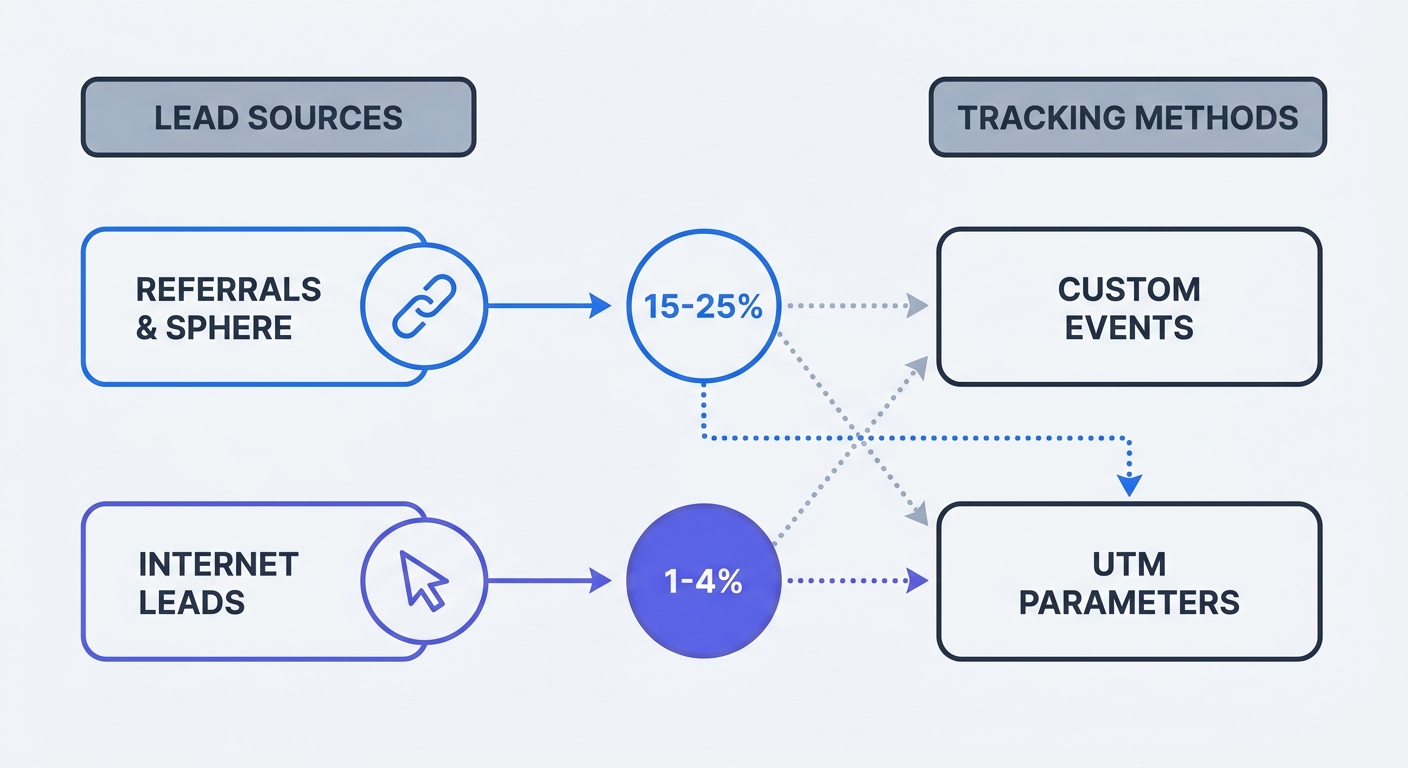
Traffic origins influence conversion probability. Referral and sphere-of-influence leads convert at 15% to 25%. Internet leads from property portals or paid ads convert at 1% to 4% across the real estate industry. Measure the return on investment for internet leads by enforcing UTM tracking. Tag every link you distribute across MLS syndications, social media ads, and email newsletters.
Build your URLs using a consistent format by appending parameters to the destination link: ?utm_source=mls&utm_medium=syndication&utm_campaign=123_main_street.
- utm_source: Identifies the site sending traffic (facebook, zillow, google).
- utm_medium: Identifies the channel type (cpc, social, email).
- utm_campaign: Identifies the specific property or marketing push.
Paste the tagged link into your ad platform. Swetrix parses these parameters on page load to segment your internet leads by exact source.
Key Metrics and Micro-Conversions to Measure
Benchmarking Your Conversion Rates
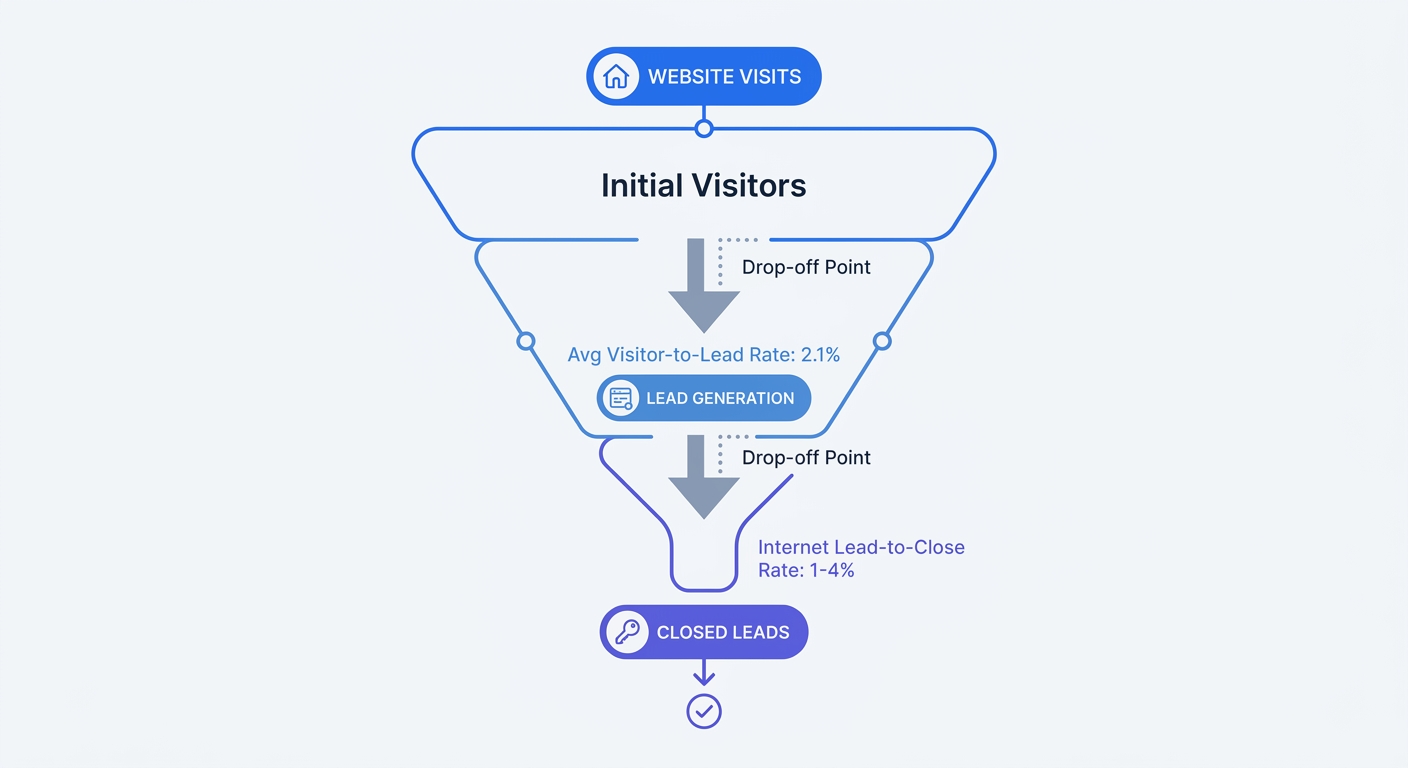
Real estate agents confuse visitor-to-lead conversion with lead-to-close conversion. Measure both distinct metrics to locate bottlenecks in your funnel. The average real estate website converts 2.1% to 2.8% of visitors into inquiries, while top-performing brokerages achieve rates above 4.7%.
A site receiving 1,000 visitors and generating 5 leads produces a 0.5% conversion rate. This low metric signals a website UX problem. Fix the landing page before buying more traffic.
Calculate your lead-to-close rate as a distinct metric. Track how many website inquiries sign a contract. A 3% lead-to-close rate aligns with industry averages for online buyer leads. Compare this figure against your different traffic sources. Identify which campaigns drive high-volume junk leads and which campaigns drive ready-to-buy clients.
Setting Up Custom Event Tracking
Contact form submissions provide limited data. Buyers engage with listings long before speaking to an agent. Track these micro-conversions to measure high-intent behavior. Real estate landing pages featuring virtual 3D tours convert 2.3 times higher than pages displaying standard photography. Track "3D Tour Initiated" as a custom event.
Configure event tracking in Swetrix for high-value actions:
- Mortgage calculator interactions
- Clicks on "Schedule a Viewing"
- Photo gallery scrolls exceeding 10 images
- Floor plan PDF downloads
Add a Javascript function to the button elements on your site. This code logs a custom event every time a user clicks the virtual tour button:
document.getElementById("3d-tour-btn").addEventListener("click", function () {
  swetrix.track({
    ev: "3D_Tour_Initiated",
    meta: { property: "123_Main_St" },
  });
});
Monitor these custom events in your dashboard. When buyers engage with 3D tours but skip the contact form, marketers identify a pricing issue.
Optimizing for Mobile and AI Search Trends
Segmenting Mobile vs Desktop Traffic
Mobile search drives the real estate market. Segment your traffic data by device type to ensure your mobile experience functions without errors. Start by opening the device reports in Swetrix. Compare the bounce rates between mobile and desktop visitors.
A mobile bounce rate exceeding 70% suggests slow page loads or broken layouts. Prevent these bounces by testing your site on a standard 4G connection. Compress high-resolution property images to reduce load times. Resize large MLS data tables that break small screens, and place your primary call-to-action buttons within thumb reach on mobile displays.
Adapting to Zero-Click AI Overviews
Search engines answer user questions on the results page. Generative Engine Optimization (GEO) forces real estate marketers to adapt. When Google AI Overviews appear, 83% of standard informational searches end without a click to an external site, though this rate varies by industry and query type. Buyers consume neighborhood stats, property histories, and market trends direct from the AI summary.
Track AI search traffic in your dashboard. Create segments in your analytics platform to isolate traffic arriving from ChatGPT, Perplexity, or Google's AI interface. These visitors possess high intent because they bypassed the AI summary to view your specific listing. Design your landing pages to capture this traffic. Place clear "Book a Showing" buttons above the fold. Optimize your site copy with structured data to ensure AI engines cite your brokerage as the primary source for local market data.
Real estate marketing requires accurate data to map long buyer journeys and validate ad spend. Swetrix provides open-source, privacy-focused analytics that track every property view without using cookies. Plans start at $19/month for 100,000 events, allowing you to bypass ad blockers and remain GDPR-compliant as your brokerage scales. Reclaiming lost data ensures you can attribute every lead to the correct marketing channel. Start your 14-day free trial today and measure the traffic your current analytics tool misses.