- Date
How to Track Users Without Cookies in 2026
 Andrii Romasiun
How to Track Users Without Cookies in 2026
Browser privacy controls, consent choices, and ad blockers affect what client-side tracking can record. Test your setup with these restrictions enabled and compare recorded conversions against backend records to identify gaps.
The cost shows up in your attribution reports. A $10,000 Facebook campaign drives 500 conversions, but your analytics platform records 300 because ad blockers stripped the tracking pixel before data reached your server. Revenue gets filed under "direct" or "unknown source." Campaign ROI calculations collapse.
Cookieless tracking solves this by moving data capture from the browser to your server or using privacy-first platforms that never touch personal identifiers. Server-side implementations capture 25-35% more conversions than client-side pixels. Privacy platforms like Swetrix eliminate consent banners by collecting zero personal data—no cookies, no fingerprints, no cross-site tracking.
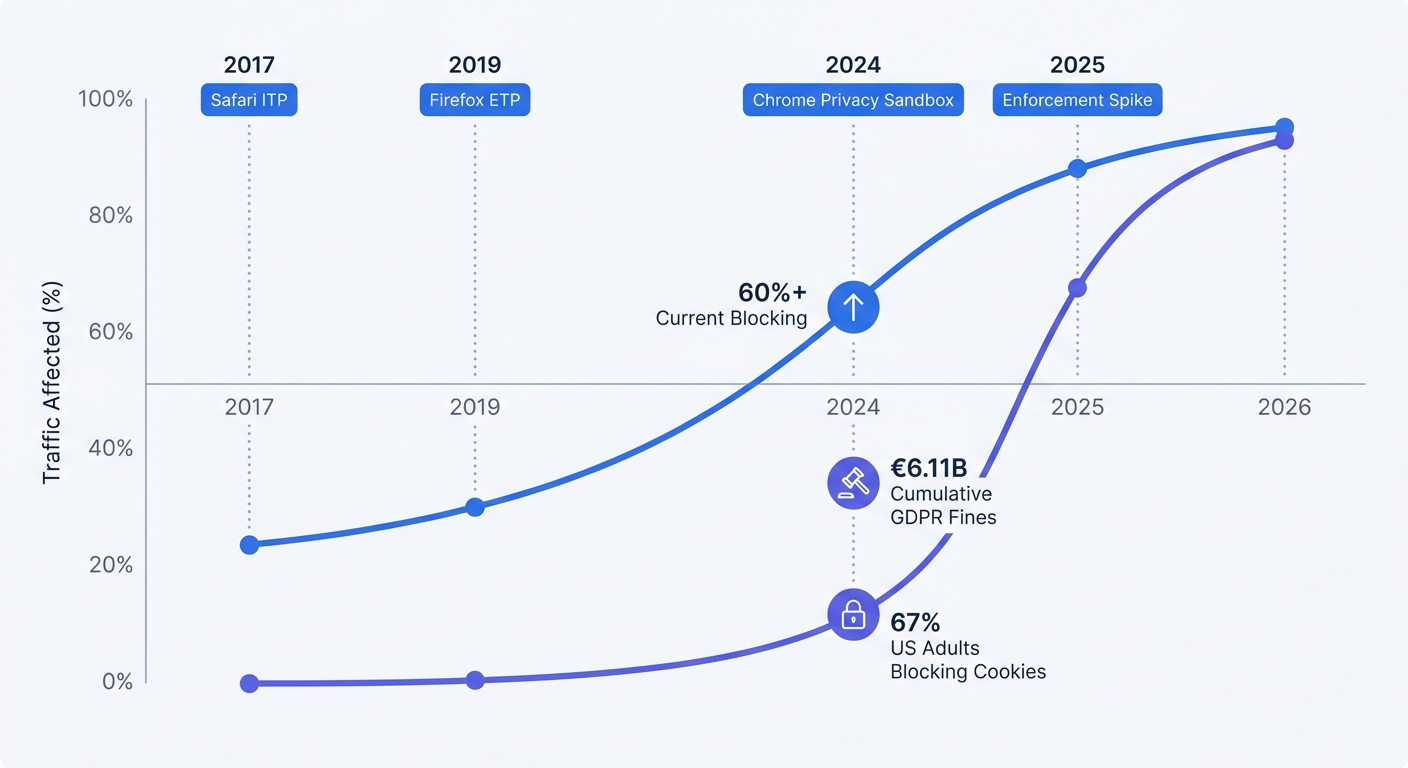
GDPR enforcement accelerated the shift. Cumulative fines reached €7.1 billion by early 2026 , with individual penalties hitting €90 million for cookie consent violations. Google received that fine for making cookie acceptance one-click while rejection required multiple steps. Several EU data protection authorities declared Google Analytics non-compliant because it transfers data to US servers without adequate safeguards.
Swetrix runs on European servers in Germany, stores no personal data, and requires no consent banner under GDPR. The platform is cookieless by design. Install the script, and tracking starts without legal risk or user friction. Compare that to GA4's ongoing compliance issues and the 70%+ of users frustrated with consent prompts.
Why Cookie-Based Tracking Is Dead (And What Replaced It)
The Cookie Apocalypse: 60% of Traffic Blocked
Safari controls 23.4% of mobile browsing globally and 51.2% of mobile browsing in North America . Every Safari user runs Intelligent Tracking Prevention by default, blocking third-party cookies and purging first-party cookies after seven days of inactivity. Firefox's Enhanced Tracking Protection does the same for its user base. Chrome introduced user choice in July 2024 instead of full deprecation, but the trend is irreversible.
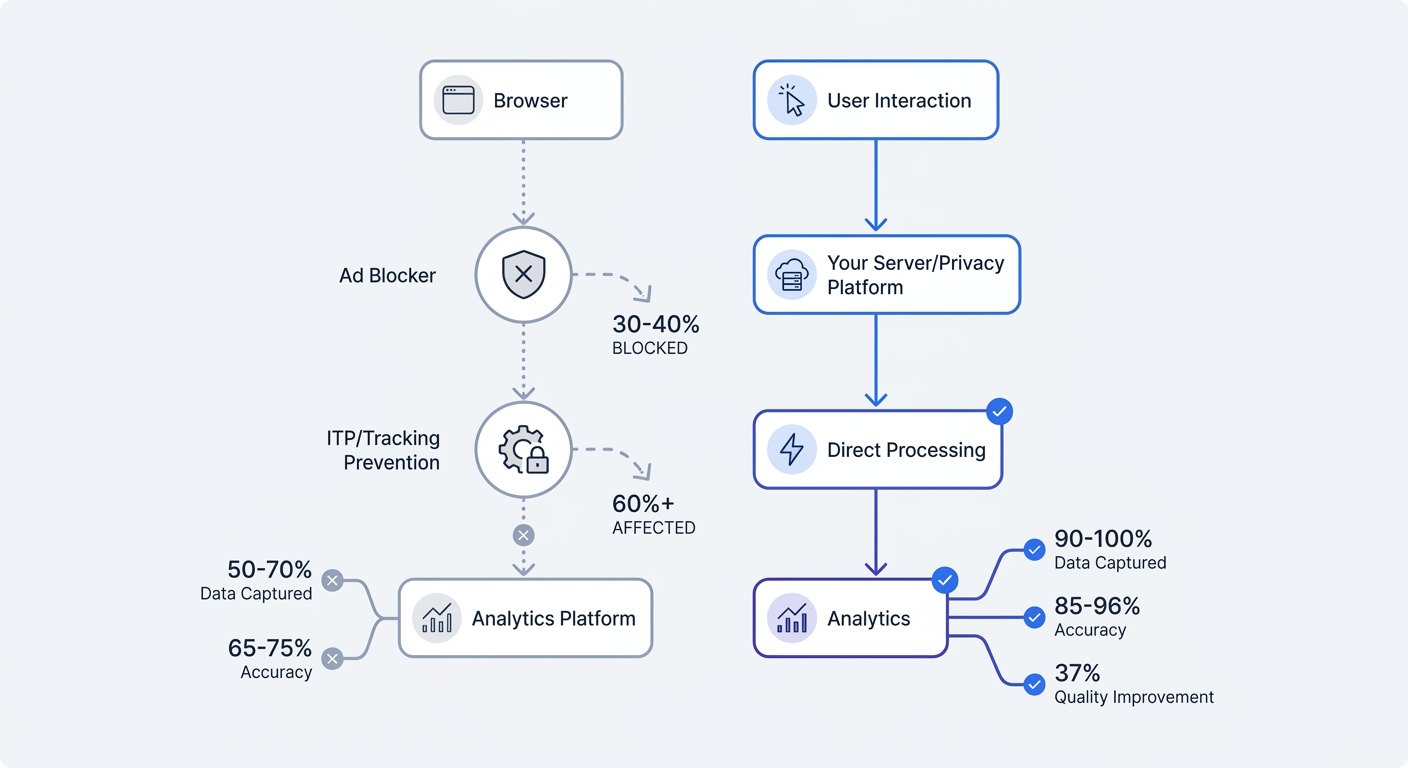
30-40% of desktop users run ad blockers that strip tracking pixels before they fire. Apple's App Tracking Transparency framework means only 15-30% of iPhone users opt into tracking . Add browser restrictions, user settings, and consent rejections together, and more than half your traffic becomes invisible to traditional analytics.
The blocking happens without warning. A visitor lands on your site from a paid ad, browses three pages, and converts. The analytics platform records the session but attributes it to "direct" because the ad blocker prevented the UTM parameters from reaching your server. Multiply that across thousands of sessions, and your attribution model shows organic traffic driving 60% of revenue when paid ads drove 40%.
The Real Cost: Missing 30-50% of Your Conversion Data
Third-party cookie-based attribution achieved 85-90% accuracy when browsers allowed unrestricted tracking. Cookieless methods range from 50-85% depending on approach. Identity graphs reach 70-85%, fingerprinting hits 60-75%, and probabilistic matching lands at 50-65%.
Pixel-only implementations capture 65-75% of conversions. Server-side tracking pushes that to match rates above 90% for Meta CAPI and Google Enhanced Conversions . The gap represents real revenue you can't measure. A $50,000 monthly ad budget with 70% tracking accuracy means $15,000 in unattributed conversions. Scale that across a year, and you're flying blind on $180,000 in marketing spend.
Financial services lead server-side adoption at 89%, followed by e-commerce at 78% and healthcare at 71%. These industries moved first because compliance requirements forced the issue, but the performance gains apply everywhere.
Meet Cookieless Tracking: Privacy-First Analytics That Works
Cookieless tracking captures user behavior without browser-based identifiers. Instead of storing a unique ID in a cookie and reading it on each page load, the system processes events on your server or uses aggregated, anonymous data that never ties back to an individual.
Swetrix exemplifies the privacy-first approach. The platform tracks page views, sessions, referrers, UTM parameters, custom events, and revenue without collecting IP addresses, device fingerprints, or any personal identifiers. The v5 release added session analysis, A/B testing, revenue analytics with Stripe and Paddle integration, and feature flags—enterprise product analytics capabilities without sacrificing privacy.
Install the 2.5KB script on your site. Configure tracking in 15 minutes. No consent banner appears because no personal data gets collected. GDPR compliance is automatic. Compare that to GA4's 135KB script, complex setup, and ongoing legal challenges across EU member states.
Other privacy platforms include Plausible (2.5KB script, EU-hosted, open source), Fathom (GDPR/CCPA compliant, simple interface), and Matomo (self-hosted option, full data ownership). All eliminate cookies and personal data collection. Swetrix stands out with its product analytics features and open-source transparency—audit the code yourself at any time.
5 Proven Methods to Track Users Without Cookies
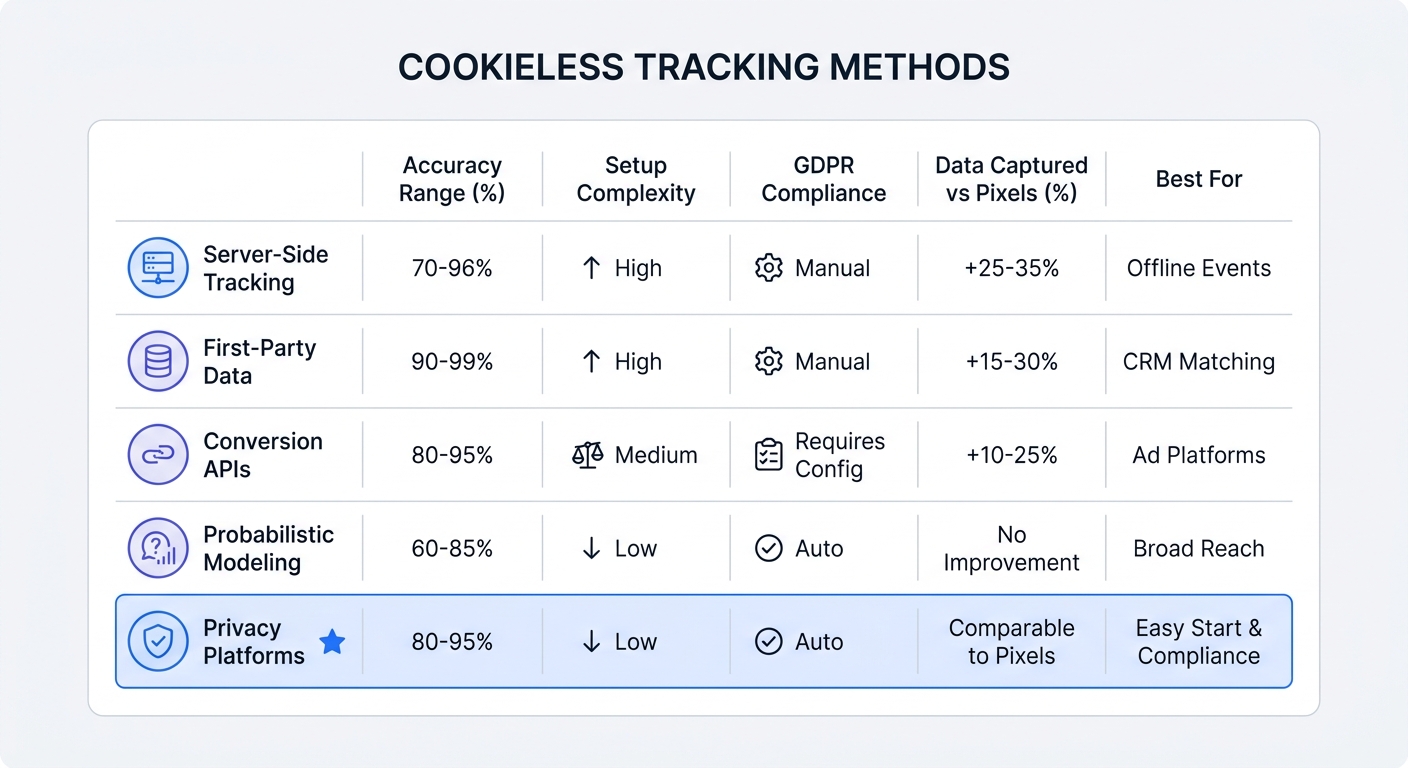
Server-Side Tracking: Capture 25-35% More Conversions
Server-side tracking moves data collection from the browser to your server. A visitor clicks a link. Their browser sends a request to your server. Your server logs the event, processes it, and forwards relevant data to your analytics platform or ad network. Ad blockers can't strip the request because it never passes through the browser's tracking prevention layer.
The method captures 25-35% more conversions than pixel-only setups. Meta CAPI achieves match rates above 90% when you send hashed email and phone data . Google Enhanced Conversions reaches similar accuracy when you hash email and phone data server-side and send it to Google's API.
Set up a custom subdomain for your tracking server—analytics.yourdomain.com instead of a third-party domain. This mitigates Intelligent Tracking Prevention restrictions. Host the server in Europe if your primary audience is European; GDPR requires EU data to stay on EU servers. Integrate your Consent Management Platform so the server respects user choices before forwarding data to third parties.
Server-side tracking provides up to 37% improvement in data accuracy by centralizing data processing and reducing reliance on browser-based signals. The infrastructure requires technical setup—Google Tag Manager Server containers, cloud hosting, API configuration—but the conversion lift justifies the effort for high-volume sites.
First-Party Data Collection: Your Most Valuable Asset
First-party data comes from your customers: email addresses from newsletter signups, purchase history from your e-commerce platform, preferences from account settings, behavior from logged-in sessions. 71% of marketers are increasing their first-party datasets in 2024 , and 70% of B2B marketers are increasing investment.
This data is unique to your business, accurate by definition, and compliant when collected with proper consent. A visitor creates an account, opts into marketing emails, and makes a purchase. You have their email, product preferences, and transaction history. Hash the email, send it to Meta CAPI or Google Enhanced Conversions, and match it to ad impressions server-side. Attribution accuracy jumps because you're matching real customer records to campaign data.
Build collection points into your user journey. Offer a discount code for email signup. Require account creation before checkout. Add preference centers where users choose content topics. Each interaction adds data you control, with no third-party intermediaries or browser restrictions.
First-party data also powers personalization without privacy violations. Segment users by purchase history, show relevant product recommendations, and send targeted email campaigns based on browsing behavior—all using data they provided. 80% of consumers prefer brands offering personalized experiences, and those customers spend 50% more.
Conversion APIs: Direct Server-to-Platform Attribution
Conversion APIs send event data from your server to advertising platforms. Facebook CAPI, Google Enhanced Conversions, TikTok Events API, and Pinterest Conversions API all follow the same pattern: your server captures a conversion, hashes any personal identifiers, and posts the event to the platform's API endpoint.
The platform matches the hashed data to user profiles in its system. A visitor sees your Facebook ad, clicks through, and converts on your site. Your server hashes their email and sends it to CAPI along with the conversion event. Facebook matches the hash to the user who clicked the ad and attributes the conversion, even if the browser blocked the pixel.
Meta CAPI achieves match rates above 90% when implemented properly. Google Enhanced Conversions hits similar accuracy. Both far exceed pixel-only accuracy because server-to-server communication bypasses browser restrictions.
Set up CAPI by generating an access token in your ad platform, installing the API library on your server, and configuring event forwarding. Hash email addresses and phone numbers using SHA-256 before sending. Never transmit plain-text personal data. The platform handles matching on its end and returns aggregated attribution data to your dashboard.
Probabilistic Modeling & Marketing Mix Modeling
Probabilistic modeling uses statistical analysis to estimate attribution when direct tracking fails. The system analyzes patterns across thousands of conversions—time of day, device type, referrer domain, session duration—and assigns probability scores to untracked sessions based on similarity to tracked ones.
Ruler Analytics' probabilistic tracking uses Bayesian statistics to match ad impressions to conversions without cookies. The model learns from observed data and applies those patterns to fill attribution gaps. Accuracy ranges from 50-65%, lower than server-side methods but better than ignoring untracked traffic.
Marketing Mix Modeling takes a macro view. Instead of tracking individual users, MMM correlates marketing spend with revenue over time. Increase Facebook ad spend by $10,000 in March, and revenue rises by $35,000. The model attributes a portion of that lift to the Facebook campaign based on timing and historical patterns.
Modern MMM tools like Recast and Rockerbox run faster and more granularly than traditional models. They incorporate daily data instead of monthly aggregates and account for external factors like seasonality and competitor activity. Use MMM for strategic budget allocation across channels, not tactical campaign optimization.
Privacy-Focused Analytics Platforms (The Easiest Path)
Privacy platforms eliminate cookies and personal data collection. Swetrix, Plausible, Fathom, and Matomo all track page views, sessions, referrers, and conversions without storing IP addresses, device fingerprints, or cross-site identifiers.
Swetrix leads in feature depth. The platform offers session analysis showing individual user journeys without identifying the user, A/B testing with statistical significance calculations, revenue analytics integrating Stripe and Paddle for automatic transaction tracking, and feature flags for gradual rollouts. These capabilities match enterprise product analytics tools while maintaining zero personal data collection.
Install Swetrix by adding a 2.5KB script to your site header. Configure tracking in the dashboard: set up custom events for button clicks, form submissions, or video plays; enable revenue tracking by connecting your payment processor; create funnels to measure conversion paths. The setup takes 15 minutes. No consent banner appears because the platform collects no personal data under GDPR definitions.
Plausible offers a similar 2.5KB script and EU hosting on renewable energy servers in Germany. Fathom provides GDPR/CCPA compliance with a simple interface focused on core metrics. Matomo gives you self-hosting options for complete data ownership, though setup complexity increases.
All four platforms share key advantages: no cookies, no consent banners, automatic GDPR compliance, and lightweight scripts that don't slow page load. Swetrix differentiates with its product analytics features and open-source codebase—inspect the code, verify privacy claims, and self-host if needed.
Choose a privacy platform when you want immediate compliance, fast setup, and core analytics without legal risk. Add server-side tracking later if you need advanced attribution for specific ad platforms.
Step-by-Step: Implementing Cookieless Tracking
Choose Your Tracking Architecture (Server-Side vs Privacy Platform)
Server-side tracking fits enterprises with existing ad platform integrations, high traffic volume, and technical resources for infrastructure management. The setup captures more conversion data and enables advanced attribution, but requires weeks of configuration and ongoing maintenance.
Privacy platforms fit businesses prioritizing compliance, fast deployment, and core analytics over granular attribution. Swetrix, Plausible, and Fathom deploy in minutes and require zero maintenance. The tradeoff: less detailed attribution for specific ad campaigns, though UTM tracking still works for source/medium/campaign reporting.
Run both if budget allows. Use Swetrix for core analytics, user behavior, and conversion tracking. Add server-side tracking for Facebook CAPI and Google Enhanced Conversions to improve ad platform attribution. The combination gives you privacy-compliant analytics plus detailed paid media performance.
Start with a privacy platform if you're unsure. Swetrix's 14-day free trial lets you test session analysis, custom events, and revenue tracking without commitment. Evaluate whether the built-in attribution meets your needs before investing in server-side infrastructure.
Set Up Server-Side Tracking (GTM Server Container Guide)
Create a Google Tag Manager server container in your GTM account. Choose a hosting region—select Europe if your audience is European to comply with GDPR data residency requirements. Google provisions a server and provides a tagging endpoint URL.
Configure a custom subdomain pointing to that endpoint. Add a CNAME record in your DNS settings: analytics.yourdomain.com → gtm-server-endpoint.google.com. This keeps tracking on your domain, reducing ITP restrictions.
Install the GTM server-side client in your container. Add tags for Facebook CAPI, Google Enhanced Conversions, or other platforms. Configure each tag to receive events from your website's client-side GTM container and forward them to the platform's API.
Integrate your Consent Management Platform. Set up triggers that check consent status before firing tags. If a user rejects marketing cookies, the server should not forward data to advertising platforms. This respects user choice and maintains GDPR compliance.
Hash personal identifiers before transmission. Use SHA-256 to hash email addresses and phone numbers in a server-side variable. Never send plain-text personal data to third parties. The hashed values enable matching without exposing raw information.
Test the setup by triggering a conversion on your site and checking the server container's debug console. Verify that events reach the server, consent checks work, and data forwards to your ad platforms. Monitor match rates in Facebook Events Manager and Google Ads to confirm attribution accuracy.
Implement Privacy-First Analytics in 15 Minutes
Sign up for Swetrix at https://swetrix.com/signup. Create a project and copy the tracking script. Paste it into your site's <head> section before the closing tag. The script loads asynchronously and won't block page rendering.
Configure custom events for key actions. Add swetrix.track('button_click') to your CTA button's onclick handler. Track form submissions with swetrix.track('form_submit') in your form's success callback. Monitor video plays, file downloads, or any user interaction relevant to your business.
Enable revenue tracking if you run e-commerce or SaaS. Connect Stripe or Paddle in the Swetrix dashboard. The platform captures transaction amounts and ties them to traffic sources. View revenue by UTM campaign, referrer, or landing page without additional code.
Set up funnels to measure conversion paths. Define steps: landing page → product page → cart → checkout → confirmation. Swetrix calculates drop-off rates at each step and shows which traffic sources convert best. Optimize campaigns based on full-funnel performance, not top-of-funnel clicks.
Create A/B tests for landing pages or features. Swetrix's built-in testing calculates statistical significance and shows which variant drives more conversions. No separate tool needed.
Check your dashboard. Page views, sessions, referrers, and UTM parameters appear immediately. No consent banner interrupts users. No cookies get stored. GDPR compliance is automatic because the platform collects zero personal data.
Accuracy & Performance: What to Expect From Cookieless Methods
Accuracy Benchmarks by Method (50-96% Match Rates)
Third-party cookie-based attribution achieved 85-90% accuracy when browsers allowed unrestricted tracking. Cookieless methods vary. Identity graphs reach 70-85% by matching hashed emails across platforms. Fingerprinting hits 60-75% by combining device signals, though privacy concerns and GDPR restrictions limit its use. Probabilistic matching lands at 50-65% by inferring attribution from behavioral patterns.
Server-side Conversion APIs outperform all browser-based methods. Meta CAPI achieves match rates above 90% when you send hashed email and phone data. Google Enhanced Conversions reaches similar accuracy with proper configuration. Both bypass browser restrictions by processing data server-to-server.
Privacy platforms like Swetrix track 100% of sessions that reach your site because they don't rely on third-party cookies or cross-site identifiers. The limitation: attribution to specific ad impressions requires UTM parameters or referrer data. If a user sees your Facebook ad, closes the browser, and returns later by typing your URL, Swetrix records the session as "direct" traffic. Server-side CAPI would match the conversion to the original ad impression via hashed email.
Combine methods for comprehensive coverage. Use Swetrix for core analytics and user behavior. Add server-side CAPI for ad platform attribution. Collect first-party data to improve matching accuracy. The hybrid approach captures 90%+ of conversions with proper attribution.
Server-Side vs Client-Side: The 37% Data Quality Gap
Server-side tracking provides up to 37% improvement in data accuracy compared to client-side pixels. The gap comes from three sources: ad blocker bypass, browser restriction avoidance, and centralized data processing.
Ad blockers strip client-side pixels before they fire. 30-40% of desktop users run ad blockers, and every blocked request loses data. Server-side tracking captures the event on your server before the browser can interfere. Data reaches your analytics platform regardless of client-side blocking.
Browser restrictions like ITP and ETP purge first-party cookies after seven days of inactivity and block third-party cookies. Client-side tracking loses session continuity when cookies expire. Server-side tracking maintains session state on your server, independent of browser storage.
Centralized processing reduces data fragmentation. Client-side tracking sends data from the browser to multiple platforms—analytics, ad networks, CRM. Each platform receives different data depending on what the browser allows. Server-side tracking processes events once on your server, then distributes consistent data to all platforms. Attribution becomes more reliable when every system works from the same event log.
The quality improvement translates to better decisions. A client-side setup shows Facebook ads driving 200 conversions at $50 CPA. Server-side tracking reveals 270 conversions at $37 CPA because it captured 35% more events. You increase Facebook spend based on accurate data instead of underestimating performance.
Why Lightweight Scripts Matter for SEO and Conversions
Page load speed affects search rankings and conversion rates. Google uses Core Web Vitals as a ranking factor. Slow sites rank lower.
Analytics scripts contribute to page weight. GA4's script weighs 135KB. Plausible's script weighs 2.5KB. Swetrix matches that at 2.5KB. The difference compounds when you load multiple tracking scripts—GA4 plus Facebook Pixel plus LinkedIn Insight Tag plus Hotjar adds 300KB+ to every page load.
A 2.5KB script loads in milliseconds on any connection. A 135KB script takes seconds on 3G mobile. Each second of delay increases bounce rate. Users leave before the page finishes loading. Conversions drop.
Lightweight scripts also reduce server requests. GA4 makes multiple requests to load libraries, fetch configuration, and send data. Swetrix makes one request. Fewer requests mean faster page rendering and better Core Web Vitals scores.
Choose privacy platforms for performance gains beyond compliance. Swetrix and Plausible improve page speed while eliminating cookies. GA4 slows pages and requires consent banners.
Staying Compliant: GDPR, Consent, and Legal Requirements
Does Cookieless Tracking Still Require Consent?
Cookieless tracking does not exempt you from GDPR. The regulation applies to all personal data processing regardless of method. Server-side tracking, device fingerprinting, and probabilistic modeling all process data that may qualify as personal under GDPR definitions.
If consent is required for tracking activities, server-side infrastructure must still respect those requirements. The difference: server-side gives you centralized control to enforce consent before forwarding data to third parties. Client-side pixels fire in the browser before you can intercept them.
Anonymous analytics may not require consent. If your tracking system collects no personal data—no IP addresses, no device fingerprints, no cross-site identifiers, no data that could identify an individual—GDPR's consent requirements may not apply. This is where privacy platforms excel.
Swetrix collects zero personal data. No IP addresses get stored. No device fingerprints get created. No user IDs persist across sessions. The platform tracks page views, referrers, and UTM parameters without identifying individuals. Under GDPR, this qualifies as anonymous data processing, which does not require consent.
Verify with legal counsel for your jurisdiction. GDPR interpretation varies by country and enforcement authority. Some regulators take a strict view that any tracking requires consent. Others accept that anonymous analytics fall outside GDPR scope. Document your data processing practices and maintain records showing no personal data collection.
Server-Side Tracking Is Not Automatically GDPR-Compliant
Server-side tracking improves GDPR compliance by centralizing data control, but implementation determines whether you meet legal requirements. Moving tracking to your server does not eliminate consent obligations, data minimization requirements, or purpose limitation rules.
Consent remains necessary when tracking requires it. If you collect personal data or use tracking for marketing purposes that need consent under GDPR, your server-side setup must check consent status before processing data. Integrate your Consent Management Platform with your server. Configure tags to fire only when users grant appropriate consent.
Data minimization applies server-side. Collect only the data you need for stated purposes. If you don't need precise geolocation, don't capture it. If you don't need device fingerprints, don't generate them. Server-side solutions enable data minimization at the processing level, but you must configure them.
Purpose limitation prevents data misuse. If a user consents to analytics but not marketing, your server must not forward their data to advertising platforms. Set up separate data streams for different purposes. Route analytics data to Swetrix or Plausible. Route marketing data to Facebook CAPI only when marketing consent exists.
Secure processing protects data in transit and at rest. Use HTTPS for all server communication. Encrypt data at rest. Restrict access to authorized personnel. Server-side tracking centralizes security controls, but you must implement them.
How to Implement Data Minimization and Anonymization
IP anonymization removes the last octet of IP addresses before storage. 192.168.1.100 becomes 192.168.1.0. This preserves geographic data for country/region reporting while preventing individual identification. Configure IP anonymization in your analytics platform or server-side container.
Swetrix anonymizes IPs automatically. The platform never stores full IP addresses. Geographic data comes from anonymized IPs, providing country and region reporting without privacy risk.
Avoid collecting PII. Don't capture email addresses, phone numbers, or names in analytics events unless necessary. If you must collect them for specific features, hash the values before storage and delete them after the retention period expires.
Set short data retention periods. GDPR requires deleting personal data when it's no longer needed for its original purpose. Configure your analytics platform to delete raw event data after 90 days or 180 days. Aggregate data can persist longer because it doesn't identify individuals.
Use European data hosting when your audience is European. GDPR requires EU data to stay on EU servers unless you have adequate transfer mechanisms. Swetrix hosts data in Germany on renewable energy servers. Plausible does the same. Both eliminate data transfer concerns for EU businesses.
Document your data processing. Maintain records showing what data you collect, why you collect it, how long you keep it, and who accesses it. GDPR requires demonstrating compliance, not claiming it.
Future-Proofing Your Analytics Stack for 2026 and Beyond
Google's Cookie Reversal Doesn't Change the Shift
Google announced in July 2024 that Chrome would not deprecate third-party cookies. Instead, the browser introduced a user choice experience allowing people to enable or disable cookies in settings. This reversed the planned 2024 deprecation.
The reversal does not restore cookie-based tracking to its 2019 state. Safari and Firefox block third-party cookies for 100% of their users. Safari holds significant mobile market share. Firefox's Enhanced Tracking Protection runs by default. Together, they affect 40%+ of traffic before counting Chrome users who choose to block cookies.
User expectations continue evolving toward privacy. 67% of US adults manage or block cookies. 70%+ experience frustration with consent banners. Regulatory pressure increases—GDPR fines reached €7.1 billion by early 2026 , with enforcement becoming more aggressive.
The trend is irreversible even if Chrome allows cookies. Privacy-first tracking is the new standard. Build your analytics stack assuming cookies will not be available, and you'll be prepared regardless of browser policy changes.
Hybrid Approaches: Combining Multiple Methods
No single tracking method captures 100% of conversions with perfect attribution. Combine multiple approaches to maximize coverage and accuracy.
Start with a privacy platform for core analytics. Swetrix provides session tracking, user behavior analysis, conversion funnels, and revenue attribution without cookies or consent banners. This forms your foundation—reliable, compliant, and comprehensive for on-site behavior.
Add server-side Conversion APIs for ad platform attribution. Implement Facebook CAPI and Google Enhanced Conversions to capture 90%+ of paid media conversions. The server-side layer fills attribution gaps that privacy platforms can't address when users don't click through with UTM parameters.
Collect first-party data for personalization and matching. Build email lists, loyalty programs, and account systems. Hash emails and send them to Conversion APIs for improved match rates. Use first-party data to segment audiences and personalize experiences without third-party tracking.
Layer in Marketing Mix Modeling for strategic budget allocation. MMM correlates spend with revenue across channels, providing a macro view that complements granular attribution. Use it to decide how much to invest in each channel, then use Swetrix and server-side tracking to optimize within channels.
The balance shifts toward server-side as browser restrictions tighten. Financial services hit 89% server-side adoption. Other industries will follow. Start with privacy platforms for immediate compliance, then add server-side components as your technical resources and attribution needs grow.
Emerging Technologies: AI, Blockchain, and Edge Computing
AI-powered analytics will provide deeper insights without intrusive tracking. Swetrix's v5 release includes AI-driven session analysis that identifies patterns in user behavior and surfaces optimization opportunities. The system analyzes thousands of sessions, finds common paths to conversion, and highlights friction points—all without identifying individual users.
Machine learning models will improve probabilistic attribution. As these models train on larger datasets, accuracy will approach deterministic methods. Expect probabilistic matching to rise from 50-65% accuracy today to 70-80% within two years.
Blockchain technology promises transparent consent management. Decentralized consent records would let users control their privacy preferences across sites without relying on centralized platforms. Early implementations are emerging, though widespread adoption remains years away.
Edge computing reduces server-side tracking latency. Processing data at edge nodes closer to users improves response times and data freshness. Server-side conversion capture has improved 5% year-over-year due to edge infrastructure adoption. This trend will continue as cloud providers expand edge networks.
Open-source analytics platforms gain traction. Swetrix's open-source codebase lets you audit privacy claims, verify compliance, and self-host if needed. Transparency builds trust in an era of privacy skepticism. Expect more businesses to choose auditable, open-source tools over closed-source alternatives.
Privacy regulations will expand beyond GDPR and CCPA. More countries are introducing data protection laws. Compliance requirements will converge toward strict consent, data minimization, and user rights. Building a privacy-first analytics stack prepares you for future regulations regardless of where they originate.
Start tracking users without cookies. Swetrix offers session analysis, revenue analytics, A/B testing, and custom events with zero personal data collection. No consent banner needed. GDPR-compliant by design. Try the 14-day free trial at https://swetrix.com/signup and see how privacy-first analytics captures the data you need without the legal risk.