- Date
The 2026 Buyer's Guide to Automated Client SEO Reports
 Andrii Romasiun
An account manager exports a CSV from Google Analytics, downloads keyword rankings from Ahrefs, and pastes both into a slide deck. Before the client ever sees this presentation, an analyst manually cleans the UTM parameters to combine paid and organic traffic. A strategist then reviews the numbers to add contextual commentary, which means the agency burns hours of billable time on administrative data entry rather than campaign optimization. Choosing software to build automated client SEO reports requires balancing operational efficiency with data accuracy. Traditional dashboards break down when privacy regulations block cookies or when clients demand proof of ROI instead of raw pageviews. You must select a platform that captures accurate traffic without consent banners, links search rankings directly to conversion bottlenecks, and scales without manual oversight. Optimizing solely for automation speed risks sending inaccurate data generated by blocked tracking scripts, while over-indexing on complex data visualization forces you to maintain a fragile web of APIs. Swetrix acts as a unified reporting hub that combines cookieless data recovery with deep product analytics and scheduled delivery to eliminate the manual bottlenecks draining your agency's profit margins.

The Hidden Cost of Manual Reporting and Approval Bottlenecks
Every hour spent formatting charts is an hour not spent optimizing client campaigns. Digital agencies routinely dedicate up to five hours per client per month to pull, clean, and format performance data, depending on the complexity of the enterprise or local accounts they manage. For a firm handling fifteen accounts, this administrative drag consumes up to $11,250 in lost billable hours every month.
Internal review processes compound this cost because a typical workflow requires an analyst to format the spreadsheet, a strategist to write the executive summary, and an account manager to handle final delivery. This linear approval chain creates a severe end-of-month bottleneck. The strategist waits on the analyst, the account manager waits on the strategist, and the client waits on the agency to deliver the final document.
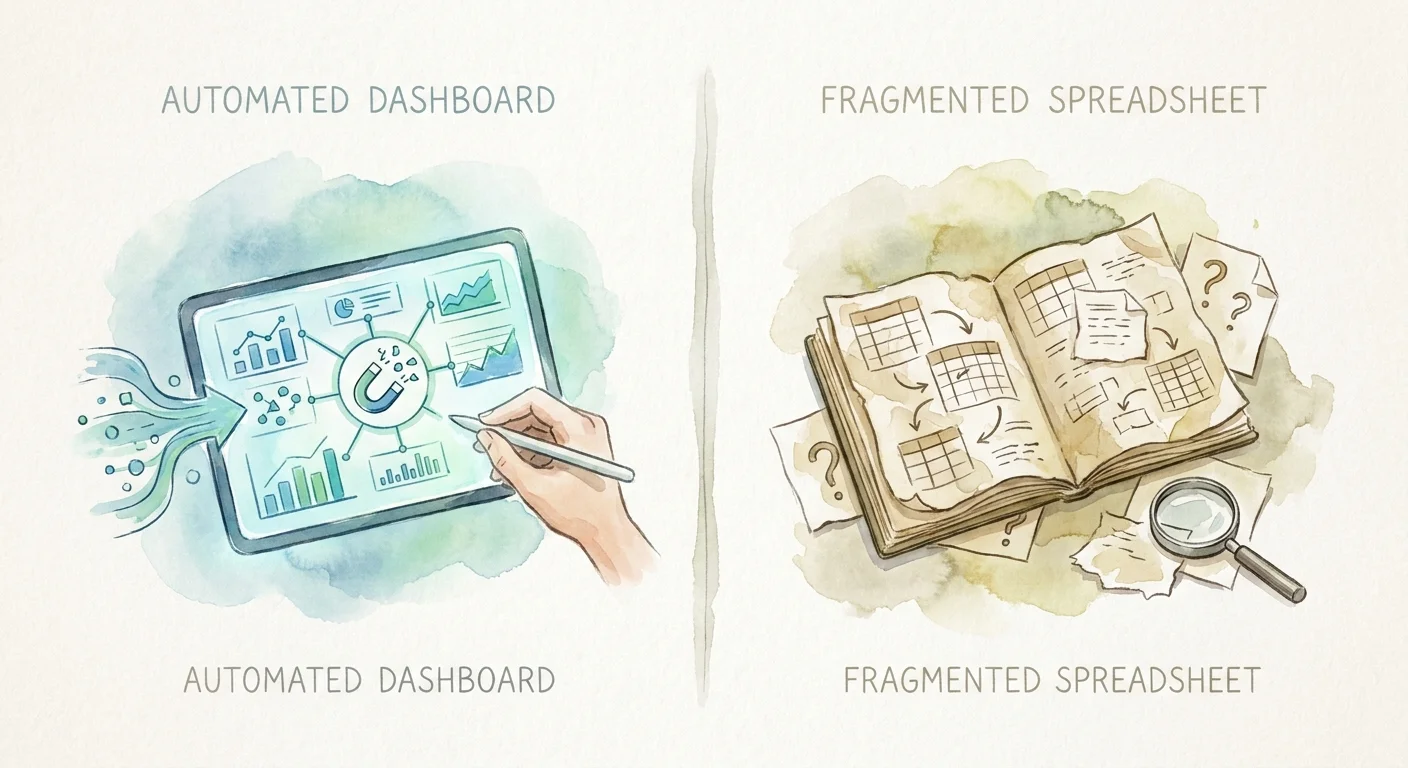
Breaking this cycle requires removing human touchpoints from routine data drops. A dedicated reporting platform pulls data directly from your tracking scripts, updates the charts dynamically based on predefined date ranges, and pushes the summary directly to the client. Consolidating your analytics into a unified reporting hub reduces data administration time and frees up capacity to take on new accounts.
Set up Swetrix to handle this distribution natively. Instead of manually exporting PDFs and writing summary emails, configure the platform to fire performance summaries directly into your existing communication channels. You can route these automated reports into a shared Slack channel, a client-specific Discord server, or a scheduled email thread.
Supplement these scheduled reports with automated alerts based on specific performance triggers. If a client's organic traffic drops below a baseline threshold, the system flags it immediately rather than waiting for the end-of-month review. Configure a webhook to notify your technical SEO team the moment server error rates spike on a critical landing page, allowing your team to intervene when a metric breaks instead of discovering the failure four weeks later during routine data entry.
Evaluating Tools for Cookieless Data Recovery
An automated report only holds value if the underlying numbers reflect reality, but standard tracking scripts rely heavily on client-side cookies to identify unique visitors across different sessions. This architecture triggers mandatory privacy banners under the General Data Protection Regulation (GDPR) and ePrivacy directives. When users decline these banners, the tracking script refuses to load entirely.
Consequently, websites in heavily regulated markets routinely lose 30% to 40% of their recorded traffic data, though this drop can exceed 70% depending on the industry and audience demographics. If a client sees a drop in organic traffic after their development team launches a strict cookie consent banner, they will blame the SEO strategy for the decline. You cannot optimize search campaigns or prove attribution based on a partial, fragmented view of audience behavior.
Recovering that lost data requires evaluating analytics tools based on their data collection methodology, prioritizing platforms that bypass client-side storage entirely in favor of server-side processing and temporary hashing.
Swetrix operates as a fully cookieless Google Analytics alternative, capturing visitor behavior without dropping trackers on the user's device. When a user lands on a page, the system generates an anonymous identifier based on their connection details to stitch together their immediate session activity before discarding the hash on a rolling schedule. Because this method collects zero personally identifiable information and leaves no residual files on the browser, you do not need to display intrusive consent banners to remain legally compliant.
Deploying this framework restores the missing segment of your audience data. Replace the heavy GA4 tag with the lightweight Swetrix script, which weighs less than 5kb and loads without slowing down the page rendering path. Your reporting tools will then begin capturing 100% of incoming organic traffic regardless of browser privacy settings. When you present the next month's performance review, you will show the client their complete visitor volume, providing a solid baseline for conversion rate calculations and precise cost-per-acquisition metrics.
Bridging Technical SEO with Product Analytics
Delivering a basic list of ranking improvements and impression counts no longer satisfies modern client demands. The marketing industry operates increasingly on performance-based billing, where clients measure agencies by qualified leads and specific conversion outcomes rather than raw traffic volume. This model requires software that connects a keyword's search volume directly to user behavior on the targeted landing page.
Start by applying the 80/20 rule of SEO to your dashboard configuration. Across most content-driven websites, roughly 20% of pages generate 80% of total organic traffic and business conversions, though this ratio scales depending on the total size of the domain. Your client templates should isolate these top-performing URLs in dedicated widgets rather than burying them in a site-wide average that obscures specific page performance.
Once you isolate those primary pages, layer behavioral data over the traffic metrics. A standard report shows a client that their primary product page receives two thousand organic visits a month, whereas a product analytics view shows them exactly what those visitors do after they arrive.
Swetrix integrates Google Search Console data alongside advanced product analytics. You connect your GSC account to map the exact query that brought the user to the site, and then utilize session replays and custom event tracking to watch their path through the layout. Configure a conversion funnel that tracks a user from the initial organic landing page, through the pricing page, and into the final checkout confirmation.
If organic traffic spikes but conversions remain flat, pageview counts offer no diagnostic value, so you must use automated error flow analysis to locate the specific bottleneck. Swetrix monitors real-time JavaScript errors and server-side performance issues directly within the analytics dashboard. When a user clicks a broken checkout button or encounters a fatal script error, the platform flags the technical failure alongside the affected device and browser type. Your monthly report then shifts from a generic traffic summary into a precise punch list that proves fixing a broken script on a high-traffic landing page will lift the client's return on investment.

Future-Proofing for the AI Search Era
Organic search behavior relies increasingly on language models answering queries directly to bypass traditional search engine result pages entirely. With AI-generated content securing a massive portion of top search results, relying strictly on traditional human click-through rates creates a blind spot. If your reporting software ignores generative engine visibility, you miss a rapidly growing segment of brand discoverability.
You must audit client sites specifically for AI crawler compatibility and incorporate these findings into your automated client SEO reports. Large language models deploy distinct user-agents alongside traditional crawlers like Googlebot to read and index website content. If a client's server blocks these bots via overzealous firewall rules or serves them unoptimized code, the brand disappears from AI-driven summaries and generative search experiences.
To track this visibility, configure your analytics tools to separate bot interactions from human engagement. Your dashboard view should highlight which LLMs access the site, which pages they prioritize, and how frequently they pull data for their training models. Evaluate the client's technical architecture against emerging standards like the llms.txt file, a markdown format that acts as a roadmap for AI crawlers by structuring key site information, pricing, and product features specifically for machine consumption.
Use the AI Search LLM Crawlability Checker to formalize this audit process. The tool validates a site's robots.txt directives to ensure language model user-agents have the correct crawl access, inspects Schema markup for clarity, and tests the page structure against the parsing rules of modern AI agents. Incorporate this crawlability score directly into your automated client SEO reports. Proving to a client that their pricing and product features are successfully indexed by language models demonstrates forward-thinking technical management that basic traffic trackers ignore.
Data Ownership, White-Labeling, and Delivery Cadence
An automated report functions primarily as a client communication tool, and its effectiveness depends heavily on its delivery schedule and presentation format. Sending granular traffic data too frequently creates panic over minor daily fluctuations, while sending it quarterly leaves clients disconnected from the ongoing marketing strategy.
Align your automated dispatch with the industry standard by delivering client reports on a monthly schedule. This thirty-day window provides enough time to gather statistically significant performance data while keeping the client informed of major trends. Supplement this monthly review with real-time internal alerts for your own team so your agency tracks daily changes via API integrations while the client receives a curated, high-level summary every thirty days.
For agencies working with clients in healthcare, finance, or enterprise software, data ownership dictates tool selection before features even matter. These sectors operate under strict regulatory privacy mandates and cannot allow third-party marketing trackers to aggregate user behavior on external servers. Recommending a standard SaaS analytics tool that extracts visitor data violates their internal compliance protocols and jeopardizes the agency relationship.
Solve this by deploying self-hosted analytics infrastructure. Swetrix offers an open-source architecture tailored for B2B companies and highly technical agencies, allowing you to provision the analytics platform directly on your own servers or deploy it via Docker onto the client's private infrastructure. This deployment guarantees absolute data ownership because the client's traffic logs and customer behavioral data never leave their controlled environment.
This self-hosted environment also allows for native white-labeling. Instead of redirecting clients to an external URL to view their automated reports, use the API to embed the Swetrix dashboard directly into your own agency admin panel or the client's internal software portal. Customize the user interface to adopt your exact agency branding, operate under your custom domain name, and display custom event tracking tailored to the client's specific business goals.
How to Choose Your Reporting Infrastructure
Select your analytics and reporting stack based on the specific constraints of your client portfolio. Use this matrix to match your agency's situation with the required feature set to ensure you optimize for the right technical capabilities:
| Agency Situation | Primary Reporting Challenge | Required Tool Capability |
|---|---|---|
| Strict Privacy Clients (Healthcare, Finance) | Banned from using third-party cookies or external data storage. | Open-source, self-hosted architecture with zero PII collection. |
| E-commerce & SaaS | High traffic volumes with unexplained drop-offs in the conversion funnel. | Integrated session replays, custom event tracking, and error flow analysis. |
| High-Volume Agency | Administrative bloat from manually copying data for 20+ clients. | Automated push notifications (Slack, Discord, Email) and unified API dashboards. |
| Technical SEO Focus | Proving visibility in emerging search formats like ChatGPT and Perplexity. | Dedicated LLM user-agent tracking and AI standard validation tools. |
Transitioning to automated reporting requires a foundation of accurate data. If your current analytics tracker loses a third of your audience to strict cookie banners, the best visualization dashboard cannot save the resulting presentation. Replace outdated, privacy-invasive scripts with a modern, cookieless platform to implement precise event tracking, connect search intent directly to product analytics, and deliver actionable insights without manual data entry.
Stop burning billable hours on manual data entry and fragmented spreadsheets. Swetrix provides cookieless tracking, integrated product analytics, and automated reporting hubs built for modern agencies. Regain your lost traffic data, monitor AI search crawlability, and self-host your analytics infrastructure today.