- Date
What Is Traffic Attribution? The Privacy-First Marketing Guide
 Andrii Romasiun
You run an ad campaign. A user clicks the ad, browses your site, and leaves. Two days later, they search your brand name, click an organic link, and buy your product. You need to know which channel gets the credit for the sale. You answer this question through traffic attribution.
Traffic attribution is the process of identifying which marketing channels and touchpoints drive visitors to your website and lead to conversions. Marketers will spend $2.76 billion on multi-touch attribution tools in 2026. They spend this money because buyers span multiple devices and platforms during the modern purchasing journey. The average consumer interacts with 6.5 touchpoints before making a purchase. In B2B marketing, a buyer touches 14 or more assets before signing a contract.
Marketers face a massive confidence gap. While 91 percent rate attribution as a top priority, 31 percent report high confidence in their tracking data. You close this gap by mapping your attribution models to your sales cycle length and adopting privacy-first measurement techniques.
What Is Traffic Attribution?
The Messy Middle of Customer Journeys
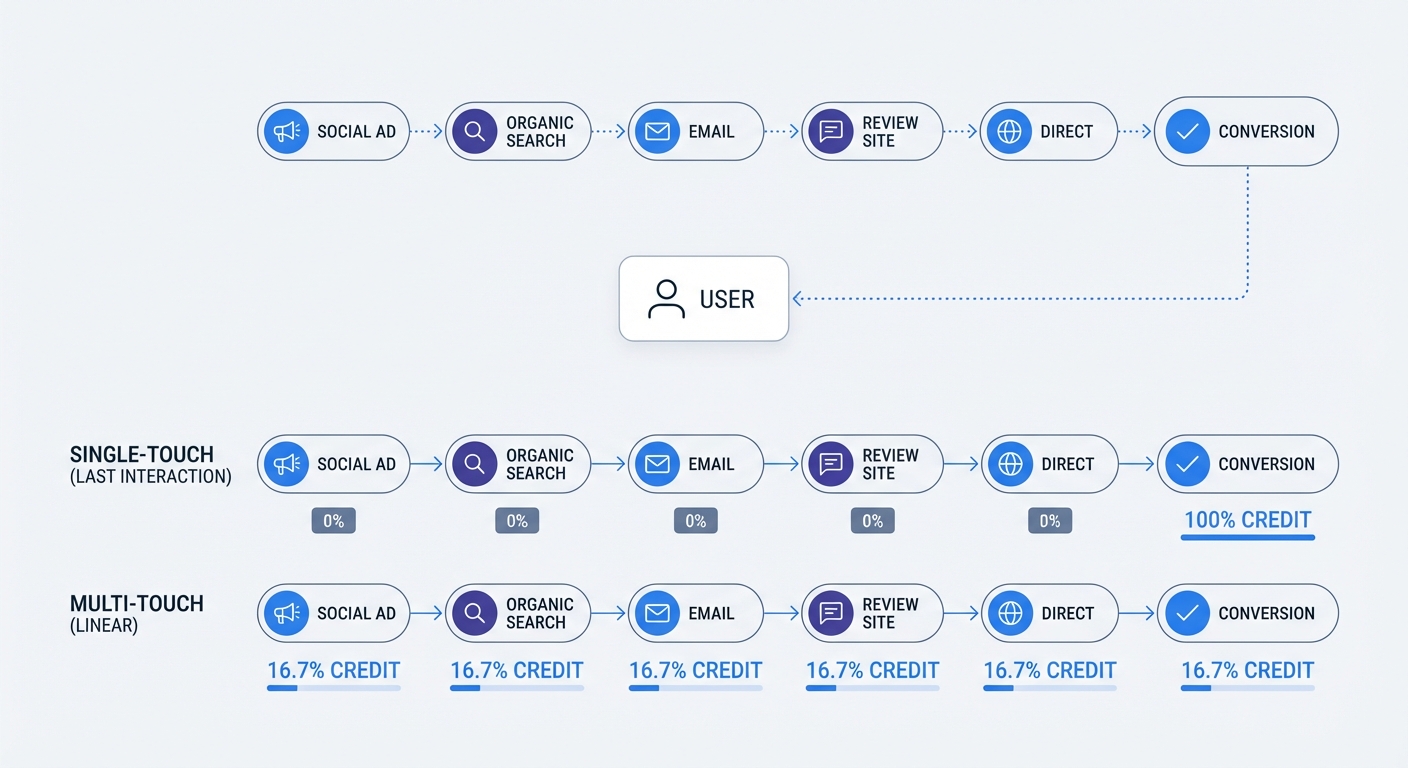
Buyers do not follow straight lines. A user might discover your brand through a LinkedIn post on their phone during a morning commute. They click a retargeting ad on their work laptop at noon. They convert via an email link on their tablet that evening. You must map these interactions to understand your return on ad spend.
You capture a referral header from the visitor's browser indicating the previous page as users land on your site. You combine this referral data with your own campaign tags to build a timeline of the user journey.
You fix your tracking gaps today by mapping your typical customer journey. Open a spreadsheet and list every place a potential customer encounters your brand. Group these into three columns: discovery, research, and conversion. Use this map to identify the specific touchpoints you fail to track.
The Business Case for Traffic Attribution
You base budget decisions on attribution data. If you spend $5,000 on Facebook ads and $5,000 on Google Search, you need to know which platform generates more revenue. You guess your marketing strategy without attribution data. You allocate your budget to the highest-performing channels when you track traffic sources.
You calculate your true Customer Acquisition Cost using attribution data. You sum your marketing expenses and divide by the number of attributed conversions for a specific channel. If you track offline events, you tie digital ad exposure to physical store visits using aggregated location data.
Audit your current reporting dashboard and identify the channel showing the highest conversion rate. Filter that channel's traffic by device type. You find a discrepancy between mobile clicks and desktop conversions. You use this discrepancy metric to highlight cross-device drop-off and identify friction points in your landing page experience.
Understanding Standard Attribution Models
Single-Touch vs. Multi-Touch Attribution
You assign 100 percent of the conversion credit to one specific interaction using single-touch models. You distribute the credit across the entire customer journey with multi-touch models.
Marketers adopt some form of attribution at 57 percent of companies, but 22 percent still rely on standard last-click tracking. These marketers ignore every prior effort when evaluating last-click setups. Industry analysts report 44 percent of advertisers find the default attribution in Google Analytics 4 insufficient for making budget allocation decisions.
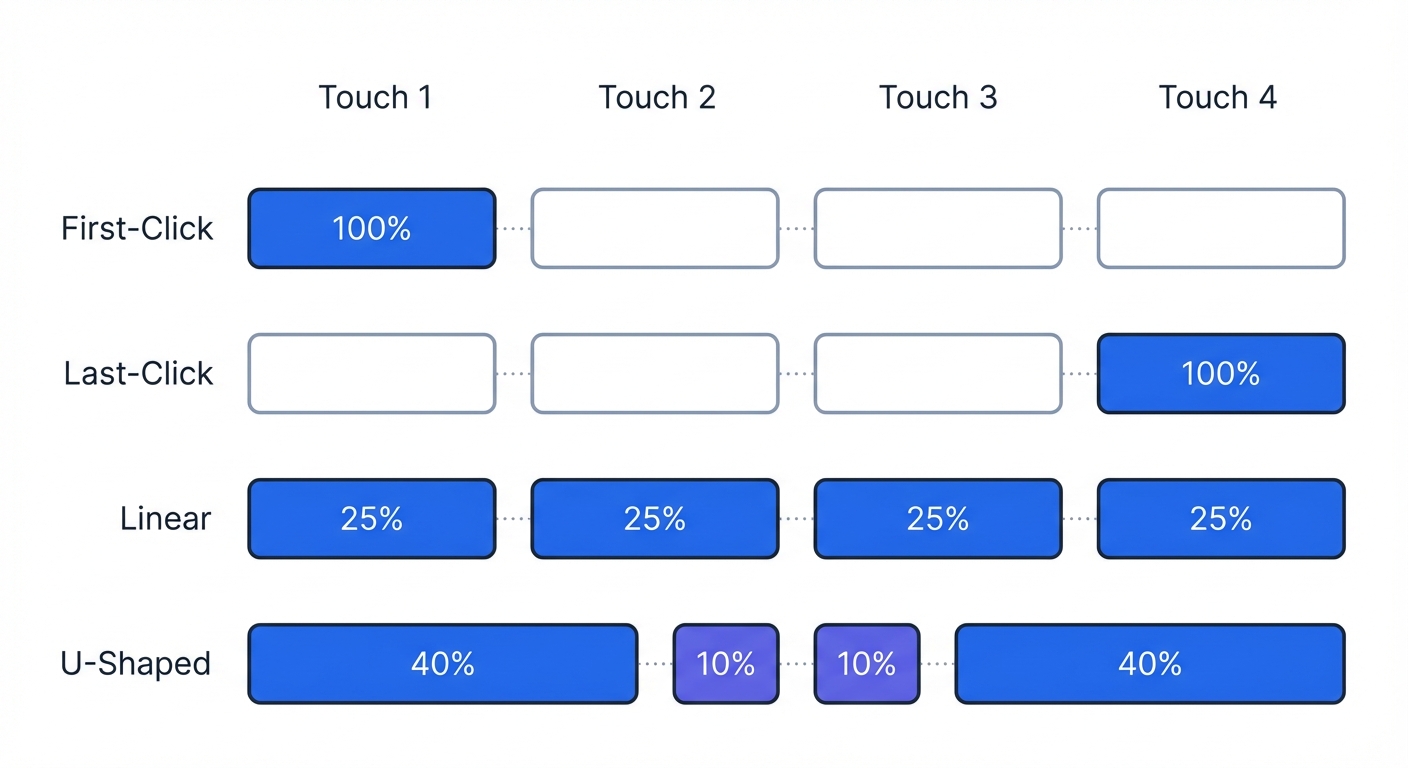
You must understand the distinct mechanics of the four primary models to assign value to your campaigns.
| Attribution Model | Credit Distribution | Best Use Case |
|---|---|---|
| First-Click | 100% to the first interaction | Evaluating top-of-funnel brand awareness and content marketing. |
| Last-Click | 100% to the final interaction | Measuring the effectiveness of direct-response ads and cart abandonment emails. |
| Linear | Equal credit to every touchpoint | Long sales cycles where constant brand engagement matters. |
| U-Shaped | 40% to first, 40% to last, 20% to middle | B2B lead generation where discovery and closing hold the most weight. |
Choosing the Right Model for Your Funnel
You select your model based on your business type and sales cycle length. E-commerce businesses with low-ticket items benefit from Last-Click models. The user sees a pair of shoes, clicks the ad, and buys them on the spot. You give the final click the credit for this impulse purchase.
B2B software companies require multi-touch models. A buyer might read a blog post, attend a webinar, and exchange emails with a sales rep over three months. You allocate proper credit to the attracting blog post and the closing email by implementing a U-Shaped model.
Log into your analytics platform and compare two different models. Pull a report showing your channel performance under a First-Click model. Pull the exact same date range under a Last-Click model. You spot channels that drive massive awareness but zero direct conversions. You keep funding those awareness channels to feed the top of your marketing funnel and generate future demand.
The GDPR Dilemma and The End of Cookies
Legacy Tracking Is Breaking
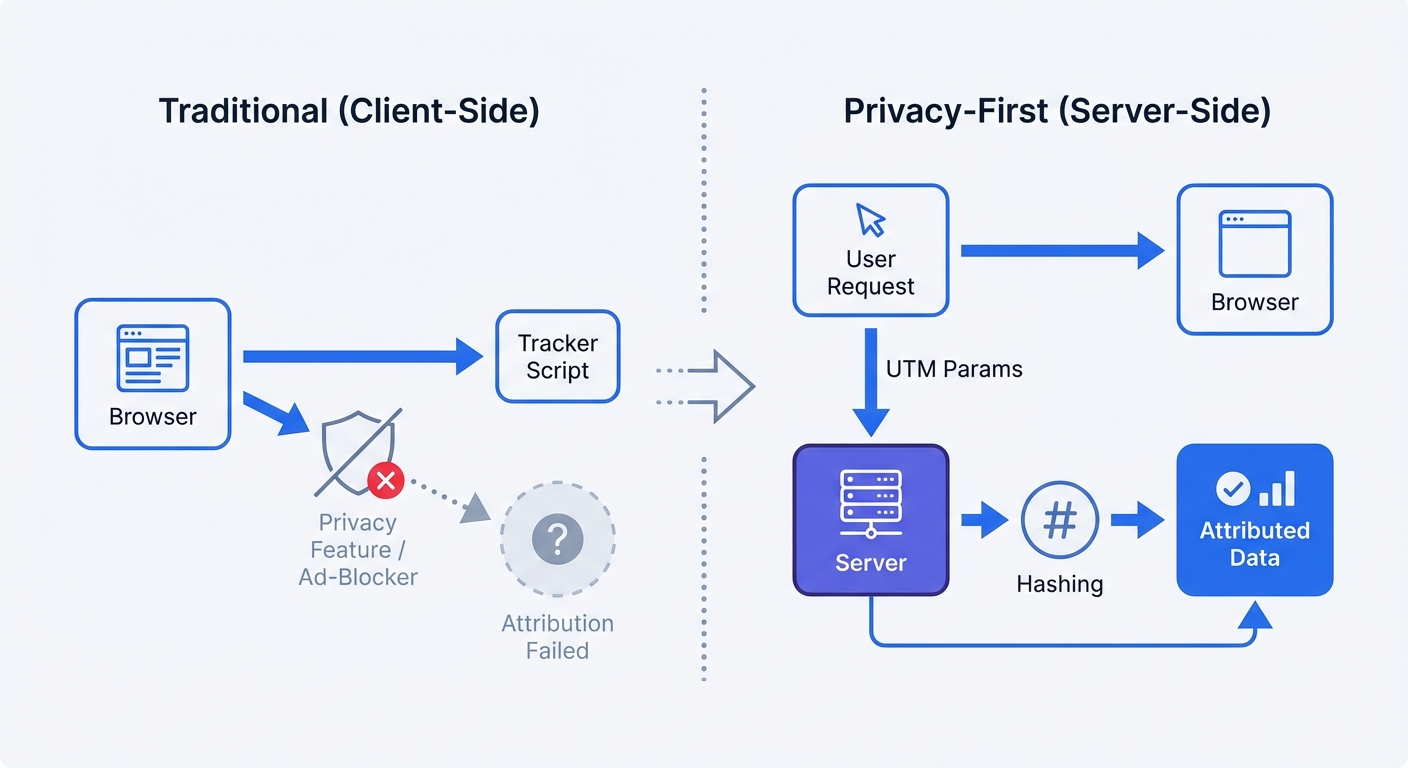
Traditional attribution platforms trace users across the internet using third-party cookies and tracking pixels. You place a piece of code on your site, and a platform like Meta or Google drops a cookie in the visitor's browser. The platform reads this cookie to record user activity.
This infrastructure is collapsing. Apple and Mozilla block third-party cookies by default. Apple forces apps to ask users for permission to track their activity. The connection severs after a user taps "Ask App Not to Track." You lose the ability to link an ad click on an iPhone to a website purchase.
You verify this signal loss yourself. Open your website in the Brave browser and click the shield icon in the address bar. You lose attribution data in legacy platforms for every blocked script you see listed in that menu.
The Rise of the Privacy Mandate
Consumers demand privacy. Over 75 percent of consumers view privacy as a human right. Legislators require you to obtain explicit consent before tracking users with cookies to enforce laws like GDPR, ePrivacy, and CCPA.
Traditional analytics tools go blind after a user clicks "Decline" on your cookie banner. You record a sale in your payment processor, but see zero traffic in your dashboard. You lose your attribution paths and return on ad spend metrics through this data loss.
You must transition to privacy-compliant tracking methods. Stop relying on cross-site tracking scripts. Audit your tech stack and remove tools that build persistent profiles of individual users across the web. You protect your business from compliance fines and build trust with your audience by respecting their tracking preferences.
Mastering Cookieless Traffic Attribution
UTM Parameters and Server-Side Tracking
You reclaim your data by using first-party tracking methods. UTM parameters stand as the gold standard for tracking marketing campaigns. A UTM parameter is a text string you append to a URL. The UTM data exists in the URL, forcing reliance on your own server logs. You bypass browser privacy restrictions by using UTM tags.
You structure your URLs with custom tags to tell your analytics platform specific details about the click. You use utm_source for the platform, utm_medium for the format, and utm_campaign for the promotion.
Format your links using a strict naming convention to prevent tracking errors. Never mix uppercase and lowercase letters. Your analytics tool splits the data into two distinct channels if one team member types "Facebook" and another types "facebook". Create a central spreadsheet for your marketing team. Require everyone to use a standard UTM generator before publishing any link.
You protect this first-party data by adopting server-side tracking. Traditional client-side setups force the user's browser to send data to your analytics provider. Users block this transmission by installing ad-blockers. With server-side tracking, the user's browser sends the event to your own cloud server. You forward the anonymized data from your server to your analytics platform. You bypass ad-blockers and maintain total control over the data payload through this architecture.
Set up a custom subdomain for your tracking. Route your scripts through metrics.yourwebsite.com instead of an external domain. You make your tracking a first-party request through this setup. You evade ad-blockers using first-party requests required for core website functionality.
Marketing Mix Modeling and Zero-Party Data
You pair your hard data with aggregate analysis. You evaluate broad historical data to attribute success using Marketing Mix Modeling. You analyze macro trends rather than tracking a single user from a YouTube ad to a checkout page. Track your total ad spend on YouTube for Q1. Observe the correlation between this spend and the corresponding increase in total direct traffic during that same period. You apply statistical regression to map this macro trend to your revenue lift.
You build a basic Marketing Mix Model in a spreadsheet. Create columns for weekly spend by channel, weekly website visitors, and weekly revenue. Update this sheet every Monday. Over six months, you spot clear correlations between specific channel investments and overall revenue growth. You avoid cookie blocking because this method ignores individual user tracking.
You fill the remaining attribution gaps with zero-party data. Customers volunteer zero-party data to your brand. You will see word of mouth, private Slack communities, and podcast mentions register as "Direct" traffic in your analytics dashboard. Marketers call this untraceable activity dark social.
You uncover dark social traffic by asking your customers. Add a required "How did you hear about us?" dropdown field to your checkout or signup form. Use a blank text box to capture specific sources rather than providing a pre-written list of generic options.
Implement this field on your registration page today. Review the submissions next week to discover podcasts, newsletters, and specific influencers driving traffic you previously miscategorized as direct visits.
Taking Control of Your Analytics Data
Escaping the Walled Gardens
You risk your budget when you rely on Meta and Google to grade their own homework. Meta and Google operate as walled gardens. They limit the data you can export and use attribution models designed to favor their own ad networks. Both platforms claim 100 percent of the conversion credit if a user views a Meta ad and clicks a Google Search ad an hour later.
You solve this double-counting problem by maintaining a neutral source of truth. You implement an independent, first-party analytics tool on your website. Your custom tool records the concrete touchpoints on your domain. You compare platform reports against your own server data to find the true cost of acquisition.
Export your conversion data from Meta and Google for the past 30 days. Sum the total conversions claimed by both platforms. Compare that number to the number of sales in your Stripe or Shopify account. The difference is your overlap. You run an independent analytics tool to attribute that overlap to the correct channel and save your ad spend.
The Privacy-First Future with Swetrix
You track your marketing performance without invading user privacy by adopting systems built for the post-cookie internet. You discard legacy tools that require massive cookie banners and alienate your website visitors.
We provide a privacy-focused alternative to Google Analytics at Swetrix. We use cookieless tracking mechanisms to capture accurate traffic data. We rely on referral headers, UTM parameters, and hashed session identifiers. This combination reveals which campaigns drive revenue.
We built Swetrix as an open-source platform to ensure you own your data. You collect accurate marketing attribution data without passing personal information to advertising conglomerates. We refuse to use your visitors' behavior to build cross-site profiles.
Deploy a privacy-first attribution setup today. Generate your UTM links, implement server-side tracking, and capture zero-party data at checkout. You route all this information into a dashboard that respects user privacy to make informed budget decisions.
Stop losing marketing data to ad-blockers and declined cookie banners. Start tracking your campaigns with accuracy and privacy compliance. Try Swetrix today with our 14-day free trial and take ownership of your web analytics.