- Date
What Is Cookieless Tracking? A Guide For Marketers
 Andrii Romasiun
A visitor lands on your website via an organic search. They dismiss the consent banner without clicking "Accept." Traditional analytics platforms ignore the visit, recording zero pageviews and zero time on site. The resulting flat dashboard hides incoming traffic.
Understanding What Is Cookieless Tracking
The Definition of Cookieless Tracking
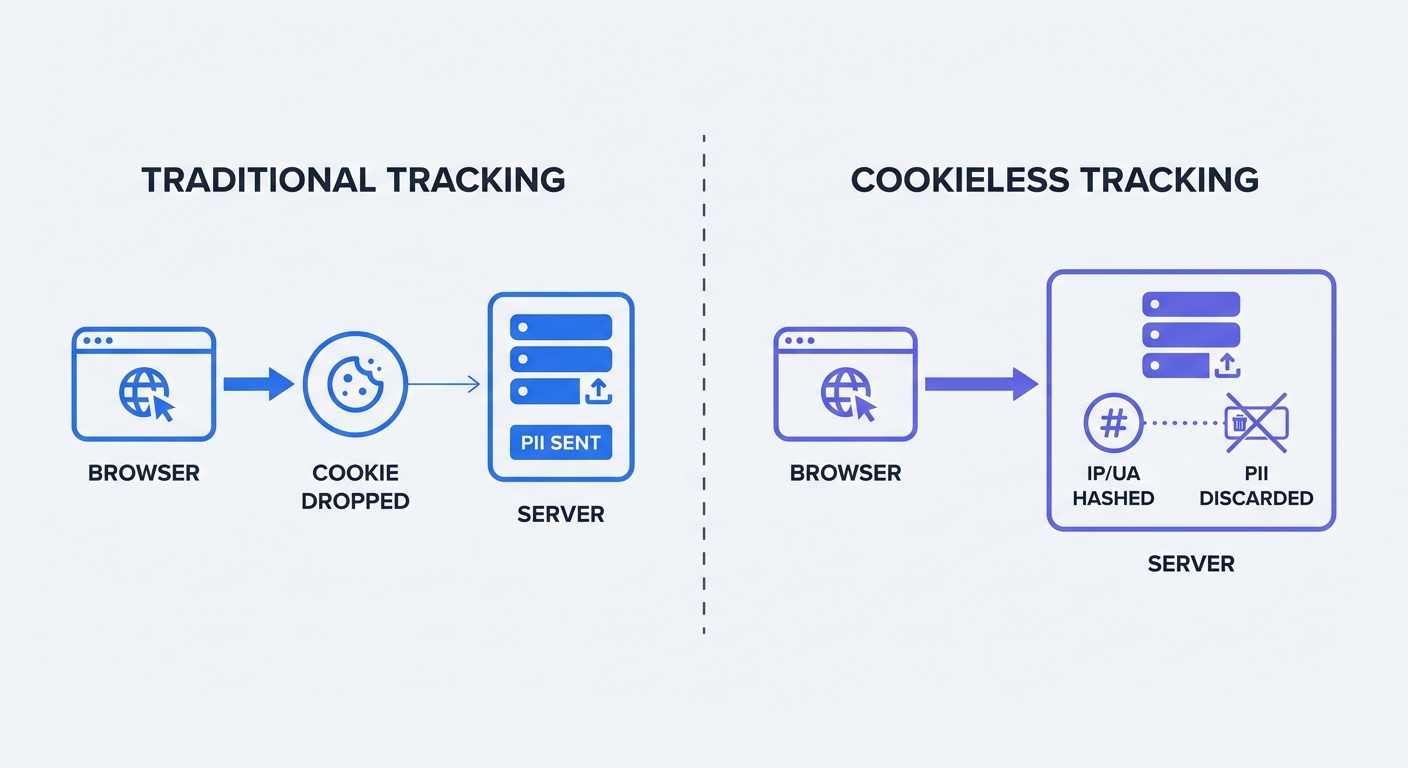
Cookieless tracking is the process of measuring website analytics and user behavior without placing text files on a visitor's local device. Platforms utilize server-side data, IP addresses, and User-Agent strings to register traffic volume. Because the system never stores an identifier on the hard drive, cross-site profiling becomes impossible. Marketing teams track the events occurring on the page rather than the individual browsing the internet.
Why Traditional Tracking Is Failing
Browsers block third-party cookies by default. Apple's Safari introduced Intelligent Tracking Prevention (ITP) in 2017, and Mozilla's Firefox followed with Enhanced Tracking Protection (ETP) in 2019. Chrome users install extensions to achieve the same result.
Global ad blocker adoption sits at 29.5% of internet users, though this metric varies by industry and content type, ranging from 15% for general lifestyle sites to over 40% for technical audiences. This consumer behavior wipes out an estimated $54 billion in global publisher revenue across varied content types.
Marketing departments feel the data loss. A 2023 Adobe benchmark report indicates that 49% of marketing strategies still depend on third-party cookies, while the rest transitioned to first-party data and secure server environments. More than one in three B2B and B2C marketers state that cookie deprecation damaged their ability to measure consumer engagement. Continuing to rely on legacy tracking scripts leads to incomplete reporting.
Audit your marketing stack to identify data leaks. List every tool requesting data from your site. Next, check the developer documentation for each platform to confirm whether it requires local storage or third-party cookies to register an event. Flag the tools failing under current browser restrictions.
How Cookieless Tracking Works
The Anonymization and Hashing Process
Secure analytics platforms use mathematical transformations to count visits without tracking individuals. The Swetrix methodology provides a clear technical blueprint for this process.
When a browser requests a webpage, your server receives standard communication signals. The IP address directs the response back to the user. The User-Agent string tells the server how to format the page for the specific device and browser version.
Storing raw IP addresses creates privacy liabilities. Hashing solves this problem through irreversible cryptography. The analytics system takes the raw IP and User-Agent, combining them with a cryptographic salt. A salt is a randomized string of text inserted into the data before the transformation occurs.
The system runs this combined string through a one-way function to output a secure hash. A raw IP address like 192.168.1.1 becomes an opaque identifier like a8f5f167f44f4964e6c998dee827110c.
A rotating salt ensures permanent anonymity. Session salts reset every 24 hours at UTC midnight, and profile salts reset every 30 days to facilitate basic monthly active user counts. The system deletes the raw IP and User-Agent the millisecond it generates the hash. Reversing the hash to expose the original user is impossible by mathematical design.
Server-Side Tracking Operations
Moving data collection from the browser to the server bypasses client-side restrictions. Standard client-side tracking fires a JavaScript pixel inside the user's browser environment. Ad blockers monitor this environment, intercepting network requests aimed at known analytics domains and terminating them.
Server-side tracking shifts the workload to your own infrastructure. The user's browser communicates with your web server. Your server logs the interaction before a backend process forwards the anonymized payload to the analytics endpoint.
Ad blockers target third-party domain requests originating from the browser. Because they cannot monitor backend server communications, the analytics payload reaches the destination intact.
Review server-side tracking feasibility with your engineering team. Ask for a resource estimate to migrate core conversion events off the client-side pixel. Compare the implementation cost against the value of recovering conversion data lost to ad blockers.
Cookieless Analytics vs. Traditional Analytics
The Consent Banner Dilemma
Privacy frameworks demand informed consent before a website interacts with a user's device storage. The General Data Protection Regulation (GDPR) in Europe and the California Consumer Privacy Act (CCPA) penalize unauthorized tracking. Legacy tools like Google Analytics write persistent IDs to local storage, meaning compliance requires a consent banner.
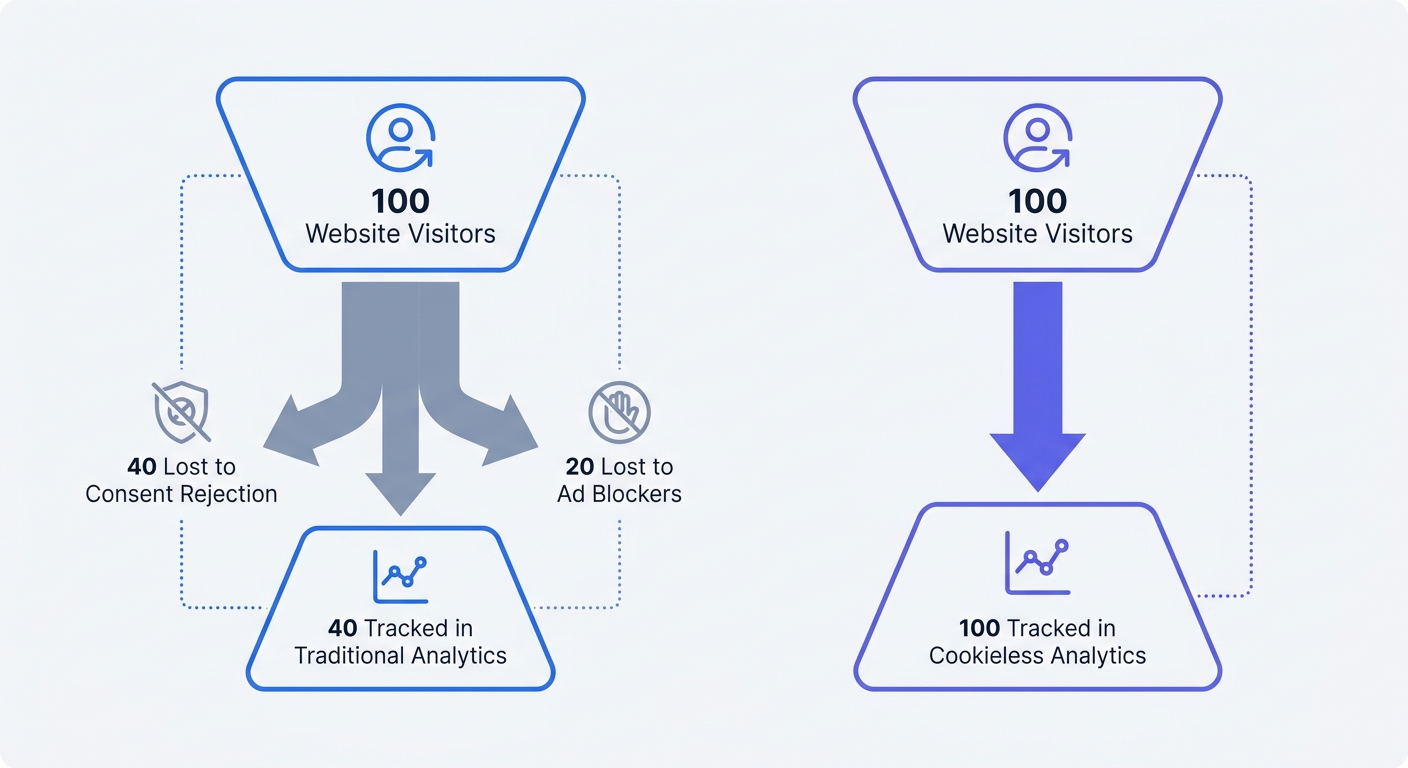
Consent banners destroy reporting accuracy. Visitors decline tracking, ignore the prompt, or close the tab. Traditional platforms drop these invisible sessions. A business reviewing traditional analytics reports makes decisions based on a fraction of overall user behavior.
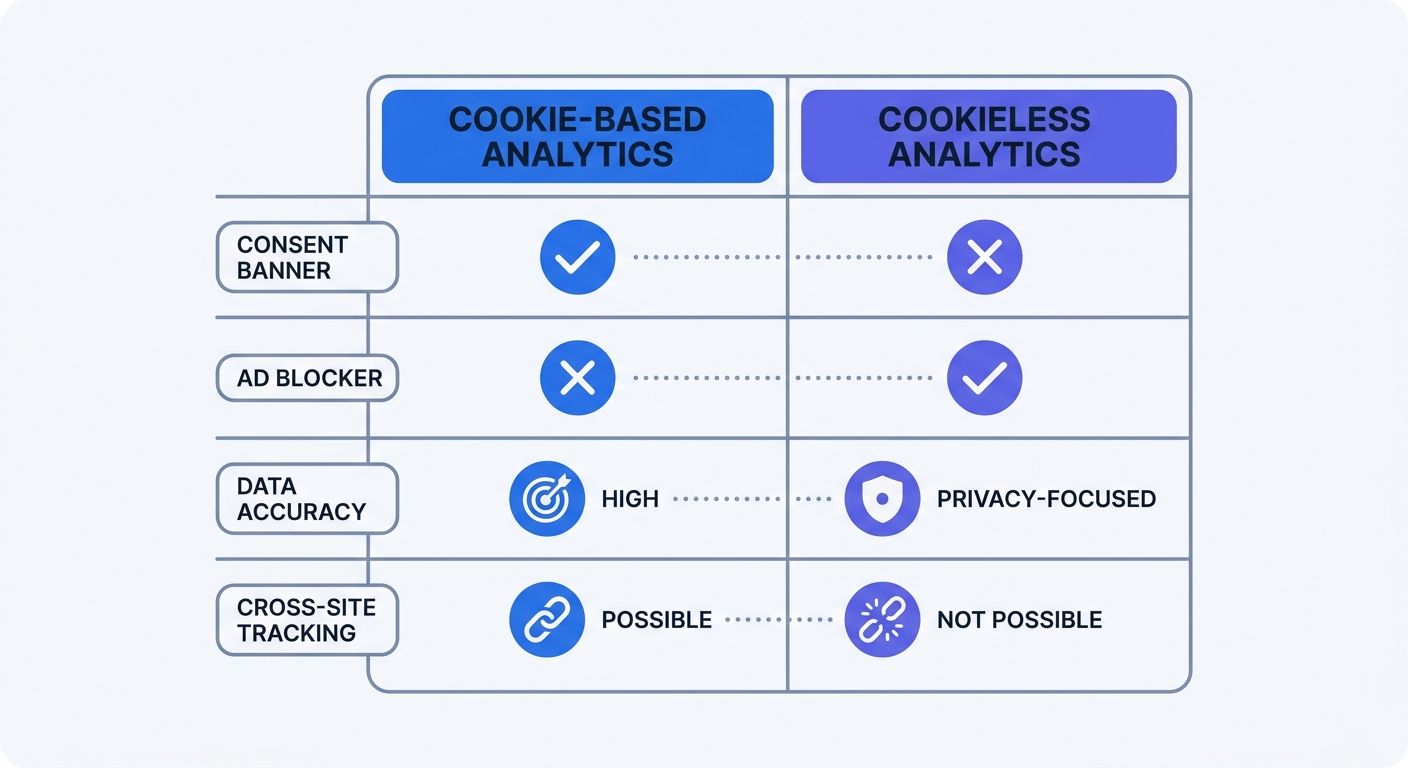
This direct comparison highlights the differences between the two approaches:
| Feature | Cookie-Based Analytics | Cookieless Analytics |
|---|---|---|
| Consent Banner | Mandatory under GDPR/CCPA | Not required |
| Ad Blocker Impact | High data loss | Zero data loss |
| Cross-Site Tracking | Yes | No |
| Data Ownership | Controlled by vendor | Owned by website host |
| User Privacy | Intrusive | Anonymous by design |
Solving the Dark Traffic Problem
Unlogged visits create dark traffic. A marketing team sees 500 clicks in the ad platform, but the analytics dashboard registers 300 sessions. The remaining 200 visits vanish into the gap between the ad click and banner interaction.
Privacy-first platforms eliminate this gap. They process aggregate data without touching local storage, generating session identifiers using temporary server signals. This alternative to Google Analytics bypasses the legal requirement for intrusive banners.
Removing the banner restores visibility. The platform logs every pageview and captures the referral source for every session. As a result, the marketing team can trust the conversion rate metric.
Calculate your dark traffic volume this week. Export your raw server access logs for the past 30 days, filtering out bot traffic. Count the total unique human requests for a specific landing page. Pull the corresponding pageviews report from your legacy analytics tool. Subtract the analytics count from the server log count to reveal your dark traffic volume.
The ROI of Privacy-First Tracking
Building Unbreakable Consumer Trust
Privacy compliance drives revenue. A Cisco benchmark study found that 94% of surveyed global organizations believe customers will refuse purchases if data remains unprotected. The same research indicates that privacy investments yield a 1.6x average return on investment across corporate sectors.
Visitors assess trust through site behavior. Intrusive retargeting ads erode confidence, and bulky tracking scripts bloat the codebase and delay rendering. Removing these elements improves the user experience.
Performance correlates with engagement. Stripping out legacy tracking tags reduces page load time. A site loading in one second retains visitors better than a site loading in four seconds. Cookieless tracking scripts weigh a fraction of traditional analytics bundles.
Turning Compliance Into an Advantage
Regulatory bodies issue severe fines for tracking violations. Relying on complex consent management platforms introduces technical risk. One misconfigured toggle exposes the business to penalties. Transitioning to an open-source web analytics platform mitigates this risk at the architectural level.
Data hygiene becomes a competitive moat. Competitors relying on broken cookie tracking optimize their campaigns using flawed data. Marketing teams using privacy-first platforms optimize based on complete traffic volume. Cost-per-acquisition metrics reflect the full scope of user activity.
Run a parallel tracking test. Deploy a cookieless analytics script alongside your existing setup. Let both systems collect data for one week. Open both dashboards on Friday. The privacy-first tool will display higher volume. Use this side-by-side comparison to build the business case for migration.
Frequently Asked Questions
Is Cookieless Tracking GDPR Compliant?
Yes. Cookieless tracking platforms achieve compliance through irreversible anonymization. They do not store Personal Data, instead applying rotating cryptographic salts to server signals. Generating a daily aggregate count does not require tracking a specific human across multiple domains. Because the software never accesses the user's hard drive, it satisfies strict privacy constraints.
How Do You Track Users Without Cookies?
Modern systems track page events instead of personal identities. They combine the inbound IP address and User-Agent string with a random salt to create a temporary hash. The platform uses this hash to bundle sequential pageviews into a single session. The salt rotates on a schedule, and the system resets the tracking context before the next day begins.
What Happens When Users Block Cookies?
Legacy tools drop the session. The user navigates your site, but the dashboard remains blank. Cookieless platforms ignore the browser's cookie preferences, relying instead on the HTTP request headers sent to the server. The ad blocker or privacy browser setting has zero impact on the tracking payload, ensuring the analytics platform logs the complete visit.
Draft a standard internal response document using these answers. Distribute it to your legal, IT, and marketing departments. Provide clear definitions to prevent confusion during security reviews.
Accurate data requires modern infrastructure. Stop losing significant portions of your traffic to ad blockers and declined consent prompts. Try Swetrix for free and capture 100% of your website analytics with an open-source, privacy-compliant platform.