- Date
Master Web Analytics For B2B Companies Without Cookies
 Andrii Romasiun
Standard analytics setups blind B2B marketing teams to a third of their pipeline. Because mandatory consent banners block data collection for every visitor who declines or ignores the prompt, standard Google Analytics 4 loses massive amounts of traffic data in strict regulatory environments, breaking attribution models and funnel math. B2B buying cycles stretch across months and involve multiple stakeholders reading whitepapers, watching demos, and leaving the site before returning weeks later. If the underlying infrastructure drops data every time a prospect denies consent, tracking platforms cannot map that complex journey. Implementing privacy-focused web analytics for b2b companies restores full visibility without violating laws. Switching to a cookieless solution like Swetrix captures 100 percent of top-of-funnel traffic legally while rebuilding trust with enterprise buyers.
Modern Web Analytics For B2B Companies
Why Traditional Tracking Is Failing
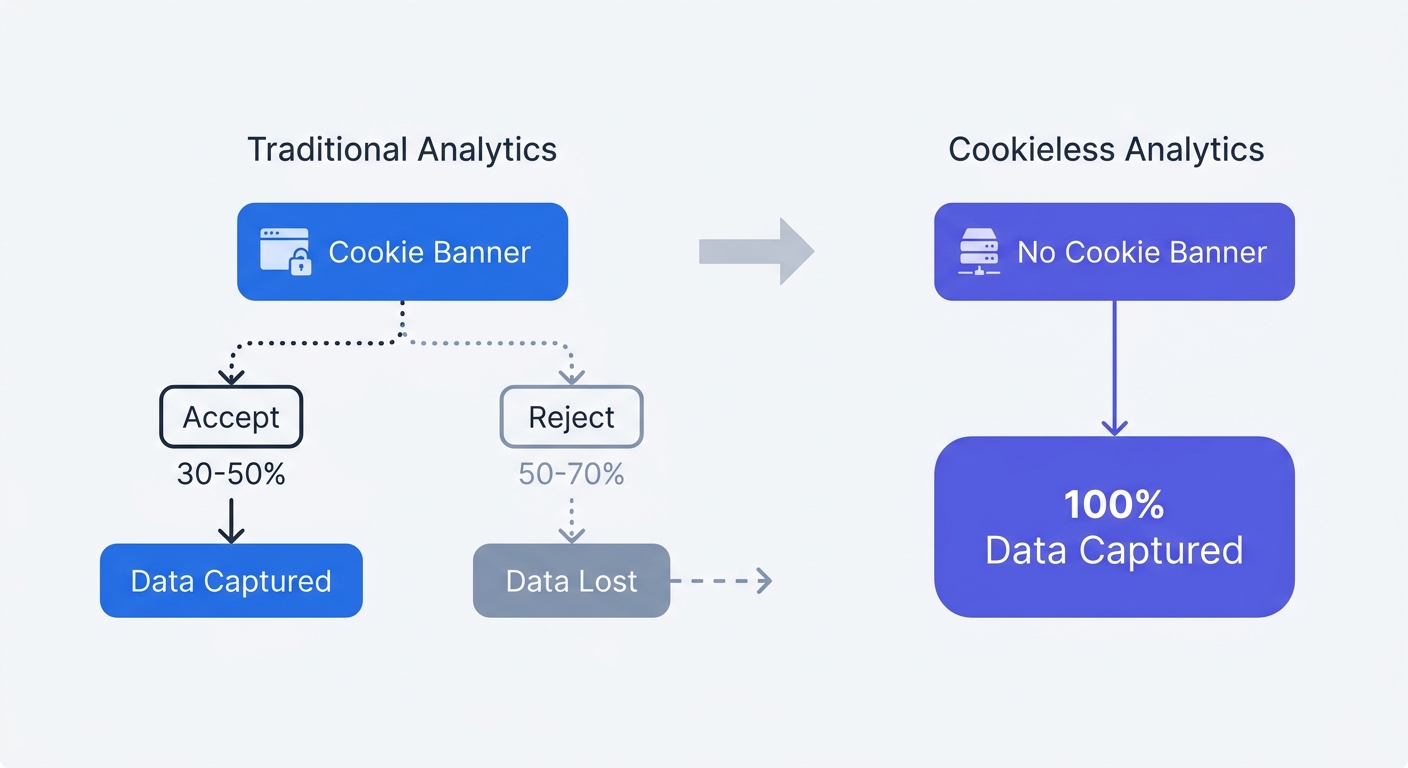
Historically, analytics platforms measured enterprise buying journeys by dropping a persistent cookie on a device and tracking that user across multiple sessions, but privacy regulations shattered that model. Because regulatory frameworks classify behavioral analytics cookies as non-essential files, websites cannot drop them on a browser without explicit prior consent. Consequently, cookie-based platforms lose massive amounts of traffic data when users decline consent, with data loss often spiking to 50 percent in strict regulatory regions.
When tracking systems lose half the top-of-funnel data, cost-per-acquisition metrics look artificially inflated. A paid campaign might drive two hundred highly qualified visitors to a landing page, but if most of those visitors reject the cookie banner, the dashboard only records fifty visits. This discrepancy causes teams to cut budgets for high-performing channels based on incomplete performance metrics. Furthermore, major browsers like Safari and Firefox block cross-site tracking by default, and Google is introducing user-level privacy controls in Chrome, making the technical infrastructure of the internet hostile to traditional cookies.
The Shift To Privacy-First Data
Restoring data accuracy requires abandoning persistent device-level tracking entirely. Instead of forcing visitors through an opt-in banner, modern B2B teams use first-party data collection methods. According to LinkedIn and Ipsos benchmark data, 94 percent of senior B2B marketing executives agree that trust drives modern marketing success, and organizations build that trust by refusing to stalk buyers across the web.
Swetrix tracks pageviews, referrers, and conversions using anonymous, rotating server-side hashes. The platform combines an IP address and a user-agent string into a cryptographic hash, creating a temporary identifier that resets every 24 hours. No persistent identifier gets stored on the user's device, and no personal data ever touches a database. This hash allows the system to distinguish between a single user clicking ten pages and ten users clicking one page each, keeping session metrics accurate. Because this process avoids storing information on the client device, it legally bypasses the requirement for a tracking consent banner.
Benchmarking Your Conversion Rates
Understanding Industry Averages
Improving a funnel requires defining a baseline metric. The median B2B website conversion rate sits at 2.9 percent, but site-wide averages hide specific performance gaps because context dictates the value of these numbers. For example, a B2B SaaS website averages between 1.1 and 2.5 percent visitor-to-lead conversion, while legal services frequently reach 7.4 percent, requiring teams to look past aggregate averages and focus on segment potential.
Top-performing SaaS companies consistently achieve 8 to 15 percent conversion rates on their demo request forms. The gap between the 2 percent average and the 15 percent ceiling represents massive revenue potential, so a demo page converting at the low end of that spectrum requires immediate optimization of the layout, copy, or traffic quality. To close this gap, deploy A/B tests on call-to-action buttons, shorten form fields to reduce friction, or clarify the value proposition above the fold.
Pipeline Drop-Offs Explained
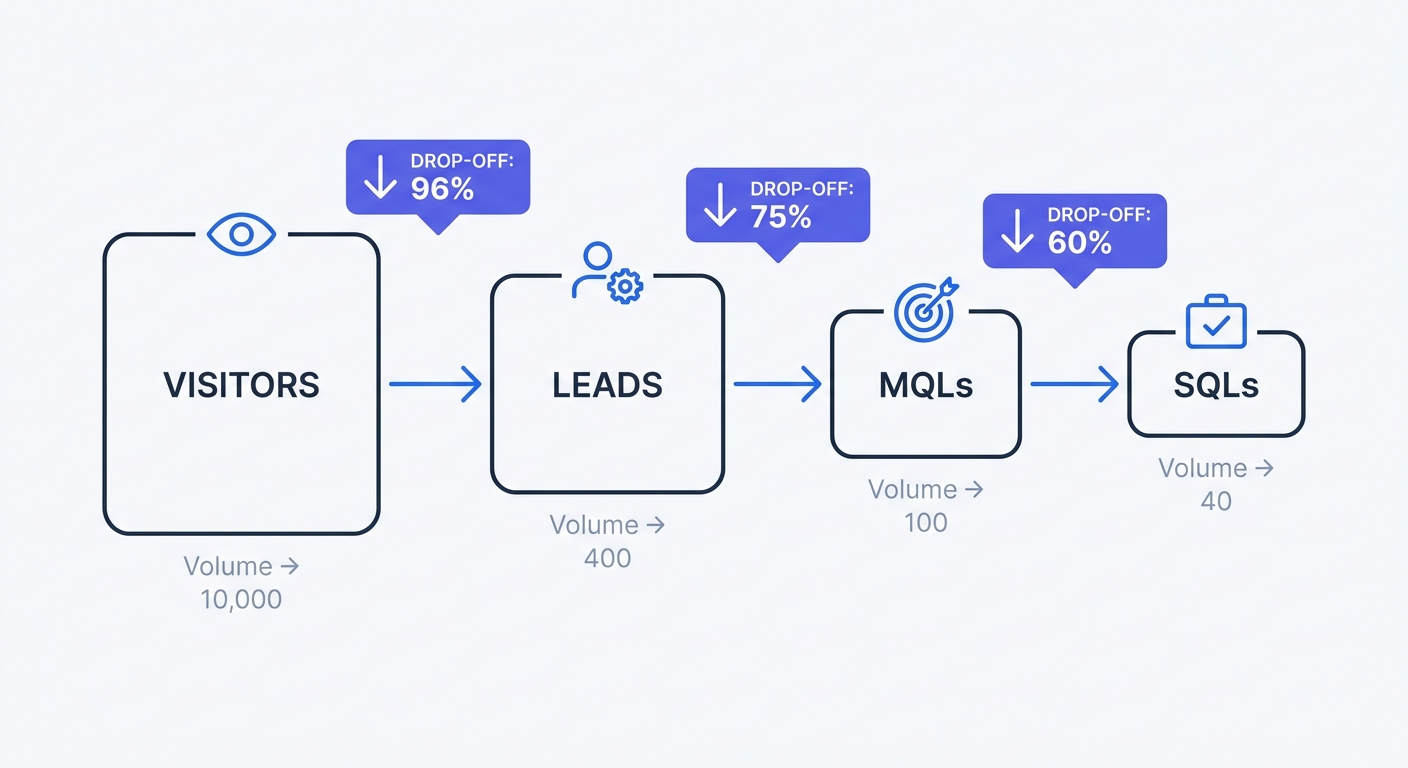
Website conversion is only the first step in a complex procurement cycle. Because B2B sales pipelines leak prospects at predictable stages, web analytics for b2b companies must map these transitions accurately. Market data indicates that an average pipeline converts 20 to 25 percent of Leads into Marketing Qualified Leads, then 12 to 18 percent of those MQLs into Sales Qualified Leads depending on the traffic source and industry.
To act on these conversion benchmarks, configure the analytics software to track specific pipeline stages by traffic source:
- Open the analytics platform and filter the dashboard by the highest-performing paid search campaign.
- Map the exact volume of visitors from that specific campaign who submitted a contact form.
- Export that cohort into the CRM to see how many passed the lead scoring criteria to become MQLs.
- Track how many of those MQLs successfully booked a meeting and transitioned to SQL status.
If a specific LinkedIn ad campaign generates a high visitor-to-lead rate but a near-zero MQL-to-SQL rate, the resulting traffic carries low purchase intent. Pause the spend on that campaign and reallocate the budget to organic search or direct partnerships that drive qualified pipeline.
Solving The Cookie Consent Crisis
Legal Requirements Versus Analytics
Cookie consent banners exist because legacy analytics tools forced marketing teams into a legal corner. Under GDPR, CCPA, and similar frameworks, any tool writing a persistent file to a user's browser to monitor behavior requires informed, proactive consent. Tracking cookies cannot fire before the user explicitly clicks the accept button, meaning native deployments of Google Analytics, Facebook Pixels, or HubSpot tracking scripts legally require a banner.
When users decline, those scripts remain blocked, causing a severe drop in reported traffic and blinding teams to site usage. These invisible visitors continue browsing pricing pages, downloading case studies, and reading blog posts while the marketing department receives zero credit for generating that engagement. Relying on consent-based tracking limits data collection to the preferences of people willing to click a banner rather than the behavior of the entire audience.
Safely Removing The Consent Banner
Auditing the tracking stack to eliminate unnecessary scripts allows organizations to legally remove the cookie banner, and transitioning the infrastructure to a privacy-first platform solves the data visibility issue permanently.
Follow this audit process to clear a site of tracking scripts:
- Open Google Chrome and navigate to the company homepage.
- Right-click anywhere on the page and select "Inspect" to open the developer tools.
- Click on the "Application" tab at the top of the developer panel.
- Expand the "Cookies" menu under the Storage section on the left sidebar and click the domain name.
- Clear the list, refresh the page without interacting with any banners, and document every cookie that appears automatically.
Seeing files labeled _ga, _gid, or _fbp indicates the site drops tracking cookies and requires a banner. Fix this compliance issue by removing those legacy tracking pixels from the tag manager and replacing them with server-side API integrations for advertising platforms. Next, swap the analytics provider to a cookieless tool like Swetrix, then verify that the content management system only uses strictly necessary functional cookies like portal login tokens or language preferences.
Once the infrastructure relies entirely on PII-free tracking, delete the consent management plugin from the website. Removing the banner upgrades the user experience by increasing page load speeds and eliminating text-blocking pop-ups on mobile devices, all while the analytics dashboard captures every single pageview.
Key Metrics B2B Marketers Must Track
Moving Beyond Vanity Metrics
Raw active user counts offer poor indications of account health or buyer intent. A massive spike in organic traffic provides little value if visitors bounce after ten seconds on a top-of-funnel blog post, requiring a shift away from surface-level volume toward interaction depth. Measuring how deeply a prospect or current client embeds product documentation into their daily workflow provides actionable retention data, as high interaction depth correlates directly with lower churn risk during renewal periods.
Audit analytics reporting dashboards to strip out vanity metrics, replacing total pageviews as the primary KPI with specific actions per user. Track micro-conversions that indicate evaluation behavior:
- PDF case study downloads from the resource center
- Clicks on pricing toggles switching between monthly and annual billing
- Time spent interacting with custom ROI calculators
- Video play rates and completion percentages on product demo embeds
- Outbound clicks to partner integrations or API documentation
Setting up custom events in Swetrix allows teams to measure these actions precisely. Adding a small Javascript function to site buttons pings the analytics server upon click, generating data that reveals which features drive interest and which pages confuse visitors.
Measuring Account-Level Engagement
Because B2B purchases happen by committee, a single enterprise software deal might involve a technical evaluator checking the API, a financial approver reading the pricing tier, and an executive sponsor skimming a case study. Analytics configurations tracking only individual, isolated sessions will miss the broader account activity happening across the domain.
Configure the analytics setup to recognize aggregate engagement from specific company networks. This approach, known as Account-Based Marketing analytics, shifts the focus from the user to the organization by sending custom events from the application backend when a user logs in. Pass an anonymized account or workspace ID instead of a personal email address to group these events, showing whether an entire department is adopting the software or a single champion is evaluating it alone. Seeing interaction depth drop across an entire account ID allows teams to trigger a CRM alert, prompting customer success intervention before the renewal conversation happens.
Building A Modern Analytics Stack
Choosing Privacy-First Platforms
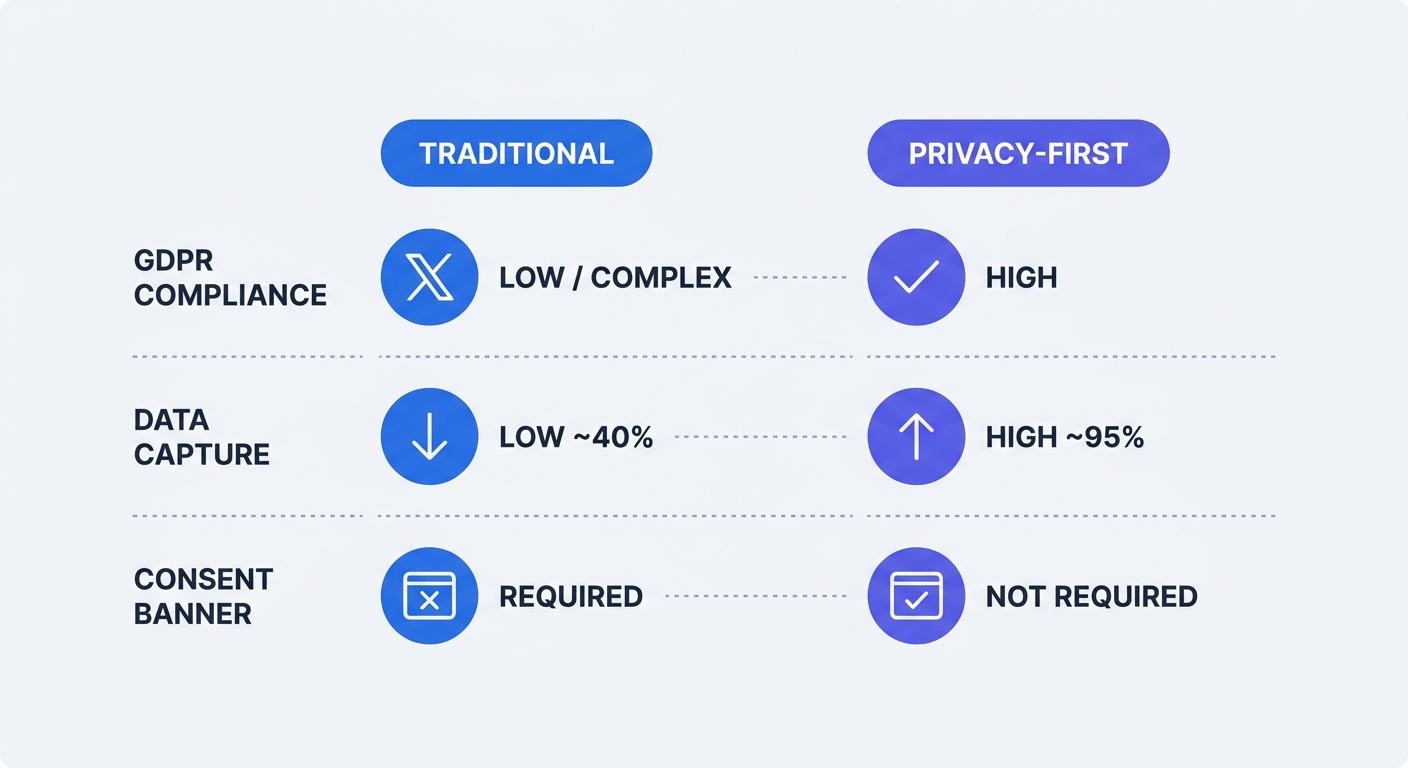
Underlying infrastructure dictates data quality, and transitioning to a privacy-focused architecture future-proofs marketing operations against aggressive browser updates and shifting international privacy laws. Sixty-seven percent of B2B companies now use server-side tracking, driving a 41 percent improvement in data reliability across their organizations.
When selecting a platform, prioritize data ownership and regulatory compliance. Swetrix provides a robust solution for web analytics for b2b companies, offering comprehensive coverage and functionality. As a fully open-source platform, Swetrix supports self-hosting the entire infrastructure on internal hardware, guaranteeing that proprietary traffic data never touches third-party servers.
The managed Swetrix Cloud tier operates exclusively on EU-based servers, ensuring default GDPR compliance without complex configuration. Because the platform includes built-in website performance monitoring alongside marketing data, engineering teams can monitor page load speeds and Javascript errors in the same dashboard used to track campaign conversions. Current public pricing starts at $19 per month for 100,000 events, delivering enterprise-grade visibility without hidden fees.
| Feature | Traditional Analytics | Privacy-First Analytics (Swetrix) |
|---|---|---|
| Cookie Banner Required | Yes | No |
| Data Capture Percentage | ~65-75% | 100% |
| GDPR Compliant by Default | No | Yes |
| Server-Side Event Tracking | Complex external setup | Native built-in support |
| Open-Source Self-Hosting | No | Yes |
Integrating AI And Attribution
Modern B2B analytics stacks increasingly rely on artificial intelligence to process complex campaign data and map multi-touch journeys, but these initiatives often fail to deliver actionable insights because of poor data quality. Feeding an AI attribution model heavily fragmented, banner-blocked analytics prevents accurate pipeline forecasting, as algorithms trained on missing data output flawed budget recommendations.
Fixing the data foundation must precede purchasing expensive AI attribution software. Shift the tracking strategy to prioritize first-party data capture by incentivizing buyers to share their information directly through gated, high-value assets rather than inferring identity via third-party data brokers. Standardize URL tracking by appending UTM parameters to every outbound link in emails, social posts, and paid ads.
Combining strict UTM tagging with complete data capture from a cookieless platform feeds clean, reliable inputs into reporting tools. The resulting dashboards reveal exactly which channels generate revenue, which campaigns drive top-of-funnel awareness, and where prospects stall in the funnel. Building an analytics stack on a foundation of complete, legally compliant data allows organizations to scale marketing spend securely.
Stop losing a third of your marketing data to cookie consent banners. Swetrix provides full traffic visibility, custom event tracking, and performance monitoring in one privacy-compliant, open-source dashboard. Start a 14-day free trial today to track complete buyer journeys legally.