- Date
Self Hosted Vs Cloud Web Analytics: Choosing The Right Setup
 Andrii Romasiun
172 countries enforce data protection laws as of 2026, and European regulators handed down over €7.1 billion in GDPR fines between 2018 and mid-2026. Standard tracking scripts send user data across borders, forcing you to display massive cookie banners. Since half of all visitors click reject depending on the industry, your conversion data vanishes. Choosing between self hosted vs cloud web analytics dictates how much data you retain and how secure your infrastructure remains. Swetrix solves this data blind spot with a privacy-first, cookieless platform available as a managed cloud service or a self-hosted open-source application.
The Privacy Shift Transforming Digital Analytics
Relying on invasive tracking cookies creates an administrative nightmare. Organizations spend hours configuring consent management platforms to block scripts until a visitor opts in. This approach destroys attribution models.
The Rising Cost of Non-Compliance
Governments penalize unauthorized data collection with massive financial penalties. Beyond regulatory fines, non-compliance alienates your customer base. Visitors abandon websites forcing them through complex consent menus before they can read an article or browse a catalog.
Investing in privacy infrastructure protects your revenue. Studies show that 96 percent of organizations report a positive return on privacy investments. Building a compliant stack requires abandoning platforms hoarding personal identifiable information. Modern setups use anonymized, temporary hashes to group page views into sessions without storing IP addresses or tracking users across the web.
Audit your current analytics platform to identify compliance risks by checking your tracking provider's data retention documentation. If the platform stores full IP addresses or sets persistent tracking identifiers in local storage, your site requires a cookie banner. Deploying a Google Analytics alternative eliminates this requirement and removes the consent banner from the user experience.
How Consent Banners Destroy Data Visibility
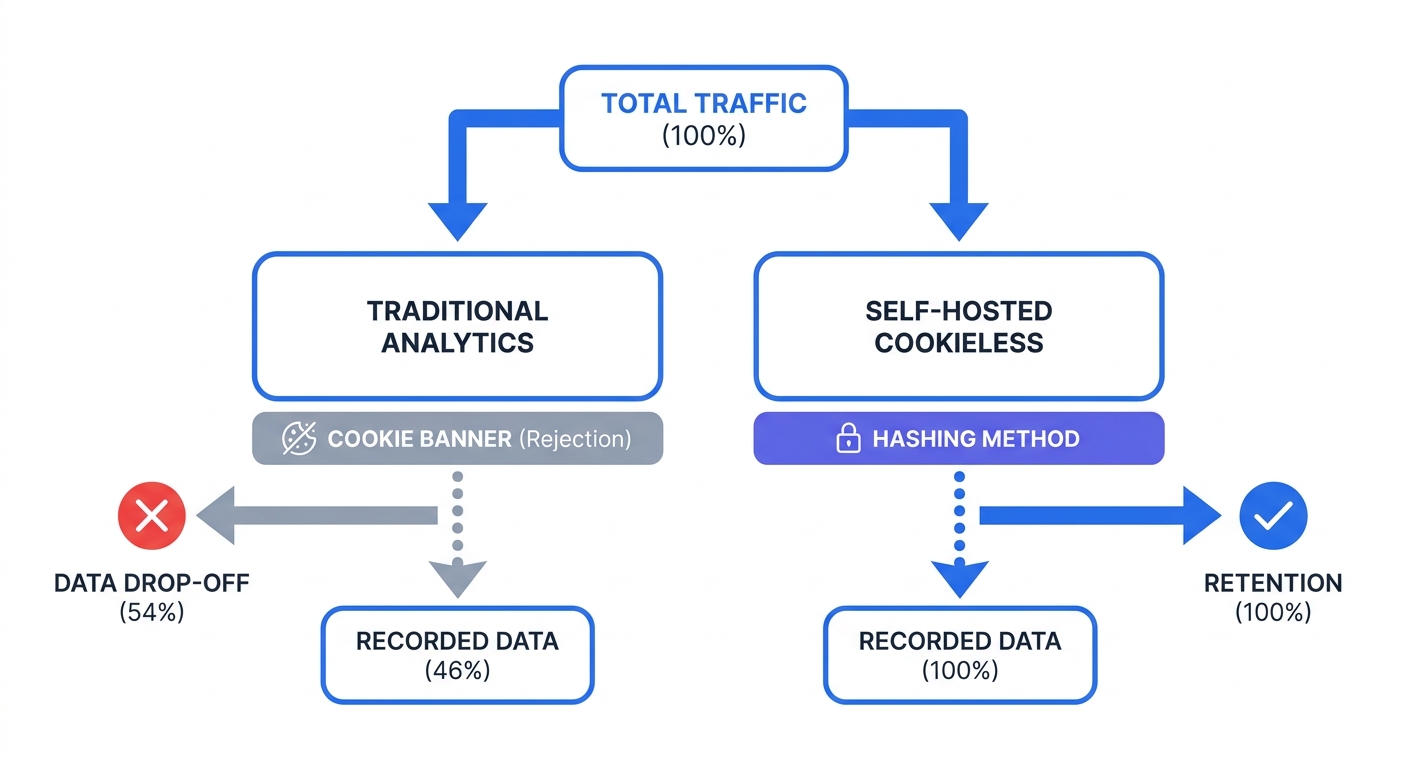
Cookie banners destroy data visibility. Average consent rates in the European Union vary significantly by country and industry, but they often hover below 50 percent. More than half of your visitors decline tracking when presented with a strict, compliant banner.
When a user rejects cookies, legacy platforms stop recording their behavior. A customer might click a paid search ad, browse three product pages, and make a $500 purchase. If they declined cookies, that revenue appears as direct traffic or vanishes from reports. Marketing teams end up optimizing campaigns based on fragmented datasets, pausing profitable ad sets because the platform failed to attribute the conversions.
Compare your internal sales data against your analytics dashboard to measure this impact. Pull the total number of processed orders from your backend database for the last 30 days. Next, check the total conversions reported in your web analytics tool for the same period. The gap between those two numbers reveals the cost of cookie-based tracking. Transitioning to a cookieless platform recovers this lost attribution data.
Decoding Self Hosted Vs Cloud Web Analytics
Infrastructure defines your data sovereignty. The location of your analytics software determines who controls the underlying database. System administrators must document the location of user data to satisfy modern procurement policies.
How Cloud Analytics Works
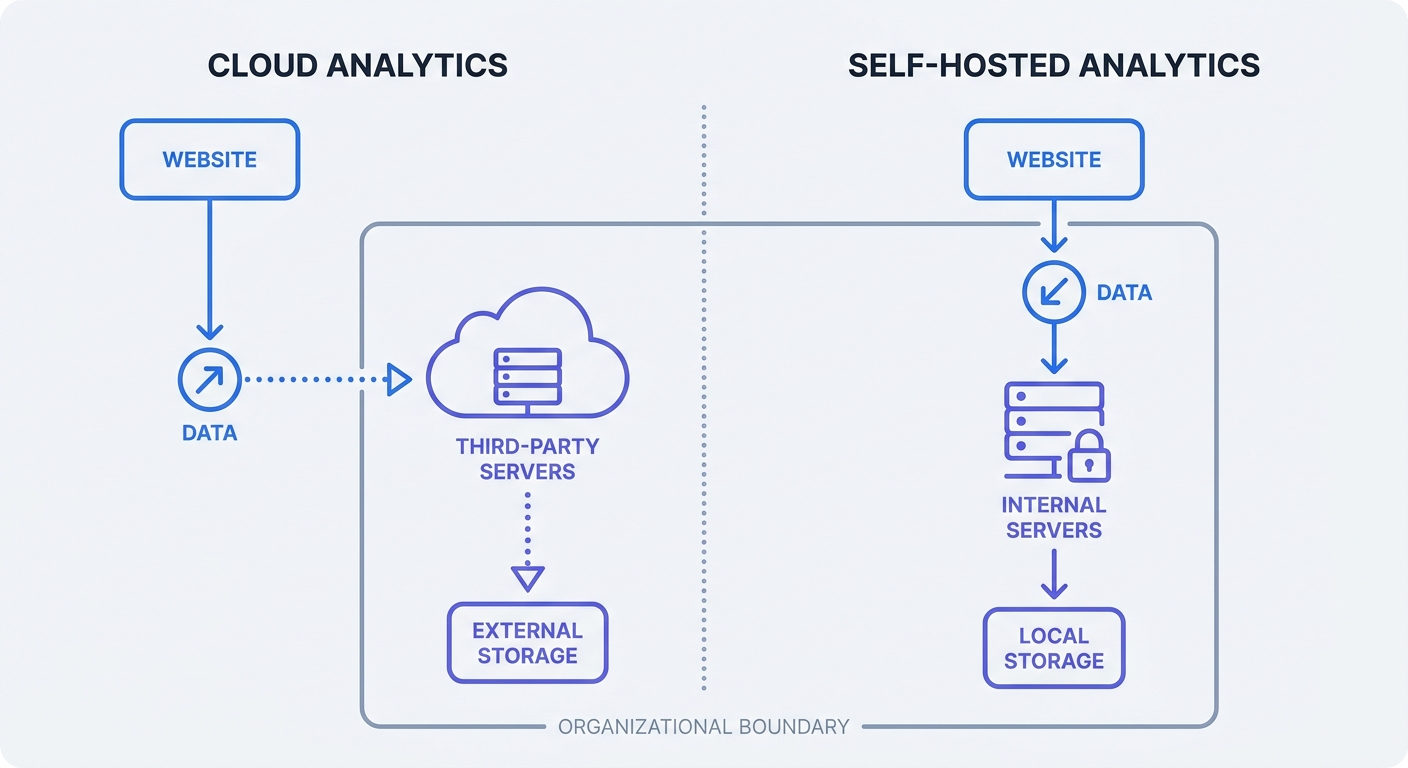
Cloud analytics providers host tracking scripts and databases on their own servers. Developers paste a snippet of JavaScript into the website header. This script fires on every page load and sends visitor information to the provider's infrastructure.
Legacy giants dominate the traffic analysis tools market using this model. They process data in the United States. European data protection authorities flag these cross-border transfers as a violation of user privacy. Storing EU citizen data on foreign servers exposes companies to government surveillance requests outside GDPR jurisdiction.
Privacy-first cloud alternatives fix the jurisdiction problem. Platforms like Swetrix Cloud host their infrastructure within the European Union. We process data on servers located in Germany to maintain adherence to local regulations. Customers gain the convenience of a managed software service without the regulatory headache of cross-border data transfers.
Map out where your current analytics data resides. Check your provider's terms of service and locate their data processing addendum. Escalate the finding to your compliance officer if the document lists server facilities outside your primary operating region.
The Case for Self-Hosting Your Data
Self-hosting provides complete ownership of the application stack. Engineering teams install the tracking software on internal servers, manage the database, and process all information within private network boundaries. Data never leaves company infrastructure.
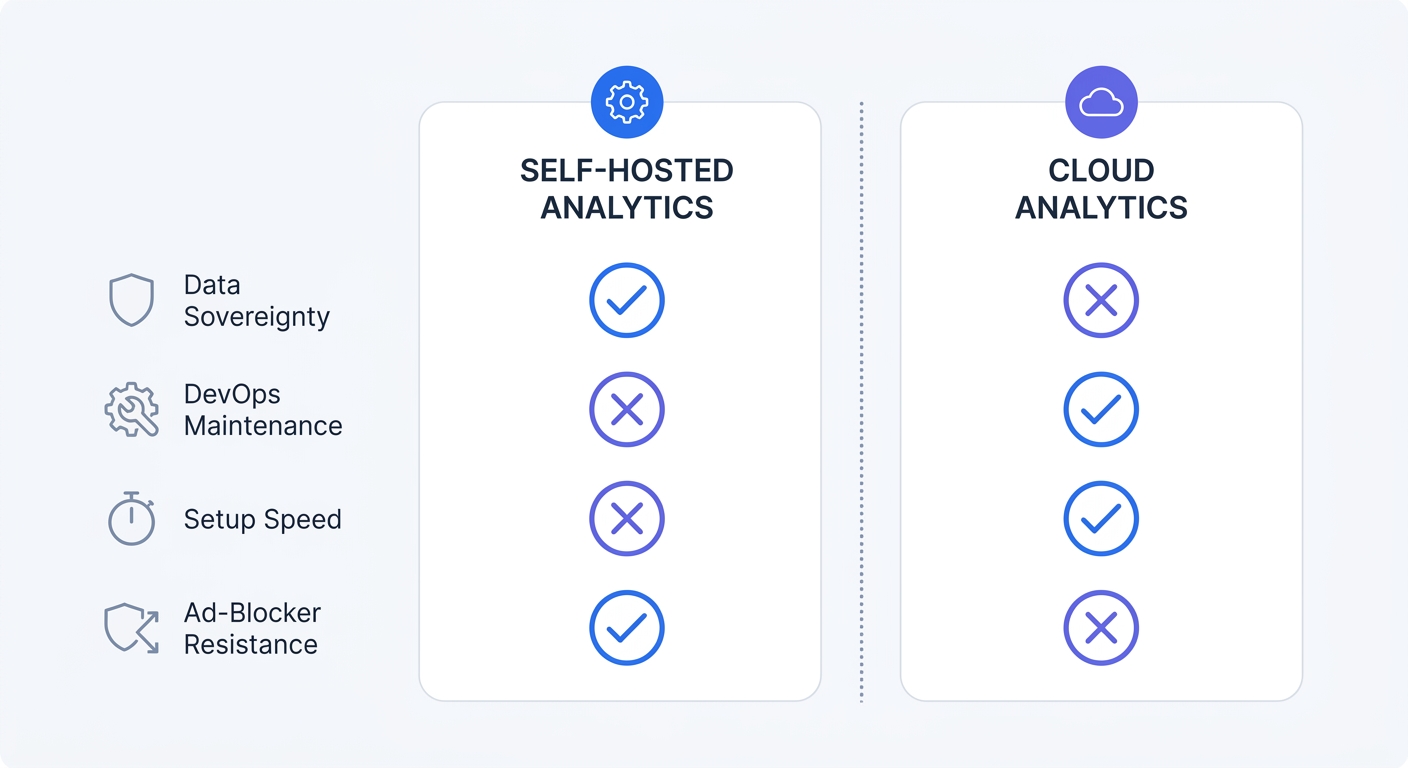
Banks, healthcare providers, and government agencies use self-hosted setups to satisfy internal compliance rules. When an auditor asks who has access to the tracking data, companies point to their DevOps team. Third-party vendors lack access to visitor metrics. Internal teams dictate the update schedule, testing new versions of the software in a staging environment before pushing them to production.
Deploying on dedicated hardware requires technical expertise. System administrators assume responsibility for uptime, security patches, and database scaling. When a viral blog post sends 50,000 concurrent visitors to a site, the server must handle the sudden influx of tracking requests. Open-source platforms package their applications into Docker containers to simplify this deployment process.
Review your team's engineering bandwidth before choosing this path. Ask your systems administrator if they have capacity to manage another PostgreSQL database and configure Redis caching layers. A managed EU-based cloud remains the safer option if the team lacks hours for routine maintenance.
Calculating The True Cost Of Ownership
Price comparisons between hosted and managed solutions ignore operational overhead. Free software licenses do not equal free operations. Procurement teams must factor in compute time, storage, and human capital.
Hidden Fees in Self-Hosted Setups
Open-source analytics platforms cost zero dollars to download. Running them in production requires ongoing capital expenditure. A reliable self-hosted environment demands multiple infrastructure components.
Application servers process incoming requests. Database servers store historical metrics. Object storage maintains automated backups. As traffic grows, network engineers must provision load balancers and caching layers to prevent the tracking script from slowing down the website.
A basic AWS deployment for medium traffic requires specific resources:
- Application Server (EC2 t3.medium): $30 per month
- Managed Database (RDS PostgreSQL): $50 per month
- Load Balancer (ALB): $16 per month
- Backup Storage (S3): $5 per month
The hard costs total $100 per month. Human costs dwarf the infrastructure bills. A DevOps engineer spends three hours per month monitoring disk space, applying security patches, and testing database restores. Factoring in their hourly rate, a free analytics platform costs thousands of dollars a year to maintain.
Calculate your projected infrastructure costs before provisioning servers. Check your current monthly page views. Map out the required CPU and RAM specifications to process that event volume based on the open-source repository's documentation. Multiply those hardware specifications by your cloud provider's pricing sheet to find your baseline cost.
Predictable Pricing With Privacy-First Clouds
Managed cloud solutions trade operational burden for a fixed monthly fee. The vendor handles server scaling, database maintenance, and security updates. Engineering teams stay focused on building the core product.
Swetrix Cloud offers predictable pricing based on event volume. The standard tier starts at $19 per month for up to 100,000 events, covering page views, custom events, and performance monitoring data. We omit an ongoing free cloud tier. We charge a fair price to maintain high-performance EU servers and guarantee your data remains unsold to advertisers. Customers test the platform via a 14-day free trial.
For teams with strict compliance needs or tight budgets, Swetrix maintains a free self-hosted Community Edition. System administrators pull our official Docker image and spin up the platform on internal infrastructure. Companies gain the same privacy-first tracking technology without the monthly subscription fee by handling the hosting.
Evaluate your traffic volume to determine the most cost-effective path. Processing 500,000 events a month on a managed cloud plan costs a fraction of the DevOps time required to maintain a self-hosted database at that scale.
Bypassing Ad Blockers and Tracking AI Traffic
Browser extensions block standard analytics scripts by referencing enormous blacklists. Ad blockers identify the domains of popular tracking providers and stop their JavaScript from executing, creating a massive hole in your reporting data.
Defeating Ad Blockers With First-Party Data
Technology enthusiasts and enterprise networks run strict ad blockers. For websites selling developer tools or B2B software, up to 40 percent of visitors block standard analytics scripts.
Self-hosted analytics bypass these filters. Because the script loads from a custom domain (e.g., analytics.yourcompany.com), the browser treats it as a first-party asset. The ad blocker sees a request communicating with the same domain the user requested and allows the script to run. Marketing teams capture accurate behavior data without violating privacy or employing malicious evasion tactics.
Cloud setups achieve this same resilience through reverse proxies. Developers configure the web server to route tracking requests through the primary domain before forwarding them to the analytics provider.
Set up a reverse proxy using Nginx or Cloudflare. A custom rule takes requests hitting yourdomain.com/metrics and forwards them to the Swetrix tracking API. After updating the website header to load the script from the new first-party endpoint, this configuration restores visibility into technical audience segments.
Fixing The AI Traffic Attribution Blind Spot
Search behavior demands new tracking strategies. Users ask ChatGPT or Perplexity a question instead of typing keywords into a search engine. These generative AI tools scrape websites and serve answers with footnote citations.
When a user clicks one of those citations, they arrive on your site. Legacy analytics tools struggle to attribute this traffic because AI chatbots strip referrer headers or use obscure user agents. A visitor arriving from a ChatGPT prompt shows up in your dashboard as an unexplained direct visit. Marketing teams cannot measure the return on investment of content marketing if organic traffic lacks a source label.
First-party tracking infrastructure captures cleaner request headers. By deploying cookieless tracking for AI search traffic, developers configure custom event listeners to identify AI bot signatures.
Review your referrer logs to identify missing AI attribution. Filtering the analytics dashboard for the past 90 days reveals spikes in "direct" traffic landing on long-form blog content. Configure your tracking script to parse specific AI user agents and categorize them as a new "AI Search" medium in acquisition reports.
How To Choose The Right Analytics Architecture
Switching analytics platforms requires careful planning. Companies risk breaking existing dashboards or losing historical context. Architecting the migration prevents missing data during the transition.
Best Privacy-First Analytics Platforms
Selecting the right tool depends on feature requirements. Basic pageview counters fail when tracking complex user flows, while heavy enterprise platforms slow down website performance. Organizations need a platform balancing privacy with actionable marketing data.
| Feature | Swetrix | Matomo | Plausible | Umami |
|---|---|---|---|---|
| Primary Focus | Privacy, Performance, Custom Events | Complex Enterprise Analytics | Minimalist Pageviews | Lightweight Tracking |
| Deployment | Cloud & Self-Hosted | Cloud & Self-Hosted | Cloud & Self-Hosted | Cloud & Self-Hosted |
| Pricing Model | $19/mo (Cloud) / Free (Self-Hosted) | High tier Cloud / Free (Self-Hosted) | Tiered Cloud / Self-Hosted | Tiered Cloud / Self-Hosted |
| Performance Monitoring | Built-in (Web Vitals) | Requires Plugins | No | No |
| Error Tracking | Built-in | No | No | No |
| Cookieless by Default | Yes | Configurable | Yes | Yes |
Swetrix bundles user behavior analytics with technical monitoring. Marketing teams view acquisition and campaign data to optimize ad spend. Engineering teams review real-time core web vitals and JavaScript error tracking in the same dashboard. Developers reduce script bloat by replacing three separate monitoring tools with one lightweight snippet.
A Step-by-Step Migration Plan
Do not delete your legacy analytics tool on day one. Perform a phased migration to validate data accuracy and build trust in the new platform.
Start by deploying temporary hashes alongside the current setup. Keep the existing platform running. Create an account with a cookieless provider. Paste the new tracking snippet into the website header below the legacy tags to record traffic in both systems.
Let the parallel setup run for two weeks. Compare the session numbers, bounce rates, and conversion events between the two dashboards. The cookieless platform records more sessions because it captures the traffic rejecting the cookie banner. Use this data discrepancy to secure stakeholder buy-in for the final switch.
Next, rebuild custom event tracking. Map button clicks, form submissions, and purchase triggers to the new platform's syntax. Use UTM parameters on active marketing campaigns to ensure the new tool attributes revenue.
Finally, remove the legacy tracking script and delete the cookie banner. Inform the legal team that the company stopped processing persistent identifiers and storing IP addresses. This provides a faster website, a cleaner user experience, and an accurate picture of marketing performance.
Regain visibility into website traffic without compromising user privacy. Deploy the Swetrix open-source container on internal infrastructure for data control, or launch our managed EU-based cloud platform. Start a 14-day free trial of Swetrix Cloud to stop losing conversions to cookie banner rejections.