- Date
Plausible vs Umami: Features, Privacy, Pricing
 Andrii Romasiun
Evaluating the right web analytics platform often comes down to matching your team's technical workflow with your privacy requirements. If you limit your search to basic pageview counters, you risk losing the behavioral insights and performance diagnostics required to grow a product or optimize a content strategy.
When comparing plausible vs umami alongside Swetrix, the decision rests on the depth of analysis you need. Swetrix serves teams that want web analytics, conversion funnels, session replays, and technical SEO utilities combined in one privacy-first workspace. Plausible focuses on clear, highly readable traffic and campaign reporting for quick answers. Umami offers broader product analytics features and clearly documents a self-hosted option if you want complete control over your data infrastructure.
Platform Profiles at a Glance
Choose based on the questions your team needs answered, your expected traffic volume, and the value you place on adjacent diagnostics like error tracking or server performance monitoring.
| Feature | Swetrix | Plausible | Umami |
|---|---|---|---|
| Core Focus | Integrated web analytics, SEO tools, and performance diagnostics | Streamlined traffic, campaign, and referral reporting | Product analytics, user journeys, and cohorts |
| Funnels & Events | Yes (Standard plan and above) | Yes (Business plan) | Yes (All Cloud plans and self-hosted) |
| Session Replay | Yes (Plus plan) | Unverified in current official pricing | Yes (Business/Enterprise and self-hosted) |
| Hosting Model | Cloud hosted | Cloud hosted (open-source code available) | Cloud hosted and supported self-hosting |
| Pricing Unit | Events | Pageviews | Events |
| Technical SEO Tools | Redirect validation, LLM crawlability, HTTP checks | Google Search Console integration | Google Search Console integration |
Tracking Traffic, Events, and Conversion Funnels
Reporting needs differ sharply between a blogger checking referral sources and a software team analyzing signup friction. The dashboard you choose dictates how easily you can track a visitor from their first landing page through a completed conversion.

Plausible organizes its interface around a single, consolidated dashboard. The default view emphasizes overall traffic, top pages, referral sources, and geographic data. You can use this layout to gauge campaign performance without configuring custom reports. The platform supports custom events and goals, allowing you to track specific actions like newsletter signups or outbound link clicks.
For multi-step processes, Plausible includes sequential, flexible, and strict funnels on its Business plan. Users can build funnel steps directly from pages or custom events without setting up goals first for individual page paths or event names, so a funnel can track a visitor moving from a blog post to a pricing page and then to a checkout screen.
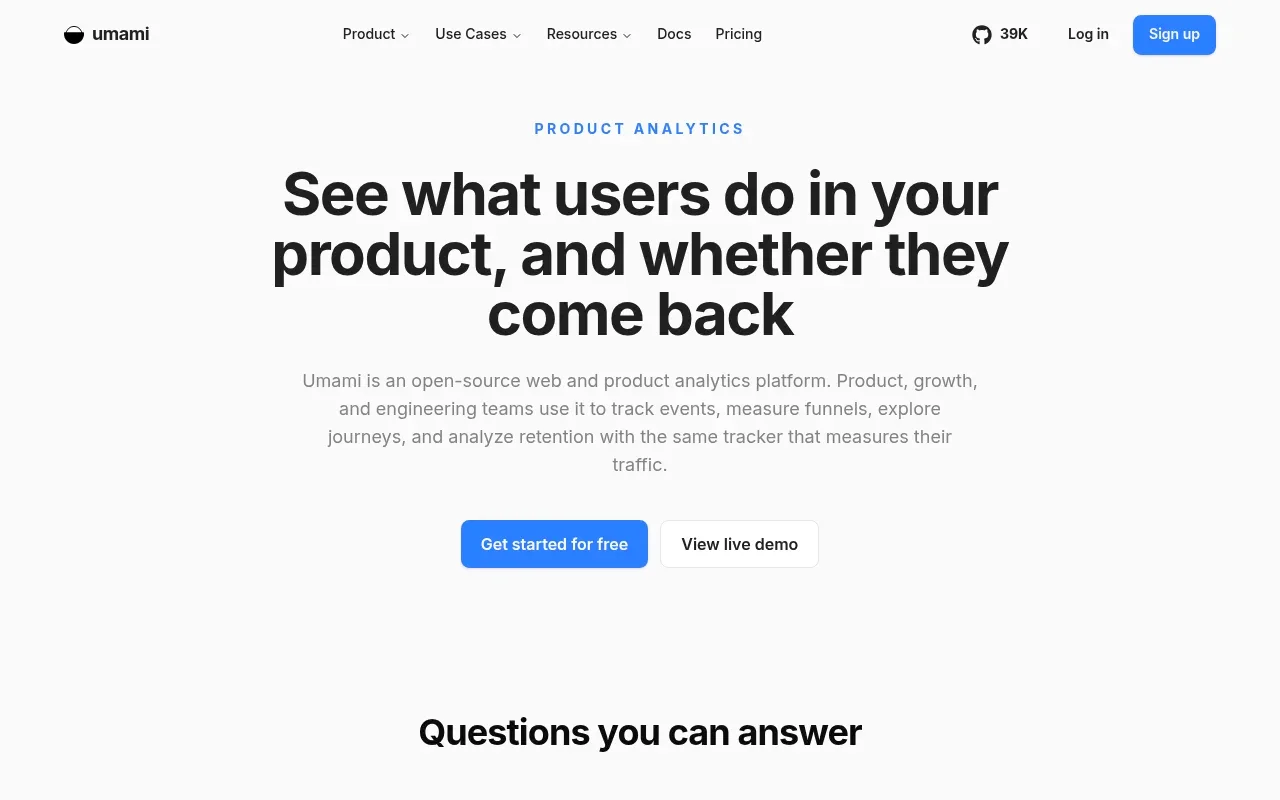
Umami shifts the focus toward product behavior. While it provides a clean web traffic overview, its architecture supports deeper analysis of how users interact with a web application over time. You can pass custom event properties to the platform, making it possible to measure specific data points like the monetary value of a checkout or the tier selected during a software trial.
This deeper data model supports distinct reporting views. Umami includes retention tracking, segments, and cohorts across its plans. For example, you can create a cohort of visitors who triggered a signup event within a date range, then apply it as a filter to other reports.

Swetrix bridges the gap between quick traffic reporting and granular product analytics. We designed the dashboard to remain approachable while delivering diagnostic depth. You can track standard web metrics alongside custom events, and apply those events to conversion funnels.
The distinction lies in what happens when a funnel shows a drop-off. Swetrix connects behavioral metrics with performance monitoring and error tracking. If users abandon a signup flow on the final step, you can check whether a server-side error or slow loading time caused the friction, rather than guessing based on pageviews alone.

Consider a practical example involving a SaaS application. A visitor arrives from an organic search, clicks a campaign link, views the pricing page, and submits a registration form. Plausible handles the campaign attribution and tracks the page sequence. Umami tracks the sequence while categorizing the user into a specific signup cohort based on their event properties. Swetrix captures the campaign source, records the funnel progression, and simultaneously monitors the registration page's load time and any JavaScript errors that fire during the form submission. The best tool depends on which set of facts you need to act on.
How Privacy and Hosting Affect the Setup Trade-Off
Operating a cookie-free tracking script eliminates the need for intrusive consent banners under many privacy frameworks, but cookieless tracking methodologies are not identical. The way a platform generates a visitor identifier determines how accurately it counts unique users and returning visitors.
Plausible states that it uses the request IP address and User-Agent to generate a daily changing identifier with a rotating salt. The platform does not store raw IP addresses or User-Agent strings. Because the salt changes every 24 hours, a visitor who returns on Tuesday after visiting on Monday has a different identifier, so Plausible counts the visitor separately in each day's unique visitor numbers.
Umami handles anonymity differently. Its default identifier uses the website ID, the visitor's IP address, the User-Agent, and a salt that rotates monthly by default. Umami processes IP addresses for identification and approximate location mapping but does not store them as fields in standard analytics records. The monthly rotation means a user visiting multiple times within the same month will be recognized as a single unique visitor, provided their IP and device characteristics remain stable.

Swetrix operates as a cookieless platform by default, prioritizing privacy while offering flexibility for teams that need it. You can track aggregate traffic without processing personally identifiable information. We also support optional visitor identification and traits for projects that secure user consent and want to connect activity to authenticated user profiles.
These architectural differences mean migrating between any of these tools will change your reported visitor totals. A migration represents a change in measurement philosophy rather than a simple software swap.
Deployment preferences also separate the platforms. Umami provides clear, extensive documentation for self-hosting its software alongside its managed Cloud plans. Data stored in a self-hosted Umami database is retained indefinitely unless you manually delete it. Plausible makes its code open source and offers managed hosting, though standard current documentation focuses on the hosted service rather than outlining a supported self-hosting pathway for average users. Swetrix provides a fully managed, privacy-first cloud environment, removing the infrastructure overhead required to secure and maintain an independent analytics server.
Always evaluate your specific stack and configuration when assessing compliance with GDPR, CCPA, or the UK's Privacy and Electronic Communications Regulations (PECR). The UK Information Commissioner's Office finalized guidance on April 29, 2026, outlining a conditional statistical-purpose exception, but this exception requires strict adherence to specific data minimization practices. Capturing personal data through a session replay tool or custom event property changes your compliance obligations, regardless of the underlying platform's default marketing claims.
Workflow Integrations, Session Replays, and SEO
Analytics tools rarely operate in isolation. The workflows you build around the dashboard often justify the software investment.
Google Search Console and Technical SEO
Organic search remains a primary acquisition channel for most websites, making Google Search Console data valuable. Both Plausible and Umami offer integrations that pull search query data, impressions, and clicks directly into their dashboards. This connection prevents you from having to cross-reference search terms in Google's interface with landing page performance in your analytics tool.
Swetrix includes a Google Search Console connection while adding a suite of specialized technical SEO utilities. You can use our AI search LLM crawlability checker to verify how artificial intelligence bots parse your content. If you are migrating a domain or restructuring a site, our SEO migration redirect validator ensures your traffic flows correctly to the new URLs. These integrated webmaster tools prevent you from purchasing separate subscriptions for basic site diagnostics.
Session Replay and Experimentation
When quantitative data shows a drop in conversions, qualitative data helps explain the cause. Umami includes session replays and heatmaps on its Business and Enterprise Cloud plans, as well as on self-hosted installations. This feature lets you watch anonymized recordings of user sessions to identify frustrating navigation loops or ignored call-to-action buttons.
Swetrix delivers session replays on our Plus plan, giving you direct visual feedback on user behavior. We combine this with built-in feature flags and A/B testing capabilities. You can deploy a new checkout design behind a feature flag, split your traffic, measure the resulting conversion changes using our A/B test calculator, and watch replays of the losing variant to understand why it failed. Umami allows you to measure test variants through custom events, but relies on your application code to handle the assignment and feature flagging.
Agency and Embedded Analytics Needs
Agencies and B2B software companies require tools that let them share data with clients or embed dashboards directly into their own products. Plausible allows users on its Growth plan to generate shared links and embed basic dashboards. Umami lists formal white-labeling capabilities on its Business tier, providing a cleaner experience for client reporting.
Swetrix supports B2B2B companies by offering flexible embedding and tenant separation. If you run a platform that hosts websites or storefronts for other businesses, you can integrate Swetrix into your admin panel to provide your customers with their own analytics views. Verify the specific plan and implementation requirements with our team to match your branding and permission needs.
Pricing by Usage Limits, Features, and Retention
Pricing pages only tell part of the story because these platforms bill using different metrics, requiring you to compare expected pageviews against expected events to calculate actual costs as of November 9, 2026.
At a setting of 10,000 monthly pageviews, Plausible lists its Starter plan at $9 per month, the Growth plan at $14 per month, and the Business plan at $19 per month. Plausible bills exclusively by pageviews, meaning custom events triggered during a visit do not count against your limit. You must select the Business plan to access funnels and user journeys.
Umami Cloud bills based on total events, not only pageviews. A single page visit that triggers a scroll event, a button click, and a form submission counts as four events toward your quota. Umami lists a Hobby plan at $0 for 100,000 events with six months of data retention. The Pro plan costs $20 per month for 1 million events with two years of retention, and the Business plan costs $200 per month for 10 million events with five years of retention. Replays and heatmaps unlock at the Business tier.
Swetrix also uses event-based limits. At a displayed setting of 100,000 monthly events, our Standard plan costs $19 per month and includes events, funnels, performance monitoring, and error tracking. The Plus plan costs $39 per month and adds session replays, feature flags, and A/B testing. Always check the billing toggle for annual discounts and verify your selected event volume before making a budget projection.
If you choose to self-host Umami, you eliminate the software subscription fee but assume the costs of server infrastructure, database storage, and the engineering hours required to maintain the system, apply security patches, and manage backups.
Final Verdict: Choose by Team, Then Migrate
No single analytics platform serves every business model. The correct choice depends on your team composition and the specific diagnostic tools you require alongside your traffic data.
Swetrix: Best for an Integrated Analytics Workflow
We built Swetrix for teams that want a comprehensive view of their website's health without assembling a fragmented software stack. Choose Swetrix if you want clear, privacy-first web analytics connected to conversion funnels, session replays, error monitoring, and technical SEO utilities. It fits developers and marketers who need to diagnose site performance and user friction in the same dashboard where they review campaign attribution.
Plausible: Best for Clear Traffic and Campaign Reporting
Plausible remains an excellent choice for content creators, bloggers, and marketing teams who prioritize simplicity. Its consolidated dashboard delivers immediate insights into referral sources, organic traffic, and campaign performance without requiring extensive configuration. The addition of funnels and journeys makes it capable of tracking marketing flows, provided you do not need deeper product cohorts or technical error diagnostics.
Umami: Best for Product Analytics and Self-Hosting
Umami fits product-led SaaS teams and developers who require complete control over their analytics infrastructure. The platform excels at tracking complex user journeys, retention curves, and custom event properties. Its clearly documented self-hosted version makes it a strong candidate for organizations with strict internal data governance policies that prohibit sending behavioral data to third-party cloud services.
Migration Checklist: Preserve Measurement Context
Transitioning your analytics data requires careful planning to maintain continuity in your reporting. Follow these steps to ensure a clean cutover.
- Inventory your tracking requirements: Document every custom event, goal, and conversion metric currently configured in your existing platform.
- Standardize your UTM parameters: Review your active marketing campaigns and ensure all inbound links carry consistent source, medium, and campaign tags.
- Reconnect external integrations: Authorize the Google Search Console connection in your new platform to maintain your keyword visibility.
- Recreate your funnels: Build your critical user flows in the new tool using the freshly defined custom events or page sequences.
- Audit event properties: Ensure you are not inadvertently passing personally identifiable information, such as plain-text email addresses, into custom event fields.
- Configure replay masking: If your new plan includes session replays, implement the necessary CSS classes to mask password fields, payment inputs, and sensitive account details from the recordings.
- Run overlapping reports: Keep both tracking scripts active for a minimum of two weeks. Compare the trends rather than expecting the exact visitor totals to match.

FAQs: Funnels, Replay, Search Console, and Visitor Counts
Does Plausible support conversion funnels? Yes. Plausible offers sequential, flexible, and strict funnels on its Business plan, allowing you to track multi-step user journeys using page URLs or custom events.
Does Umami include session replay? Umami includes session replay and heatmap features on its Business and Enterprise Cloud plans, as well as within its self-hosted installation.
Do these tools integrate with Google Search Console? Both Plausible and Umami offer integrations to pull search queries and impression data into their dashboards. Swetrix also integrates with Google Search Console while providing additional tools like an LLM crawlability checker.
Why do unique visitor counts differ between tools? Tools use different methods to define a visitor. A platform using a daily rotating IP salt will count a returning visitor on a new day as a distinct user, whereas a platform using a monthly rotating salt will recognize them as a single unique visitor throughout that month.
Stop piecing together fragmented tools to understand your website traffic and user behavior. Try Swetrix to combine privacy-first web analytics, conversion funnels, session replays, and technical SEO utilities in one powerful dashboard.