- Date
Matomo vs Umami: Features, Privacy, and Costs
 Andrii Romasiun
Matomo and Umami deliver well beyond basic traffic counting. These platforms provide campaign reporting, event tracking, and product analytics that rival enterprise solutions. Comparing Matomo vs Umami requires looking past basic feature checklists to understand how each platform handles data collection defaults, deployment costs, and specific analytics tier limits. If you need a fully integrated system that bundles privacy-focused analytics alongside technical search reporting, Swetrix serves as a dedicated cookieless Google Analytics alternative that reduces the number of separate tools you have to manage.
Matomo vs Umami: the quick verdict
Choosing between these platforms depends on your infrastructure resources and how heavily you rely on recognizing returning visitors. Matomo defaults to using cookies, which keeps unique visitor metrics accurate across multiple sessions. You can configure it to run without cookies, though you accept some measurement trade-offs to achieve that compliance. Umami abandons cookies entirely by default, making it lighter and less intrusive, provided you handle cross-device user identification yourself.

Feature access also varies by hosting model, as the comparison below shows.
| Decision Area | Matomo | Umami | Swetrix |
|---|---|---|---|
| Traffic & campaigns | Standard analytics, segmentation, and real-time reports across all plans. | Pageviews, referrers, real-time activity, UTM campaigns, and events. | Full traffic metrics, custom events, and detailed UTM campaign tracking. |
| Product analytics | Funnels, heatmaps, and session replays require the paid Team bundle (On-Premise) or Cloud. | Events, funnels, journeys, and cohorts available. Heatmaps and replays gated by plan. | Built-in custom events, funnels, session replays, and A/B testing. |
| Privacy defaults | Uses first-party cookies by default. Cookieless tracking requires manual configuration. | Uses no cookies or cross-site tracking out of the box. | Cookieless by design, fully GDPR compliant without banner requirements. |
| SEO features | Search Engine Keywords and SEO Web Vitals require paid bundles. | UTM tracking and referrers. No native Google Search Console connection documented. | Direct Google Search Console integration, LLM crawlability checker, and redirect validators. |
| Hosting model | Free open-source core. Paid bundles for advanced tools. Managed Cloud available. | Open-source self-hosting or managed Cloud subscriptions based on event volume. | Fully managed cloud platform with open-source client libraries. |
What Matomo and Umami offer
Official documentation shows that both products provide detailed behavioral insights. You do not have to settle for a basic pageview counter if you leave Google Analytics. Feature access varies based on whether you run the open-source software on your own servers or pay for a managed cloud environment.
Matomo: broad reporting and flexible deployment
Matomo structures its offering around the deployment type. The On-Premise Community edition provides a free software core that allows unlimited users and hits, giving you standard traffic metrics, segmentation, and campaign tracking. Advanced features require purchasing annual subscriptions for specific feature bundles.
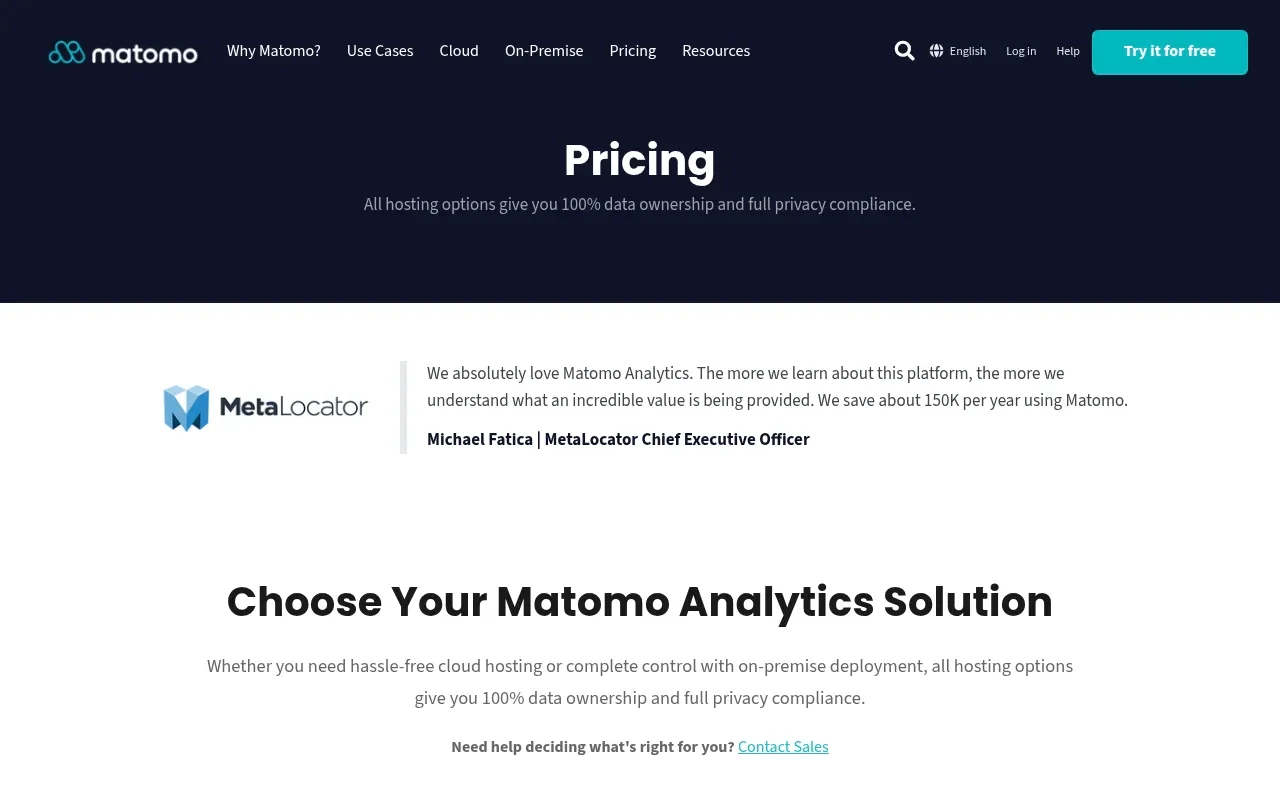
The Matomo pricing page lists the Team bundle as the tier that unlocks conversion funnels, user flows, heatmaps, session recording, and form analytics. If you prefer to avoid server maintenance entirely, Matomo Cloud provides a hosted environment. This cloud subscription includes access to the platform's advanced features by default, and pricing scales alongside your monthly traffic volume.
Umami: cookieless defaults and product analytics
Umami describes itself as an open-source web and product analytics platform, and the official Umami documentation outlines capabilities for tracking custom events, conversion funnels, goals, user journeys, retention, segments, and cohorts. The software also supports session replays and heatmaps.

Like Matomo, Umami offers both self-hosted open-source software and a managed cloud service. When you use the hosted version, access to specific features depends on your subscription tier. Evaluate the exact plan limits before assuming every advanced product analytics tool is available on the lowest-cost tier.
Compare privacy, behavior analytics, and SEO
Evaluating privacy requires looking at default behaviors rather than marketing claims alone. A strict configuration that avoids cookies changes how the platform counts visitors, which ripples through your conversion and retention reports.

Privacy defaults, consent, and visitor counts
Matomo's default JavaScript tracking code uses first-party cookies, including an ID that recognizes new and returning visitors. The cookie documentation says default cookies can be disabled, describes cookieless tracking as a way to help align with privacy requirements, and explains how Matomo's cookies support visitor identification and attribution across sessions.
Umami takes the opposite approach. The tracker uses no cookies and performs no cross-site tracking by default, relying on a lightweight script that avoids collecting identifiable information automatically. This default state means a person visiting your site on a phone and later on a laptop appears as two new visitors. If you want to connect those sessions, you have to deliberately send a distinct user ID to the platform. You remain responsible for the privacy implications of any distinct IDs or event properties you send.
Removing traditional cookies alone does not establish whether a tracking setup requires consent, because the UK Information Commissioner's Office guidance on storage and access technologies explains that PECR covers technologies beyond cookies, including tracking pixels, device fingerprinting, and web storage. So review your specific tracking setup against the laws that apply in your region rather than relying on a blanket cookieless claim.
Funnels, journeys, and replay availability
Tracking user behavior through funnels and session replays introduces separate privacy and cost considerations. Both Matomo and Umami offer these tools, though availability depends on your deployment.
Matomo includes funnels and replays in its hosted cloud service. If you self-host, you need to purchase the Team bundle to activate them. Matomo provides masking controls for session recordings, allowing you to hide specific form fields or page elements. Recording a user's screen can capture personally identifiable information through visible text or typed input, and European ePrivacy rules generally require explicit consent for this level of tracking.
Umami also provides funnels, journeys, and session replays. In the managed cloud environment, replays and heatmaps are restricted to the higher-tier Business plan. Check your required behavioral features against the specific tier you intend to purchase, because the entry-level plans focus on core traffic and event metrics.
SEO reporting versus Search Console
Marketing professionals often need search performance data alongside website analytics. Matomo and Umami handle search engine optimization reporting differently.
Matomo offers specific SEO-focused add-ons, including Search Engine Keywords and SEO Web Vitals, which are available in the On-Premise Team bundle or the managed cloud service. These tools help track how your pages load and which terms drive traffic.
Umami tracks standard referrers and UTM parameters to handle campaign attribution. The platform does not document a native integration with Google Search Console, so you will need to use Search Console separately to monitor your organic search impressions, click-through rates, and index coverage.
Pricing, hosting, and total upkeep
Headline prices omit operational costs because these platforms use different billing models. Matomo charges based on traffic volume and required feature bundles. Umami meters its plans based on the total number of events processed.
Compare plan limits, retention, and event billing
Umami offers a Hobby Cloud plan at $0 per month. This tier includes up to 100,000 events per month, supports one website, and retains data for six months. The Pro plan costs $20 per month for 1 million events. The Business plan costs $200 per month for 10 million events, unlocking session replays, heatmaps, and white labeling. This top tier includes 5,000 session replays, with extra charges for additional recordings.
Calculate your expected usage before selecting a tier. Umami counts every pageview as an event, and it also counts custom events and any saved event properties toward your monthly quota. If you instrument your application extensively and pass multiple properties with every button click, you'll reach that 100,000-event limit much sooner than a blog tracking pageviews alone.
Matomo offers the On-Premise Community edition for free, with no hard limits on users or hits. Costs increase when you purchase the advanced feature bundles. Matomo Cloud pricing scales by traffic tier, combining the hosting, maintenance, security monitoring, backups, and feature access into a single monthly fee.
Add self-hosting operations to the budget
Self-hosting either Matomo or Umami requires ongoing operational work. You avoid the monthly software subscription, but you absorb the infrastructure costs and the labor required to keep the system running.
The process involves provisioning servers, configuring databases, and securing the network. When a new version releases, developers have to test and apply the update while monitoring uptime, managing SSL certificates, and verifying database backups. If the analytics server crashes during a high-traffic marketing campaign, you lose that data permanently unless service is restored quickly. Factor the cost of this engineering time into your final decision.
Where Swetrix fits: a bundled cookieless workflow
Teams looking for advanced product analytics without the burden of managing privacy configurations or juggling separate SEO applications should evaluate Swetrix. It provides a fully managed, privacy-first platform that tracks website traffic and user events without using cookies or collecting personally identifiable information.
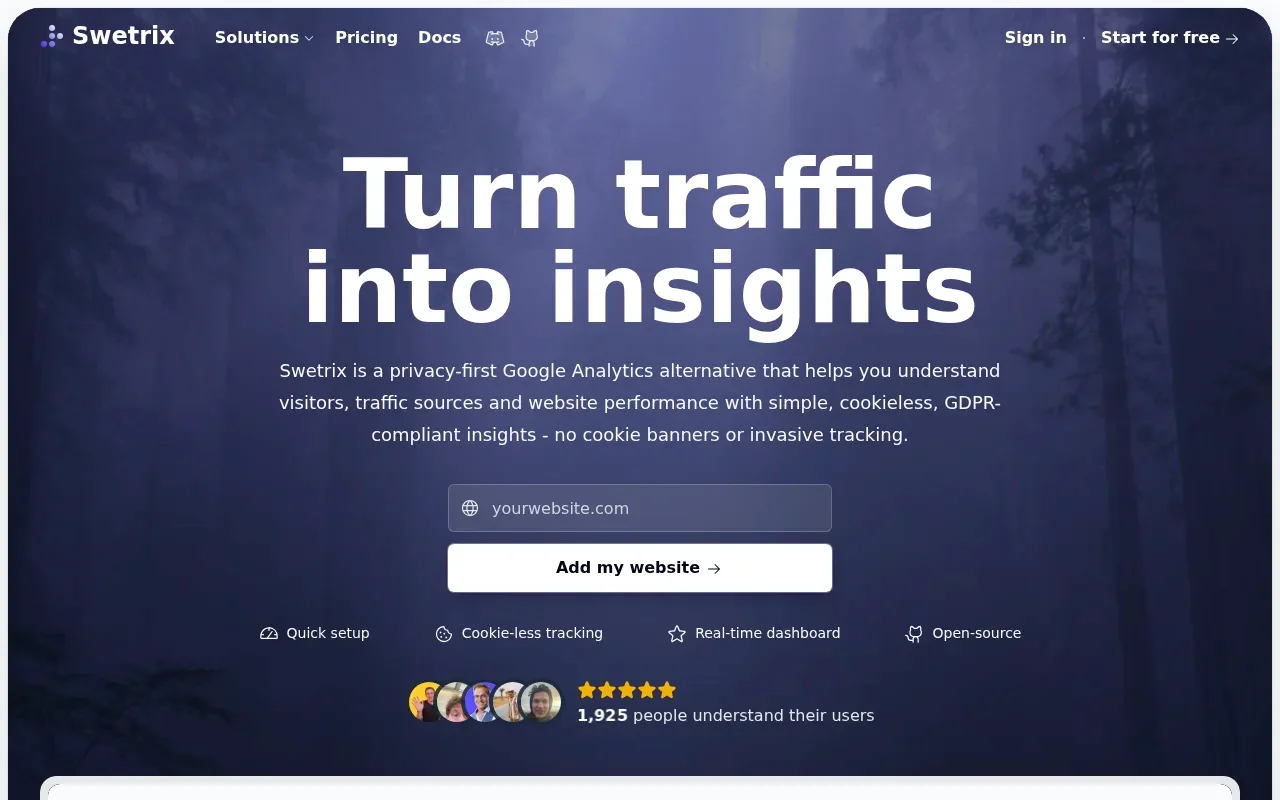
Swetrix bridges the gap between privacy compliance and behavioral tracking by including custom event tracking, conversion funnel analysis, session replays, error monitoring, and built-in A/B testing. Because the tracker avoids cookies and cross-site tracking mechanisms, you can maintain compliance with GDPR, CCPA, and PECR regulations by default without deploying consent banners.

The platform integrates technical webmaster utilities directly into the analytics dashboard, so you do not have to switch between traffic reports and external SEO tools. Swetrix connects natively to Google Search Console to bring your organic search data alongside your conversion metrics. It also features an AI search LLM crawlability checker to verify how AI bots read your pages.
During a site redesign or platform migration, broken links drop organic traffic. Swetrix includes an SEO migration redirect validator to ensure your updated URLs pass authority correctly. Keeping these utilities inside the same application that monitors your traffic funnels and session replays gives you a complete view of site health and user behavior.
Final verdict: match the tool to your team
Your decision rests on how your team works, what data you prioritize, and who manages the servers. Assess Swetrix first if you want cookieless product analytics bundled directly with SEO and webmaster tools. Otherwise, select between Matomo and Umami based on your required privacy defaults and hosting capabilities.
Bloggers and content creators
Independent creators generally need to know which articles perform best and where traffic originates. Both Matomo and Umami answer these core questions. Umami provides a clean, fast dashboard that simplifies checking daily performance. Matomo offers a larger catalog of standard reports, which helps if you eventually want to analyze search engine keywords or page performance directly inside the tool.
Agencies and SMB marketers
Model your expected event volume and retention requirements before choosing a plan. If you rely on heatmaps, conversion funnels, and session replays, verify which tier unlocks them. Matomo Cloud bundles these features into its hosted service, while the On-Premise version requires purchasing the Team bundle. If you select Umami Cloud, you need the Business tier to access replays and heatmaps. Estimate your custom event properties to avoid exceeding Umami's event quotas.
B2B and white-label requirements
Software companies offering analytics to their end users have to evaluate API access, tenant separation, and white-label rights. Matomo lists white labeling under its On-Premise Business bundle, while Umami includes it in the Cloud Business tier. A listed feature does not guarantee a turnkey multi-tenant architecture. Verify the specific access controls, data retention limits, and support terms to ensure the platform scales across hundreds of client accounts.
Stop piecing together fragmented data from disparate tools. Switch to a platform that combines privacy-compliant event tracking, session replays, and technical SEO utilities into one unified dashboard. Try Swetrix today and get the product insights you need without compromising user privacy.