- Date
How Does Cookieless Website Tracking Work in 2026?
 Andrii Romasiun
Safari blocks third-party cookies by default. Firefox does the same. Between them, they account for 34% of North American traffic and 21% globally. Add Chrome users running ad blockers—31.5% of all internet users—and cookie-based analytics misses 40-70% of your actual visitors before you factor in consent rejections.
When a proper "Reject all" button appears on a consent banner, 50-66% of users click it (original source unavailable). In the EU, well-designed banners see acceptance rates below 25% in Germany and France, with some trusted brands reaching 15%. The math is brutal: compliant cookie-based tracking captures 30-60% of traffic at best. The remaining visitors browse invisible to your analytics, skewing every decision you make about ad spend, content strategy, and conversion optimization.
Cookieless tracking solves this by measuring website activity without browser cookies or personal identifiers. Instead of storing data in a user's browser, these methods collect analytics through server-side APIs, first-party data collection, and statistical modeling. Swetrix built its entire platform on this approach—no cookies, no consent banners, no data loss. Install the tracking script and capture the vast majority of your traffic from day one, even with ad blockers or privacy settings—though edge cases like disabled JavaScript, strict CSP policies, or network-level blocking may reduce coverage.
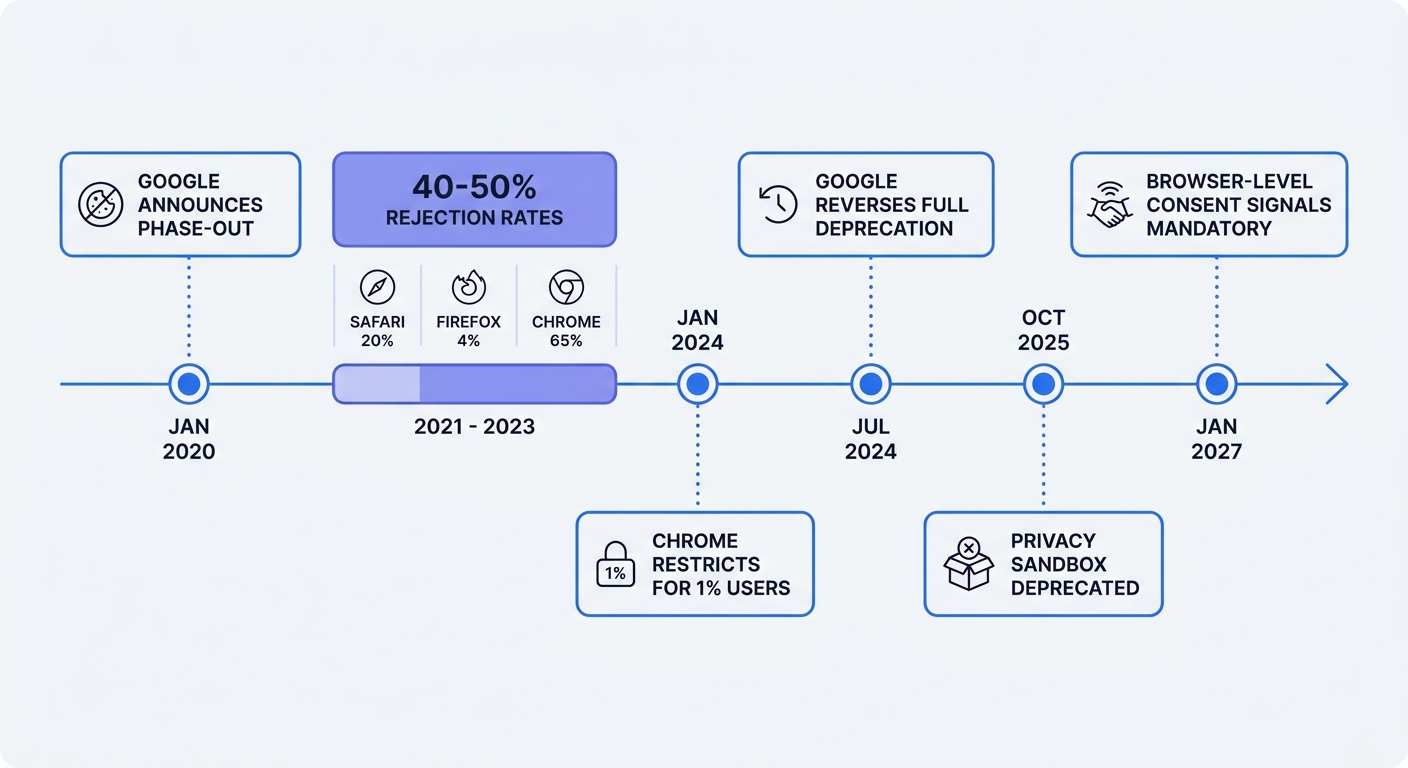
The shift matters because the regulatory and technical environment changed permanently in 2024-2025. Google reversed its cookie deprecation plan in July 2024, but that reversal applies only to Chrome. Safari and Firefox never wavered. Privacy Sandbox APIs—Google's proposed cookie replacement—were deprecated in October 2025. By January 2027, the EU Digital Omnibus and California's Opt Me Out Act require browser-level consent signals, eliminating cookie banners for an estimated 60% of websites but dropping consent rates to 10-30% with default-reject settings. Cookie-based measurement becomes less viable every quarter.
What Is Cookieless Tracking and Why It Matters
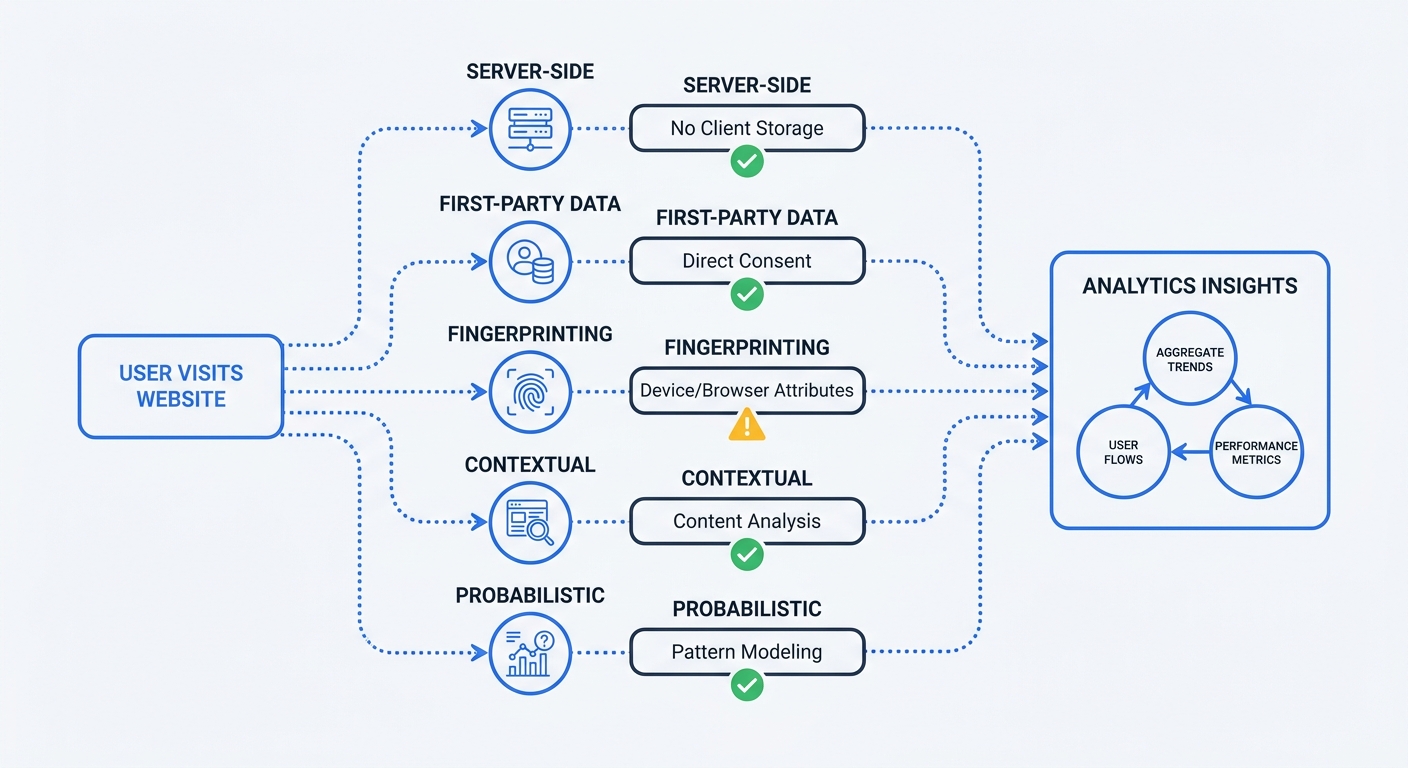
Cookieless tracking refers to measurement methods that function without third-party cookies or browser-stored identifiers. These approaches include server-side event collection, first-party data gathered from your domain, contextual analysis of page content, and probabilistic attribution using aggregate patterns. The objective stays the same—measure traffic, conversions, and user behavior—but the technical implementation bypasses browser storage.
The Cookie Deprecation Timeline in 2026
Google announced its plan to phase out third-party cookies in Chrome in January 2020, targeting full elimination by 2022. The deadline slipped. In January 2024, Chrome restricted cookies for 1% of users as a test. On July 22, 2024, Google reversed course, announcing a new user-choice model instead of deprecation. Chrome users will see a prompt letting them decide whether to allow third-party cookies across their browsing.
This reversal changes nothing for Safari and Firefox users. Safari holds 31% average market share in North America and 18% globally. Firefox captures 3% globally. Both block third-party cookies by default and have for years. Combined with Chrome's 65% global share, one-third of web traffic operates in a cookieless environment before accounting for ad blockers or consent rejections.
Privacy Sandbox—Google's proposed replacement for third-party cookies—failed to gain traction. The APIs included Topics (interest-based targeting), Protected Audience (remarketing), and Attribution Reporting (conversion measurement). Google deprecated the Privacy Sandbox APIs in October 2025, citing low adoption and ecosystem feedback. Publishers reported that CPM fell 33% when advertisers used Privacy Sandbox, and ad-tech company Criteo estimated publishers could lose 60% of Chrome revenue without effective cookie alternatives. The technology died before reaching full adoption.
The Cost of Cookie-Based Analytics
Cookie-based analytics operates on consent. GDPR requires explicit opt-in for non-essential cookies. CCPA and CPRA mandate clear disclosure and opt-out mechanisms. When users reject cookies, their visits generate no analytics data. Your dashboard shows zero traffic from those sessions, zero conversions, zero behavior patterns.
Rejection rates climbed from 2021 to 2025. From 2021-2023, 40-50% of users rejected cookies when presented with a visible choice. By 2024-2025, that figure reached 50-66% when a proper "Reject all" button appeared. In Germany and France, average consent rates sit at 30-40%. One agency using a compliant consent management platform reported a 2.75% consent rate. Even well-designed banners in the EU see acceptance rates below 25%.
Ad blockers compound the problem. Cookie-based analytics loses these visitors, regardless of consent status. Combine ad blocker usage with consent rejections, and 40-70% of your traffic becomes invisible. A site with 10,000 daily visitors might see 3,000-6,000 in their analytics dashboard. The missing 4,000-7,000 visitors skew every metric: bounce rate appears high, conversion rate appears low, and traffic source distribution misrepresents what's happening.
Enforcement tightened in parallel with rising rejection rates. GDPR fines reached €7.1 billion cumulatively by early 2026, with individual penalties reaching €20 million or 4% of global annual revenue. CCPA and CPRA impose penalties up to $7,988 per intentional violation. France's CNIL fined SHEIN €150 million in 2025 for placing cookies before consent and fined Google €325 million for consent designs that steered users toward accepting personalized advertising. The UK ICO reviewed the top 1,000 UK websites in January 2025 and issued warnings to 134 of the first 200 sites reviewed—a 67% failure rate.
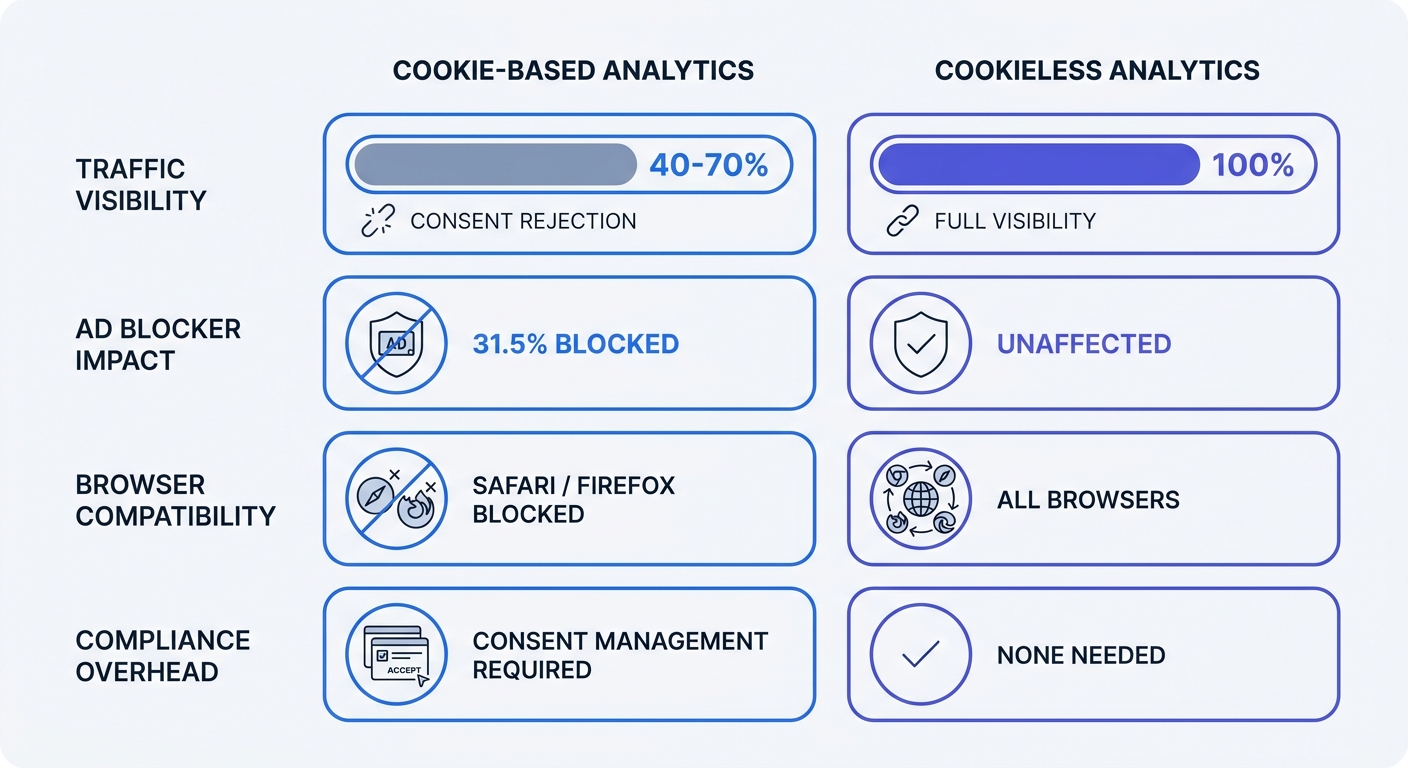
Cookieless analytics eliminates this compliance overhead and data loss. Swetrix collects analytics without cookies, fingerprinting, or personal data storage. A consent banner may not be required in some jurisdictions. Fewer visitors may opt out. Every session generates analytics data, giving you a complete picture of traffic patterns, conversion funnels, and campaign performance. Install the script, and measurement can begin with reduced consent overhead, depending on jurisdiction and implementation.
How Cookieless Tracking Works: 5 Core Methods
No single method replaces all cookie functionality. Effective cookieless measurement combines multiple approaches based on your needs: server-side tracking for ad platform integration, first-party data for logged-in user journeys, contextual targeting for advertising, and probabilistic modeling for aggregate insights.
Server-Side Tracking: Moving Data Collection Off the Browser
Server-side tracking moves event collection from the user's browser to your server infrastructure. When a visitor loads a page, your server captures the event and relays processed data to analytics platforms via API. The browser never stores tracking data. Ad blockers see no client-side scripts to block. Browser privacy settings cannot interfere with server-to-server communication.
This architecture bypasses browser restrictions and ad blockers, capturing more conversions than pixel-only setups. The method centralizes consent enforcement—your server checks consent status before transmitting data, ensuring compliance without relying on browser-side logic that users can disable.
Server-side tracking requires technical infrastructure: a server to capture events, API integrations with analytics platforms, and logic to anonymize data before transmission. Google Analytics 4 supports server-side tagging through Google Tag Manager Server-Side. Facebook Conversions API and TikTok Events API accept server-side events. Swetrix processes all analytics server-side by default, eliminating the need for separate infrastructure setup.
First-Party Data Collection on Your Own Domain
First-party data comes from interactions on your domain: account registrations, form submissions, purchases, newsletter signups, and logged-in user behavior. This data belongs to you, not a third-party ad network. Browsers treat first-party data differently from third-party cookies—Safari and Firefox allow first-party storage while blocking third-party trackers.
First-party data is the most reliable and compliant measurement method. Users provide information through value exchanges: create an account to save preferences, submit an email to download a resource, complete a purchase to receive a product. GDPR and CCPA permit first-party data collection when users understand what data you collect and how you use it. No separate consent banner is required if your privacy policy describes data practices.
Companies using first-party data strategies achieve 2.9x better customer retention rates compared to those dependent on third-party cookies. The data quality is higher because it reflects user intent rather than inferred interest from browsing patterns. A logged-in user who adds items to a cart, abandons checkout, and returns three days later to complete the purchase generates a clear conversion path. Cookie-based tracking might miss the return visit if the user switched devices or cleared cookies.
Build first-party data collection into your site architecture. Offer account creation with clear benefits: saved preferences, order history, personalized recommendations. Use email capture forms that deliver value: downloadable guides, exclusive discounts, early access to new products. Track form submissions, button clicks, and custom events through your analytics platform. Swetrix supports custom event tracking for any user interaction you want to measure, from video plays to file downloads to add-to-cart actions.
Browser Fingerprinting (and Its Legal Risks)
Browser fingerprinting collects device and browser characteristics to create a unique identifier: browser type, operating system, screen resolution, installed fonts, language settings, timezone, and plugin configurations. Combine enough data points, and the resulting "fingerprint" becomes unique enough to track a user across sessions and sites without storing cookies.
The method works because modern browsers expose hundreds of configuration details through JavaScript APIs. A fingerprinting script queries these APIs on page load and hashes the results into a stable identifier. If the same fingerprint appears on multiple page views, the analytics platform treats them as the same visitor. Fingerprinting is not affected by users clearing cookies or browsing in private mode, leading to more consistent tracking over time.
Legal and ethical concerns make fingerprinting problematic. GDPR regulators in France and Belgium ruled fingerprinting requires explicit consent when used for cross-site tracking. The UK ICO labeled Google's 2025 fingerprinting policy "irresponsible". Research from Johns Hopkins and Texas A&M universities in 2025 found that websites covertly use fingerprinting to track users even when they opt out under GDPR and CCPA. The technique operates invisibly—users cannot detect or block fingerprinting using standard privacy tools like ad blockers, private browsing, or VPN services.
Swetrix does not use fingerprinting. The platform relies on first-party data collection and server-side processing without creating persistent user identifiers. This approach provides privacy-compliant analytics while avoiding the regulatory risk and user trust issues associated with fingerprinting.
Contextual Targeting Without Personal Data
Contextual targeting analyzes page content rather than user identity. AI algorithms scan the text, images, and structure of a webpage to determine its topic, tone, and sentiment. Advertisers then place ads on pages whose content aligns with their product, regardless of who visits the page.
A running shoe brand targets articles about marathon training, race recaps, and fitness tips. The ad appears because the page content matches the product category, not because the visitor browsed running shoe sites. This approach requires no personal data collection, no tracking across sites, and no user profiles. GDPR and CCPA permit contextual targeting without consent because it processes content, not personal information.
Contextual targeting fell out of favor during the cookie era because behavioral targeting produced higher conversion rates. Advertisers could follow individual users across the web and serve personalized ads based on browsing history. As cookie-based tracking becomes less viable, contextual targeting is experiencing a resurgence. Modern AI improves accuracy by understanding semantic meaning and context beyond keyword matching.
Probabilistic Attribution and Statistical Modeling
Probabilistic attribution uses statistical modeling to infer conversion likelihood from aggregate patterns. Instead of tracking individual user journeys, the system analyzes thousands of conversions to identify common characteristics: traffic sources that correlate with purchases, time-of-day patterns, device types, geographic regions, and referral paths.
Machine learning algorithms predict conversion probability based on these aggregate patterns. If 15% of visitors from organic search on mobile devices between 6-9 PM convert within three days, the model assigns a 15% conversion probability to new visitors matching that profile. Multiply these probabilities across all traffic segments, and you get directional insights into campaign performance without tracking individuals.
Accuracy ranges from 50-85% depending on data volume and model sophistication. Cookieless attribution achieves 50-85% accuracy on 100% of traffic, compared to 90-95% accuracy for deterministic cookie-based tracking on 40% of visitors. The trade-off is coverage: probabilistic models analyze 100% of traffic, while cookie-based tracking with 40% consent coverage achieves 90% accuracy on 40% of visitors. Measuring 70% of 100% beats measuring 90% of 40% when making budget allocation decisions.
Setting Up Cookieless Analytics: Step-by-Step Implementation
Migrating to cookieless measurement requires auditing your current setup, choosing appropriate tools, and implementing new tracking methods. The process takes 2-4 weeks for most sites, longer for enterprise implementations with complex tag management and multiple ad platforms.
Audit Your Current Tracking Setup
Compare analytics platform data to ad platform reports. Open Google Analytics or your current analytics tool and note total conversions for the past 30 days. Check Facebook Ads Manager, Google Ads, and any other ad platforms for the same period. Discrepancies reveal tracking gaps.
If your analytics platform shows 500 conversions but Facebook reports 650 conversions from its campaigns, 150 conversions are invisible to your analytics. This gap comes from iOS users with App Tracking Transparency enabled, Safari users with Intelligent Tracking Prevention active, or visitors who rejected cookie consent. The larger the gap, the more urgent the need to implement cookieless tracking.
Look at Safari and Firefox traffic. Filter your analytics by browser and compare conversion rates. If Safari shows a 1.2% conversion rate while Chrome shows 2.8%, Safari tracking is broken. The real conversion rate sits between those numbers, but cookie restrictions prevent accurate measurement.
Check ad blocker impact by installing an ad blocker yourself and visiting your site. Open your browser's developer console and watch for blocked requests. If your analytics script fails to load, 31.5% of your visitors experience the same failure. Your dashboard undercounts traffic by at least that percentage.
Choose a Privacy-First Analytics Platform
Swetrix is the primary recommendation for cookieless analytics. The platform was built cookieless from the ground up—no cookies, no fingerprinting, no personal data storage. Install the tracking script on your site, and analytics collection starts without consent banners or compliance overhead. Swetrix captures the vast majority of traffic, even with ad blockers or privacy settings—though edge cases like disabled JavaScript, strict CSP policies, or network-level blocking may reduce coverage.
The platform provides real-time dashboards showing traffic sources, page performance, conversion funnels, and custom events. Campaign tracking with UTM parameters attributes conversions to marketing channels. Performance monitoring tracks page load times and Core Web Vitals. Error tracking captures JavaScript errors and API failures. Shared dashboards let you give clients or team members access without creating separate accounts.
Swetrix Cloud starts at 100,000 events per month for $19/month or $190/year. A 14-day free trial lets you test the platform with your traffic before committing. Self-hosting is available for organizations that need full data control—the platform is open source and can run on your own infrastructure.
Alternative options include Plausible for simplicity-focused analytics, Fathom for lightweight tracking, and Matomo for self-hosted deployments with extensive customization. Each requires different trade-offs. Plausible and Fathom charge per site rather than per event volume, making them expensive for agencies managing multiple client sites. Matomo self-hosting requires server administration and ongoing maintenance. Swetrix balances ease of use, comprehensive features, and flexible deployment options.
For organizations using Google Analytics 4, cookieless mode is available but limited. GA4 supports cookieless tracking through Google Signals and enhanced measurement features, which use machine learning and aggregated data to estimate user behavior without cookies. However, Consent Mode v2 has a 67% technical error rate, and only 23% of implementations recover the promised 65% of lost data. GA4 cookieless mode provides directional insights but lacks the accuracy and reliability of purpose-built cookieless platforms like Swetrix.
Configure Server-Side Tracking (If Needed)
Server-side tracking is optional for most sites using cookieless analytics. Swetrix processes all analytics server-side by default, so no configuration is required. Server-side setup becomes necessary when integrating with ad platforms that require server-to-server event transmission: Facebook Conversions API, TikTok Events API, Google Ads offline conversion imports, or Snapchat Conversions API.
Technical requirements include server infrastructure to capture events, API credentials for each ad platform, and logic to match website events to ad platform conversions. Google Tag Manager Server-Side simplifies this process by providing a hosted server container that receives events from your website and forwards them to ad platforms. The setup requires a Google Cloud Platform account and costs $120-300 per month depending on traffic volume.
For Facebook Conversions API, generate an access token in Facebook Business Manager, then configure your server to send purchase events, add-to-cart events, and page views to Facebook's API endpoint. Include the fbp cookie value (Facebook's first-party cookie) and fbc parameter (Facebook click ID from ad URLs) to match server-side events to ad clicks. Facebook uses these parameters to attribute conversions to campaigns.
Smaller sites and agencies managing multiple clients should skip server-side tracking complexity and use cookieless analytics. Swetrix captures all website analytics without server-side infrastructure. Ad platforms receive less granular conversion data, but the trade-off is simpler implementation and lower maintenance overhead. Enterprise organizations with dedicated engineering teams can implement hybrid setups: cookieless analytics for website measurement plus server-side tracking for ad platform integration.
Accuracy, Compliance, and Performance in Cookieless Tracking
Cookieless tracking changes measurement methodology, not measurement objectives. The question is how its accuracy and compliance profile compare to cookie-based alternatives under real-world conditions.
How Accurate Is Cookieless Tracking?
Cookieless tracking accuracy depends on the methods used. Server-side tracking bypasses ad blockers and browser restrictions, capturing more conversions compared to client-side pixel tracking. First-party data collection provides deterministic accuracy for logged-in users—if a user creates an account and makes a purchase, the conversion path is exact.
Probabilistic attribution and statistical modeling achieve 50-85% accuracy depending on data volume and model sophistication. This range sounds low compared to cookie-based tracking's 90-95% accuracy, but the comparison is misleading. Cookie-based tracking achieves 90-95% accuracy on the 40-70% of traffic that accepts cookies. Cookieless tracking achieves 50-85% accuracy on 100% of traffic.
Run the math on a site with 10,000 monthly visitors and 200 conversions. Cookie-based tracking with 40% consent coverage sees 4,000 visitors and 80 conversions, achieving 95% accuracy on those 80 conversions. Cookieless tracking sees all 10,000 visitors and 200 conversions, achieving 70% accuracy on those 200 conversions. The cookieless system measures 140 conversions (70% of 200), while the cookie-based system measures 76 conversions (95% of 80). Cookieless tracking provides 84% more accurate conversion data despite lower per-conversion accuracy.
Fingerprinting-based tracking is not affected by users clearing cookies, leading to more consistent tracking over time. The same device generates the same fingerprint across sessions, eliminating the "new visitor" inflation that occurs when cookie-based systems treat returning visitors as new visitors after they clear cookies. This consistency improves longitudinal analysis: cohort retention, lifetime value calculations, and multi-visit conversion paths become more reliable.
GDPR, CCPA, and Legal Compliance Requirements
Cookieless tracking methods have different compliance requirements. First-party data collection and contextual targeting do not require consent when users understand what data you collect through clear privacy policies. Server-side tracking requires consent if it processes personal data or creates persistent user identifiers. Fingerprinting requires explicit consent when used for cross-site tracking, according to GDPR regulators in France and Belgium.
Swetrix operates without consent requirements in many jurisdictions because it collects no personal data and creates no persistent user identifiers. The platform tracks page views, referrers, and custom events using anonymized session data that expires after 24 hours. No IP addresses are stored. No device fingerprints are created. No cross-site tracking occurs. This architecture can help meet compliance requirements under GDPR, CCPA, CPRA, and ePrivacy Directive depending on implementation and jurisdiction.
Regulatory enforcement intensified in 2024-2025. GDPR fines reached €7.1 billion cumulatively by early 2026. France's CNIL fined SHEIN €150 million for cookie violations and fined Google €325 million for consent designs that steered users toward accepting personalized advertising. The UK ICO's January 2025 review of the top 1,000 UK websites found a 67% failure rate on basic compliance requirements. While 67% of the top 10,000 websites across 31 countries display some form of cookie banner, only 15% met basic compliance requirements.
Compliance failures stem from implementation complexity. Cookie consent management requires legal review, technical integration, ongoing monitoring, and regular updates as regulations evolve. Cookieless analytics can reduce this overhead. Install the tracking script, and you may avoid some compliance requirements, depending on your jurisdiction and implementation. No consent management platform. No legal review of banner copy. No technical maintenance of consent state across domains.
Performance Impact: What You Gain and Lose
Cookieless tracking improves website performance by reducing client-side JavaScript execution. Cookie-based analytics loads tracking scripts, consent management platforms, and tag management containers—often 200-500 KB of JavaScript that executes on every page load. Swetrix's tracking script weighs 4 KB and executes asynchronously, minimizing impact on page load time and Core Web Vitals scores.
Companies using first-party data strategies achieve 2.9x better customer retention rates compared to those dependent on third-party cookies. These gains come from capturing complete traffic data rather than partial samples skewed by consent rejections and ad blocker usage.
Revenue impact varies by business model. Publishers fear 60% ad revenue declines without cookie alternatives because programmatic advertising relies on behavioral targeting. E-commerce and SaaS companies see different outcomes: better measurement leads to better optimization, which drives higher conversion rates and customer lifetime value. One agency reported that switching to cookieless analytics revealed 35% more conversions than their previous cookie-based setup, allowing them to increase ad spend on campaigns that appeared unprofitable under partial measurement.
User experience improves when consent banners disappear. 70%+ of users experience frustration from intrusive consent prompts, and the average user faces 3+ consent requests weekly. Eliminating these interruptions reduces bounce rate and improves engagement metrics. The Cisco 2024 Consumer Privacy Survey found that customers who trust a brand spend 50% more on its products and services. Cookieless analytics demonstrates privacy commitment without sacrificing measurement capability.
The Future of Cookieless Tracking: 2026-2027 and Beyond
Browser-level consent signals, Privacy Sandbox deprecation, and evolving regulations reshape measurement infrastructure over the next 18 months. Organizations that migrate to cookieless analytics avoid disruption when these changes take effect.
Browser-Level Consent Signals Coming in 2027
The EU Digital Omnibus proposes Article 88b, requiring websites to accept machine-readable consent signals from browsers by 2027. California's Opt Me Out Act mandates browser-built Global Privacy Control (GPC) by January 2027. Combined, these regulations will eliminate cookie banners for an estimated 60% of websites.
Browser-level consent works differently from current cookie banners. Instead of each website presenting its own consent interface, browsers will include a privacy settings menu where users set their tracking preferences once. Websites read these preferences through a standardized API and respect them. If a user sets their browser to "reject all tracking," every website they visit honors that choice without displaying a banner.
Consent rates may drop to 10-30% when browsers deploy default-reject settings. Most users never change default settings. If browsers ship with tracking disabled by default, 70-90% of users will browse with tracking disabled. Cookie-based analytics becomes unusable at that scale—measuring 10-30% of traffic provides no actionable insights.
Cookieless analytics may not require consent in some jurisdictions. Swetrix collects no personal data and creates no persistent identifiers, so browser privacy settings may not apply depending on implementation. Install Swetrix, and it continues working largely unchanged when browser-level consent launches in 2027.
Privacy Sandbox Deprecation and What Replaced It
Google deprecated all Privacy Sandbox APIs in October 2025 after three years of development and testing. Topics, Protected Audience (formerly FLEDGE), Attribution Reporting, and the remaining APIs are gone. The initiative failed because it could not match cookie-based targeting performance while satisfying privacy advocates and regulators.
Publishers reported that CPM fell 33% when advertisers used Privacy Sandbox. Criteo estimated publishers could lose 60% of Chrome revenue without effective cookie alternatives. Advertisers found the APIs too complex to implement and too limited in functionality. Privacy advocates criticized the APIs for maintaining Google's advertising dominance while providing minimal privacy improvements over cookies.
No replacement emerged. Google's July 2024 reversal on cookie deprecation removed the urgency to develop alternatives. Chrome will continue supporting third-party cookies indefinitely, with a user-choice prompt letting people decide whether to allow them. Safari and Firefox maintain their cookie-blocking stance. The web operates in a fragmented state: some browsers allow cookies, others block them, and no universal standard exists.
This fragmentation makes cookieless analytics necessary. A measurement system that works across all browsers, regardless of their cookie policies, provides consistent data for decision-making. Swetrix operates identically on Chrome, Safari, Firefox, Edge, and mobile browsers. No special configuration. No browser-specific workarounds. Install once, measure everywhere.
Building a Future-Proof Measurement Strategy
Five steps create a measurement infrastructure that survives regulatory changes and browser updates:
First, migrate to cookieless analytics before 2027 browser signals take effect. Swetrix provides a 14-day free trial to test the platform with your traffic. Install the tracking script alongside your current analytics for two weeks, compare the data, then switch to Swetrix once you verify accuracy.
Second, build first-party data collection through value exchanges. Offer account creation with saved preferences and order history. Provide downloadable resources in exchange for email addresses. Create tools that require registration: ROI calculators, A/B test calculators, or QR code generators. Each registered user generates deterministic conversion data that supplements cookieless analytics.
Third, implement server-side tracking for ad platforms that require it. Facebook Conversions API, TikTok Events API, and Google Ads offline conversion imports accept server-to-server events. Configure these integrations to send purchase events and high-value conversions from your server. This approach bypasses browser restrictions while maintaining ad platform optimization.
Fourth, avoid fingerprinting due to regulatory risk. GDPR regulators in France and Belgium ruled fingerprinting requires explicit consent. The UK ICO labeled Google's 2025 fingerprinting policy "irresponsible". Research from Johns Hopkins and Texas A&M found covert fingerprinting even when users opt out. The legal and ethical risks outweigh any measurement benefits.
Fifth, focus on contextual targeting for advertising. AI-powered contextual platforms analyze page content to place relevant ads without tracking users. This approach complies with all privacy regulations and works regardless of browser settings or consent status. Contextual targeting fell out of favor during the cookie era but is experiencing a resurgence as behavioral targeting becomes less viable.
Swetrix is future-proof. The platform was built for the post-cookie world from day one. No adaptation is required when browser signals launch. No changes are needed when regulations evolve. Install Swetrix, and your measurement infrastructure remains stable through 2027 and beyond.
Common Cookieless Tracking Questions Answered
Does Cookieless Mean No Tracking at All?
Cookieless tracking changes methods, not objectives. Server-side tracking and cookieless analytics measure traffic and conversions without browser cookies. Swetrix tracks page views, sessions, referrers, conversion events, and custom interactions—all without cookies, fingerprinting, or personal data storage.
The term "cookieless" refers to browser cookies: small text files stored on a user's device. Cookieless tracking collects analytics through server-side APIs, first-party data, and statistical modeling instead of reading browser-stored cookies. Measurement continues. Data collection continues. Only the technical implementation changes.
What Metrics Can You Still Measure?
Cookieless analytics tracks all standard web metrics: page views, unique visitors, session duration, bounce rate, traffic sources, referrers, geographic location (country/region level), device type, browser, operating system, and screen resolution. Custom events measure interactions: button clicks, form submissions, video plays, file downloads, add-to-cart actions, and checkout steps.
Server-side tracking can record backend actions such as completed form submissions and purchases. Use the Swetrix Events API for supported events, and define attribution separately; recording an event does not automatically establish which campaign caused it.
Can You Track Conversions and Attribution?
Cookieless tracking measures conversions through server-side event collection and first-party data. When a user completes a purchase, the conversion event fires from your server to your analytics platform. Attribution connects that conversion to the traffic source: organic search, paid ads, email campaigns, or referral links.