- Date
Healthcare Recruitment Marketing for Better-Fit Candidates
 Andrii Romasiun
Job advertising pushes an open role in front of a candidate, but getting a candidate to start an application requires more than visibility. Because healthcare professionals compare schedules, staffing models, and unit culture before committing to an interview, you have to earn their intent. Healthcare recruitment marketing handles the coordinated process of attracting, educating, and converting potential candidates before they reach your hiring system.
Transitioning from generic tracking platforms to a cookieless Google Analytics alternative like Swetrix allows your team to measure these candidate journeys while respecting applicant privacy. You can track traffic sources, page behavior, custom events, and funnel drop-offs without relying on intrusive cookie banners.
Defining the Boundary Between Recruitment Attraction and Operations
Marketing earns attention before and around the application, while recruiters and HR teams manage screening, interviews, offers, hiring, and retention through an Applicant Tracking System (ATS). Swetrix operates as the privacy-first analytics layer for the candidate-facing digital journey. It identifies traffic sources, measures career-page engagement, and tracks conversion funnel stages, which means it supports rather than replaces your ATS.
When candidates research an employer, they look for specific operational realities. For example, the 2026 AHA Health Care Workforce Scan highlights staffing-model redesign, AI foundations, changing roles, and multigenerational support as primary themes. Use these as content topics only if your organization can substantiate them, because presenting an aspirational staffing model that unit managers cannot confirm damages trust. Always source qualified applicants, interviews, and accepted offers from your ATS or HR system to validate whether the marketing claims matched candidate expectations.

Build a Healthcare Employer Value Proposition Candidates Can Trust
An employer value proposition answers why a specific candidate should choose one organization instead of another. Researching this requires employee and recruiter interviews, candidate surveys, application data, and a review of recurring questions from past applicants, especially since different roles involve unique decision criteria.
Turn organizational claims into proof using a structured framework that includes the claim, the proof, the condition, and the call to action. For a structured new-graduate nurse preceptorship, the claim might state that new nurses receive dedicated clinical support. You can then provide program details, a training timeline, a named contact, and a verified employee experience as proof. Finally, specify the condition, such as whether the support applies to a specific community hospital unit, and use a CTA to direct the candidate to a relevant job link.
Segment your campaigns by role, specialty, facility, location, shift, employment type, and career stage. Night-shift registered nurses in a metropolitan area need different messaging than physicians considering a rural facility, so you will want to target behavioral-health clinicians, allied-health workers, or clinic medical assistants with distinct landing pages. As you do this, segment roles and geography without using protected characteristics to exclude or discourage applicants.
Make the employment experience concrete by addressing schedules, staffing models, manager accessibility, onboarding, continuing education, and internal mobility. Because candidates also evaluate benefits, commute times, relocation assistance, and well-being support, providing accurate details always outperforms abstract cultural statements.
Create Content and Campaigns Around Real Candidate Questions
Organize content around what candidates need to know at each stage of their decision process. At the awareness stage, employee stories and mission content introduce the organization, while the evaluation stage pushes candidates toward role pages, facility introductions, schedules, and onboarding details. Consideration requires benefits summaries, development paths, employee Q&As, and recruiter contacts. Once intent forms, candidates need specific requirements, locations, approved compensation information, and clear application links. If they are not ready to apply, you can invite them to join talent communities or job alerts for future nurture.
Build a reusable content system for nurses, physicians, allied-health professionals, administrative staff, new graduates, and experienced specialists, because one generic employer message rarely works across all disciplines. You can then distribute this content through owned career sites, organic search, email communities, employee advocacy, professional associations, alumni networks, paid search, and local partnerships.
Employee testimonials add credibility when they are voluntary, truthful, current, and representative. Review all stories for patient confidentiality and follow FTC guidance on disclosing material connections if incentives are involved. Furthermore, the EEOC says that reliance on word-of-mouth recruitment by a mostly Hispanic workforce may violate the law if almost all new hires are Hispanic, so treat employee referrals and community partnerships as supplements to broader outreach.
Consider a community hospital night-shift nurse campaign where the marketing team connects an employee story, a facility page, and a schedule explainer. By tagging the campaign links, they can direct traffic to a specific job page and track clicks on the application button.

Optimizing Career Pages to Answer Candidate Search Intent
While educational career content answers broader candidate questions, individual job pages must describe one current opening clearly. Maintain separate role, specialty, facility, location, graduate, fellowship, physician, and allied-health pages to structure your site logically. Follow Google's people-first approach by creating original, useful information rather than producing content primarily to attract visits from search engines.
A strong job page includes a clear title, location, schedule, and employment type alongside required and preferred qualifications. Providing team context, outlining development opportunities, and noting accessibility support gives the candidate a fuller picture. Include internal links to related facilities, ensure the layout works well on mobile devices, and explain the ATS handoff transparently so candidates know they are leaving the career site to apply.
Apply JobPosting structured data correctly by placing this markup on a specific, readable job page whose visible content matches the code. Including accurate dates, organization details, employment types, canonical URLs, and current open or closed status helps search engines interpret the listing. While structured data makes a page eligible for enhanced job-search visibility, it does not guarantee higher rankings or Google Jobs placement.
Google Search Console provides impressions, clicks, click-through rates, and position data. Because the Performance report aggregates data differently by property and by page, and Google notes that the newest data can be preliminary and can change in the next few hours, pulling this information regularly requires careful review.
Measure the Candidate Funnel With Privacy-First Analytics
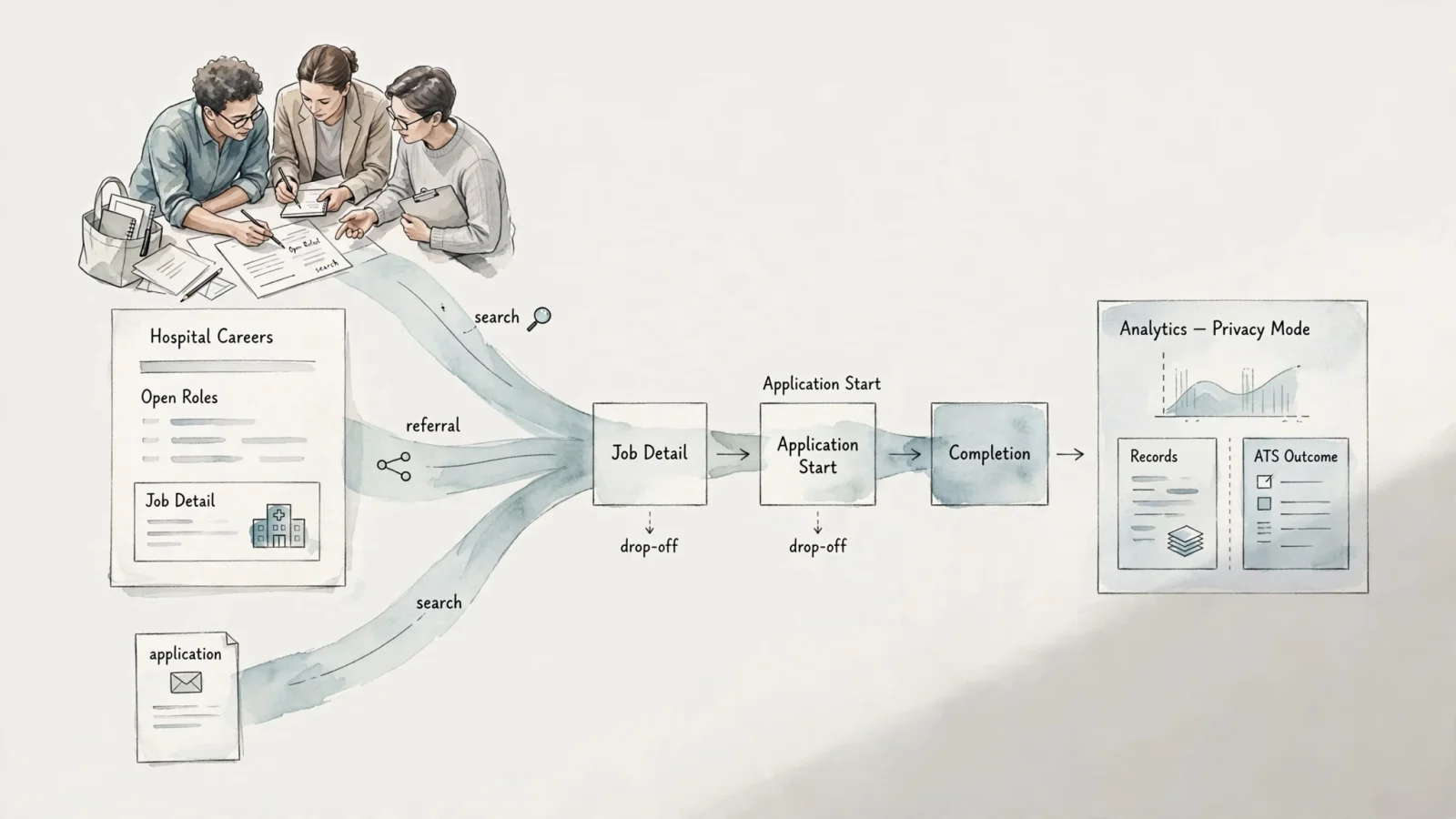
Start by mapping the measurable journey from the campaign landing page to the role or facility page, the job-detail page, the application start, the ATS handoff, and the application completion. To keep candidate data secure, bring qualified-applicant, interview, offer, and hire outcomes back into your reporting only through an approved ATS integration, server-side event, or aggregated data process.
Using consistent UTM fields across all channels means standardizing your source, medium, campaign, content, and term values. For instance, a LinkedIn paid-social campaign for a specific role and market needs a distinct UTM string from an employee-story email variation. You can configure custom events such as career_page_view, role_filter_used, job_view, recruiter_contact_click, application_start, application_handoff, and application_submit. To keep the properties safe, rely on public job IDs, role families, coarse regions, page types, and error types, while deliberately excluding names, email addresses, phone numbers, resumes, medical information, license numbers, candidate notes, patient identifiers, and unnecessary demographic data.
Website engagement differs from application completions, qualified applicants, and eventual hires. Tracking your job-detail rate, application-start rate, completion rate, and hire rate by source gives you a clearer picture. Because universal benchmarks remain unverified and vary wildly by role, market, process, and channel, a conversion rate calculator can help establish your own baseline for specific job families over time.
Swetrix serves as the primary measurement layer for this data by handling UTM attribution, referral reporting, custom events, and ordered funnels without relying on default cookie-based tracking. You gain SEO integration and error visibility while identifying exactly where candidates leave the funnel. If an agency runs these campaigns, they can standardize event taxonomies, create client reports, and embed selected Swetrix dashboard views, keeping candidate identity and hiring records safely inside the client's ATS. This setup helps you diagnose drop-offs; high job views combined with low application starts suggest unclear requirements or a weak CTA, whereas high starts and low completions point to ATS friction or form errors.
Maintaining Trust and Compliance in Recruitment Marketing
Healthcare recruitment marketing operates under specific privacy and fair-employment guidelines. Your recruitment advertising, audience targeting, exclusions, referral programs, and automated workflows cannot prefer or discourage applicants based on protected characteristics, and state or local rules often add further requirements.
Protect patient and applicant data at every step, keeping in mind that patient stories, images, testimonials, and clinical details can involve protected health information (PHI). Never use them in recruitment content without appropriate authorization and privacy review. Instead, rely on employee stories and non-identifying operational examples, which provide safer starting points for employer branding. You can maintain clear boundaries around advertising and testimonials by ensuring all employee endorsements are truthful and disclosing any material relationships.
For organizations targeting candidates in the UK, analytics cookies and similar technologies require appropriate consent under the Privacy and Electronic Communications Regulations (PECR). A cookieless analytics platform helps reduce this tracking footprint, though it does not resolve privacy obligations created by forms, advertising platforms, or other external scripts.
Set strict boundaries for session replay and experimentation. Swetrix separates its standard cookieless analytics from optional features like replays, which should never automatically record application portals, authenticated candidate areas, or free-text submissions. If you deploy session replay on public career pages to diagnose usability issues, start the recording deliberately, mask text input, exclude sensitive areas, and define a retention period. Similarly, you can run A/B tests on CTA wording, page layouts, story placement, or recruiter-contact locations, provided you avoid experimenting on protected characteristics or sensitive candidate attributes.
Structuring a 30-Day Recruitment Marketing Plan
You can turn this framework into a manageable 30-day starting plan for a hospital, clinic, health system, staffing firm, or recruitment agency by breaking the work into focused phases.
During days one through seven, establish a baseline by selecting one priority role and market. Inventory the associated career pages and ATS handoffs, connect Google Search Console, standardize your campaign naming conventions, and define your event map. Be sure to review sensitive-page exclusions and privacy settings before deploying any tracking script.
During days eight through twenty-one, focus on improving one candidate journey. Update a specific role or facility landing page with accurate schedules, locations, team structures, clinical support, and development pathways, then add an authentic employee story. Strengthen the call to action on the job page, validate mobile responsiveness, and review the JobPosting markup for accuracy. You can check for technical friction using a broken link checker to verify every ATS handoff works before launching tagged campaigns to drive traffic to this updated flow.
During days twenty-two through thirty, learn, report, and scale carefully by comparing traffic sources and creative variations. Review Search Console queries to see what candidates ask before finding your site, and inspect funnel drop-offs or technical errors in your analytics dashboard. After comparing your website signals with the qualified-applicant data recorded in the ATS, you might run one controlled landing-page experiment if your traffic volume and governance policies support it. Moving forward, avoid reallocating budget based on pageviews alone; instead, use application starts and completed handoffs as your primary optimization signals.
Measure your healthcare recruitment funnel without giving up privacy. Swetrix connects campaign sources, career-page behavior, and funnel drop-offs in one secure dashboard. Agencies and B2B platforms can embed privacy-first recruitment analytics directly into client portals while keeping downstream hiring decisions in the appropriate ATS. Start measuring your candidate journey at Swetrix.