- Date
Is Google Analytics Illegal in Europe? 2026 Guide
 Andrii Romasiun
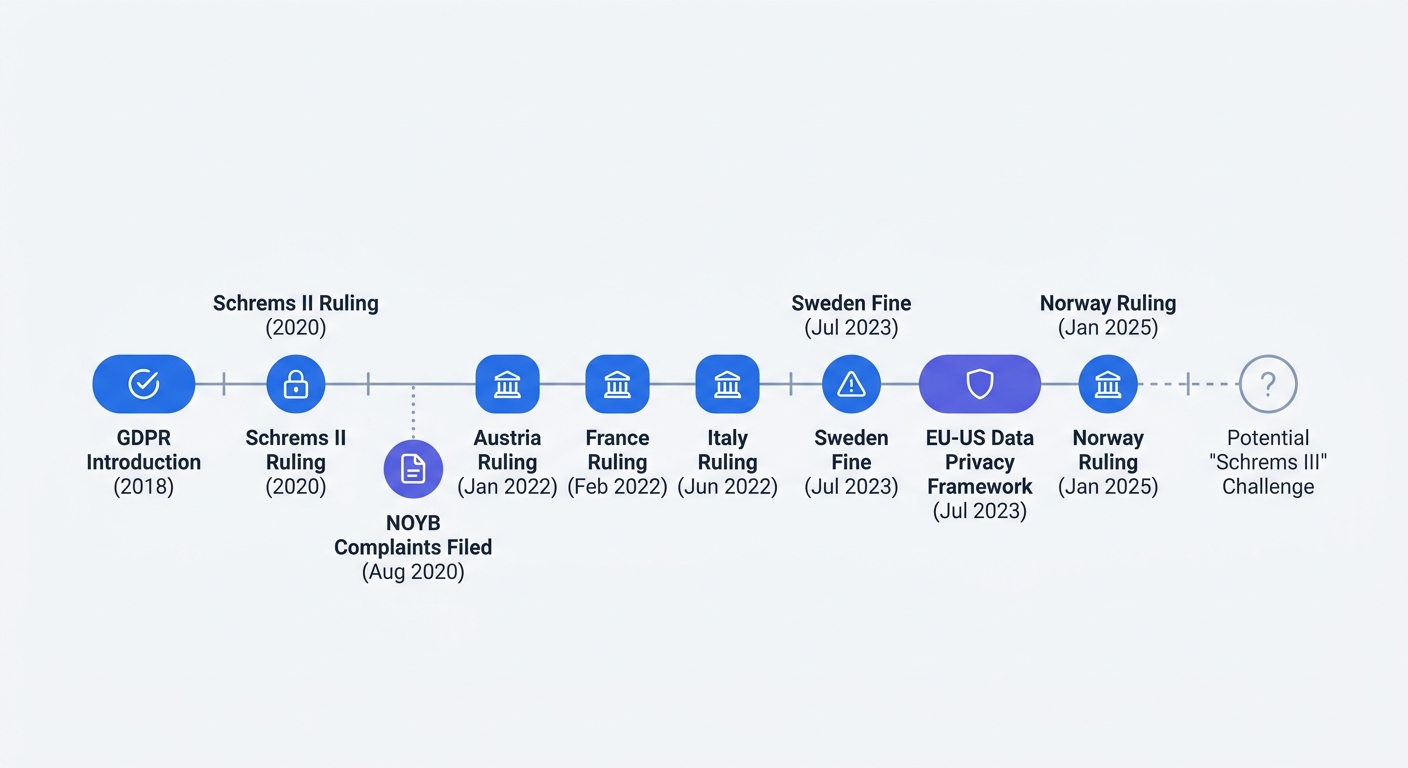
Multiple European data protection authorities have ruled Google Analytics non-compliant with GDPR. Austria banned it in January 2022 . France followed in February. Italy joined in June. By January 2025, Denmark, Finland, Norway, and Sweden had issued similar rulings. The Swedish authority fined telecommunications provider Tele2 €1 million in July 2023 for using the platform. GDPR violations carry penalties up to €20 million or 4% of global revenue, whichever is higher.
The legal status remains fluid in 2026. The EU-US Data Privacy Framework, adopted in July 2023, addressed some data transfer concerns. Privacy advocates question whether it will survive judicial review. Max Schrems, who brought down the previous Privacy Shield agreement, recommends businesses "have a 'host in Europe' contingency plan" in case the framework collapses under political pressure.
Check whether your country has issued a ruling. Assess your fine exposure based on revenue. Document your current analytics setup before regulators come knocking.
Why European Authorities Declared Google Analytics Illegal
The Schrems II Ruling and Its Impact
The Court of Justice invalidated Privacy Shield in 2020 because US surveillance programs could access EU users' data beyond what was necessary and proportional. FISA 702 and Executive Order 12.333 grant US intelligence agencies broad authority to collect data from American companies. Google, headquartered in California, falls under these laws.
European data protection authorities concluded that Google Analytics violated GDPR since US authorities could access EU users' data and anonymized data combined with other information could identify individuals. The platform collects pages visited, browser information, operating system, screen resolution, selected language, timestamps, and IP addresses. Each data point alone might seem harmless. Combined, they create a unique fingerprint.
Standard Contractual Clauses, the legal mechanism Google relied on after Privacy Shield fell, proved insufficient. Authorities ruled that contractual promises cannot override US surveillance laws. A company cannot promise not to comply with a government order.
Which Countries Have Banned Google Analytics
Seven countries have issued official rulings: Austria, France, Italy, Denmark, Finland, Norway, and Sweden. The Austrian Data Protection Authority decided in January 2022 that the platform is "subject to surveillance by U.S. intelligence services." France's CNIL declared EU-US data transfers to Google Analytics illegal one month later. Italy's Garante followed in June 2022.
Nordic countries joined the enforcement wave in 2025. Norway's Datatilsynet published its ruling in January. By mid-2025, six national DPA enforcement cases against GA4 had been published. Each ruling followed the same logic: transferring personal data to a US company subject to intelligence surveillance violates GDPR's data transfer restrictions.
Other EU member states have not issued formal bans, but the European Data Protection Board coordinated the approach. Decisions in one country signal how authorities elsewhere will rule on identical complaints. The lack of a public ruling does not mean permission to use the platform without compliance measures.
The NOYB Complaint Campaign Across 30 Countries
Privacy advocacy group NOYB filed 101 complaints in all 30 EU and EEA member states in August 2020. The complaints targeted European companies forwarding visitor data to Google and Facebook. The European Data Protection Board set up a task force in September 2020 to promote consistent handling across jurisdictions.
The campaign aimed to force systematic enforcement rather than isolated cases. Filing in every member state prevented authorities from waiting to see what others would do. The strategy worked. Multiple countries issued rulings within 18 months.
Tele2's €1 million fine demonstrated that enforcement carries financial consequences. The penalty was the first major fine for using Google Analytics. More will follow as authorities work through the complaint backlog.
The EU-US Data Privacy Framework: Does It Make GA Legal Again?
What Changed in July 2023
The European Commission adopted the Data Privacy Framework adequacy decision on July 10, 2023. The framework establishes new safeguards for data transferred to certified US companies. Google LLC joined the DPF program, resolving the most pressing legal issue with transatlantic data transfers.
The framework requires participating companies to implement specific privacy protections. US intelligence agencies face new limitations on data access. An independent Data Protection Review Court handles complaints from EU residents. These mechanisms aim to address the deficiencies that doomed Privacy Shield.
Using Google Analytics to transfer personal data from the EEA to Google is no longer illegal in itself, for now. The conditional phrasing matters. The framework provides a legal basis for transfers, but other GDPR requirements still apply. Consent, data minimization, and purpose limitation remain mandatory.
Why Privacy Experts Remain Skeptical
Max Schrems expressed skepticism that the DPF will survive under Trump's restructuring agenda. He stated: "I can hardly imagine that a Biden Executive Order that was forced on the US by the EU and that regulates US espionage abroad could survive Trump's 'America First' logic." A January 2025 NOYB press release questioned whether the DPF can offer the protection GDPR requires.
Norway's Datatilsynet noted that while transatlantic transfers may be resolved, other privacy challenges remain. The authority stated: "What until now had been a major problem with Google Analytics seems to have been solved. That said, we do not rule out that there may be other privacy challenges with the tool."
The framework's survival depends on political will in Washington. Executive orders can be revoked. Intelligence agency practices can change. A new administration might prioritize surveillance over trade relations. European businesses relying on the DPF face regulatory risk if the framework collapses.
Preparing for a Potential 'Schrems III' Scenario
Document your compliance measures now. If the framework falls, you need evidence that you took reasonable steps to protect EU data. Maintain records of your data processing activities. Update your privacy policy to reflect current practices. Sign a Data Processing Agreement with Google.
Evaluate alternatives hosted within the EU. If the DPF is annulled, you will need to switch quickly. Testing a backup solution now prevents scrambling during a regulatory crisis. Run parallel analytics for one month to verify the alternative captures equivalent data.
Set up alerts for regulatory news. Subscribe to your national data protection authority's announcements. Follow NOYB's press releases. The first indication of a "Schrems III" challenge will come from privacy advocacy groups, not official channels. Early warning gives you time to migrate before enforcement actions begin.
Is Google Analytics 4 GDPR-Compliant in 2026?
GA4's Built-In Privacy Improvements
GA4 doesn't log or store IP addresses from EU users. IP anonymization is enabled by default and cannot be disabled. Google positioned this as a direct response to European privacy concerns. Unlike Universal Analytics, where anonymization was optional, GA4 strips IP addresses before any processing or storage occurs.
The platform processes data differently than its predecessor. GA4 uses event-based tracking rather than session-based. This architectural change reduces the amount of personal data collected. The platform also offers more granular data retention controls. Set retention periods as short as two months, though 14 months is the practical minimum for meaningful year-over-year comparisons.
These improvements do not solve GDPR compliance. The platform still transfers data to US servers. Google remains subject to US laws. Technical privacy features do not override legal requirements for consent and lawful data processing.
The Consent Mode v2 Requirement
Google's Consent Mode v2 has been compulsory for sites receiving EEA traffic since March 2024. The feature adjusts tracking behavior based on user consent choices. When a visitor declines analytics cookies, GA4 switches to cookieless pings that provide aggregate data without identifying individuals.
Consent Mode v2 requires integration with a Consent Management Platform. The CMP presents the cookie banner, captures user choices, and communicates those choices to GA4. The platform then loads different tracking scripts based on consent status. Visitors who accept analytics cookies receive full tracking. Those who decline receive minimal, non-identifying measurement.
Configure your CMP to block GA4 until users accept analytics cookies. Default "opt-in" settings violate GDPR. The platform cannot load before consent is granted. Test your implementation by declining cookies and verifying that no GA4 requests fire in your browser's network tab.
Configuration Steps to Make GA4 Legal
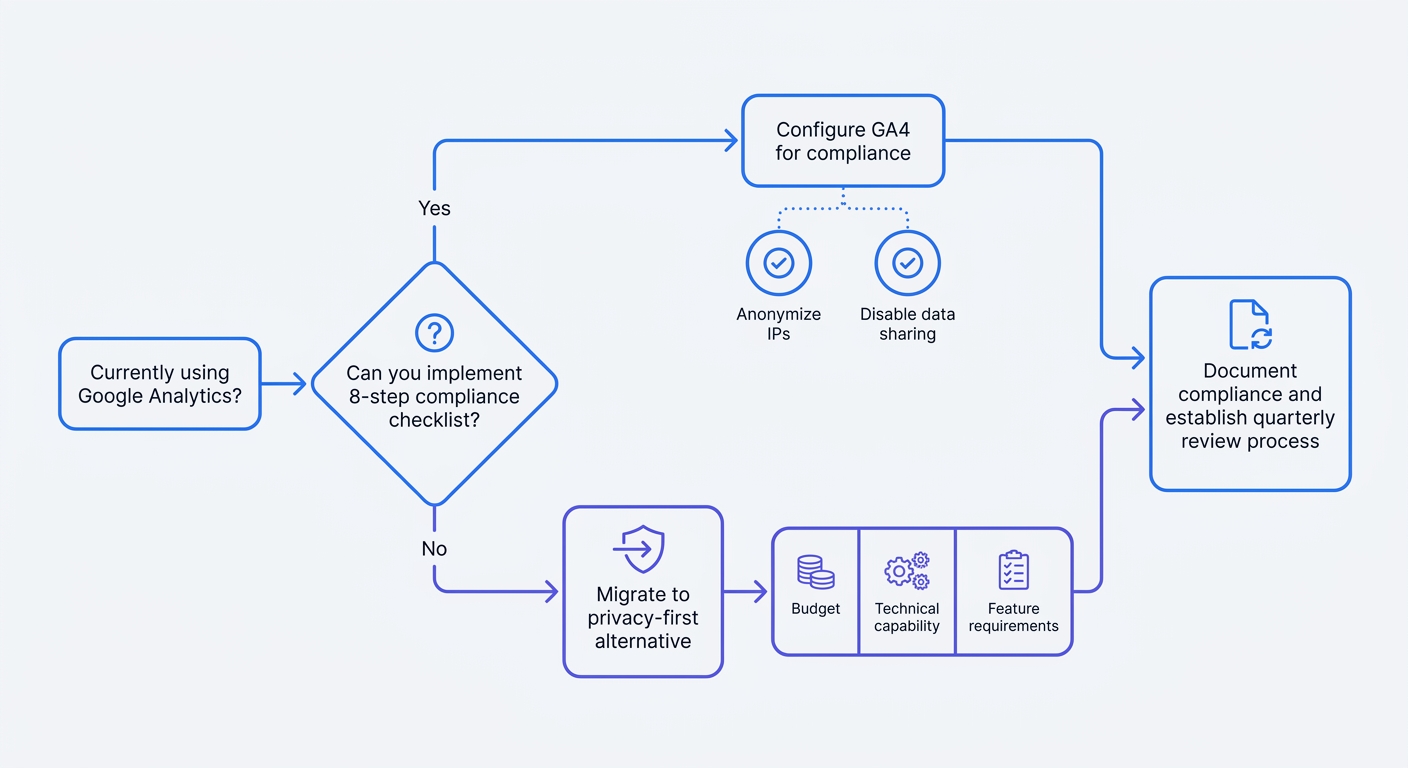
Follow this eight-step checklist to configure GA4 for GDPR compliance:
- Obtain valid opt-in consent before activating analytics tracking or setting cookies. Pre-checked boxes do not constitute valid consent.
- Set allow_google_signals and allow_ad_personalization_signals to 'off' by default in your GA4 configuration.
- Configure your cookie consent banner to block GA4 until users accept analytics cookies.
- Enable IP anonymization (enabled by default in GA4, but verify in your property settings).
- Set up Consent Mode V2 through your CMP integration.
- Configure data retention to 14 months minimum in the "Data Retention" section of GA4 admin settings.
- Disable data sharing with Google products and services in the property settings.
- Sign a Data Processing Agreement with Google and update your privacy policy to reflect GA4 usage.
Alternatively, load gtag.js and associated pixels via Server-side Google Tag Manager from an EU server. Purge IP addresses before sending data to Google Analytics for processing. This approach keeps data processing within EU borders until anonymization is complete.
Audit your current setup against this checklist. Fix gaps within 30 days. Document each step in your compliance records.
The Hidden Cost of Using Google Analytics in Europe
The 90% Traffic Data Loss Problem
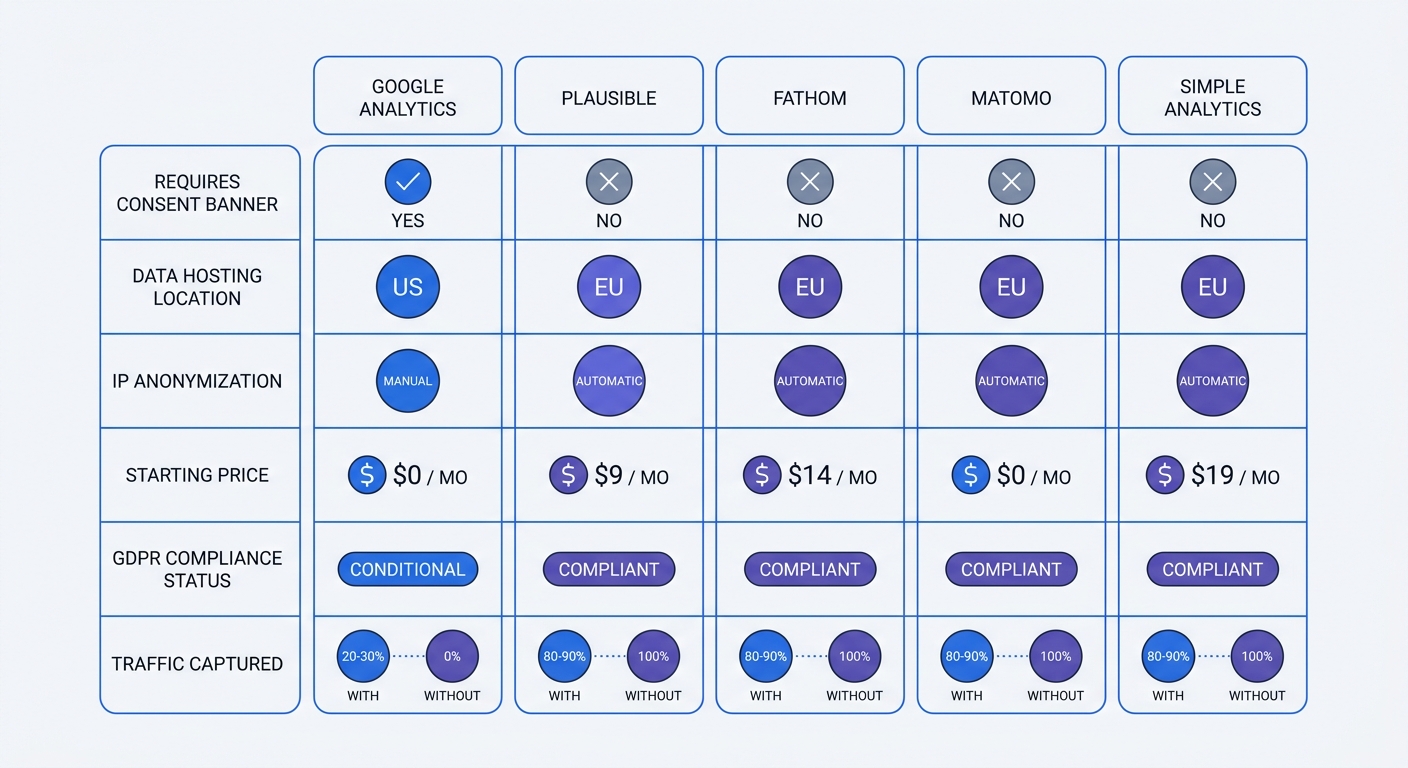
The UK's Information Commissioner's Office shared that their website traffic dropped by 90.8% after showing visitors a cookie consent banner. The ICO, the UK's data protection authority, experienced this data loss despite being a government entity with high brand trust. Commercial websites face similar or worse decline rates.
Visitors who decline consent aren't tracked at all. Depending on your audience, a significant portion of traffic becomes invisible. European users decline cookies at higher rates than users in other regions. Privacy-conscious visitors, the demographic most likely to decline tracking, often represent your most engaged audience segment.
Calculate your potential data loss. If 50% of visitors decline cookies, half your traffic data disappears. Marketing attribution becomes guesswork. Conversion rate optimization relies on incomplete data. A/B test results lack statistical significance because sample sizes shrink by half.
Why Consent Banners Kill Your Analytics Accuracy
Consent banners introduce selection bias into your data. Visitors who accept cookies differ from those who decline. Accepters tend to be less privacy-conscious, less technical, or more trusting of brands. Decliners often represent power users, early adopters, and high-value customers.
Your analytics now show what one subset of visitors does, not what all visitors do. Bounce rates, time on page, and conversion rates reflect the behavior of cookie accepters only. Decisions based on this skewed data optimize for the wrong audience.
The problem compounds over time. As privacy awareness grows, acceptance rates decline. Your historical data becomes incomparable to current data. Year-over-year trends reflect changing consent rates as much as changing user behavior. Seasonal patterns blur when acceptance rates fluctuate.
Legal Risks That Go Beyond Fines
Websites that continue unlawful transfers face administrative fines up to €20 million or 4% of global turnover under Article 83 GDPR. The financial penalty is only one risk. Regulatory investigations consume management time and legal fees. Public enforcement actions damage brand reputation.
Competitors can file complaints with data protection authorities. A single complaint triggers an investigation that examines your entire data processing operation, not just analytics. Authorities may discover violations in other areas: email marketing, customer databases, third-party integrations. One complaint cascades into multiple enforcement actions.
Business partners and enterprise customers require GDPR compliance certification. Non-compliance blocks partnerships, delays contracts, and eliminates you from procurement processes. The opportunity cost exceeds any fine.
Privacy-First Alternatives to Google Analytics
Why Cookieless Analytics Eliminates Compliance Risk
Cookieless tracking doesn't require consent banners. By not using cookies, you do not need to obtain consent from visitors to store and retrieve data from their devices. No cookie banner required. Track 100% of visitors without selection bias.
Cookieless platforms use server-side tracking, browser fingerprinting alternatives, or first-party data collection that doesn't rely on persistent identifiers. These methods comply with GDPR because they don't process personal data in ways that require consent. The platforms collect aggregate statistics without identifying individuals.
The accuracy advantage is substantial. As Google Analytics data becomes more inaccurate and unreliable, more businesses turn to privacy-focused cookieless solutions where data isn't shared with third parties.
Top GDPR-Compliant Analytics Tools Compared
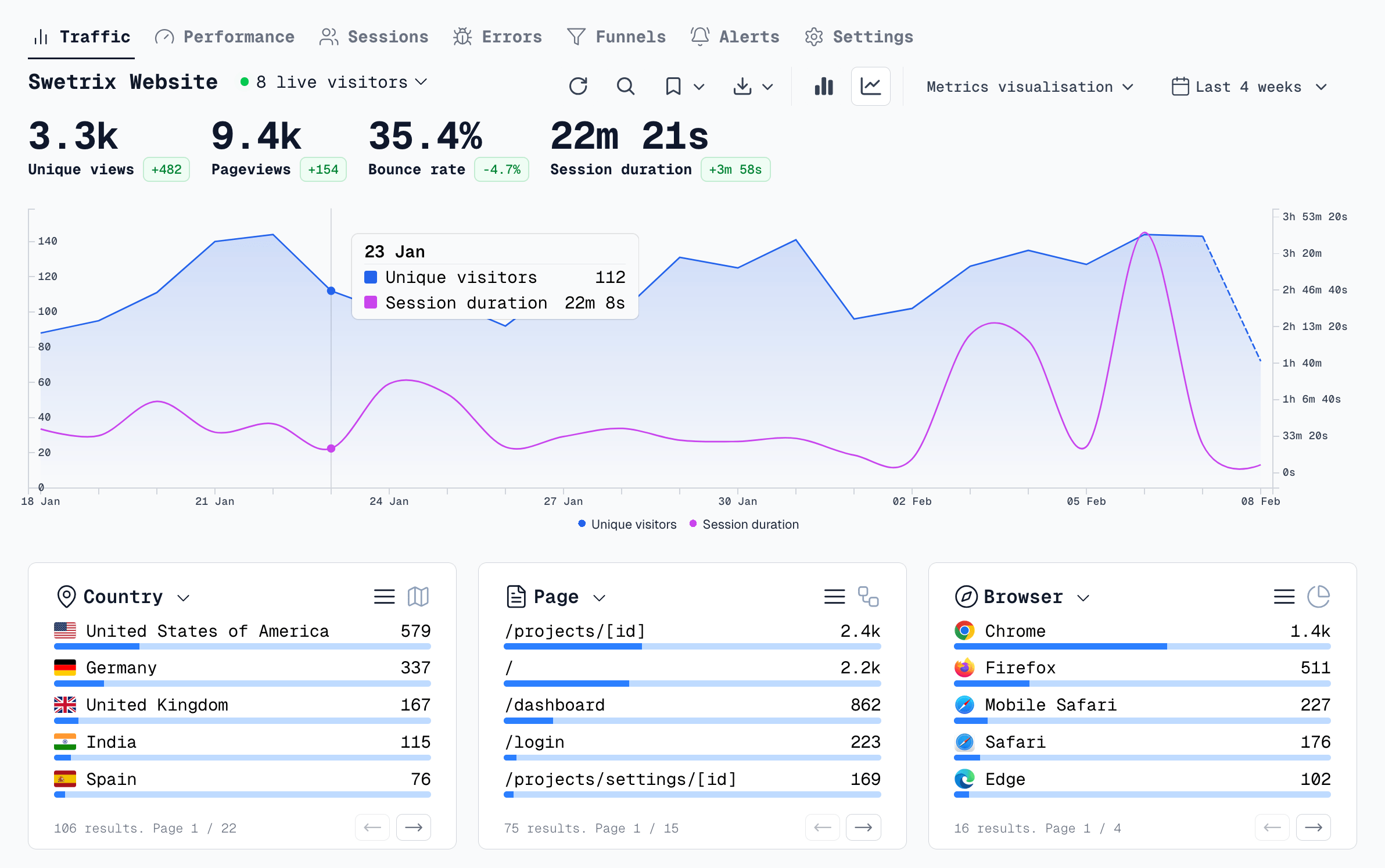
Swetrix is a cookieless, privacy-focused Google Analytics alternative built for teams that want accurate traffic data without consent-banner data loss. Swetrix is open source, stores data in the EU, and avoids cookies and cross-device tracking, so you can measure 100% of visits while respecting visitor privacy. The dashboard covers the essentials - page views, unique visitors, sessions, bounce rate, referrers, devices, countries, UTM campaigns, entry pages, and exit pages - then goes deeper with custom events, conversion goals, funnels, user flows, session analysis, real-user performance monitoring, and client-side error tracking. Teams can share public or password-protected dashboards, invite teammates, export data, use the API, and set alerts through email, Slack, Telegram, Discord, webhooks, or browser push. Start with a 14-day free trial, or self-host the Community Edition if you need full infrastructure control.
Plausible Analytics is a lightweight alternative offering simple web metrics: page views, unique visitors, bounce rate, and visit duration. The company is based in Estonia with legal entity incorporated in the EU. All data is kept secured, encrypted, and hosted on renewable energy powered servers in Falkenstein, Germany, owned by Hetzner. Pricing starts at $9/month for 10,000 monthly pageviews. The self-hosted version is free.
Fathom Analytics tracks unique visitors, page views, time on site, bounce rate, and referral data without cookies. Pricing starts at $5/month for 100,000 pageviews. The platform emphasizes speed, loading in under 1KB compared to GA4's 45KB script size.
Matomo offers both self-hosted and cloud versions. The self-hosted version is free. Cloud plans start at €22/month. Trusted on over 1 million websites, Matomo's privacy protection is configured to track 100% of visitors without consent screens. The platform provides more features than lightweight alternatives, including heatmaps, session recordings, and A/B testing.
Simple Analytics is 100% GDPR compliant from installation. Because it only processes non-personal data, it satisfies the strictest privacy regulations, including GDPR, ePrivacy Directive, UK GDPR, and PECR. The platform provides a single-page dashboard showing visitors, referrers, and top pages.
PostHog offers EU data hosting, keeping all user data within the EU to comply with GDPR. The platform combines product analytics, session replay, feature flags, and A/B testing in one tool. Pricing scales with event volume.
How to Migrate Without Losing Historical Data
Export your Google Analytics data before migrating. GA4 allows data export through BigQuery integration or the API. Download reports for your most important metrics: traffic sources, top pages, conversion funnels, and user demographics. Store these reports as baseline comparisons.
Run both platforms in parallel for 30 days. Install the new analytics code alongside GA4. Compare metrics side-by-side to verify the alternative captures equivalent data. Expect minor discrepancies due to different tracking methodologies, but core metrics should align within 5%.
Document the differences between platforms. GA4 and privacy-focused alternatives measure some metrics differently. "Sessions" in GA4 might not match "visits" in the alternative. Understand these definitional differences before making decisions based on the new data.
Set up custom events and goals in the new platform to match your GA4 configuration. If you track form submissions, button clicks, or video plays in GA4, replicate those events in the alternative. Test each event to confirm it fires correctly.
Update your team's dashboards and reports. Stakeholders accustomed to GA4's interface need training on the new platform. Create documentation showing where to find equivalent metrics. Schedule a walkthrough session for anyone who uses analytics data.
Your Action Plan: Ensuring Analytics Compliance in 2026
Audit Your Current Google Analytics Setup
Open your GA4 property settings and check these four items:
Consent implementation: Visit your website in an incognito window. Does GA4 load before you accept cookies? If yes, you violate GDPR. The tracking script must not fire until consent is granted.
IP anonymization: In GA4 admin settings, verify that IP anonymization is enabled. This setting is on by default, but custom implementations sometimes override it.
Data retention: Check the "Data Retention" section. If set to "Do not expire," change it to 14 months. Indefinite retention violates data minimization principles.
Data Processing Agreement: Search your email for a DPA from Google. If you haven't signed one, visit the GA4 admin section and complete the DPA acceptance process.
Document your findings in a compliance checklist. Note which items need fixing and assign deadlines for each fix.
Implement a Compliant Solution in 3 Steps
Step 1: Choose your path. Either configure GA4 for compliance using the eight-step checklist from earlier, or migrate to a privacy-first alternative that eliminates compliance concerns. GA4 configuration requires ongoing maintenance as regulations evolve. Privacy-first alternatives provide compliance by design.
Step 2: Execute the technical implementation. For GA4 compliance, integrate a Consent Management Platform, configure Consent Mode v2, and update your privacy policy. For migration, install the alternative analytics code, set up custom events, and run parallel tracking for 30 days. Budget one week for implementation and one week for testing.
Step 3: Document your compliance measures. Create a compliance file containing your privacy policy, DPA, consent implementation documentation, and data retention settings. Store evidence that you obtained proper consent: screenshots of your cookie banner, CMP configuration settings, and consent logs. Regulators require this documentation during investigations.
Future-Proofing Against Regulatory Changes
Set a quarterly review process to monitor regulatory developments. Subscribe to your national data protection authority's newsletter. Follow NOYB's press releases for early warnings about legal challenges. Join industry groups that track privacy regulations.
The Europe web analytics market accounted for USD 1.4 billion in 2025, representing 22.33% of the global industry, and is expected to reach USD 1.62 billion in 2026 . This growth reflects demand for compliant analytics solutions. Market momentum favors privacy-first platforms.
Test your backup plan now. If you rely on GA4, identify a privacy-first alternative and run a one-month trial. Verify it captures the metrics you need. Document the migration process so you can execute it quickly if the Data Privacy Framework collapses. Waiting until a regulatory crisis forces your hand leaves you scrambling without data during the transition.
Establish a 30-day deadline to complete your audit and implementation. Mark the date on your calendar. Assign responsibility to a specific person. Compliance requires ongoing attention as regulations evolve and enforcement intensifies.
Ready to reduce analytics compliance risk? Swetrix provides cookieless, privacy-focused web analytics with EU hosting to help you meet privacy requirements depending on your configuration and data practices. No consent banners are required for typical cookieless analytics setups, subject to your implementation and local law. Start your 14-day free trial and see how privacy-first analytics captures more accurate data than cookie-based platforms. For more on privacy regulations across different jurisdictions, read our guide on privacy regulations for websites by country.