- Date
Mastering Cookieless Attribution Models For Digital Marketing
 Andrii Romasiun
A visitor discovers your product through a targeted display ad while browsing on Safari. They click the link, read your landing page, and close the tab. Two days later, they return and buy. Traditional pixel setups credit the direct visit, assigning zero value to the display ad.
Standard attribution systems require third-party cookies to stitch together cross-site user journeys. Browsers block these trackers. Users reject consent banners at alarming rates. Marketing budgets flow into campaigns lacking visibility into return on investment.
Cookieless attribution models for digital marketing fix this visibility gap. Platforms like Swetrix bypass fragile client-side pixels using first-party data collection. You capture accurate performance metrics without invading user privacy.
Why Digital Marketing Is Going Cookieless
The Death Of Third-Party Tracking
Third-party cookies track user behavior across independent domains. Ad networks plant a cookie on a user device when they view an ad on a news site, then read that same cookie when the user arrives on your e-commerce store. This deterministic matching builds the foundation of traditional multi-touch attribution.
Browser-level privacy controls mandate the end of cross-site tracking. Safari commands a 53 percent mobile market share in the United States. Firefox holds another substantial segment of desktop users. Both browsers block tracking scripts.
Third-party cookie blocking and consent rejection alter data collection for more than 60 percent of global retail and B2B web traffic. Marketers relying on legacy pixels operate blind for more than half of their website visitors.
In April 2025, Google abandoned plans to force total deprecation of third-party cookies in Chrome. Google adopted a user choice model instead. Chrome users receive prompts within their privacy settings, shifting the burden of blocking trackers to the consumer. Audiences opt out, and third-party data disappears.
Browser Restrictions And Consent Drop-Offs
Regulations like the European Union General Data Protection Regulation (GDPR) and the ePrivacy Directive require explicit opt-in consent for non-essential tracking cookies. You must present a banner to users before firing marketing scripts.
Consent fatigue alters user behavior. When you present a "Reject All" button on a cookie banner, half to two-thirds of those users hit reject across e-commerce domains.
If your analytics platform depends on client-side cookies, every rejected banner equals a missing session in your reports. You lose the page view, the referrer data, and the conversion attribution. Revenue materializes in the database while the analytics dashboard shows a flatline.
Action Step: Audit your web traffic distribution. Open your analytics dashboard and filter sessions by browser and device type. Calculate the combined percentage of Safari and Firefox traffic. This number represents the baseline of your attribution data loss.
Exploring Cookieless Attribution Models For Digital Marketing
Defining Cookieless Attribution
Cookieless attribution eliminates third-party ad network tracking while maintaining measurement continuity. The term causes confusion because a cookieless setup might still utilize first-party cookies.
First-party cookies originate from the host domain. When a user visits your website, your server places a first-party cookie to remember their shopping cart or session ID. Browsers permit first-party cookies because they do not track users across independent domains. Cookieless analytics platforms use first-party data, aggregated server logs, and statistical modeling to measure performance.
These models categorize traffic without individual profiling. A privacy-focused platform like Swetrix uses hashed and anonymized signals. The system hashes the incoming IP address alongside a 24-hour rotating salt to generate a unique session identifier. At midnight, the salt changes and the identifier breaks. You measure the complete session journey without storing persistent personal data.
Accuracy Vs. Coverage Trade-Offs
Transitioning to cookieless models requires a mindset shift regarding accuracy. Deterministic tracking provides definitive proof that User A clicked Ad B and bought Product C.
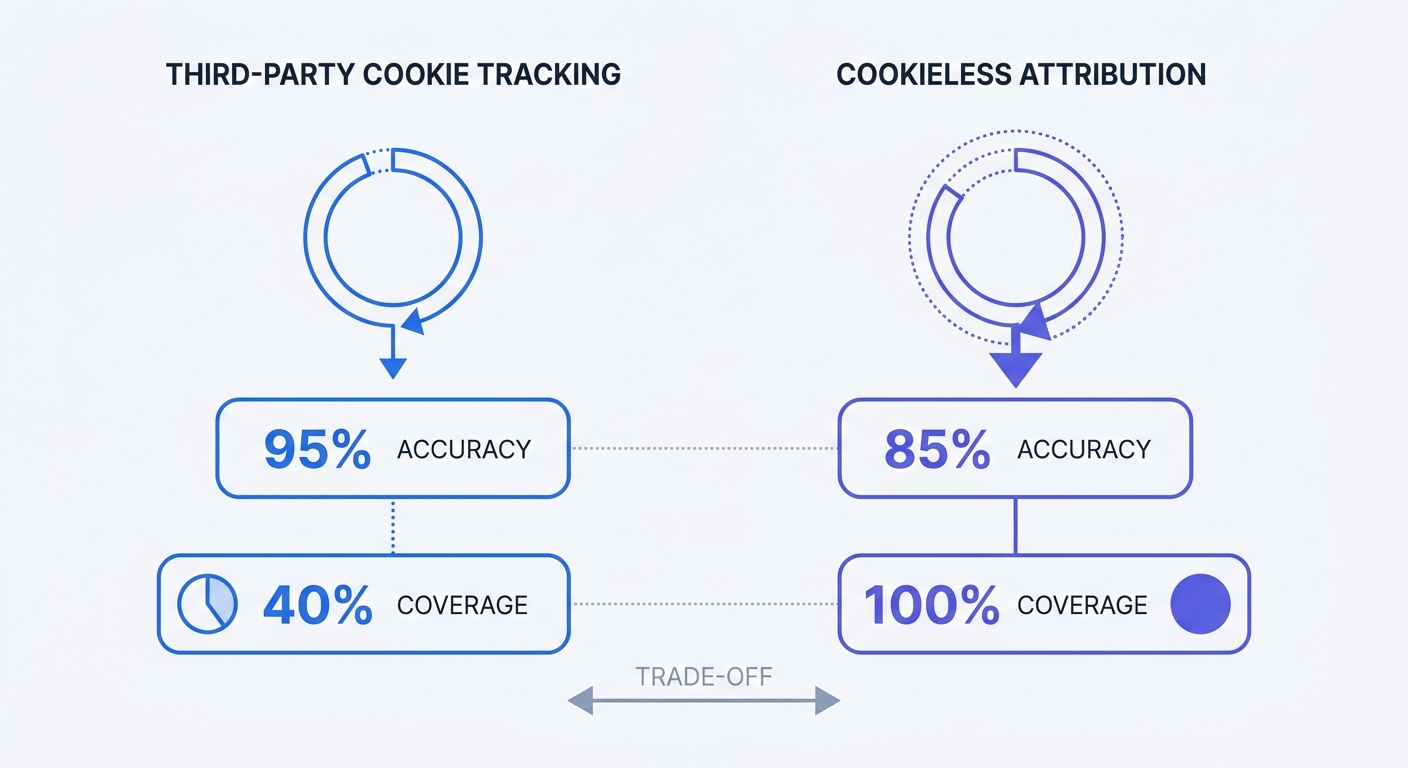
This one-to-one precision exacts a massive cost on total visibility. Our internal breakdown of cookieless website tracking details this trade-off for SaaS and e-commerce platforms. Deterministic methods hit 90 to 95 percent accuracy but shrink to 40 percent coverage due to ad blockers and rejected consent banners.
Cookieless probabilistic models cover 100 percent of traffic. The accuracy ranges from 50 to 85 percent depending on the methodology:
- Identity Graphs: Map hashed email addresses and first-party logins across devices to reach 70 to 85 percent accuracy.
- Device Fingerprinting: Analyze browser versions, screen resolutions, and installed fonts to hit 60 to 75 percent accuracy.
- Probabilistic Matching: Compare aggregated timestamp data, geographic regions, and referral patterns to achieve 50 to 65 percent accuracy.
| Feature | Deterministic Attribution | Cookieless Probabilistic Modeling |
|---|---|---|
| Tracking Mechanism | Third-party cookies, cross-site pixels | First-party data, hashed signals, server logs |
| Data Coverage | 40% (declining) | 100% |
| Individual Accuracy | 90% - 95% | 50% - 85% |
| Privacy Compliance | Requires explicit opt-in consent | Built-in compliance via anonymization |
| Ad Blocker Impact | High data loss | Low to zero data loss |
Action Step: Shift your marketing measurement focus from individual user tracking to aggregate traffic trends. Evaluate campaign success based on overall lift in conversion volume rather than hunting for specific user purchase paths.
Proven Techniques For Cookieless Attribution
Implementing Server-Side Tracking
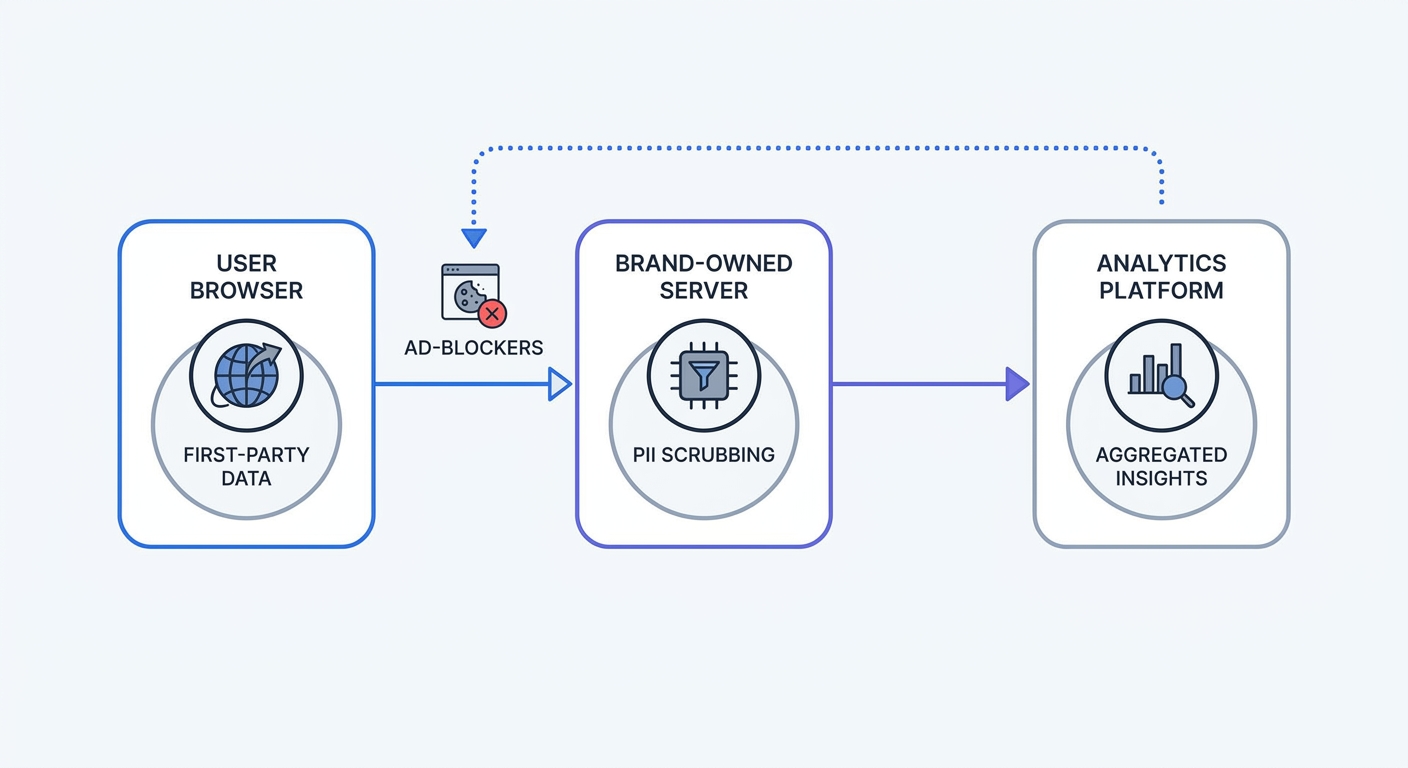
Client-side tracking executes tags inside the user browser. The browser downloads the webpage, runs the JavaScript pixel, and sends data to an analytics provider. Extensions, privacy browsers, and network-level firewalls intercept and kill these outbound requests.
Server-side tracking moves the data collection process to your infrastructure. When a user interacts with your website, their browser communicates with your web server. Your server logs the event, formats the data, and dispatches it to your analytics platform through a secure backend API connection.
Browsers avoid third-party scripts during this process. Ad blockers cannot block a standard first-party server request. Bypassing browser-level restrictions through server-side environments captures 25 to 35 percent more conversions for typical e-commerce brands compared to traditional client-side pixels.
Deploying a server-side analytics setup requires routing traffic through a designated endpoint:
- Configure a custom subdomain connected to your main website.
- Deploy a server-side container to receive incoming HTTP requests.
- Write parsing rules to strip out Personally Identifiable Information (PII) from the payload.
- Forward the clean, aggregated event data to your analytics dashboard.
Conversion APIs And Identity Graphs
Ad networks offer server-to-server integrations to bypass the dying pixel ecosystem. Meta Conversion API (CAPI) and Google Enhanced Conversions allow you to send hashed first-party user data from your database to the ad platform.
When a customer completes a purchase, your server takes the email address, hashes it using SHA-256 encryption, and transmits it to the advertising network alongside the conversion value. The network matches the hashed string against their internal user database to credit the correct campaign.
Swetrix handles cookieless performance tracking within its core infrastructure. We process page views, referrers, custom events, and session durations through our open-source tracking script or dedicated API. You retain total ownership of your performance data on our EU-hosted cloud without injecting invasive trackers into your user experience.
Action Step: Set up a server-side analytics provider like Swetrix to run in parallel with your pixel setups. Compare the raw session and conversion counts over a 14-day window to quantify how much data your client-side pixels miss.
Balancing Privacy Compliance And Marketing ROI
Complying With GDPR And ePrivacy
Analytics tools must respect user privacy boundaries. Regulatory bodies enforce massive fines for tracking users without consent, and GDPR classifies IP addresses, cookie identifiers, and device IDs as personal data. Processing this information demands legal justification.
Cookieless models protect against privacy violations when users opt out of non-essential cookies. By stripping PII at the collection point and utilizing short-lived hashes, you measure broad traffic behavior without identifying the individual.
You avoid needing a cookie consent banner for analytics if your tracking mechanism guarantees total anonymity and refrains from cross-site profiling. Dropping the banner improves user experience, lowers page load times, and restores total visibility into your baseline traffic volumes.
Solving The 50 Billion Dollar Attribution Problem
Failing to capture data ruins automated bidding algorithms. When ad platforms lose conversion signals, their machine learning models bid on the wrong audiences. Cost per acquisition spikes. Return on ad spend plummets. This widespread data blackout represents a multi-billion dollar attribution problem across the marketing industry.
Marketers must shift from deterministic Multi-Touch Attribution (MTA) models to privacy-safe, probabilistic first-party data strategies. Media Mix Modeling (MMM) offers a resilient alternative.
Analysts use MMM to evaluate historical aggregate data and determine the incremental impact of each marketing channel. Instead of tracking a single user from a podcast ad to a website purchase, MMM utilizes regression analysis to correlate podcast ad spend with total regional revenue spikes. The model accounts for seasonality, baseline sales, and overlapping channel investments without requiring a single tracking cookie.
Action Step: Update your website privacy policy to reflect your transition away from third-party tracking. State that you use aggregated, cookieless methodologies to measure site performance to assure users their data remains secure.
How To Implement Your Cookieless Strategy
Connecting CRM Pipeline Data
Business-to-business sales cycles stretch over months. A client-side cookie expires in seven days under strict browser tracking prevention rules. When a lead converts 90 days after clicking an ad, browser-based analytics fail to connect the closed revenue back to the original click.
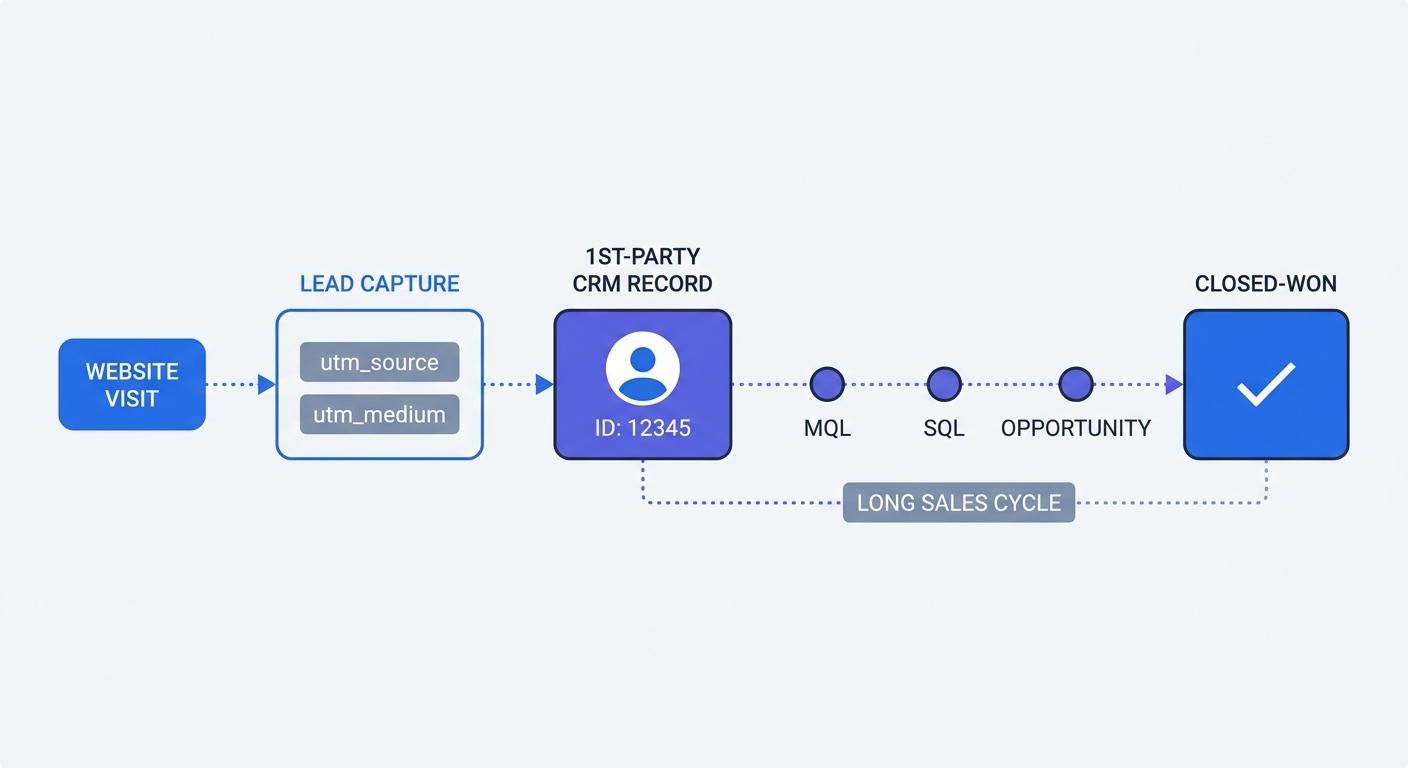
First-party pipeline attribution solves long sales cycles. You capture campaign data at the moment of lead creation and bind it to the Customer Relationship Management (CRM) record.
Use UTM parameters on every inbound marketing link. Append ?utm_source=linkedin&utm_medium=cpc&utm_campaign=q3_webinar to your ad destinations. When the user lands on your site, extract those parameters from the URL string and write them into hidden fields on your lead capture form.
<!-- Example of hidden fields in a lead capture form -->
<form action="/submit-lead" method="POST">
  <input type="text" name="firstName" placeholder="First Name" required />
  <input type="email" name="emailAddress" placeholder="Email" required />

  <!-- Hidden UTM fields populated by JavaScript on page load -->
  <input type="hidden" id="utm_source" name="utm_source" value="" />
  <input type="hidden" id="utm_medium" name="utm_medium" value="" />
  <input type="hidden" id="utm_campaign" name="utm_campaign" value="" />

  <button type="submit">Download Guide</button>
</form>
The server processes the form submission and saves the UTM values alongside the contact record. The attribution data lives in your first-party database and does not expire. When the sales team closes the deal six months later, you run a CRM report grouping closed revenue by the original utm_campaign field.
Transitioning To A First-Party Data Future
Relying on ad networks to grade their own homework creates a conflict of interest. Ad platforms want to claim credit for every conversion to justify your continued ad spend.
Building a first-party data warehouse gives you an independent source of truth. Capture interactions on your domain, log them on your servers, and connect the dots through business intelligence tools or robust analytics platforms.
Swetrix gives you the infrastructure to implement this strategy today. We offer custom event tracking, campaign grouping, error monitoring, and real-time reporting without touching third-party cookies. The platform complies with GDPR, CCPA, and PECR.
Action Step: Build a first-party data capture process integrating your CRM and your analytics tool. Add hidden UTM fields to your highest-converting lead form to start logging attribution data on your own servers.
Stop losing conversion data to ad blockers and consent banner rejections. Swetrix delivers 100 percent traffic visibility through cookieless web analytics. Start your 14-day free trial to access real-time dashboards, custom event tracking, and server-side deployment options. Pricing scales with your traffic, starting at $19 per month for 100,000 events. Own your data and protect your marketing ROI.