- Date
PostHog vs Google Analytics: Which is better in 2026?
When businesses decide they need to understand their web traffic, they almost always start with Google Analytics. However, as products scale and teams demand more detailed, actionable data, many turn to PostHog for deeper product insights.
While both platforms are giants in the analytics space, they are built for entirely different purposes. Google Analytics focuses heavily on marketing and ad conversion, while PostHog is designed for product engineers who want to track user behaviors, run experiments, and write SQL queries.
In this detailed comparison, we will explore the strengths and weaknesses of both tools. Then, we will introduce Swetrix, an alternative that strikes the perfect balance between powerful insights, an intuitive interface, and absolute data privacy.
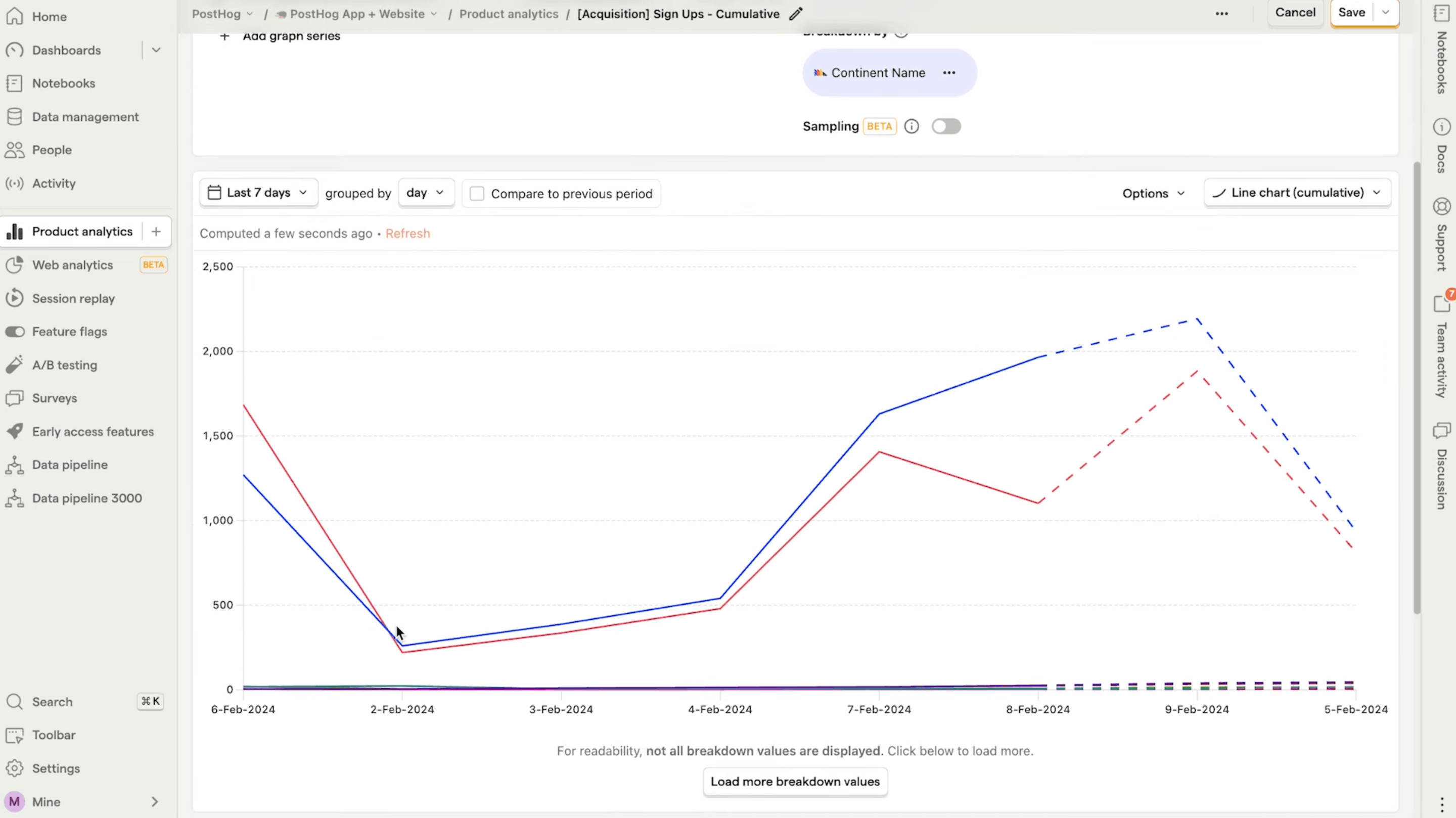
PostHog Overview
PostHog is an all-in-one product analytics operating system. It goes far beyond simple pageviews by offering session replays, feature flags, A/B testing, and deep user profile tracking. It is built for developers and product teams who want granular data on how features are being used.
Strengths:
- Complete Product Suite: Offers everything from session recordings and heatmaps to feature flags in one unified platform.
- SQL Access & Customization: Power users can write direct SQL queries and build incredibly complex, custom dashboards.
- Open Source Roots: While they have an enterprise cloud offering, the core product remains open source.
Cons:
- Steep Learning Curve: It is not a plug-and-play tool. Getting the right data requires significant configuration and technical knowledge.
- Complex Self-Hosting: Hosting it yourself requires maintaining a heavy stack (ClickHouse, Kafka, Redis, etc.), which is not suitable for hobbyists or small teams.
- Unpredictable Pricing: The usage-based pricing model can lead to unexpected bills if traffic or events spike suddenly.
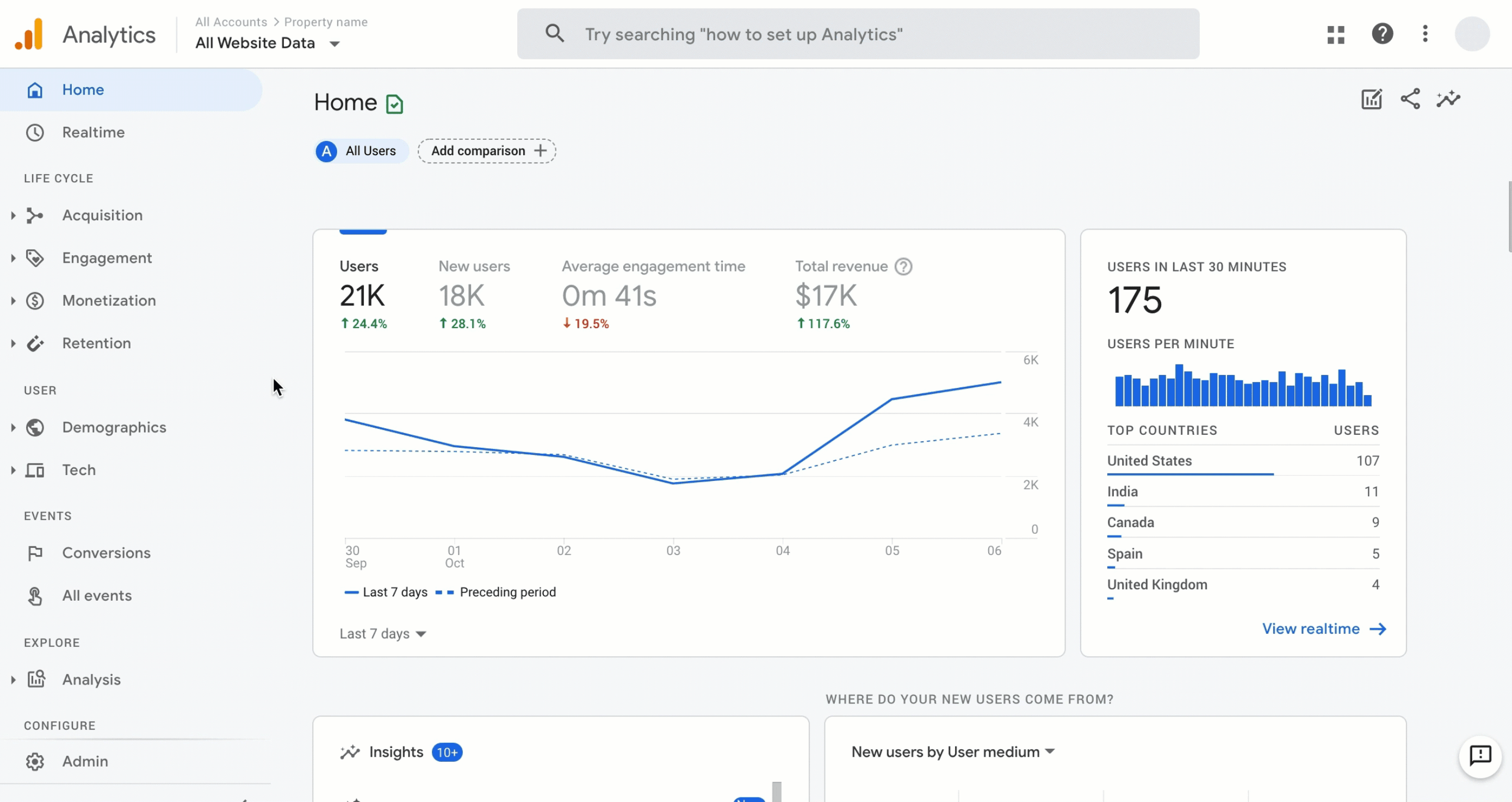
Google Analytics Overview
Google Analytics (specifically GA4) is the industry standard for web analytics. It is heavily utilized by marketers to track ad performance, user acquisition sources, and high-level traffic metrics. Because it is closely tied to the Google Ads ecosystem, it remains a default choice for many e-commerce and marketing-driven sites.
Strengths:
- Deep Ecosystem Integration: Integrates flawlessly with Google Ads, Search Console, and Google Tag Manager.
- Advanced Machine Learning: Utilizes predictive analytics to guess user behavior and conversion probabilities.
- Familiarity: Because of its market share, finding tutorials, guides, and agencies that specialize in GA4 is very easy.
Cons:
- Data Privacy Issues: Heavily reliant on cookies and invasive tracking, leading to it being deemed illegal in several EU countries due to GDPR violations.
- Data Sampling & Delays: GA4 often samples data, meaning it guesses metrics rather than counting every visitor. Real-time accuracy is also poor, often delaying data by up to 24 to 48 hours.
- Bloated and Complex: The interface is notoriously difficult to navigate, often burying basic stats behind layers of menus.
Feature Comparison: PostHog vs Google Analytics (vs Swetrix)
To truly see how these tools stack up, here is a comprehensive feature comparison comparing PostHog, Google Analytics, and Swetrix.
| Feature | PostHog | Google Analytics |  Swetrix Swetrix |
|---|---|---|---|
| Core Features | |||
| Real-time Analytics | (Delays up to 24-48h) | ||
| Custom Events | |||
| Page views | |||
| Live visitors count | |||
| UTM Tracking | |||
| Device stats (browser, OS, type) | |||
| Email Reports | |||
| Advanced Features | |||
| Performance Monitoring (Web Vitals) | |||
| User Flow Analysis | |||
| Error Tracking | |||
| Alerts / Notifications | |||
| Geolocation map visualisation | |||
| Funnels | |||
| Segments | |||
| Custom dashboards | |||
| Growth & Product | |||
| AI Chat | |||
| Goals | |||
| Experiments (A/B tests) | (Requires 3rd party) | ||
| Feature flags | |||
| User Profiles | |||
| Revenue analytics | |||
| SEO insights (Google Search Console) | |||
| CAPTCHA | |||
| Security & Access | |||
| Bot filtering | |||
| Two-Factor Authentication (2FA) | |||
| Role-based Access Control | |||
| Shared Dashboards | |||
| Organisations (Teams) | |||
| Privacy & Compliance | |||
| Cookie-less Tracking | |||
| Privacy compliance | (Illegal in some EU countries) | ||
| Open Source | (Open Core) | ||
| Easy Self-hosting | |||
| Technical specifications | |||
| Data Sampling | 0% (None) | Heavy (Data is approximated) | 0% (None) |
| Script size | >30 KB | 74 KB | 6 KB |
| API access | |||
| Bypass adblockers | |||
| Pricing | |||
| Pricing Model | Usage-based | "Free" (Data is sold) | Predictable (Flat fee) |

Where Both Tools Fall Short
While PostHog and Google Analytics serve their distinct audiences well, they both come with significant baggage that can frustrate modern website owners.
1. Excessive Complexity
Neither tool is simple. Google Analytics requires dedicated training just to understand its nested menus and reporting logic. PostHog, built by engineers for engineers, assumes you want to spend hours configuring custom SQL queries and complex dashboards. If you just want to see how your site is performing without a manual, both platforms will feel overwhelming.
2. Script Weight and Site Speed
Google Analytics bloats your website with a heavy 74 KB script, negatively impacting your page load speeds and SEO rankings. PostHog isn't much better, weighing in at over 30 KB. If website performance is critical to your business, these trackers are actively working against you.
3. The Cost of Data
Google Analytics is "free" because Google uses your visitors' data to train models and serve ads. PostHog respects data ownership more, but its pay-as-you-go pricing model can severely punish you for going viral, leading to massive, unpredictable monthly invoices.
A Better Way: Why Swetrix is the Superior Choice
You don't have to choose between the privacy-violating complexity of Google Analytics and the heavy, developer-focused infrastructure of PostHog. Swetrix provides a beautifully simple, privacy-first platform that gives you the exact insights you need without the headaches.
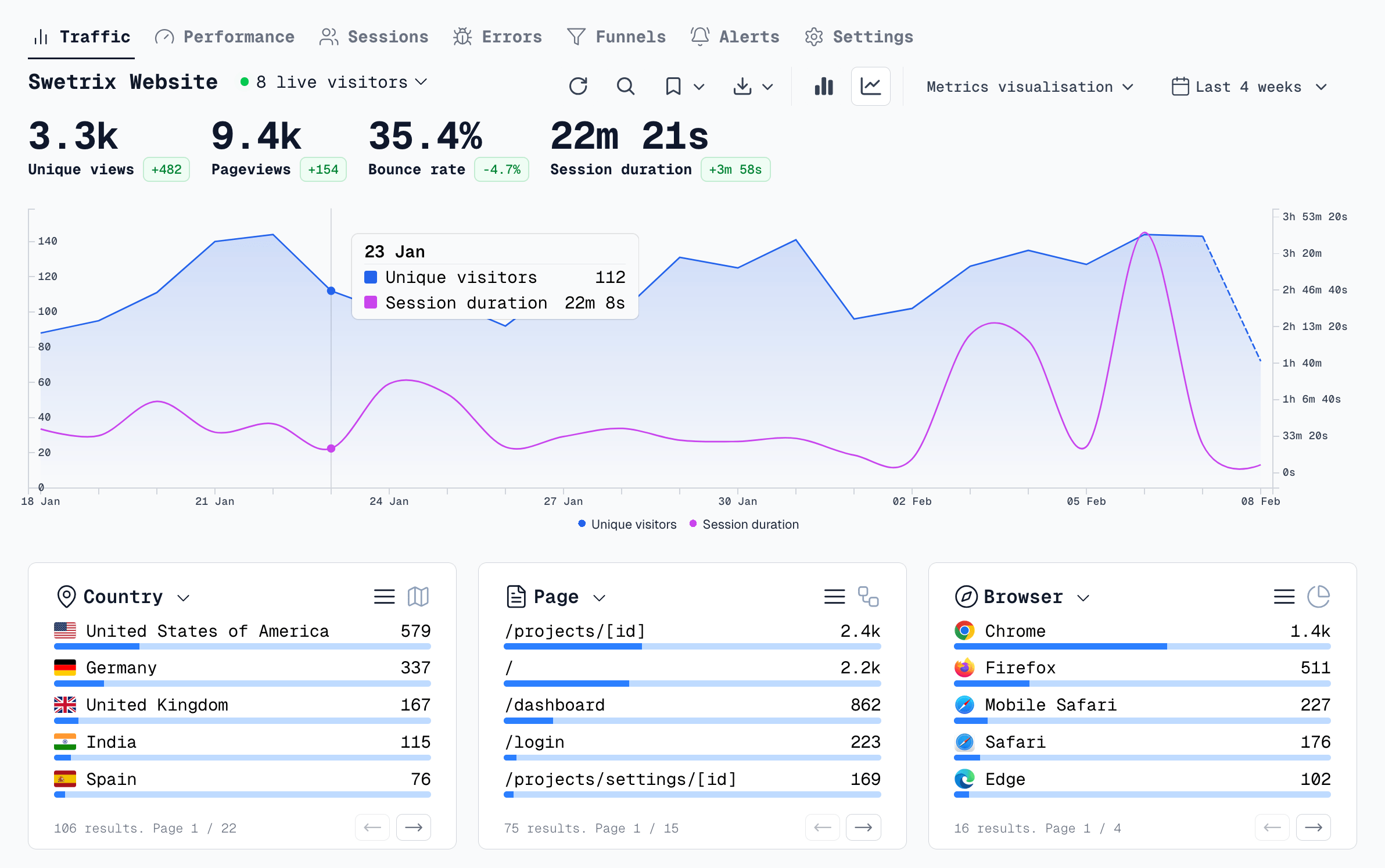
Swetrix stands out as the definitive winner for several key reasons:
- Unmatched Simplicity: The Swetrix dashboard is clean, intuitive, and ready to use immediately. You get vital metrics at a glance without needing to build custom reports or write SQL queries.
- Deep Technical Observability: Unlike Google Analytics, Swetrix bridges the gap between marketing and engineering by offering built-in Performance Monitoring (tracking Core Web Vitals) and automated Error Tracking.
- 100% Data Accuracy & Ownership: Swetrix never samples your data. Whether you have ten visitors or ten million, every request is counted accurately. Plus, you retain 100% ownership of your data, and we offer an easy 5-minute self-hosting setup via Docker if you want total control.
- Built-in Growth Tools: Swetrix includes everything you need to scale, including A/B Testing, Feature Flags, User Flows, and a natural language AI Chat assistant, effectively replacing multiple expensive third-party tools.
- Lightweight & Fast: Our tracking script is a mere 6 KB. It loads instantly and completely bypasses adblockers, ensuring you capture accurate data without slowing down your site.
If you are looking for an analytics tool that respects user privacy, delivers perfectly accurate real-time data, and is a joy to use, it is time to make the switch. Swetrix offers the advanced growth capabilities you want with the simplicity you deserve.

The web analytics your site deserves.
Tired of bloated dashboards, privacy concerns, and data you can't trust? Switch to Swetrix and get simple, powerful analytics that respects your users.