- Date
What Is Data Ownership and Why Does It Matter for Your Business
 Andrii Romasiun
When you hear the term data ownership, what comes to mind? For many, it's a fuzzy concept, but getting it right is one of the most important things you can do for your business.
Think of it this way: owning your data is like owning a physical property. You have the deed, which gives you the legal right to the property, and you have the keys, which give you the practical ability to control who comes and goes. Data ownership is the combination of both—having the legal authority and the hands-on control over your company's information.
What Does Data Ownership Really Mean?
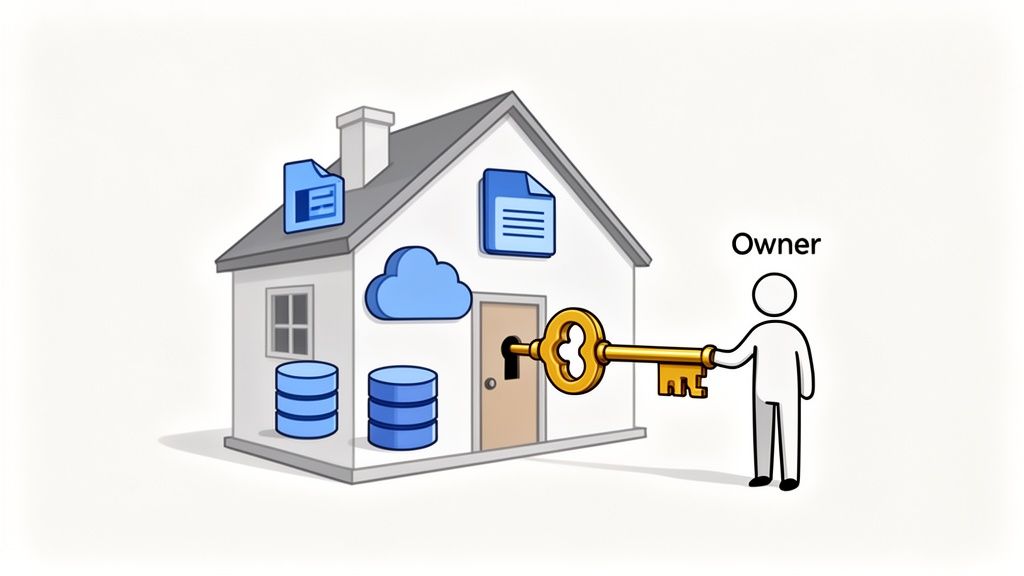
True data ownership isn’t just about having files stored on a server you pay for. It’s a complete framework that dictates how you can access, use, share, and even delete that information. Without a clear handle on this, you're essentially handing over the keys to your most valuable business asset.
This isn't just an IT problem, either. The insights you pull from user behavior are the lifeblood of your product and marketing teams. This is the foundation of modern web analytics, and if you don't own the data, you can't guarantee the integrity or availability of those insights.
The Three Pillars of Data Ownership
To really get to the heart of data ownership, it's best to break it down into three distinct, yet interconnected, pillars. Each one answers a different fundamental question about control and responsibility.
Let's quickly summarize these pillars before we dive deeper into each one.
The Three Pillars of Data Ownership
| Pillar | Core Question | Primary Focus |
|---|---|---|
| Legal Ownership | "Who has the legal claim to the data?" | Contracts, privacy laws (GDPR, CCPA), and terms of service. |
| Technical Ownership | "Who can physically access and manage the data?" | Infrastructure, databases, access controls, and security. |
| Practical Ownership | "Who can actually use the data to create value?" | Analytics tools, APIs, and the ability to act on insights. |
Getting all three of these right is what separates companies that are in control from those that are just renting their data from a third-party vendor.
At its core, data ownership is about having the final say. It means you are the ultimate authority, not just a temporary custodian, with the power to manage your data's entire lifecycle from the moment it's created to the moment it's deleted.
Why Data Ownership Is a Strategic Business Imperative
Data used to be an afterthought, a simple byproduct of doing business. Not anymore. Today, it’s one of the most valuable assets a company has, and figuring out who owns it has become a boardroom-level conversation. When data ownership is a grey area, you’re not just dealing with a technical messy-desk problem—you're opening your business up to serious financial, competitive, and reputational risks.
Without a firm grip on your data, you’re vulnerable. We’re talking about everything from devastating security breaches and eye-watering regulatory fines to product teams flying blind because they can't get the information they need. Getting data ownership right is the bedrock of a modern, resilient business. It’s what turns a potential liability into a genuine strategic advantage.
Fueling Growth and Building Trust
When you establish clear data ownership, you shift from a defensive, compliance-first mindset to one focused on proactive growth. It’s the foundation for building real trust with your customers, who are more skeptical than ever about how their personal information is being used. And with the sheer volume of data being created, this has never been more critical.
The numbers tell the story. The global data governance market was valued at $1.81 billion in 2020 and is on track to hit $5.28 billion by 2026. This is happening because we’re expected to generate a mind-boggling 180 zettabytes of data by 2025. At the same time, customer patience is wearing thin—a full 77% of consumers say they’d walk away from a company for good if it mishandled their data.
When you don't own your data, you are building your business intelligence on rented land. You're subject to the landlord's rules, rent hikes, and the constant risk of eviction, leaving you without the historical insights you need to grow.
This reality check makes one thing clear: data ownership isn't just a good idea; it's a non-negotiable part of staying in business.
From Technical Task to Business Imperative
Ultimately, when you treat data ownership as the strategic priority it is, you empower everyone in your organization. Your analytics and product teams can finally make smart, quick decisions because they have direct access to a complete and reliable source of truth. They’re no longer stuck wrestling with the limitations of third-party tools or worrying about vendor lock-in.
The best way to achieve this level of control is often through first-party data collection. For example, setting up a **self-hosted web analytics** platform gives you total authority over the infrastructure and every byte of data it collects. This approach guarantees that your most valuable asset remains yours, fueling innovation and sustainable growth on your own terms. In today's market, ignoring data ownership isn’t an option—it’s the difference between leading the pack and being left behind.
Navigating the Complex World of Data Privacy Laws
To really get what data ownership means on the ground, you have to look at the laws that shape it. Over the last decade, a wave of global regulations has completely changed the game, giving everyday people solid, enforceable rights over their personal information. This legal shift essentially positions consumers as the true owners of their data, making businesses the temporary custodians tasked with keeping it safe.
These aren't just polite suggestions; they come with serious teeth. A single mistake can trigger fines running into the millions, not to mention the kind of reputational damage that can sink customer trust for good. The golden rule here is simple but critical: your compliance obligations follow your users, no matter where your company calls home.
This worldwide push for stronger data ownership isn't a fluke. It's a direct response to the explosion of data and the growing unease people feel about how it's being used.
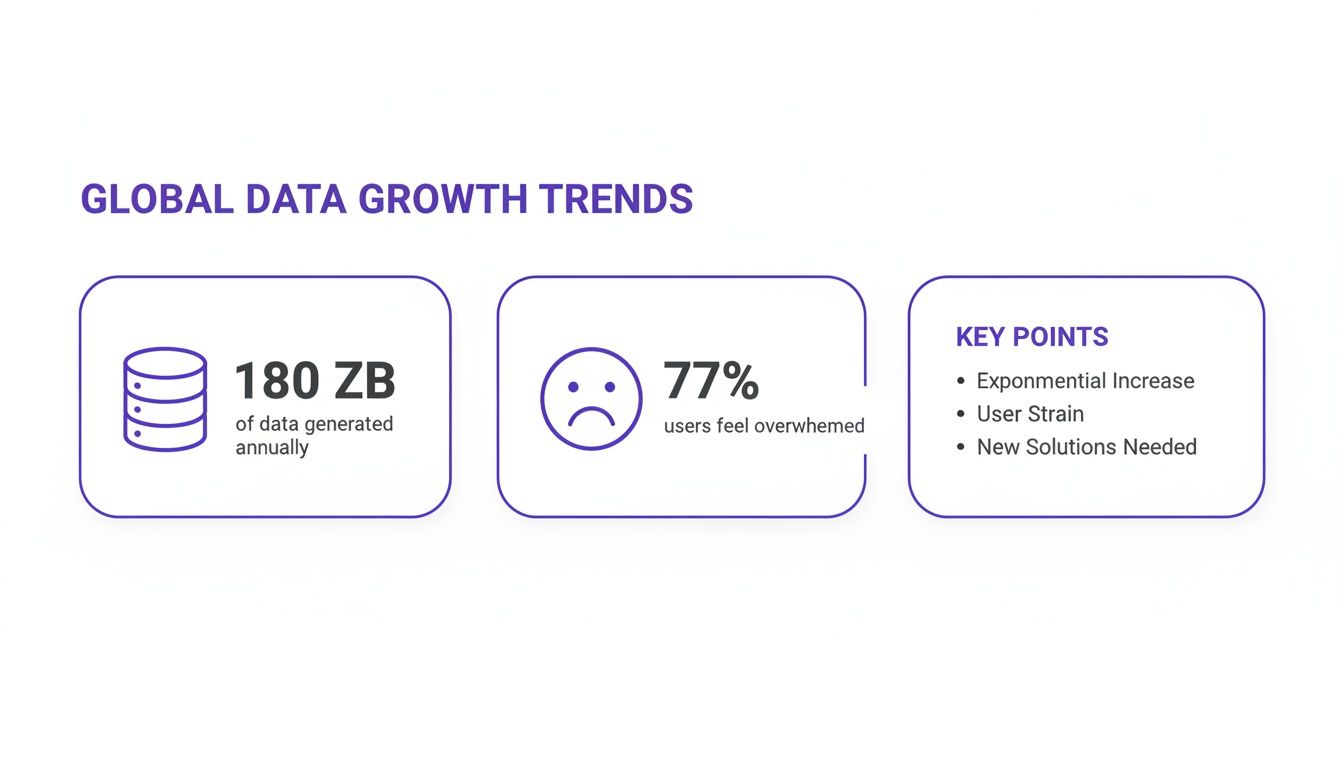
The sheer volume of data we're creating, combined with a clear public demand for more control, is exactly why these laws now form the bedrock of how we do business online.
Key Regulations Shaping Data Ownership
Two landmark regulations have become the gold standard for data privacy laws everywhere: Europe's General Data Protection Regulation (GDPR) and the California Consumer Privacy Act (CCPA). While they have their own unique flavors, both are built on the same foundation of empowering individuals.
Let's take a quick look at how these two pivotal laws compare and what they mean for data ownership.
GDPR vs CCPA: A Quick Comparison
| Feature | GDPR (General Data Protection Regulation) | CCPA (California Consumer Privacy Act) |
|---|---|---|
| Geographic Scope | Applies to organizations handling data of EU residents, regardless of the company's location. | Applies to for-profit businesses that collect data from California residents and meet certain thresholds. |
| Core Principle | Opt-in consent. Requires clear, affirmative consent from users before collecting or processing data. | Opt-out consent. Gives consumers the right to tell businesses not to sell their personal information. |
| Key Consumer Rights | Includes the "right to be forgotten" (erasure), data portability, and the right to access personal data. | Includes the right to know what data is collected, the right to delete it, and the right to opt-out of its sale. |
| "Personal Data" Definition | Broadly defined to include any information related to an identified or identifiable person. | Broadly defined, including information that can be linked to a household as well as an individual. |
| Enforcement & Fines | Penalties can be severe: up to €20 million or 4% of global annual revenue, whichever is higher. | Fines are up to $2,500 per unintentional violation and $7,500 per intentional violation. |
This table just scratches the surface, but it highlights the fundamental shift: businesses must now actively manage data based on user rights, not just internal policy. While the CCPA was a huge step for the U.S., its successor, the CPRA, expanded these protections even further. You can dive deeper into these changes in our guide on CCPA vs CPRA.
These laws also introduced important terminology that defines roles and responsibilities. A data controller is the organization that decides why and how personal data is processed. A data processor is the one who actually handles the data on behalf of the controller. Knowing which role you play is the first step toward understanding your legal duties.
The trend is undeniable. By early 2025, a staggering 144 countries had put data privacy laws on the books, with regulations covering an estimated 79% of the global population. In the US alone, 42% of states had passed their own comprehensive privacy laws by 2025. This isn't just a blip; it's a fundamental change in how the world views data.
At the end of the day, these regulations take the abstract idea of "data ownership" and turn it into a concrete set of legal obligations. They force every company to operate from a new reality: while you might collect and analyze the data, the true ownership of personal information always stays with the individual.
The Hidden Costs of Using Third-Party Analytics Tools
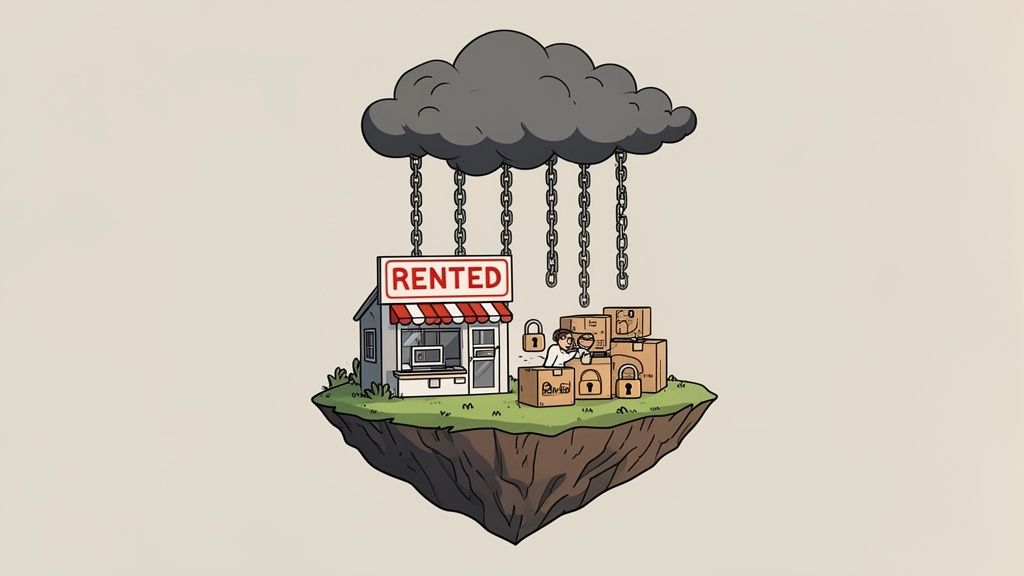
The moment you install a third-party analytics or marketing script, you might be giving away one of your most valuable assets without even realizing it. These tools are incredibly convenient, but they often come with a steep, hidden price: you lose ownership of your own data. It’s a lot like building your business on rented land. Sure, you can operate there, but you never truly own the property or get to set the rules.
When you use an external service, your user data is shipped off to their servers. From that point on, it’s stored and processed according to their policies, not yours. You have no real say over where that data lives, how it’s secured, or who can access it. This creates a massive gap between collecting information and actually owning it, leaving your business exposed to risks you might not even see coming.
How Third-Party Tools Undermine Your Control
Losing ownership isn't a single, dramatic event. It’s a slow erosion that happens in a few subtle but crucial ways. Buried in the terms of service you click "agree" to are often clauses that grant these platforms broad permissions to use your data for their own benefit—like improving their services or training their advertising models.
This dynamic creates a dangerous dependency known as vendor lock-in. What happens if your provider jacks up their prices, sunsets a feature you rely on, or just goes out of business? You could lose access to years of historical data overnight, with no easy way to get it back in a format you can actually use.
Think about these common ways your ownership gets chipped away:
- Restrictive Terms: The platform’s fine print might allow them to aggregate your data and sell it as part of their own market intelligence reports.
- Opaque Data Processing: You have zero visibility into how your data is being sampled or manipulated behind the scenes. This means you could be making decisions based on incomplete or skewed information.
- Inaccessible Raw Data: Many platforms make it next to impossible to export your raw, unsampled data. They effectively hold your most granular insights hostage within their ecosystem.
When you rely on third-party tools, you’re essentially renting insight. The data might live on someone else’s servers, and you access it via their interfaces. You might not be able to take it all with you if you switch providers.
The Impact on Your Teams
This lack of control has very real consequences for the people on the ground. Your marketing team might struggle to build a complete customer picture because they can only see what the vendor’s predefined dashboards show them. Your product managers could find their analysis blocked by the tool's limited reporting, stopping them from asking the deeper, more nuanced questions they need to ask about user behavior.
Ultimately, it forces your teams to make critical decisions with one hand tied behind their backs. Without true data ownership, your business is constantly operating at the mercy of another company’s rules, priorities, and potential failures. Reclaiming that control begins with understanding that convenience should never come at the cost of your most strategic asset.
Actionable Strategies for Full Data Control
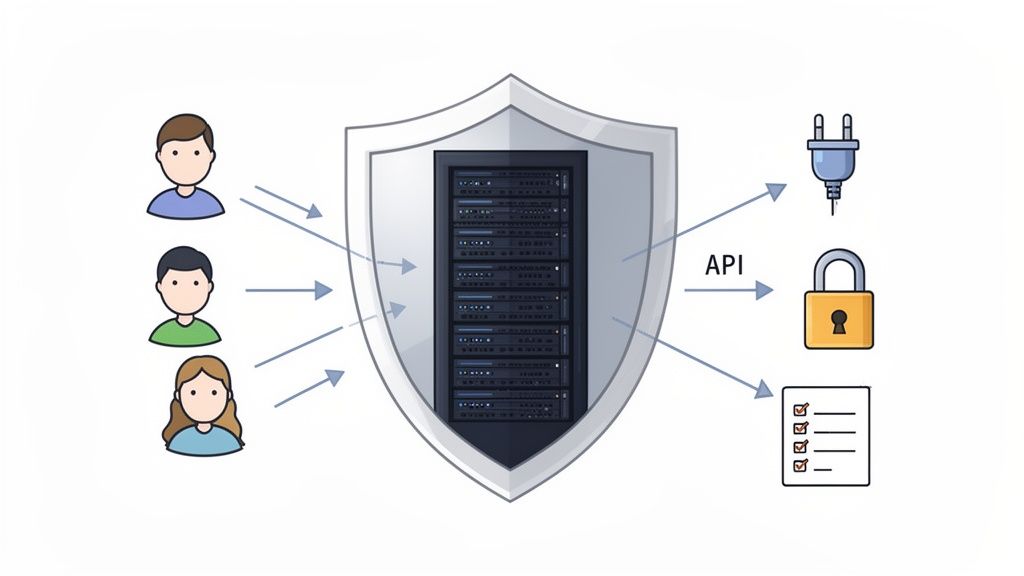
It’s one thing to understand the risks of third-party tools, but it's another to actually take back control. Moving from theory to practice means having a clear playbook for data sovereignty. True data ownership isn't an accident; it's built on a foundation of intentional technical and procedural choices that keep your most valuable asset securely within your own infrastructure.
This isn’t about locking your data away in a fortress. It's about creating a secure, transparent ecosystem where you're the one calling the shots. When you adopt a first-party data strategy, you stop treating data as a potential liability and start seeing it as a reliable engine for growth. The goal here is to build a resilient data foundation that serves your business, not a vendor’s bottom line.
Embrace First-Party Data Collection
Hands down, the most effective way to guarantee 100% data ownership is to collect it yourself. This means ditching platforms that siphon your data off to their own servers and, instead, using tools that operate entirely within your environment.
A perfect example is setting up a self-hosted analytics solution. When you self-host, the data never leaves your infrastructure. You own the server, the database, and the access policies, giving you complete technical and practical ownership right from the get-go. This approach not only prevents vendor lock-in but also ensures you can always access your raw, unsampled data whenever you need it.
By self-hosting, businesses can drastically reduce third-party exposure, streamline incident response, and potentially lower breach costs. In fact, one report found the average cost of a data breach hit a record $4.45 million—a figure that often gets much worse when third-party vendors are involved.
Implement Practical Governance Tactics
Beyond the infrastructure itself, a few key tactics can help you tighten your grip on your data. These practices are all about minimizing risk and making sure data is handled responsibly across your entire organization.
PII Minimization: The golden rule of data security is simple: you can't lose what you don't have. Only collect the personally identifiable information (PII) that is absolutely critical for your operations. This shrinks your compliance surface area and limits the potential fallout from a breach.
Granular Access Control: Not everyone on your team needs access to everything. Implementing role-based access control (RBAC) ensures employees can only see or change the data necessary for their specific jobs. This is a fundamental pillar of good data governance.
Secure APIs for Data Sharing: When you do need to share data with partners or other tools, use secure and well-documented APIs. Think of an API as a controlled gateway; it lets you share specific information without handing over the keys to your entire database. This way, you can integrate with other services without surrendering ownership.
Modern privacy-first platforms are built on these exact principles. For instance, analytics tools like **Swetrix** are designed from the ground up to ensure you retain full ownership without resorting to invasive tracking. It provides a real-world model for gathering actionable insights while respecting user privacy and maintaining complete control. By combining self-hosting, PII minimization, and secure APIs, you create a powerful framework for genuine data sovereignty.
A Practical Checklist for Data Ownership
Alright, theory is great, but putting it into practice is what really matters. Let’s boil everything down into a straightforward checklist you can use right away to see where your company stands and how you can tighten up your data ownership strategy.
Think of this as your starting point. Each one of these items is a critical step toward getting a real handle on your most valuable asset.
Legal and Compliance Check-In
- Dig Into Your Data Processing Agreements (DPAs): Don't just skim them. Really read the terms of service for every single third-party tool you use. You need to know exactly what rights they claim over your data and make sure that lines up with your own policies and, more importantly, with regulations like GDPR.
- Map Out Your Data's Journey: Where does your data come from? Where does it live? Who has the keys? Documenting the entire lifecycle is fundamental for compliance and helps you spot weak links in the chain before they become real problems.
- Set Clear Expiration Dates for Data: Decide how long you actually need to keep different types of data and then automate the process of getting rid of it. The less you hold onto, the lower your risk. It's that simple.
Technical and Security Safeguards
- Use Role-Based Access Control (RBAC): This is a simple but powerful idea: people should only be able to see and touch the data they absolutely need for their job. Limiting access is one of the single most effective ways to prevent data from walking out the door.
- Make First-Party Data Your Default: If you can, always lean towards self-hosted solutions or tools that let you keep the data on your own servers. This is the ultimate form of control and frees you from being locked into a vendor's ecosystem.
- Be a PII Minimalist: Only collect the personally identifiable information you truly need. You can't lose, leak, or misuse data you never had in the first place.
Data ownership isn’t a one-and-done project. It's a continuous commitment. Regularly reviewing these practices is the foundation for building customer trust, fueling real innovation, and finding success in a world that runs on data.
Frequently Asked Questions About Data Ownership
We've covered a lot of ground, but let's be honest, data ownership can still feel a bit fuzzy. Let's tackle some of the most common questions that pop up when teams start digging into this.
Who Actually Owns the Customer Data?
This is the big one. Under laws like GDPR and CCPA, the individual customer—the data subject—is the legal owner of their personal information. Full stop.
Your company is merely a "data controller" or "processor." Think of it as being entrusted with something valuable. You have a legal and ethical duty to protect it and use it responsibly, but you don't hold the title deed.
What's the Difference Between Data Ownership and Data Stewardship?
It's easy to mix these two up, but they play very different roles.
- Data Ownership is strategic. This person or entity has the ultimate authority and control over a particular dataset. They make the high-level decisions.
- Data Stewardship is operational. Stewards are on the ground, managing the day-to-day quality, security, and classification of the data. They make sure the owner's policies are actually being followed.
A simple way to think about it: the owner decides to build a house and sets the rules for it. The steward lives there and handles the daily maintenance and security.
Can We Sell or Transfer Our Data?
It really depends on what kind of data you're talking about.
If the data is truly anonymized or aggregated to the point where no individual can be identified, it's often considered a business asset that you can sell. But when it comes to personal data, the game changes entirely. You can't just sell a list of customer emails like you'd sell old office furniture. Transferring that kind of information requires explicit consent from each person and has to follow strict legal rules.
Does Using the Cloud Mean We Give Up Ownership?
Nope. Storing your data with a provider like AWS or Google Cloud does not mean they own it. You are still the data owner.
Your contract with them clearly defines their role as a data processor. It's crucial to read the fine print, but the bottom line is that you're renting space and tools—you're not handing over your most valuable assets. You're still responsible for securing and managing it.
Ready to take control and achieve 100% data ownership without sacrificing the insights you need? Swetrix is a privacy-first analytics platform built for exactly that.
See how it feels to have complete control. Start your 14-day free trial and experience the difference.