- Date
Protect Your Startup: Guide to protecting your security and privacy
 Andrii Romasiun
Let's break down what security and privacy actually mean in the digital world. The simplest way to think about it is this: security is the vault you build to protect your data, while privacy is about who gets the key and under what conditions.
For any startup, getting this distinction right isn't just some technical checkbox—it's fundamental to your business. If you ignore it, you're opening yourself up to massive risks that can derail your company before you even find your footing.
Why Startups Can No Longer Ignore Online Security
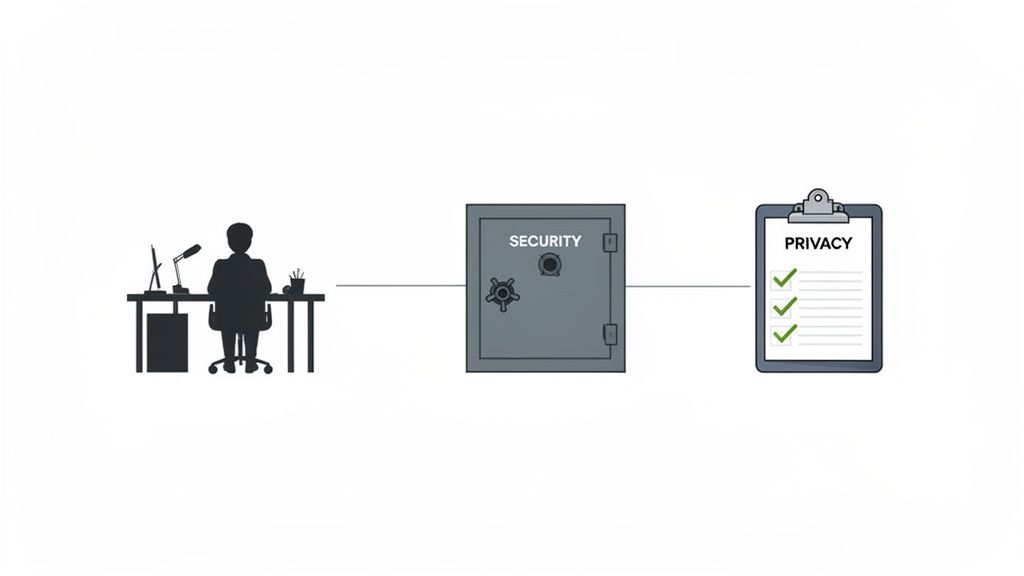
When you're a lean startup, the focus is almost always on building the product and getting it into customers' hands. It’s tempting to push security and privacy down the road, treating them as "later" problems. But that's a dangerous gamble. Every single piece of user data you collect is an asset you're responsible for keeping safe.
A security breach is so much more than a technical hiccup. It's a violation of trust. When your users give you their information, they're doing so with the expectation that you'll protect it. Failing them on that front can have brutal, long-lasting consequences.
The Real-World Costs of Inaction
The risks of getting security and privacy wrong aren't just abstract threats; they're very real and can hit your startup where it hurts. Here’s what’s at stake:
- Reputational Damage: One data breach can shatter customer trust overnight. Once that trust is gone, winning new users and keeping existing ones becomes an uphill battle.
- Financial Penalties: Regulations like the GDPR don't mess around. The fines for non-compliance are steep enough to bankrupt an early-stage company.
- Loss of Competitive Edge: In a packed market, showing a genuine commitment to privacy can make you stand out. If you neglect it, you’re throwing away a powerful way to differentiate your brand.
The numbers are honestly staggering. In just one recent year, 425.7 million accounts were compromised globally. That works out to roughly 810 breaches every single minute. This isn't a distant threat; it's a constant reality that demands a privacy-first mindset from day one.
The sheer volume of these attacks makes it clear that waiting for something to happen is not a strategy. Startups that build privacy and security into their DNA aren't just dodging a bullet; they're building a stronger, more trustworthy company that’s set up for the long haul.
To see how this works in practice, check out how Swetrix provides solutions for startups. By using cookieless, anonymous analytics, you drastically shrink your risk by collecting less sensitive data in the first place, a key takeaway from recent research on data breach trends.
Understanding the Most Common Digital Threats

Let's move from theory to the real world. To protect your startup's data and your users' trust, you have to know what you’re up against. These aren't abstract monsters hiding in the dark; they are specific, calculated attacks that exploit common weak spots in how we all operate online.
Getting a handle on these threats is the first step toward building a solid defense. The goal isn't to scare you, but to give you the insight you need to make smarter, more informed decisions about security and privacy online.
Credential Stuffing: The Domino Effect of a Single Leak
Imagine a thief finds a key someone dropped. Instead of just trying the front door, they try that same key on every house in the neighborhood. That's the core idea behind credential stuffing. Attackers get their hands on massive lists of usernames and passwords from a data breach at one company, then use automated bots to try—or "stuff"—those same login details into countless other websites.
Why does this work so well? Because so many of us reuse passwords across different services. A breach at some forgotten online forum from a decade ago could suddenly give an attacker access to a user’s account on your shiny new platform. The damage can spiral quickly, leading to account takeovers and fraudulent activity.
The sheer scale of this is hard to comprehend. Researchers recently uncovered a "mega leak" containing over 16 billion login credentials scraped together from countless breaches. You can read more about these widespread cyber attacks and their impact to understand the full scope.
Ransomware: Holding Your Business Hostage
Ransomware is a particularly nasty type of malware that encrypts your files, locking you out of your own data. The attackers then demand a ransom—usually in cryptocurrency—in exchange for the key to unlock everything. For a startup, this is a showstopper. It can bring your entire operation to a grinding halt.
Think of it as a digital kidnapping. Your most valuable assets, like customer data, intellectual property, and financial records, are taken hostage. Paying up is a huge gamble; there’s no guarantee you’ll get your data back. Even if you do, the hit to your reputation and the cost of downtime can be crippling.
Insider Threats: Risks from Within
Not every threat comes from a shadowy figure on the other side of the world. An insider threat is someone who already has legitimate access to your systems—a current or former employee, a contractor, or even a business partner—who misuses that access.
This could be a disgruntled employee deleting critical files on their way out, or it could be a well-meaning team member who accidentally exposes sensitive data by misconfiguring a cloud service. Whether malicious or accidental, the outcome is the same: a security breach and a serious blow to customer trust.
To help you connect these concepts to real-world consequences, here’s a quick breakdown of how these threats can directly affect your business.
Common Online Threats and Their Business Impact
| Threat Type | How It Works | Primary Business Risk |
|---|---|---|
| Credential Stuffing | Attackers use stolen username/password lists from other breaches to gain unauthorized access to accounts on your platform. | Account takeovers, fraudulent activity, and damage to user trust. |
| Ransomware | Malicious software encrypts your critical data, and attackers demand a payment to restore access. | Complete operational shutdown, financial loss (from ransom and downtime), and potential permanent data loss. |
| Insider Threats | A trusted individual with authorized access—intentionally or unintentionally—misuses their privileges to compromise data. | Data theft, intellectual property loss, system sabotage, and severe reputational damage. |
As you can see, these aren't just technical problems; they are fundamental business risks. Understanding them is the first step toward building a resilient security posture.
Navigating Data Privacy Regulations Like GDPR
Let's be honest, the world of data regulation can feel like a minefield of acronyms—GDPR, CCPA, and more—all designed to trip up growing businesses. But instead of seeing them as a burden, it helps to think of them as the digital equivalent of food safety standards. They’re just common-sense rules built to protect consumers, which in turn helps you build lasting trust.
These regulations are about more than just dodging massive fines, which under GDPR can be as high as 4% of your annual global turnover. They signal a huge shift in how we must think about personal information. We've moved from a model of data ownership to one of data stewardship. You're the temporary guardian of your users' data, not its owner.
Core Principles You Must Understand
While the specific laws can vary by country or state, they all share a common DNA. Getting a handle on these core ideas is the key to both staying compliant and boosting your reputation for security and privacy online.
- Data Minimization: Only collect what you absolutely need for a specific, legitimate reason. If you don't need a user’s phone number to make your app work, don't ask for it. It's that simple.
- User Consent: You need to get clear, "yes, I agree" consent before you collect personal data. Gone are the days of pre-checked boxes and burying permissions in pages of legalese. Consent has to be freely given and just as easy to take back.
- The Right to Be Forgotten: People have the right to ask you to completely wipe their personal data from your systems. You need to have a process in place to actually make that happen when they ask.
These principles turn compliance from a boring checklist into a smart business strategy. When you embrace them, you show genuine respect for your users, and in a crowded market, that's a powerful way to stand out. For a deeper dive, check out our guide on how GDPR compliance works for websites.
Adopting these regulations isn't just a legal chore; it's a strategic opportunity. A transparent privacy policy and clear data practices become marketing assets, showing potential customers you're a partner they can trust with their information.
Ultimately, getting this right means changing your perspective. Instead of asking, "What data can we collect?" the question should be, "What's the absolute minimum data we need to deliver an amazing experience?" This approach doesn't just keep you compliant—it helps you build a more resilient, ethical, and customer-focused business from the ground up.
Choosing Privacy-First Analytics for Smarter Growth
To genuinely put online security and privacy first, you have to fundamentally change how you think about data. A lot of the old-school analytics tools are basically digital vacuum cleaners, sucking up huge amounts of personal information by default. For a startup, that approach just creates a massive, unnecessary liability.
The modern, more ethical way forward is through privacy-preserving analytics. This isn't about tracking who your users are; it's about understanding what they do as a group. You still get all the essential insights you need to grow—like which pages are popular, how people move through your site, and where conversions happen—but without hoarding sensitive personal data.
The Power of Cookieless, Anonymous Data
Think about it like this: cookieless analytics is like looking at a map of a park's most popular trails. You can see which paths get the most foot traffic, where people tend to slow down, and which routes lead to the best views. You learn everything you need to know about the park's flow without ever putting a GPS tracker on a single hiker. That’s the whole idea—respecting privacy while still getting a clear picture.
When you collect data anonymously, you immediately shrink your risk profile. Global ransomware attacks shot up 32% in just one year, and those attackers are always hunting for servers packed with valuable user data. If your systems don't store any personally identifiable information (PII) to begin with, you become a far less juicy target. This simple shift drastically cuts down your risk and potential fallout from a breach. You can dig deeper into the latest findings on ransomware trends to see how serious this is.
Take a look at this Swetrix dashboard. It’s clean, focused, and built for privacy.
See how it emphasizes core metrics like pageviews, bounce rate, and session duration? There's no exposed individual user data anywhere. It's proof that you don't have to give up powerful insights to protect privacy.
Making Data-Driven Decisions Ethically
Going with a privacy-first tool doesn't mean you have to guess your way to growth. Platforms like Swetrix were specifically designed to deliver deep, ethical insights. You can still track all the metrics that matter and get a firm handle on user behavior.
Here’s just a sample of what you can still measure without crossing any privacy lines:
- Top Pages and Referrers: Find out what content is really hitting the mark and which channels are sending you the best traffic.
- User Journeys: See how people actually navigate your site, so you can spot roadblocks and smooth out the experience.
- Conversion Goals: Track sign-ups, downloads, or purchases to measure the actions that truly drive your business forward.
The big idea here is that the old trade-off is dead. You no longer have to choose between collecting useful data and respecting your users. Modern tools let you do both, turning your commitment to security into a real competitive advantage that builds lasting customer trust.
This approach doesn't just make it easier to comply with rules like GDPR; it also aligns your brand with what customers increasingly expect and demand.
For teams who want the ultimate control, a self-hosted web analytics solution can take data ownership and security to an even higher level. At the end of the day, smarter growth is sustainable growth—and it’s built on a foundation of respecting the people who use your product.
Your Action Plan for a Privacy-First Business
Making your business "privacy-first" isn't just about tweaking a few settings. It's a fundamental shift in strategy that places customer trust at the very core of your operations. To build a solid framework for security and privacy online, you need more than just good intentions—you need a clear, actionable roadmap.
Let's move past the abstract ideas and get into tangible steps your team can start taking today.
Start With a Data Minimization Audit
The most critical first step is a full-blown data audit. Get your team in a room (virtual or otherwise) and ask one simple, powerful question: What personal data are we collecting, and why do we absolutely need it?
You'd be surprised how often this exercise uncovers that companies are hoarding information they never even use, creating a completely unnecessary risk.
Data minimization is exactly what it sounds like: collecting only the data that is absolutely essential for a specific, legitimate purpose. By cutting the fat from your data collection, you immediately shrink your attack surface and make regulatory compliance far simpler.
- Map Every Data Point: Go through every platform—from sign-up forms to analytics tools—and list every single piece of user information you gather.
- Justify Its Existence: For each data point, you need a clear answer for its direct value. If you can't justify it, get rid of it.
- Tweak Your Collection Methods: Start removing those non-essential fields from your forms and reconfigure your tools to only grab what’s necessary.
Think of this audit as laying the foundation for a brand people can genuinely trust.
The way we think about analytics has changed dramatically, moving from invasive tracking to a more modern, privacy-focused approach.
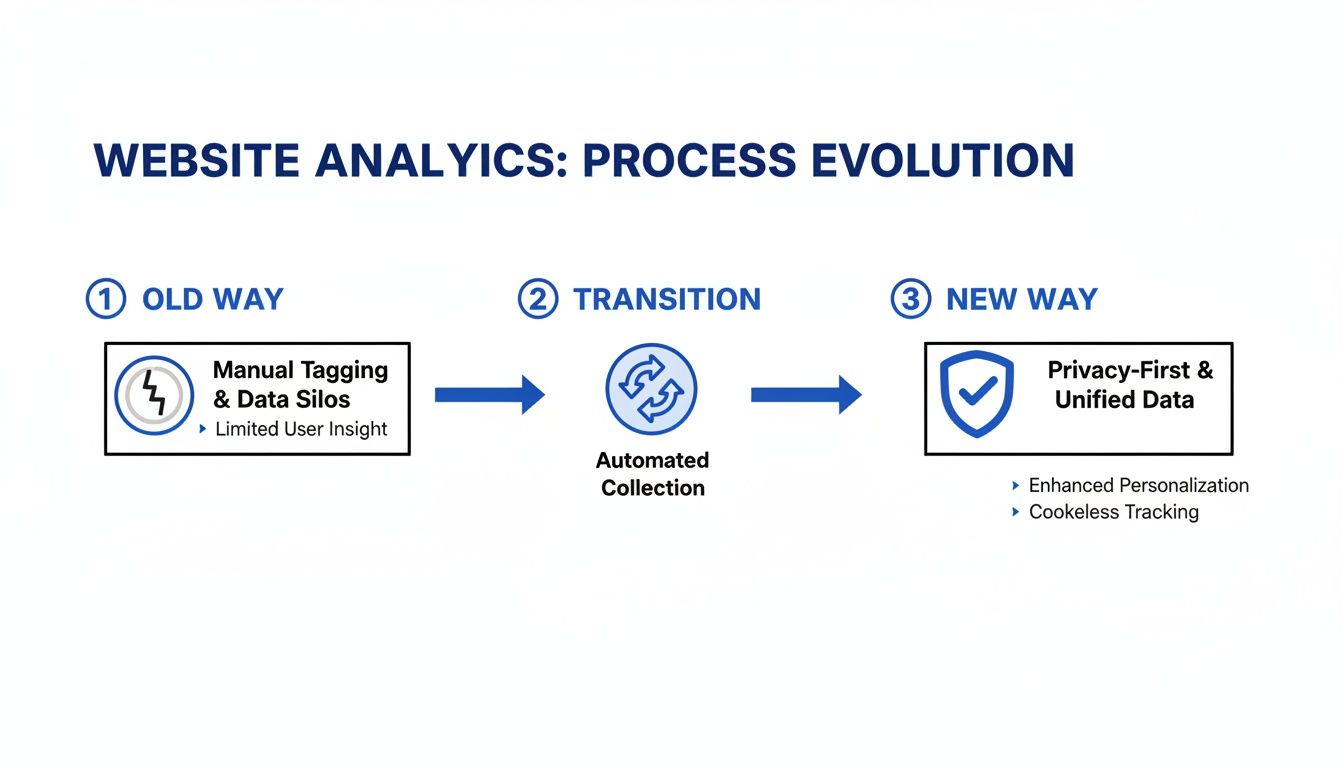
As you can see, the new model prioritizes user protection (the shield) while still giving you the insights you need to grow.
Update Your Privacy Policy for Full Transparency
Let’s be honest: nobody wants to read a wall of legal jargon. Your privacy policy shouldn't be a document designed to confuse people; it should be a clear, straightforward explanation of how you handle their data.
A transparent policy is actually a powerful marketing tool. It builds instant trust with new users.
Use plain English to explain what you collect, why you collect it, and how you keep it safe. Be upfront about any third-party services you rely on, like payment processors or analytics tools, that might also handle user data. This kind of honesty shows you have nothing to hide and reinforces your commitment to your users.
A privacy-first approach is no longer a niche preference; it's a mainstream expectation. Companies that proactively build security and privacy into their operations are not just avoiding fines—they are creating a sustainable competitive advantage built on customer loyalty and trust.
Vet Your Vendors and Secure Internal Protocols
Your dedication to privacy is only as strong as your weakest link, and that often includes your partners. You need to carefully evaluate every third-party tool and vendor to make sure their privacy practices are as strict as yours. Prioritize services that are GDPR-compliant and built on the principle of data minimization.
Finally, turn that focus inward and establish strong internal security protocols for your own team. This means implementing strong password policies, mandating two-factor authentication, and restricting access to sensitive data on a strict need-to-know basis. Regular training is key to making sure every single person on your team understands their role in protecting user information.
To help you get started, here's a checklist that breaks down the process into manageable phases.
Your Privacy-First Implementation Checklist
This checklist offers a step-by-step guide for startups to audit their data practices and implement a privacy-centric approach across their operations.
| Phase | Action Item | Key Objective |
|---|---|---|
| 1. Discovery & Audit | Conduct a full data minimization audit. | Identify and eliminate all non-essential data collection points. |
| 2. Policy & Transparency | Rewrite the privacy policy in plain language. | Build user trust by clearly explaining data handling practices. |
| 3. Tool & Vendor Review | Vet all third-party services for compliance. | Ensure your entire tech stack aligns with your privacy standards. |
| 4. Internal Security | Implement access controls and security training. | Minimize internal risks and empower your team to protect user data. |
| 5. Analytics Overhaul | Switch to a privacy-preserving analytics tool. | Gain valuable insights without compromising user privacy. |
| 6. Ongoing Compliance | Schedule regular (e.g., quarterly) privacy reviews. | Maintain high standards and adapt to new regulations and threats. |
Following these steps systematically will put you on the right path to building a business that not only respects its users but also earns their long-term loyalty.
Building a Culture of Security and Privacy
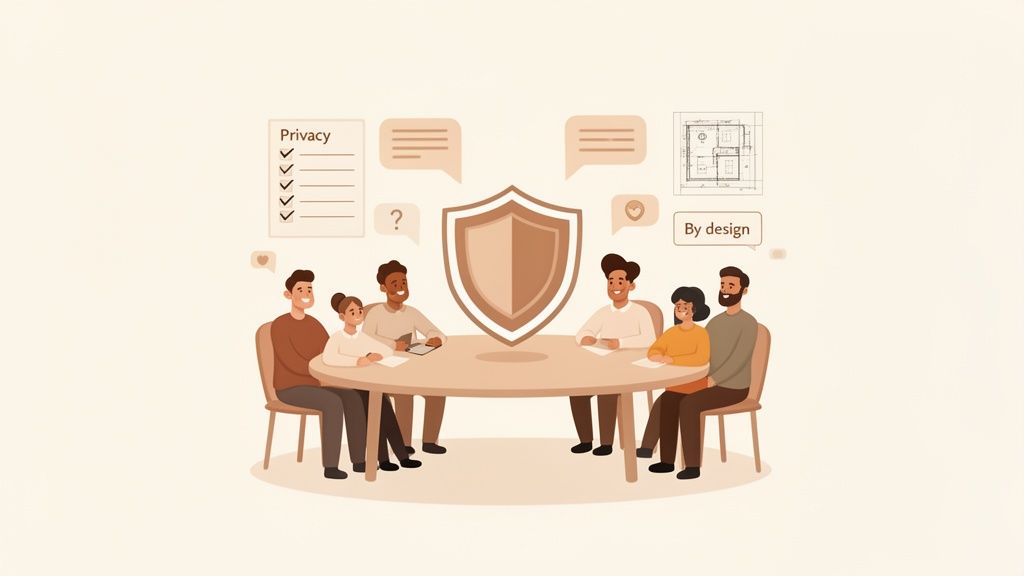
At the end of the day, the best tools and policies are only as good as the people who use them. Real, lasting security and privacy online isn't a technical problem you can just solve with software. It's a cultural commitment that needs to be woven into the very DNA of your company, right from the start.
This means getting past the idea of a one-and-done training session. It’s about creating an environment where everyone, from marketing to engineering, feels a genuine sense of ownership over protecting user data. It's about making privacy an ongoing conversation, not just a box to check.
Embed Privacy by Design
The most powerful way to build this culture is by adopting the principle of privacy by design. This concept is simple but profound: consider privacy at the very beginning of any new product or feature, not as a scramble to fix things later. Before a single line of code is written, your team should be asking some tough questions.
- Necessity: Do we actually need to collect this piece of data to provide value?
- Transparency: How are we going to explain this to our users in plain English?
- Security: What could go wrong here, and what’s our plan to prevent it?
By making these questions a standard part of your development process, you turn privacy from a defensive hassle into a proactive strategy for building better, more trustworthy products.
Thinking this way is about more than just staying compliant. It sends a clear signal to your customers that you respect them and their data. That kind of trust is what builds real brand loyalty—a powerful competitive advantage no matter what market you're in.
Frequently Asked Questions
Switching to a privacy-first approach is a smart move, but it naturally comes with questions. Let's tackle some of the most common ones that pop up for founders, marketers, and developers.
Can I Still Get Meaningful Marketing Insights with Privacy-First Analytics?
Absolutely. This is probably the biggest misconception out there. Privacy-first analytics tools are built from the ground up to give you actionable insights without collecting Personally Identifiable Information (PII). The whole game changes—you stop tracking individual people across the internet and start understanding user behavior on your site as a whole.
This means you still get the data that actually drives growth:
- Top-performing pages that show you what content is a hit with your audience.
- Traffic sources and referrers to see which of your marketing channels are actually working.
- User flows and conversion events so you can fine-tune your website for better engagement.
Honestly, this approach often gives you clearer, more focused insights. You’re looking at genuine website performance and user engagement, not getting lost in the noise of individual tracking.
Is Switching to a Privacy-Focused Tool Difficult for a Small Team?
Not at all. Modern privacy-first platforms like Swetrix are designed to be incredibly easy to set up. It’s usually as simple as adding a small, lightweight script to your website's header—a process that’s probably familiar if you've ever installed any other analytics tool.
The best platforms are intuitive right out of the box. They have clean dashboards and a straightforward setup that doesn't require a dedicated data analyst to make sense of it all. This makes it a breeze for small teams to get going quickly.
For teams that need a bit more control, many services also offer open-source and self-hosting options, giving your developers and operations folks the flexibility they need.
What Is the First Step My Startup Should Take to Improve Its Security?
The single most important first step? Conduct a simple data audit. Get your team in a room (or on a call) and ask one fundamental question: "What user data are we currently collecting, and why do we absolutely need it?"
You'll probably be surprised to find you're collecting data you never even look at, which just sits there increasing your risk. By adopting a data minimization mindset and cutting out any unnecessary data collection, you immediately shrink your attack surface and make regulatory compliance much simpler. This internal review will naturally point you toward your next steps, whether that’s updating your privacy policy or picking tools that align with a more secure, minimalist approach.
Ready to get actionable insights without compromising user privacy? Start your journey with Swetrix and see how simple ethical analytics can be. Get started for free.