- Date
Choosing the Best Open Source Marketing Dashboard Software
 Andrii Romasiun
You launch a campaign, traffic spikes, and your analytics dashboard shows a flatline. Although the ad platform reports 500 outbound clicks, your website registers only 200 sessions because users click "Reject All" on your cookie banner.
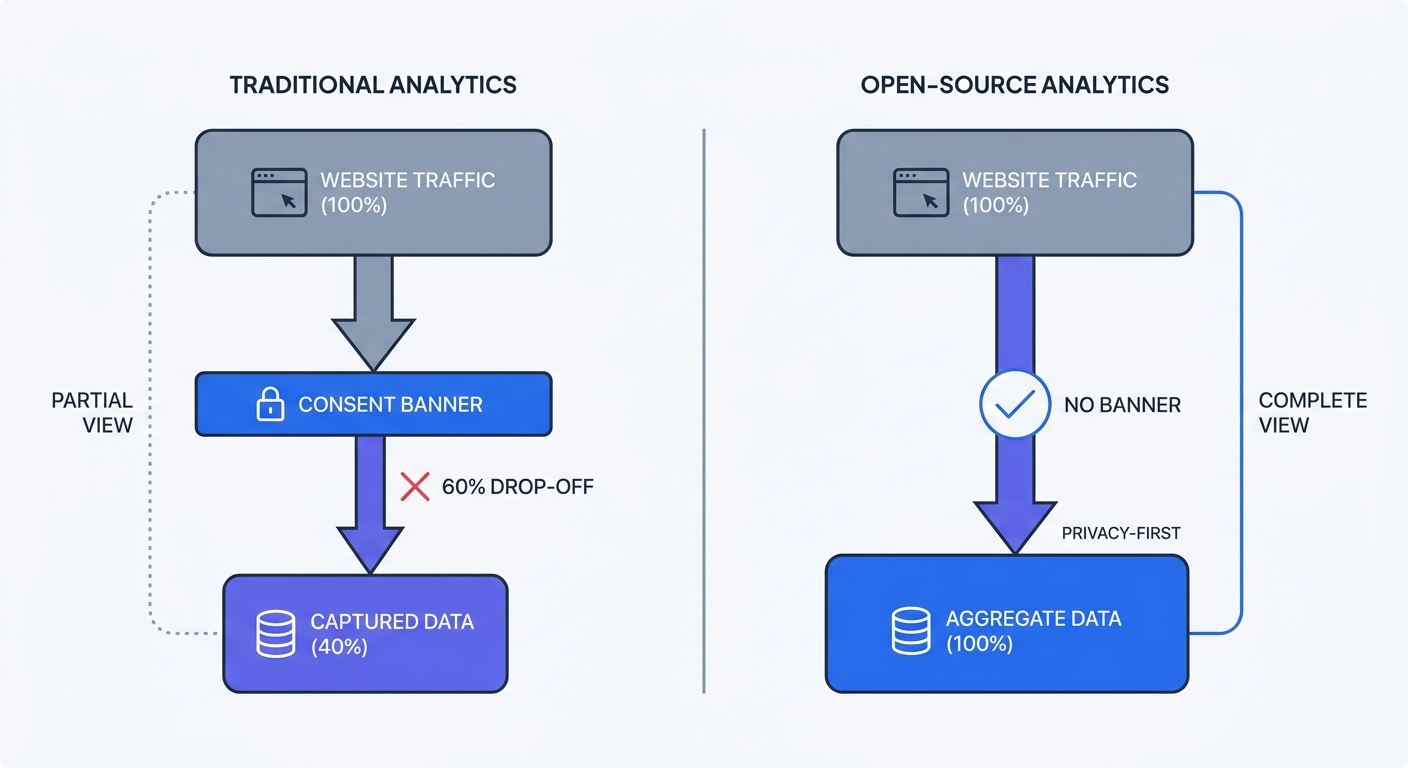
When you enforce a strict GDPR-compliant prompt, you lose visibility into the majority of your traffic. A recent etracker benchmark shows that prominent opt-out buttons result in a 60% average data loss across general B2B and B2C websites (though this rate varies by region and industry), which means you pay for the click, the user lands on your page, and the session vanishes from your reports.
Relying on third-party cookies destroys your attribution modeling. If you cannot see the traffic, you cannot calculate the Return on Investment (ROI) of your marketing spend, but open source marketing dashboard software solves this problem by eliminating the need for persistent tracking cookies entirely.
Why Traditional Marketing Analytics Are Failing
Legacy platforms rely on client-side storage to identify users across multiple visits. They drop a small text file into the browser, read it on every page load, and compile a granular history of individual behavior, but modern privacy laws broke this model.
The 60% Data Loss Problem
Banner fatigue drives consumers to reject cookies by default. Because browsers like Safari and Firefox block third-party trackers automatically and ad blockers strip Google Analytics scripts before the page even finishes rendering, your marketing funnel breaks.
If your dashboard misses six out of ten visitors, your conversion rates appear artificially low and your Cost Per Acquisition (CPA) calculations inflate. Consequently, you end up pausing profitable campaigns because the reports show them failing.
To quantify this damage, open your ad platform and pull the total clicks for your highest-spend campaign over the last thirty days. When you compare that number to the landing page sessions recorded in your analytics tool, the discrepancy represents your consent drop-off rate.
Schrems II and GDPR Enforcement Penalties
Data blindness is only half the problem, as using proprietary, US-based analytics exposes your business to massive legal liability. The European Court of Justice invalidated the EU-US Privacy Shield under the Schrems II ruling, making it illegal to transfer European visitor data to servers subject to US surveillance laws.
Standard Contractual Clauses (SCCs) no longer provide blanket protection. Regulatory authorities actively enforce these rules, pushing the historical aggregate total of GDPR fines beyond €5.88 billion.
Swetrix offers a direct bypass for these compliance risks. Because the platform uses privacy-friendly hashing instead of cookies, it operates entirely without consent banners, allowing you to restore dashboard accuracy, capture 100% of your aggregate traffic, and keep the data strictly within EU borders.
Run a network trace on your homepage to audit your current risk by pressing F12, opening the Network tab, and refreshing the page. Check the request URLs for your tracking scripts, and if you see US-based endpoints capturing user data, migrate to a European-hosted open-source alternative.
Understanding Open Source Marketing Analytics
The "marketing dashboard" category fragmented rapidly over the last three years. Instead of relying on a single monolith to handle everything, you can now deploy specialized open-source stacks to bring control back to your organization.
Data Sovereignty and 100% Ownership
Proprietary Big Tech tools silo your marketing data and feed it into their own advertising networks, turning you into a data provider for their machine learning models. Open-source software prevents this extraction.
Because the code is public and transportable, you own the infrastructure. 96% of organizations are either maintaining or increasing their open-source usage to achieve this data sovereignty. You control the retention periods, the backup schedules, and the physical location of the servers, ensuring nobody else can access your traffic logs.
Map your current data supply chain in a spreadsheet to document exactly which third-party vendors receive your website visitor data. Once mapped, terminate contracts with any vendor that claims ownership rights over your audience behavior in their Terms of Service.
The Shift to Embedded Compliance
Legacy platforms treat privacy as an afterthought. When you deploy an invasive tracking script and then install a heavy consent management platform (CMP) to block that script from firing, you create a slow, fragile architecture that constantly breaks during updates.
Modern open-source dashboards build compliance directly into the core design by processing data server-side and discarding identifying details before anything reaches the database. There is no need for a CMP because the tracker never touches personal data.
Configure your analytics server to drop raw IP addresses at the edge by overwriting the final octet of the IP before it hits your application logic, ensuring that persistent logs only contain generalized geographic data.
Top Open Source Analytics Tools for Marketers
Choosing the right platform depends on what you need to measure. Marketing sites require broad traffic visibility, while SaaS applications demand deep interaction logging.
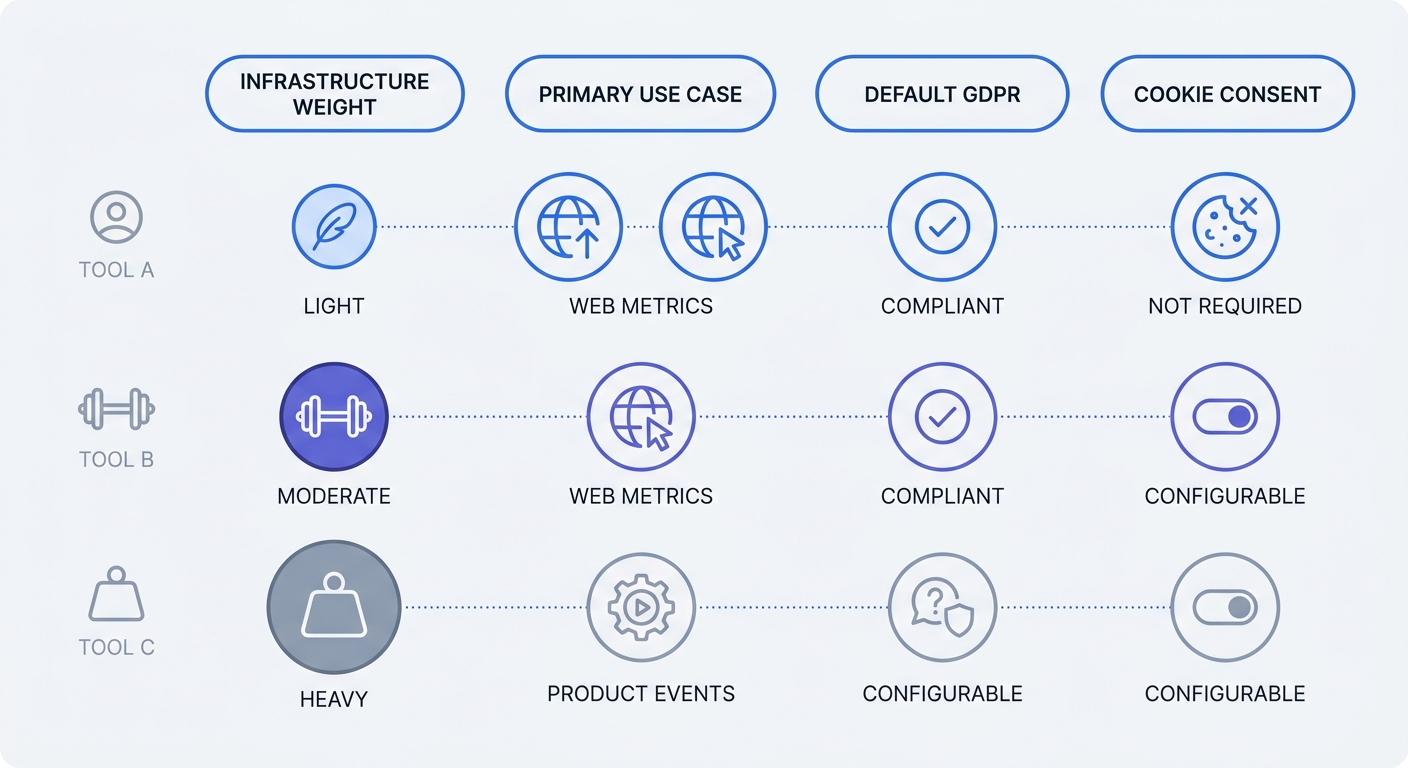
| Tool | Primary Focus | Database Architecture | GDPR Compliance | Consent Banner Required |
|---|---|---|---|---|
| Swetrix | Marketing metrics, cookieless web analytics | Lightweight, high-speed | Default | No |
| Matomo | Legacy GA replacement, custom reporting | MySQL/MariaDB | Configurable | Varies by setup |
| PostHog | Product analytics, authenticated events | ClickHouse | Manual configuration | Yes (if tracking users) |
Swetrix: Lightweight and Cookieless By Default
For top-of-funnel marketing campaigns, website performance, and macro-conversions, Swetrix serves as the primary standard because it aligns natively with GDPR data minimization principles by refusing to store Personally Identifiable Information (PII).
Because the script weighs less than 3KB, it loads instantly and never slows down your landing pages. When you append UTM parameters to your Facebook ads, email newsletters, and affiliate links, the dashboard files each visit under the correct campaign in real time.
Remove your legacy tracking snippet, deploy the Swetrix script in your document <head>, and delete your cookie banner. Your dashboard will capture every pageview, custom event, and outbound link click without generating a single compliance warning.
Matomo: The Heavyweight Legacy Alternative
Matomo mirrors the heavy, feature-dense interface of Universal Analytics, providing heatmaps, session recordings, e-commerce integrations, and deep custom reporting.
The tradeoff for this functionality is severe infrastructure weight. Running a complete Matomo instance requires significant server resources, persistent database tuning, and regular security patching. If configured incorrectly, the software collects PII and triggers GDPR consent requirements.
Before committing to Matomo, provision a test server with at least 4GB of RAM and simulate a traffic spike using an open-source load testing tool like Apache JMeter. Monitor the CPU and memory consumption during this test to gauge your ongoing hosting costs.
PostHog: Deep Event-Level Product Analytics
Once a user signs into your application, marketing metrics lose their value. You need to track if they clicked a specific button, completed an onboarding flow, or encountered a system error, which is the specialized product analytics use case PostHog handles.
Built on ClickHouse, PostHog excels at deep, event-level behavior tracking for authenticated users. It links sessions to specific user IDs so you can build complex retention funnels and feature flags, but because it tracks specific individuals, you must secure user consent before deploying it.
Segment your tracking stack by using Swetrix on your public marketing pages to capture anonymous, banner-free traffic data, and deploying PostHog exclusively behind your application login screen to track user-specific product metrics.
Tracking Metrics Without Invading Privacy
Cookieless analytics requires a shift in how you process visitor data. You cannot legally stalk people across the internet, but you still need accurate counts of unique visitors to calculate campaign ROI.
How Temporary Hashing Works
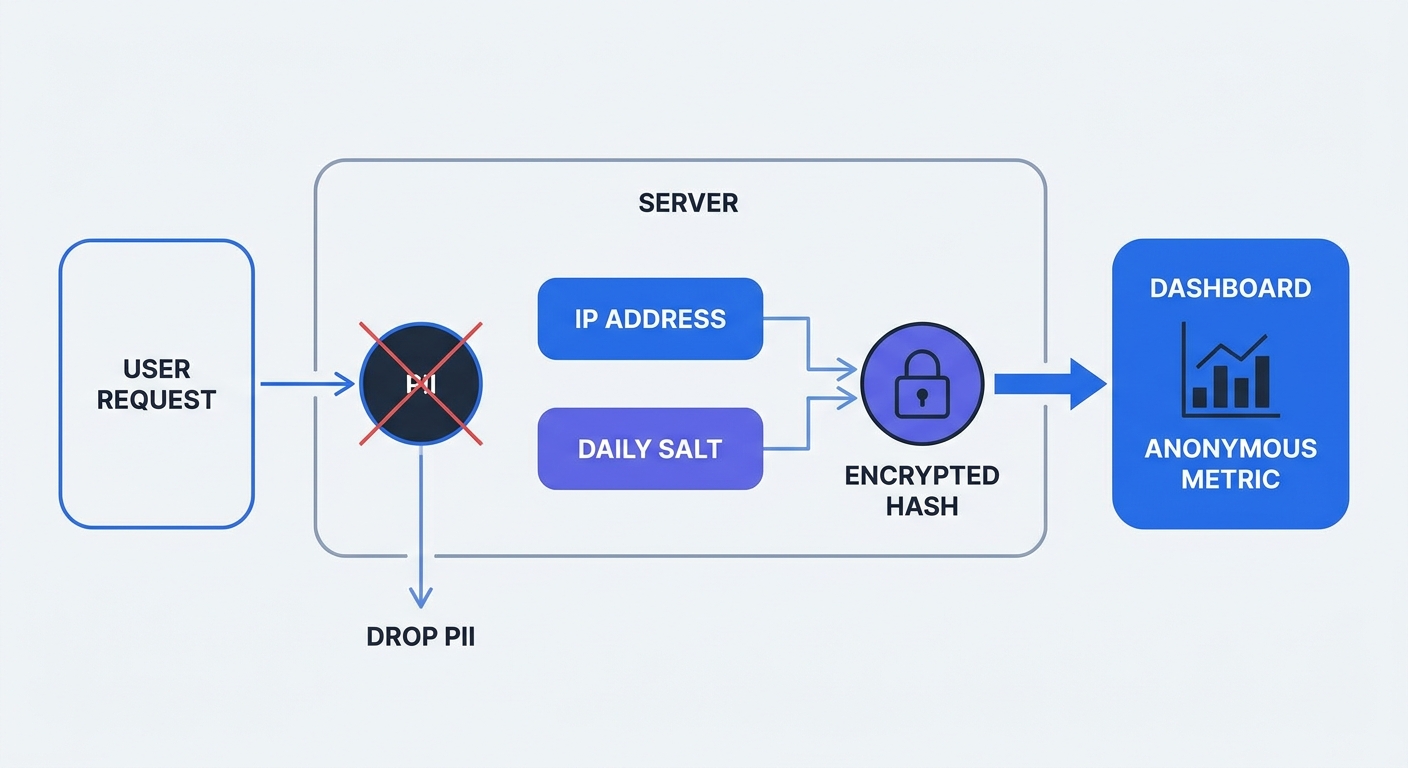
Open-source platforms solve the unique visitor problem through cryptography. When a visitor lands on your site, the server captures their IP address and User-Agent string before combining these two data points with a random salt, which is a string of characters generated fresh every 24 hours.
The system then hashes this combined string, producing an anonymous, encrypted identifier for that specific day:
Hash(IP + User-Agent + Daily_Salt) = Unique_Visitor_ID
If the same person clicks three different pages in one afternoon, the hash remains identical, and the dashboard records one unique visitor with three pageviews. At midnight, the daily salt automatically rotates so yesterday's hash mathematically cannot be linked to today's hash. The user starts fresh, rendering persistent tracking impossible.
Review your analytics vendor's data retention documentation to verify that their daily salt is generated randomly, stored securely in memory, and destroyed completely every 24 hours.
Shifting to Aggregate KPIs
GDPR Article 5(1)(c) mandates data minimization, and you adhere to this principle by redesigning your marketing reports. Instead of attempting to map granular, multi-device user journeys across a 90-day window, focus entirely on aggregate outcomes.
Aggregate data provides the metrics required to run profitable campaigns. If a Google Ads campaign drives 5,000 visits and generates 100 purchases, your conversion rate is 2%. You do not need to know the names, home addresses, or search histories of those 100 buyers to scale the ad spend.
Restructure your dashboard to highlight these specific macro-metrics:
- Traffic by UTM Source/Medium: Identifies which channels drive volume.
- Conversion Rate by Campaign: Proves which messaging sells.
- Aggregate Drop-off Rate: Highlights where the landing page UX fails.
- Country/Region Distribution: Guides geotargeting budget allocation.
Implementation and Hosting Considerations
Open-source software licenses cost nothing, but operating the software requires capital. Choosing between self-hosting and managed cloud instances dictates your long-term maintenance overhead.
Calculating Total Cost of Ownership (TCO)
Running a robust marketing dashboard on your own hardware requires multiple components, meaning you must provision a virtual private server, deploy Docker containers, configure an Nginx reverse proxy, install SSL certificates, and maintain a database layer like PostgreSQL.
You also pay for the engineering hours required to monitor uptime, scale storage, and apply security patches. If a database query locks up during a traffic spike, your developers must drop product work to fix the analytics pipeline.
Managed cloud tiers remove this operational burden. Swetrix Cloud handles the infrastructure, server scaling, DDoS protection, and EU data residency automatically, and with pricing starting at $19 per month for 100,000 events, it costs significantly less than dedicating internal engineering resources to maintenance.
Build a TCO spreadsheet before making a decision by listing the monthly costs for a DigitalOcean or Hetzner server, the database licensing, and two hours of your DevOps engineer's time per month. Comparing that final number against the SaaS pricing reveals your break-even point.
Achieving High Privacy ROI
Corporate investments in privacy yield massive returns because consumers notice how you treat their data and punish aggressive tracking.
In fact, a Cisco data privacy study reveals that 95% of organizations report a positive ROI from their privacy initiatives. When you remove intrusive third-party trackers, page load speeds improve drastically, causing bounce rates to drop, SEO performance to benefit from faster Core Web Vitals, and user trust to increase.
Turn your privacy compliance into a marketing asset by adding a plain-English statement to your footer and checkout pages. Explicitly inform visitors that your website uses open-source analytics, operates without tracking cookies, and refuses to share behavior data with advertising networks, turning that transparency into a conversion tool.
You can capture 100% of your traffic data without violating user privacy or managing complex server infrastructure. Start your 14-day free trial at Swetrix.com/signup and build a marketing dashboard you can trust.