- Date
What an IP Address Can and Can’t Reveal
 Andrii Romasiun
An IP to address lookup maps a network connection to an estimated broad geographic region, but it cannot reliably reveal a physical street address. It estimates the region associated with the network rather than a household’s precise location, so an IP address is not a reliable stand-in for one person’s exact location. For website owners, Swetrix bridges straightforward, privacy-conscious tracking with advanced product analytics, so moving from Google Analytics to a cookieless solution doesn’t mean giving up growth data such as conversion funnels, session replays, or technical SEO insights.

The Mechanical Role of an IP Address
Network communication requires precise instructions for moving data from one machine to another. When a visitor opens your website, their browser sends a request for the page files, prompting your server to find a return path to deliver that content. The IP address provides that return path.
The ICANN glossary defines an IP address as a numeric value used to route packets to their intended destinations. It functions as an address for network infrastructure, allowing routers to forward data toward the requested device across interconnected networks.
Devices use two widely deployed formats for these addresses. ICANN’s glossary entries for IPv4 and IPv6 describe IPv4 as a 32-bit format with just over four billion possible address values, and IPv6 as a 128-bit format. Because IPv4 address space became scarce, network engineers developed IPv6. This newer standard uses hexadecimal groups separated by colons, such as 2001:db8:3333:4444:5555:6666:7777:8888, and provides a vastly larger address space than IPv4. Many modern devices and networks support both protocols, using whichever is available for a given connection.
Together, these formats let routers deliver packets between network endpoints. Their purpose is to route network traffic, not to track individual people.
How Networks Separate Public and Private Routing
In a home IPv4 network using NAPT, the private IP address your laptop uses differs from the public address a website sees. With NAPT, a form of Network Address Translation (NAT), multiple devices on a private network can access external networks through one public IP address.
Private addresses are used within private networks and aren’t globally routable on the public internet. The private-use IPv4 ranges listed in RFC 3022 are 10.0.0.0–10.255.255.255, 172.16.0.0–172.31.255.255, and 192.168.0.0–192.168.255.255.
In a common home IPv4 setup, a request carries the device’s private source address to the router. The router translates it to the address used on its external interface and keeps temporary state so it can direct reply traffic back to the right device.
This mechanism means web servers usually interact with network edge devices, not individual user machines. A busy coffee shop may route dozens of laptops through one public IP, so an analytics platform can see their requests as coming from the same network address.
Geographic Location Estimates and Limitations
IP geolocation is an inferential process that estimates a location from clues gathered from various sources. For country-level validation, providers can use traceroutes and proprietary data about where networks are in use, as MaxMind explains in its geolocation overview. The result is an approximate region, which does not pinpoint a device’s exact location.
IP geolocation isn’t designed to identify a household or street address. MaxMind’s published estimates put country-level accuracy generally above 99%, especially when VPN use is excluded. State or province accuracy typically ranges from 55% to 80%, depending on the country, and city-level accuracy typically ranges from 20% to 75%, with accuracy often higher in larger, more densely populated cities, especially on networks that provide residential internet service.
Several technical factors routinely degrade city-level precision:
- Mobile carrier architecture: Mobile geolocation typically resolves to a broad region, sometimes spanning multiple subdivisions, rather than a specific city or postal code. A mobile IP address can move between users hundreds of kilometers apart within minutes, as MaxMind notes.
- Virtual Private Networks: A VPN masks the user’s true IP, so geolocation associates the address with the VPN server, which can be in a different city or country.
- Corporate networks: Behavioral geolocation signals can be less relevant because employees access corporate networks from home and while traveling.
You can explore these geographic approximations directly by testing an IP address locator tool on your own connection. Treat the result as a broad regional estimate or network location, not a pin on your home.

Balancing Web Analytics With Network Limitations
Website owners rely on aggregate data to understand where their audience lives and how many unique visitors read their content. Relying on raw IP addresses alone to calculate these metrics can create two distinct problems: it can expose network identifiers if they’re retained indefinitely, and it can distort visitor counts when multiple people share a connection.
Shared networks can skew unique visitor counts. If a school district routes many student tablets through one public gateway, an analytics script that identifies visitors by IP alone may count the shared address as one visitor instead of many readers. Conversely, a script that relies only on public IP may count one mobile user multiple times as they move between cellular service and different Wi-Fi networks.
How IP data is collected and retained also matters for privacy. Storing raw visitor IPs in an exposed database can increase the impact of a breach without fixing shared-network counting errors. A privacy-conscious system can process requests transiently to estimate geographic trends, then avoid retaining raw addresses longer than needed.
For teams moving from Google Analytics, Swetrix is a strong starting point because it combines cookieless traffic measurement with product analytics, including custom events and conversion funnels. That approach can preserve useful growth insights while keeping IP-based location data in perspective as an estimate, rather than a precise account of where visitors live.
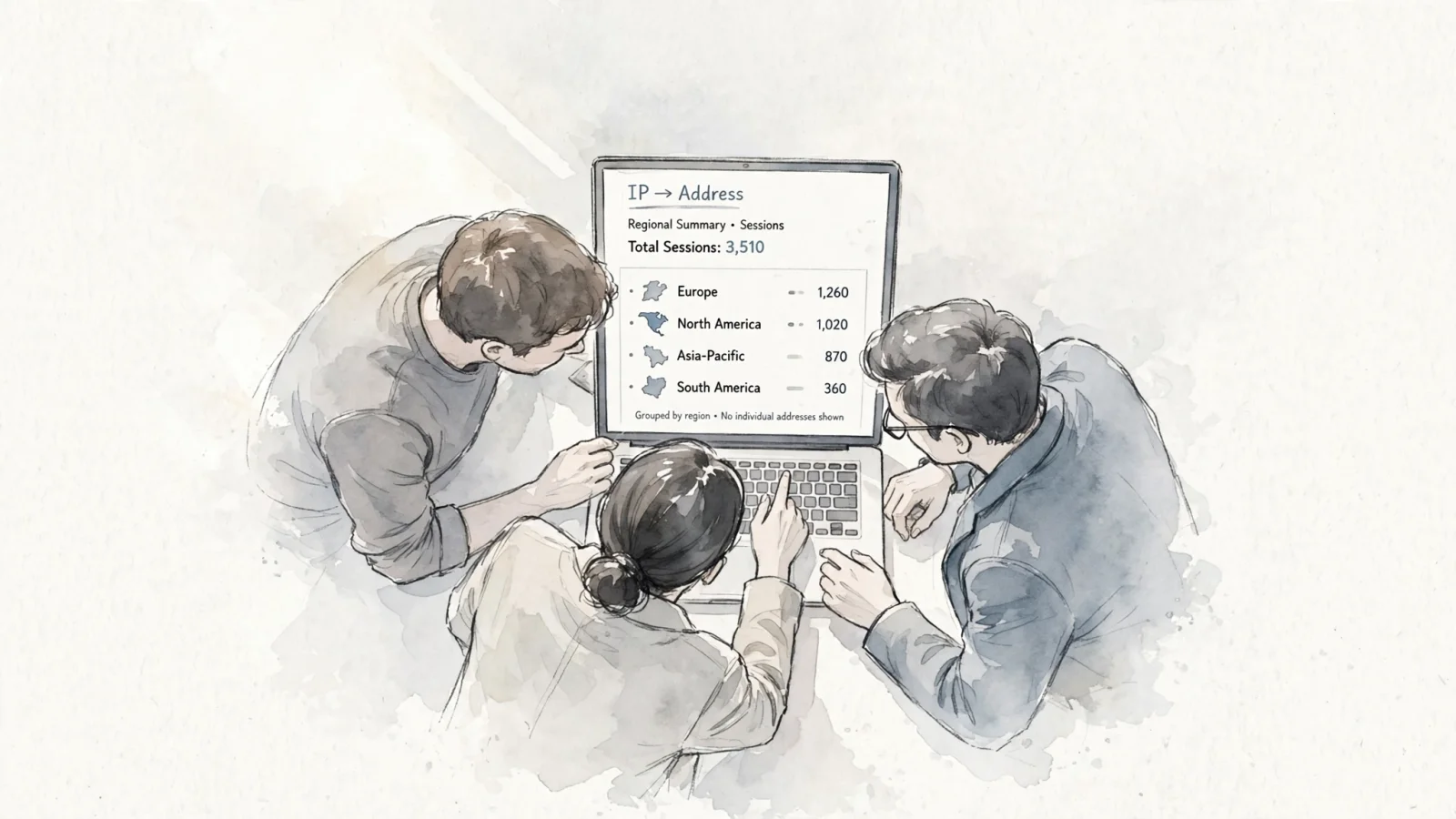
Visitor Identification Without Raw Retention
Analytics tools handle these constraints differently. Some avoid IP-based processing, which can limit IP-derived geographic reporting and make visitor deduplication harder. Others use persistent cookies to distinguish browsers that share a connection. A privacy-conscious middle ground uses the network address briefly, then discards the raw value after processing.
The Swetrix Events API documentation says the service uses an incoming IP address and user-agent to create a temporary salted session hash. It uses the IP for country, region, and city reports, does not store the raw IP address, and removes the session hash after 30 minutes of inactivity or at midnight UTC, whichever comes first.
That expiration limits how long the temporary session can link requests, while the location remains an estimate based on the IP address. Cookieless tracking still processes network data, but it can avoid keeping a raw IP as a long-term identifier.
Forwarding Network Data in Server-Side Environments
Deploying analytics scripts directly in a visitor’s browser is straightforward, but many developers prefer server-side tracking to centralize event collection or reduce reliance on browser-side scripts. Server-side environments introduce a new complication for IP-based geolocation.
When you send an analytics event from your backend server, the analytics platform sees your server’s IP address rather than the user’s address. If you run a web application hosted on AWS in Ohio, every user event you forward to your analytics provider may appear to originate from Ohio, making geographic reports less useful.
The common approach uses a request header called X-Forwarded-For. Proxies, load balancers, and content delivery networks may add client-address information to this header before forwarding the request. When you pass it to an analytics service, use the value supplied or verified by a proxy you control, not unverified client-provided data.
To manage events from your backend, pass the client IP from trusted proxy metadata in the outgoing analytics request. The Swetrix Events API reference instructs developers to set X-Forwarded-For to the visitor’s IP when sending events from a backend or proxy. Supplying the visitor’s address rather than the server or CDN address lets the platform base its geolocation reports on the client’s network, though city-level results remain approximate. You can verify which addresses your proxy chain passes by inspecting your traffic with an HTTP headers checker during development.
Frequently Asked Questions
Can Someone Find My Home Address From My IP?
An IP lookup estimates the broad region associated with a network address, not a person’s precise physical location or street address. Depending on the connection, it can reflect the network’s region or a VPN server’s location rather than the user’s home, as MaxMind’s geolocation guidance explains.
Can an IP Lookup Pinpoint My Exact Location?
IP geolocation doesn’t provide GPS-level precision. According to MaxMind’s guidance, city-level accuracy is typically 20% to 75%, with accuracy often higher in larger, more densely populated cities, especially on networks that provide residential internet service, so a reported city is an estimate rather than the user’s precise physical location.
Can Multiple Visitors Share One Public IP?
Yes. NAT lets many devices share a public-facing address, so offices, universities, public Wi-Fi networks, and mobile carriers may route requests from multiple users through the same IP.
Can Cookieless Analytics Process IP Data?
Yes. Cookieless describes browser storage, while network-data processing may still occur. The Swetrix Events API documentation says it uses the IP for temporary session identification and geographic reports without storing the raw address.
What Affects IP-Based Location Results?
VPNs and proxies mask the user’s true IP, so geolocation reflects the VPN or proxy server’s location rather than the user’s. Mobile geolocation typically resolves to a broad region, and a mobile IP address can move between users hundreds of kilometers apart within minutes, so the address’s geolocation does not guarantee the current user’s location, as MaxMind’s guidance explains.
Moving to a privacy-first analytics setup requires understanding what your metrics represent. You can report on broad geographic trends and site activity without retaining raw network addresses or relying on persistent tracking cookies.
Swetrix offers a cookieless alternative to Google Analytics that processes network data temporarily for visitor identification and aggregate regional reporting. It estimates daily visitor counts and provides product insights. You can track custom events, build conversion funnels, and monitor site performance in the default mode without setting analytics cookies. As your needs grow, Swetrix helps connect privacy-conscious tracking with deeper product insights, including conversion funnels, session replays, and technical SEO insights.
Start tracking your traffic responsibly and explore Swetrix’s cookieless analytics and full suite of developer tools by visiting Swetrix.com.