- Date
How To Track Podcast Downloads And Attribution Without Cookies
 Andrii Romasiun
Global podcast audiences reached 584.1 million listeners in 2025, and brands follow this attention. Advertisers will spend an estimated $5 billion on audio campaigns in 2026. Marketing teams buy sponsorships on prominent shows, wait for the episodes to publish, and expect clear data on revenue generation.
Despite billions in ad spend, market research shows 44 percent of marketers trust their audio return on investment data. The gap between ad dollars spent and conversions tracked causes immense frustration. Measuring audio performance requires a system built for offline attribution.
Learning how to track podcast downloads and attribution stops the guesswork. Tracking protocols assign every website visit and purchase to the correct audio source. Measuring offline media with precise, cookie-free systems proves the value of your audio budget and justifies future ad spend.
The Challenge of Podcast Analytics Today
Audio distribution relies on decentralized infrastructure. Creators use RSS feeds to deliver MP3 files to diverse applications across iOS, Android, and desktop operating systems. Performance marketers face blind spots when trying to trace an iOS or Android download back to a purchase.
The Disconnect Between Market Size and Measurement
Apple Podcasts, Spotify, and independent apps represent distinct ecosystems. When a user taps play, the hosting platform registers a file request. The host lacks visibility into the user's behavior after that moment.
Sponsors evaluate shows using raw server requests. A top-tier active show might generate thousands of file requests per hour. Marketing teams pay B2B technology or mainstream entertainment rates between $18 and $30 per thousand impressions based on these numbers, though this range varies significantly depending on the show's genre and audience niche. Campaign managers calculate customer acquisition cost by dividing the ad placement cost by the resulting new customers.
The math breaks down at the attribution stage. Marketers relying on traditional web analytics assign credit to the last measurable click. Listeners hear an ad while jogging, open a browser hours later, and type your domain into the address bar. Default dashboard settings classify this customer as "Direct Traffic" or "Organic Search." Advertisers fail to credit the audio campaign for the sale.
The Death of IP Tracking and Chartable
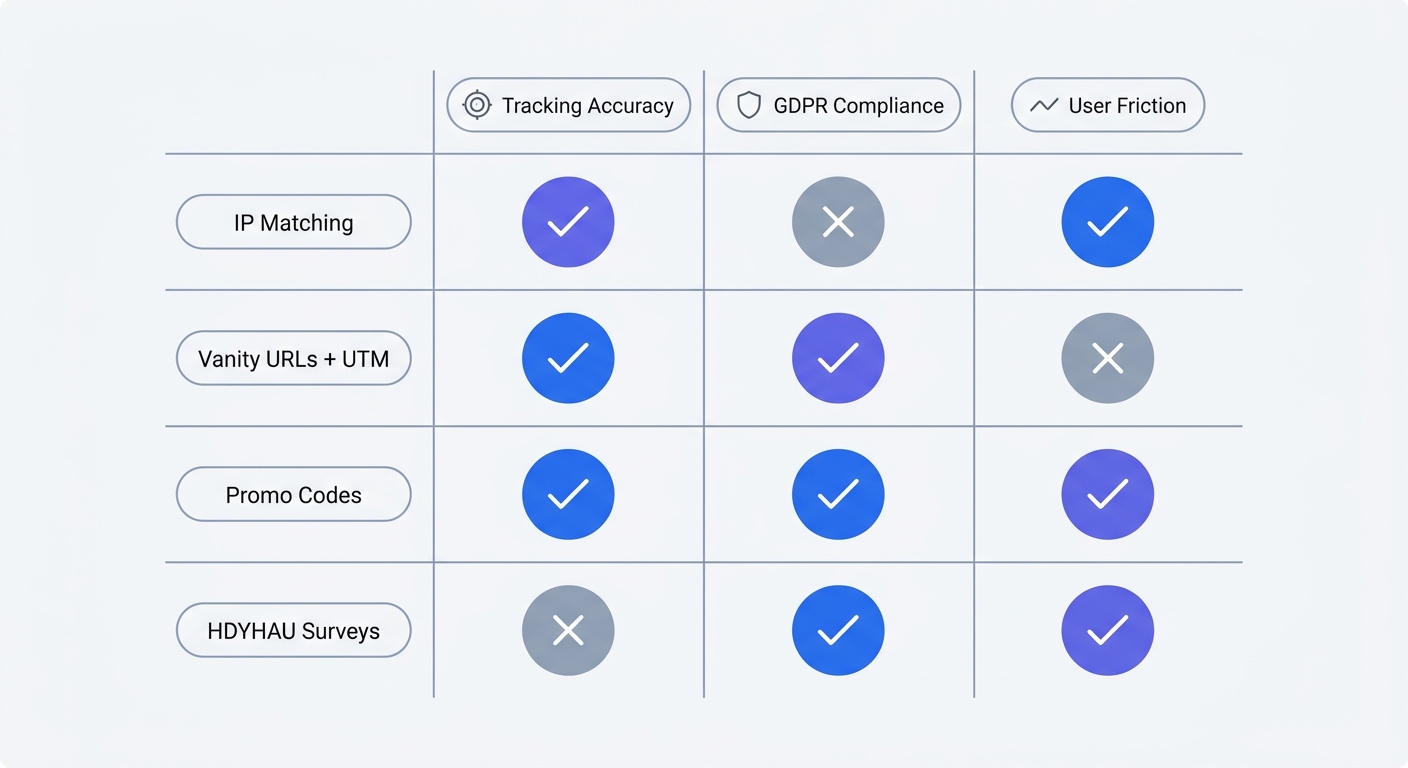
For years, the industry applied a workaround called IP matching. Advertisers used a pixel on the podcast host to log the listener's IP address when they fetched the audio file. Another pixel on the advertiser's website logged the visitor's IP address. Companies linked the two events and claimed a successful conversion.
Podcast measurement tools change over time. Check that your hosting provider and attribution integrations are still supported, and keep exports of historical reports before migrating to a different service.
Marketers who cling to matched network addresses overreport duplicate conversions and underreport mobile sales. Rebuilding a measurement framework requires abandoning network-level matching.
How to Track Podcast Downloads
Understanding audience size begins with understanding the delivery mechanism. Advertisers must distinguish between server events and application events to audit media buys.
Downloads vs. In-App Listens
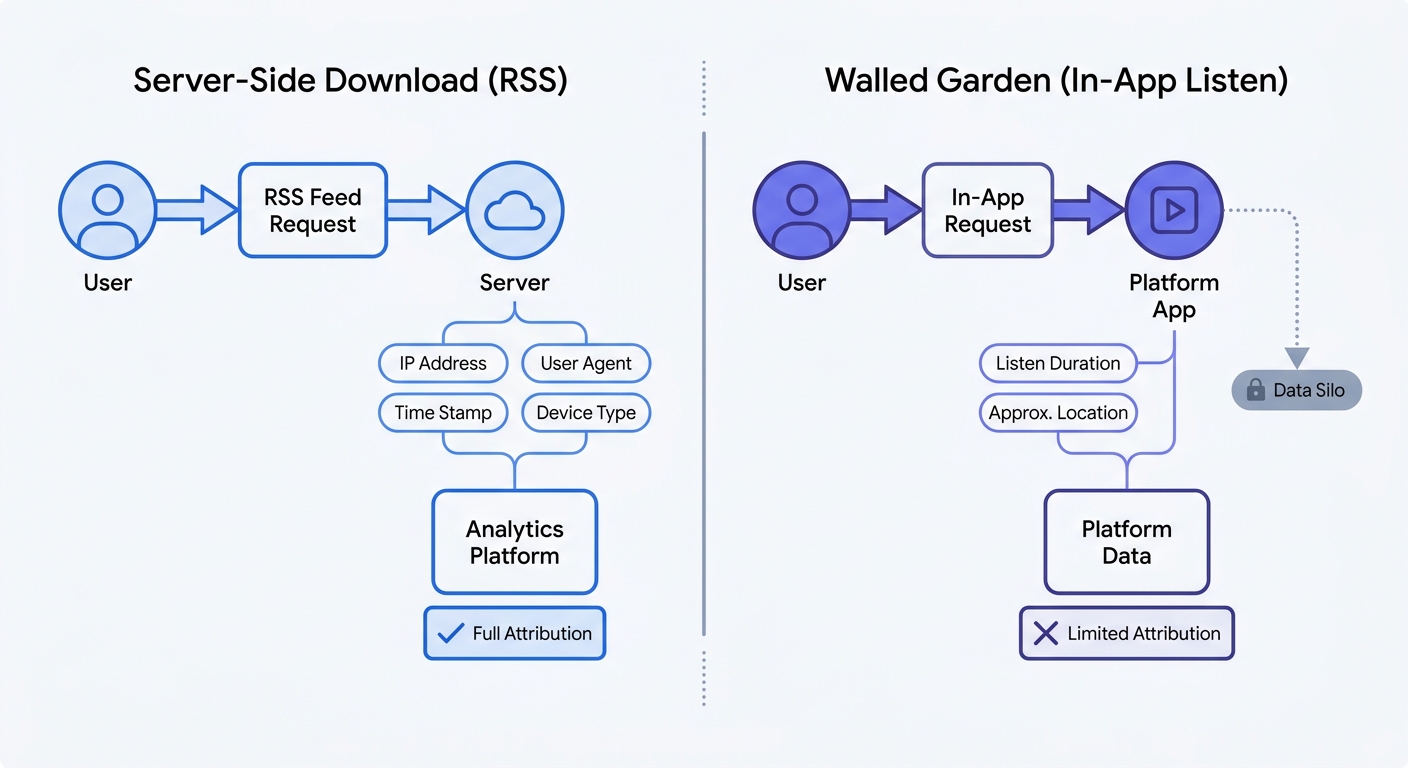
A podcast download is a server-side event. A user subscribes to a show. Their phone checks the RSS feed for new content. Upon episode publication, the listener's device requests the MP3 file from the hosting provider. The server delivers the file and records one file transfer.
An in-app listen is a client-side event. The user presses play. The application measures how many seconds the user consumes. It records skips, rewinds, and completion rates.
Spotify and Apple hide client-side metrics behind proprietary dashboards. These platforms provide aggregate listening data to the show creator while blocking third-party analytics software from accessing behavioral signals. Advertisers must base media buying decisions on the server-side metrics provided by the host.
The IAB v2.2 Measurement Standard
Server logs do not always represent human listeners. Smartwatches fetch duplicate files, and desktop aggregators scrape feeds for indexing purposes. Unfiltered server logs inflate audience size.
The Interactive Advertising Bureau addresses this inflation through strict measurement rules released in May 2024. The v2.2 mandate forces hosting providers to implement anomaly resolution protocols.
Hosts must filter out secondary device requests. The standard alters dynamic ad insertion rules. Previous guidelines counted an impression during a partial file transfer. The v2.2 update dictates that the entire ad byte payload must transfer to the device before the host logs a valid impression.
Demand proof of compliance before buying ad inventory. Ask the show creator to verify their host holds active IAB v2.2 certification. Platforms like Captivate and RSS.com adhere to these rules. Buying ads on uncertified hosts results in inflated pricing based on bot traffic.
How To Track Podcast Attribution
Modern attribution requires explicit user-initiated routing. Campaign managers must guide the listener from the offline audio experience into a tracked digital environment.
Vanity URLs and UTM Parameters
Audio ads require memorable calls to action. Listeners cannot click hyperlinks while washing dishes, and complex character strings result in zero conversions.
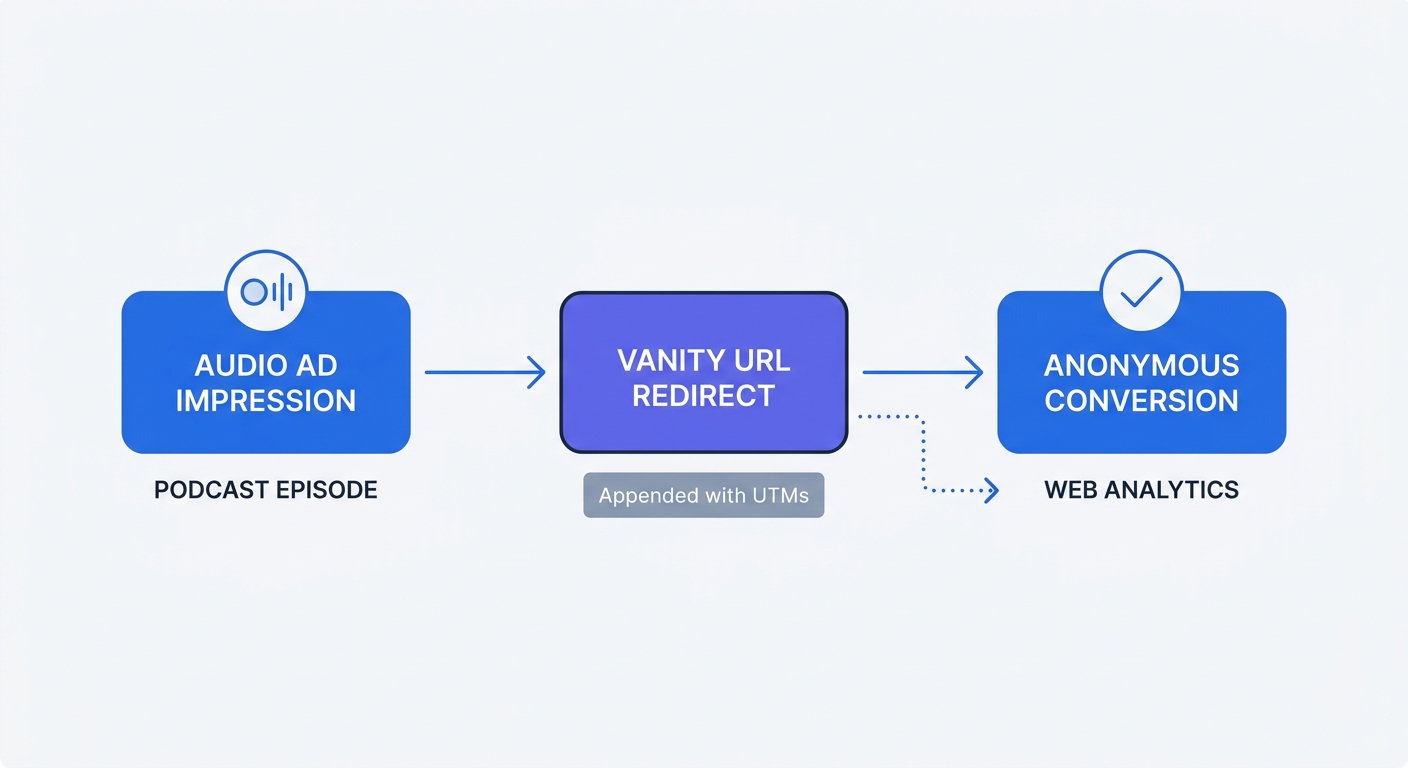
Purchase a short, relevant domain or create a dedicated subfolder on your primary website. The host reads this address on air. When the listener types yourbrand.com/audio into a browser, the server intercepts the request.
Configure the web server to issue a 301 redirect. Point the short address to the primary landing page and append tracking parameters. Use the Swetrix UTM Generator to build the destination link.
Your web server configuration should look like this:
- Source URL:
yourbrand.com/audio - Destination URL:
yourbrand.com/landing-page?utm_source=indiehackers&utm_medium=podcast&utm_campaign=q3_sponsorship
Visitors arriving via the short address carry these parameters into the analytics dashboard. This routing makes the traffic source explicit and eliminates "Direct Traffic" ambiguity. Create a unique short link for every sponsored show to track separate campaigns.
Dedicated Promo Codes for Direct Response
Tracking parameters capture top-of-funnel website visits, while promo codes capture bottom-of-funnel revenue events. Offer a discount tied to a specific text string.
Instruct the podcast host to read the code during the ad segment. A call to action like "Use code SWETRIX20 at checkout for twenty percent off" provides a financial incentive to remember the source.
Promo codes provide definitive proof of purchase intent. A customer might bypass the custom landing page, search for the brand on Google, browse the site for three days, and complete a purchase. Web analytics platforms credit the search engine in this scenario. The promo code overrides the digital trail. Customer entry of "SWETRIX20" in the checkout form assigns that revenue to the audio campaign.
Measure the profit margin impact before launching a code-based campaign. Calculate customer lifetime value using the Swetrix LTV Calculator. Verify the initial discount preserves the long-term profitability of the acquired user.
Using Zero-Party Data to Close Tracking Gaps
People forget promo codes and misspell vanity URLs. Relying on technical tracking leaves a percentage of conversions invisible. Bridging this gap requires asking the customer for the attribution source.
Accounting for Passive Listening
Audio consumption ranks as a secondary activity, as people listen while driving, exercising, or working. Immediate response rates hover near zero, and the duration between the ad impression and the website visit spans hours or weeks.
This delay destroys session-based tracking. A listener hears a pitch on Tuesday and decides to test the software on Saturday. The prospect opens a laptop and types the brand name into a search engine. This user ignores the custom landing page and never uses a promo code.
The analytics dashboard credits Google for the conversion, leaving the podcast host with zero credit. Scaling ad spend becomes impossible when top-performing channels look like underperformers in reporting software.
The 'How Did You Hear About Us?' Survey
Zero-party data solves the delay problem through voluntary customer feedback. Implementing a self-reported attribution survey captures sales that technical methods miss.
Build a 'How Did You Hear About Us?' field into the checkout process or signup flow. Position this element as a mandatory dropdown menu before the final submission button.
Structure the dropdown to prevent survey fatigue:
- Search Engine
- Social Media
- Podcast
- Friend or Colleague
- Other
When a user selects "Podcast," trigger a secondary optional text input field asking "Which one?" Customers type the exact name of the show. Compare this self-reported data against promo code redemptions to discover customers who heard the audio ad but purchased at full price without tracking mechanisms.
Cross-reference survey results with overall traffic trends. If a show drives ten direct promo code redemptions but fifty people mention it in the checkout survey, adjust return on investment calculations to reflect the true impact.
Measuring Podcast ROI With Privacy-First Analytics
Data collection practices face strict regulatory scrutiny. Building an attribution model requires respecting user privacy frameworks across global jurisdictions.
Avoiding the GDPR PII Trap
The General Data Protection Regulation classifies network addresses as personal data. European law protects consumer IP addresses with the same rigor as email addresses or phone numbers.
Audio distribution architectures cannot support consent banners. A listener's podcast application fetches an MP3 file via RSS, and the protocol lacks an interface to ask the user for tracking permission. Capturing the network address during the download happens without explicit consent.
Matching that unconsented network address to a website visitor profile violates privacy laws. Review GDPR documentation to understand the scope of these restrictions. Third-party vendors offering pixel-based audio tracking expose brands to compliance risks. Operating within the law requires abandoning surveillance-based attribution.
Tracking Podcast Conversions With Swetrix
Advertisers require a platform built for modern compliance rules. Swetrix provides a privacy-focused analytics solution that measures marketing performance without hoarding personal data.
Swetrix captures data from tagged vanity URLs upon page load. The platform logs the visit, records session duration, and attributes specific campaign parameters. The software accomplishes this without deploying invasive tracking cookies or logging visitor network addresses.
Set up custom conversion events within the Swetrix dashboard to track form submissions, button clicks, and checkout completions. A cookie-free architecture bypasses the need for disruptive consent banners on landing pages. Visitors experience a fast, frictionless journey from the audio ad to the final purchase.
Marketing reports display precise data. Dashboard metrics reveal how many users arrived from specific show sponsorships. Campaign managers measure engagement time, count resulting conversions, and prove the value of the audio budget using transparent analytics.
Stop guessing which audio campaigns drive revenue. Switch to a platform that captures precise marketing attribution without violating user privacy. Try Swetrix with a 14-day free trial at swetrix.com/signup and start measuring return on ad spend.