- Date
Understanding First-Party Cookies: A Practical Guide to Privacy
 Andrii Romasiun
Ever visited a website that remembered your username or kept items in your shopping cart even after you closed the tab? That’s a first-party cookie at work.
Think of it as a small text file that a website you're directly visiting places on your device. It’s like a digital nametag or a friendly note the site leaves for itself, helping it recognize you and recall your preferences the next time you drop by. This makes your experience much smoother, creating a private conversation just between you and that one specific site.
The End of an Era and the Rise of First-Party Data
The world of digital marketing is going through a seismic shift. For what feels like forever, advertising has leaned heavily on third-party cookies—those little trackers that follow you from site to site, building a profile of your interests. But that model is crumbling under the weight of privacy concerns and new regulations like the GDPR.
Major web browsers are leading the charge. Safari and Firefox have been blocking these trackers for years, and others are quickly catching up.
This isn't just a simple technical update; it's a fundamental change in how businesses need to think about building relationships with people. We're moving away from gathering data from shadowy, third-party sources and toward creating direct, transparent connections with our audience. This is exactly where the first-party cookie shines. It's the digital version of a loyalty card from your favorite local coffee shop—it knows you're a regular, remembers your usual order, and makes your visit better because of it.
This transition forces a healthier, more honest approach to data. The focus is shifting from mass tracking to building genuine trust and delivering real value directly to the user.
Why This Matters to You Right Now
Getting a handle on first-party data isn't just a "nice-to-have" anymore. For anyone working online—marketers, developers, business owners—it's become essential. The old playbook for tracking and advertising is being thrown out, and businesses that don't adapt risk being left in the dark. A strategy built on first-party data is now the foundation for effective and ethical digital operations.
Here’s why you need to get this right:
- Builds Real Trust: When you collect data directly from users with their clear consent, you start the relationship on a foundation of transparency and respect.
- Drives Deeper Personalization: First-party data gives you incredibly accurate, high-quality insights into what people actually do on your site, allowing you to create experiences that are genuinely helpful and relevant.
- Creates a Future-Proof Strategy: As privacy rules inevitably get stricter, having a solid first-party approach ensures your marketing and analytics will remain compliant and effective for years to come.
This guide is designed to walk you through everything you need to know, from the basic mechanics of first-party cookies to advanced strategies you can use to grow your business.
First-Party vs. Third-Party Cookies Explained
To really get why a first-party cookie strategy is so important now, you have to understand what it's up against. The difference between first-party and third-party cookies has nothing to do with their technical guts—at the end of the day, they’re both just little text files. It’s all about context: who creates the cookie, and for what purpose.
Think of a first-party cookie like a friendly greeting from a shopkeeper. You walk into their store (their website), and they remember your name, what you like, and what you left in your shopping cart last time. It's a direct, one-on-one interaction designed to make your visit smoother on that specific website.
Third-party cookies are completely different. They're more like someone from a marketing agency following you from store to store, taking notes on everything you look at. These cookies are set by a domain you aren't even visiting—usually an ad-tech platform or a social media widget—to build a profile of your behavior across the entire web for ad targeting.
Who Controls the Data
This is where the real distinction lies: ownership. With a first-party cookie, the website you're visiting creates it and controls the data. They use it for things that genuinely help you and them, like remembering your preferences or analyzing site traffic. It’s a transparent relationship.
Third-party cookies, on the other hand, are placed by outsiders. The website owner often has no real say in what data gets collected or where it goes. This is the mechanism that has powered cross-site tracking for years, and it's precisely what privacy laws and browser updates are now shutting down. If you want to get into the nitty-gritty, you can explore everything you need to know about cookies in our complete guide.
A first-party cookie is like a membership card for a specific club—it enhances your experience while you're there. A third-party cookie is like a tracker someone slipped into your pocket to see every single club you visit.
This relationship between a website and its users is built on trust, with first-party data acting as the foundation.
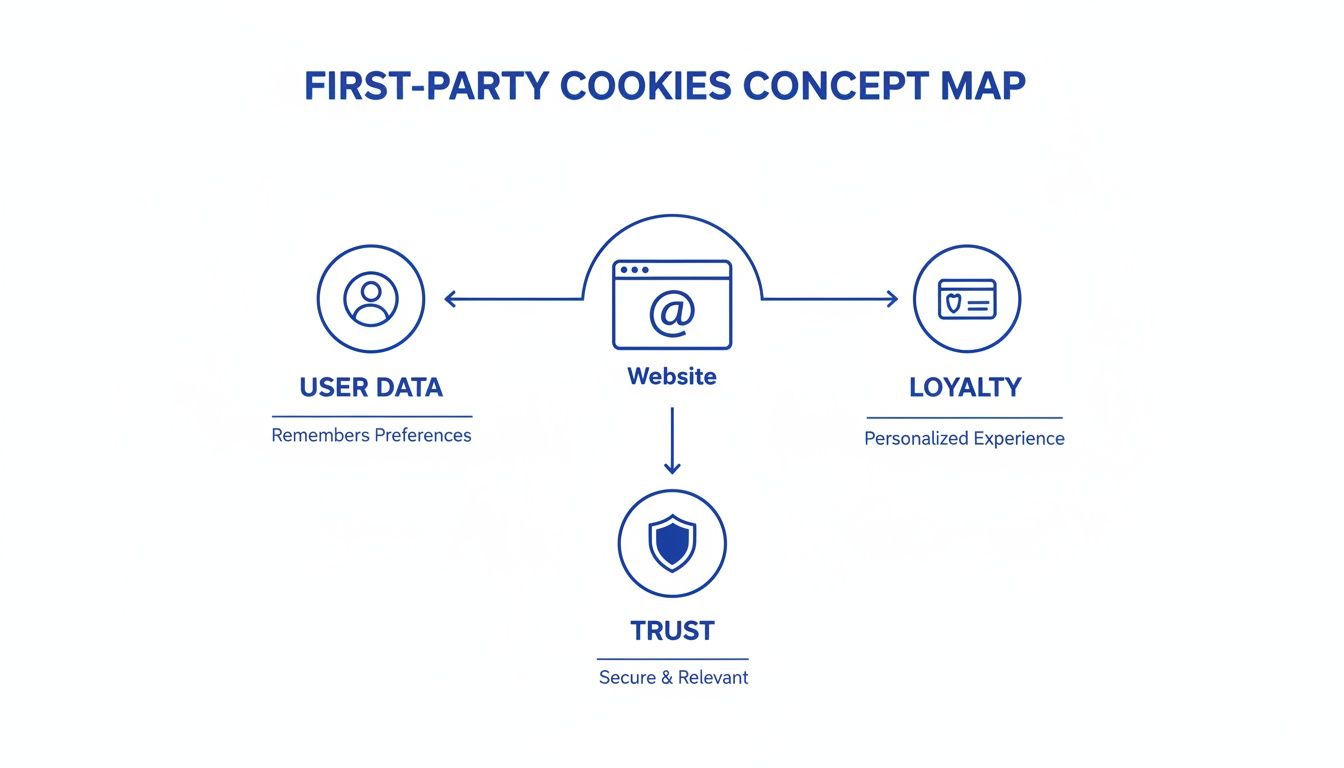
As you can see, when data is gathered and used directly by the site you’re visiting, it helps build genuine user loyalty and trust. The interaction is straightforward and contained.
First-Party vs. Third-Party Cookies: A Head-to-Head Comparison
Sometimes the easiest way to see the difference is to put them side-by-side. This table breaks down exactly how these two types of cookies stack up against each other.
| Attribute | First-Party Cookie | Third-Party Cookie |
|---|---|---|
| Creator | The website you are actively visiting. | An external service or different domain (like an ad network). |
| Purpose | To improve user experience on that one site (logins, analytics, preferences). | To track users across many different websites for advertising. |
| Browser Support | Accepted and supported by all web browsers. They are essential. | Blocked by default in many browsers (Safari, Firefox) and being phased out elsewhere. |
| User Trust | Generally considered helpful and necessary for a site to work properly. | Widely seen as an invasion of privacy, fueling the rise of ad blockers. |
The takeaway is clear. First-party cookies are a core part of a functional, user-friendly website, while third-party cookies are an external tracking tool that is rapidly becoming obsolete.
Driving Real Business Growth with First-Party Data
It’s one thing to get your head around the technical details of a first-party cookie, but it’s another thing entirely to see how it actually drives business results. Owning your user data isn't just about ticking a compliance box; it's a massive competitive advantage that fuels real, sustainable growth. This is where we shift from the "what" to the strategic "why."
When you collect data straight from your users on your own domain, you get an incredibly accurate, high-quality picture of how they behave. This clarity lets you move past generic marketing and start creating deeply personal experiences that connect with what your audience truly cares about.
From Data to Dollars
For marketers, this kind of high-fidelity data is pure gold. Instead of guessing with murky third-party profiles, you can build laser-focused audience segments based on actual actions people took on your site. The result? More effective campaigns, less wasted ad spend, and a much higher return on investment (ROI).
For startup founders and indie makers, the upside is even more immediate. A solid first-party data strategy helps you understand your earliest users on a deep level. You can guide product development and sharpen your conversion funnels without blowing your budget on broad, expensive advertising. It’s all about making smarter, data-backed decisions right from the start.
A Forrester study really drives this home, showing that businesses with first-party data strategies see a 2x increase in conversion rates and a 30% reduction in customer acquisition costs (CAC). For founders who need simple, GDPR-compliant insights, those are game-changing numbers. You can read the full research about these findings to learn more.
Building Loyalty and Boosting Lifetime Value
Personalization fueled by first-party data isn't just about getting that first conversion—it’s about creating lasting customer loyalty. When people feel like you understand them and value their time, they're far more likely to come back.
This kicks off a powerful growth loop:
- Better User Experience: You use first-party data to remember preferences, recommend relevant content, and make their journey seamless.
- Increased Engagement: A smooth, personal experience keeps users around longer and encourages them to visit again.
- Stronger Relationships: This consistent exchange of value builds trust, turning casual visitors into loyal customers and even brand advocates.
In the end, a first-party data strategy helps you acquire customers more efficiently while also massively increasing their lifetime value. This isn't just a pivot to adapt to a privacy-first world; it's about building a fundamentally stronger, more resilient business. By investing in the direct relationship with your audience, you create an asset that no competitor can copy and no browser update can ever take away.
Navigating Consent Under GDPR and Privacy Laws
Shifting your focus to a cookie first party strategy is a fantastic move for building a more direct, transparent relationship with your audience. But there's a common myth floating around: that first-party cookies get a free pass from privacy laws like GDPR. That's just not true.
The rules don't just ask who places the cookie; they're far more interested in why it's being placed. Even though a first-party cookie comes directly from your domain, its purpose determines your legal responsibility. If a cookie isn't absolutely essential for your site to work, you still need to get the user's explicit permission.
Differentiating Essential from Non-Essential Cookies
To keep everything above board, you have to get good at telling different types of cookies apart. This isn't just a technical detail—it's the bedrock of a sound, ethical data strategy.
- Strictly Necessary Cookies: These are the non-negotiables. Think about the cookie that keeps items in a shopping cart as a user browses, or the one that keeps someone logged in. Your site would break without them. Generally, you don't need to ask for consent for these.
- Non-Essential Cookies: This bucket holds everything else—cookies for analytics, personalization, and advertising. Even if your first-party analytics cookie is just helping you improve your website, it’s not strictly required for the user to get the basic experience they came for. And that means you need their opt-in consent.
Getting this distinction wrong can land you in hot water. For a deeper dive into the specifics, our guide on GDPR compliance for websites is a great resource to make sure you're on the right track.
The core principle of modern privacy laws is user control. Simply because a cookie is first-party does not give a website the automatic right to track user behavior for analytics or marketing without clear, affirmative consent.
Best Practices for User-Friendly Consent
Let's face it: your consent banner is often the very first thing a new visitor sees. It's your first handshake, and it sets the tone for their entire experience. A clunky, confusing banner is an instant turn-off and can send people bouncing right off your page.
Instead of treating it like a legal chore, think of it as a chance to show you're trustworthy.
- Use Clear Language: Ditch the legal jargon. Explain what you're asking for in plain English. Tell them what the cookie does and why you want to use it.
- Provide Granular Choices: The all-or-nothing approach is outdated. Give users the power to accept all, reject all, or pick and choose which cookie categories they're comfortable with.
- Make "Reject" as Easy as "Accept": Don't bury the opt-out button or use sneaky design tricks (often called "dark patterns"). This stuff doesn't just violate the spirit of GDPR; it completely demolishes user trust.
When you implement an honest and clear consent process, you're doing more than just ticking a legal box. You're showing your users you respect their privacy, which is the perfect foundation for the strong, direct relationship that a first-party data strategy is all about.
Let's be honest: relying on third-party data is no longer a viable long-term strategy. It's time to build an analytics approach centered on privacy, and that journey starts with a hard look at your current data habits. You need to map out every single tool and script on your site to see where you're leaning on third-party data and, more importantly, where you might be creating privacy risks for your users.
Once you have that map, the real work begins: building your own first-party data. This isn't about finding new ways to track people. It's about creating a genuine value exchange. When you offer a better, more personalized experience, users are often happy to share information directly with you.

The dashboard you see above is a perfect example of how modern platforms can deliver powerful insights without invasive tracking. It's a fundamental shift that lets businesses get the data they need while truly respecting user privacy.
Embracing Modern Analytics Platforms
The heart of any privacy-first strategy is choosing the right tools for the job. Thankfully, a new generation of analytics platforms has emerged, built from the ground up to respect user consent. Many of these solutions don't even use cookies. Instead, they focus on providing the aggregate data you need to make smart decisions, not on tracking individuals across the internet.
For example, a platform like Swetrix can give you a clear view of user journeys, identify your most popular content, and track conversion funnels—all without resorting to invasive methods. This approach gives you the critical data you need for growth and, at the same time, lets you offer a more secure and trustworthy experience to your audience.
As third-party cookies head for the exit, businesses that have already pivoted to a cookie first party data strategy are reaping the rewards. One recent report found that marketing campaigns built on first-party data can drive a 5-8x higher ROI than generic ones. That's a massive win for any team trying to get GDPR-compliant insights.
A privacy-first approach isn't a limitation; it's a competitive advantage. It forces you to focus on the data that truly matters, leading to more accurate insights and stronger customer relationships built on a foundation of trust.
A Practical Roadmap for Implementation
Making the switch isn't as daunting as it sounds, especially if you break it down into a few manageable steps. This isn't just about swapping out one tool for another; it's a shift in mindset toward data ownership and user respect.
Here’s a simple roadmap to get you moving in the right direction:
- Audit Your Current Setup: Pop open your browser's developer tools or use a privacy scanner to get a list of every third-party script running on your site. Make a note of what each one does and what data it's collecting.
- Define Your Core Metrics: Figure out which key performance indicators (KPIs) actually move the needle for your business. Zero in on things like conversion rates, user engagement on important pages, and which traffic sources are most effective.
- Choose a Privacy-First Tool: Start evaluating cookieless analytics solutions that fit your goals. Look for platforms that give you full data ownership, are transparent about how they work, and make it easy to comply with regulations like GDPR.
- Implement and Validate: Once you've chosen a new tool, install it and let it run alongside your old system for a little while. This helps you validate the new data and ensures a smooth transition without losing valuable historical context. For those who want the ultimate control, exploring **self-hosted web analytics** is a fantastic option for total data sovereignty.
- Sunset Third-Party Trackers: When you're confident in your new setup, it's time to say goodbye. Systematically remove the old, invasive tracking scripts from your website. You'll not only improve privacy but will likely see a nice boost in your site's performance and loading speed, too.
Following this path will help you build an analytics strategy that’s both resilient and ethical. You’ll be prepared for a cookieless future and, more importantly, you’ll strengthen the trust that users place in your brand.
Common Questions About First-Party Cookies
With the internet moving toward a more privacy-focused future, a lot of questions—and a few myths—have popped up around first-party cookies. Getting straight answers is the only way to build a strategy that actually works while respecting user privacy. Let's clear up some of the most common points of confusion.
You’ve probably heard the phrase "death of the cookie" thrown around for years now. It sounds dramatic, but that whole conversation is almost entirely about third-party trackers. It's so important to remember that not all cookies are the same, and their futures are worlds apart.
Are First-Party Cookies Going Away Too?
Nope, first-party cookies aren't going anywhere. They are a core, essential part of how the modern web even works. Browsers have zero plans to block them because doing so would completely break the basic functionality of most websites.
Just think about it. Without these cookies, you’d have to log back into your email every single time you clicked a new message. Your online shopping cart would mysteriously empty itself every time you navigated to a different product page. They're basically a website's short-term memory, created by the site you’re on to make your visit go smoothly.
The entire phase-out discussion—from browser updates by Safari and Firefox to Google's big policy shifts—is aimed squarely at third-party cookies. Those are the ones used for tracking you across different websites, powering the kind of advertising that feels a little too much like surveillance.
Can First-Party Cookies Still Be Used for Tracking?
Yes, but with one massive limitation: they can only track user activity on your domain. A first-party cookie is perfect for understanding how people behave on your website or app, giving you incredibly valuable insights without following them across the web.
This is how you answer crucial business questions like:
- Which blog posts are actually resonating with our readers?
- Where are people getting stuck and abandoning the checkout process?
- How do users get from our homepage to our most important feature pages?
This is what responsible, contained analytics looks like. The cookie helps you improve your service for your visitors. It can't, however, tell you which other sites a person visits after they leave yours, which is the very privacy issue that sparked the war on third-party cookies in the first place.
A simple way to think about it is scope. First-party tracking is like a store manager watching how shoppers move through their own store to improve the layout. Third-party tracking is like that same manager following those shoppers to every other store in the mall.
Is a First-Party Data Strategy Enough?
For most businesses, a solid first-party data strategy isn't just "enough"—it's flat-out better. Sure, you can't replicate the creepy cross-site tracking of third-party cookies, but what you get instead is far more powerful: accurate, high-quality data that your audience gives you directly and with consent. This is the foundation of any modern, resilient business.
That said, a complete strategy is usually more than just data collection. It means blending your first-party insights with other privacy-friendly methods to get the full picture.
This often includes a mix of:
- Contextual Advertising: Placing ads based on the content of the page a person is viewing, not their browsing history.
- Privacy-First Analytics: Using tools designed to give you essential metrics without tracking individual users.
- Zero-Party Data: Just asking! This is information customers willingly share through surveys, quizzes, or account preferences.
When you combine these approaches, you build a marketing and analytics engine that's both powerful and sustainable. You stop relying on borrowed, often inaccurate data and start building real, trust-based relationships with your customers. This doesn't just prepare you for a future without third-party cookies; it builds a stronger, more ethical brand that people feel good about supporting.
Ready to build a privacy-first analytics strategy? Swetrix provides clear, actionable insights without cookies or intrusive tracking, helping you understand your audience while respecting their privacy. Get started with a 14-day free trial.