- Date
12 Essential Feature Flagging Best Practices for 2026
 Andrii Romasiun
Feature flags have evolved from simple on/off switches to a cornerstone of modern software development, enabling teams to ship faster, mitigate risk, and make data-driven decisions. But without a strategic framework, these powerful tools can introduce technical debt, create confusion, and lead to inconsistent user experiences. Moving beyond basic toggles requires a disciplined approach to flag management that touches every part of your development lifecycle, from initial design to eventual cleanup.
Mastering feature flagging isn't just about flipping a switch; it's about building a robust process that integrates with your analytics, respects user privacy, and accelerates your development cycle. This guide provides a comprehensive list of actionable feature flagging best practices designed for teams looking to implement a sophisticated, scalable release strategy. We will move beyond generic advice and provide specific, practical steps you can take today.
Throughout this listicle, we will cover critical areas including:
- Strategy and Governance: Establishing clear naming conventions, lifecycle management, and ownership.
- Targeted Releases: Implementing gradual rollouts and sophisticated user segmentation.
- Testing and Observability: Integrating flags with CI/CD pipelines, A/B testing frameworks, and performance validation.
- Security and Compliance: Ensuring your flagging practices are secure and handle user data responsibly.
Each practice is designed to be directly implemented, helping you avoid common pitfalls like flag interdependencies and technical debt. We'll also explore how to pair these techniques with privacy-first analytics tools like Swetrix to measure impact confidently, ensuring your data-driven decisions don't compromise user trust. Let's dive into the essential practices that will transform your feature releases from risky deployments into controlled, strategic rollouts.
1. Implement Gradual Rollout Strategies
One of the most powerful feature flagging best practices is the gradual rollout, also known as a percentage-based rollout or canary release. This strategy involves releasing a new feature to a small, controlled segment of your user base first. As you gain confidence in its stability and performance, you incrementally increase the percentage of users who have access until it reaches 100%.
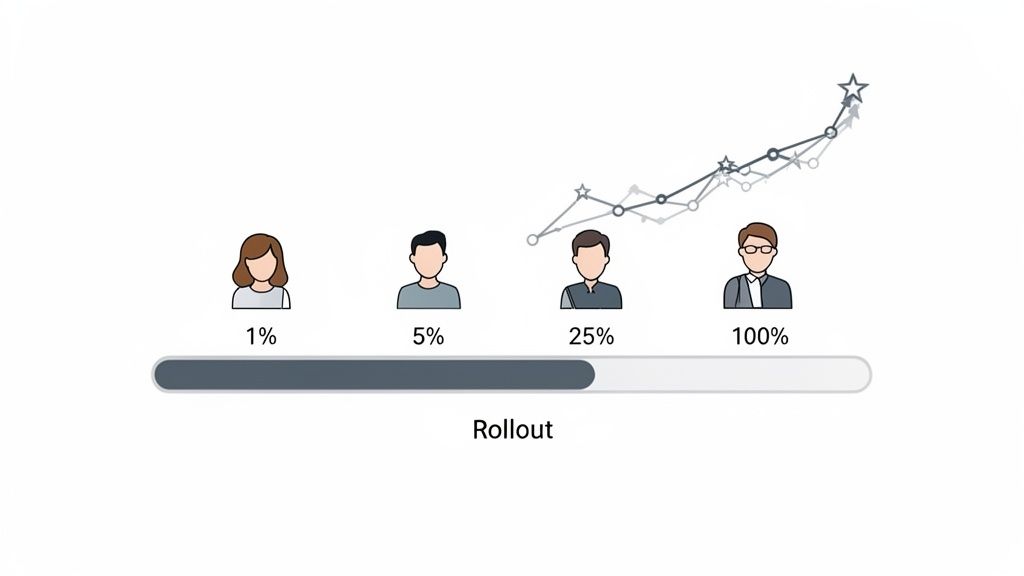
This method significantly minimizes risk by limiting the "blast radius" of potential bugs or negative performance impacts. Instead of a high-stakes "big bang" release, you de-risk the launch by validating the feature in a live production environment with real user traffic. Tech giants like Google and Facebook popularized this approach to test new features and infrastructure changes safely at scale.
Actionable Tips for Gradual Rollouts
To execute this effectively, integrate your feature flagging system with your analytics and monitoring tools. For privacy-focused teams using a tool like Swetrix, this provides a powerful feedback loop.
- Establish Baselines: Before starting, document key performance indicators (KPIs) like error rates, latency, and conversion rates. This baseline is crucial for comparison.
- Track Adoption with Custom Events: Use custom events to monitor how users in each cohort interact with the new feature. This helps validate that the feature is being used as intended.
- Monitor System Health: Keep a close eye on error-tracking dashboards and performance metrics during each phase of the rollout (e.g., at 1%, 10%, 50%).
- Automate Alerts: Set up automated alerts in Slack or Discord to notify the team immediately of any significant anomalies or regressions, enabling a swift rollback if necessary.
This methodical approach transforms releases from a source of anxiety into a controlled, data-driven process.
2. Establish Clear Feature Flag Naming Conventions
As your application grows, so does the number of feature flags. Without a standardized naming system, your flag dashboard can quickly become a confusing, unmanageable mess. Establishing clear naming conventions is a foundational feature flagging best practice that enhances clarity, simplifies maintenance, and accelerates development velocity by making flags instantly understandable.
A well-structured name should communicate a flag's purpose, scope, and lifecycle at a glance. Instead of ambiguous names like new_feature or test123, a descriptive name like exp_checkout_flow_optimization_marketing immediately tells you it's an experiment related to the checkout flow, owned by the marketing team. This clarity is indispensable for large teams and agencies managing multiple products, preventing accidental changes and simplifying cleanup.
Actionable Tips for Naming Conventions
To implement a robust naming strategy, document the convention and enforce it through process. This small investment pays huge dividends in long-term manageability.
- Create a Standardized Pattern: Define a consistent structure, such as
[type]_[scope]_[description]_[owner]. For example,feat_profile_avatar_upload_frontendorkill_legacy_payment_processor_platform. - Document Everything: Add your naming convention to your team's wiki or a central README file so it’s easily accessible to all engineers.
- Enforce During Code Review: Make checking the feature flag name a required step in your pull request checklist to maintain consistency.
- Align with Analytics: When tracking flag exposure, use a consistent event name in your analytics tool. For a flag named
feat_new_dashboard_v2, you could track an event likefeature_flag_feat_new_dashboard_v2_enabledin Swetrix to directly link user behavior to the feature's activation.
This disciplined approach ensures that your feature flag system remains an organized, powerful tool rather than a source of technical debt.
3. Define Clear Flag Lifecycle and Retirement Processes
One of the most crucial feature flagging best practices is establishing a clear lifecycle for every flag. Feature flags are inherently temporary and should not live in your codebase indefinitely. Creating a defined process for their creation, active use, and eventual retirement is essential for preventing technical debt, reducing complexity, and maintaining a clean, manageable system.
Without a formal retirement strategy, flags accumulate and become "stale," making the code harder to reason about and increasing the risk of unexpected interactions. Companies like Etsy and Uber pioneered rigorous flag hygiene practices to manage this complexity at scale. A well-defined lifecycle ensures that every flag serves a clear, time-bound purpose, from a two-week A/B test to a month-long beta rollout, after which it is systematically removed.
Actionable Tips for Flag Lifecycle Management
Integrating this process into your team's workflow from the start is key. For teams using analytics to drive decisions, this lifecycle ensures that data-backed conclusions lead to decisive action and code cleanup.
- Set Expiration Dates: When creating a flag, assign an owner and a "review by" or "expiration" date. This creates accountability and a clear timeline.
- Automate Reminders: Set up automated alerts in Slack or project management tools to notify the flag owner two weeks before its scheduled expiration.
- Use A/B Test Results to Decide: When an A/B test concludes, use the results to determine the winning variant. The flag for the losing path should be scheduled for immediate removal.
- Integrate Cleanup into Sprints: Make flag removal a standard part of your sprint planning or backlog grooming. A "cleanup" ticket should be created when the flag's purpose is fulfilled.
- Document Final Learnings: Before deleting a flag, document its outcome, key metrics, and any lessons learned. This creates a valuable knowledge base for future experiments.
This disciplined approach ensures your feature flagging system remains a powerful tool for innovation rather than a source of long-term technical debt.
4. Integrate Feature Flags with A/B Testing Frameworks
Beyond simple on/off toggles, one of the most strategic feature flagging best practices involves integrating them with A/B testing frameworks. This transforms feature flags from a release mechanism into a powerful tool for experimentation. The flag controls which user sees which variant (e.g., a red vs. a blue checkout button), while the A/B testing framework measures the impact on key metrics like conversion rates.
This combination allows you to make data-driven decisions backed by statistical significance. Instead of guessing which user experience is better, you can prove it. Companies like Amazon and Google have built entire cultures around this level of experimentation, using it to optimize everything from onboarding flows to headline variations. This approach removes subjectivity and ensures product changes genuinely improve the user experience.
Actionable Tips for A/B Testing with Flags
To run effective experiments, a feature flagging system must be paired with a robust analytics tool. Platforms like Swetrix offer built-in A/B testing, creating a seamless workflow from experiment setup to analysis.
- Document Your Hypothesis: Before launching, clearly state what you expect to happen (e.g., "The new onboarding flow will increase user activation by 15%").
- Calculate Sample Size: Determine how many users you need in each variant to achieve statistical significance. Avoid peeking at results early, as it can lead to false conclusions.
- Track Primary and Secondary Metrics: Use custom events in Swetrix to monitor your main goal (like sign-ups) and secondary indicators (like user engagement or session duration).
- Analyze User Behavior: Once the test concludes, use session analysis to understand why one variant outperformed the other, providing qualitative insights to complement the quantitative data. To learn more about optimizing key pages, explore these strategies for A/B testing for landing pages.
This methodical approach ensures that your feature releases don't just happen safely; they happen intelligently, driving measurable business growth.
5. Use Contextual Flag Evaluation for Sophisticated Targeting
One of the most strategic feature flagging best practices is to move beyond simple on/off switches and use contextual evaluation. This approach allows flags to resolve differently based on rich, dynamic attributes from the user or request context. This means you can target specific user segments with surgical precision-without deploying new code for every rule change.
This method enables sophisticated release strategies, such as enabling a feature only for users with a specific subscription tier, a particular geographic location, or a certain user role. It's especially powerful for multi-tenant SaaS platforms that need to serve different features to enterprise clients versus free-tier users, or for agencies managing diverse client needs. Companies like LaunchDarkly and Split.io have pioneered these advanced, rule-based targeting capabilities.
Actionable Tips for Contextual Targeting
To leverage this powerful technique, your feature flagging system needs access to user and request data. Integrating this with a privacy-focused analytics tool like Swetrix creates a seamless feedback loop for measuring the impact on each segment.
- Define Your Attributes: Start by identifying and documenting the key contextual attributes that matter for your business, such as
account_tier,user_role,geo_country, ordevice_type. - Segment Performance Monitoring: Use custom events in your analytics to track KPIs for each targeted segment. For example, monitor conversion rates specifically for users in your "beta_testers" segment who have a new feature enabled.
- Validate Geographic Rollouts: If you release a feature to a specific country, use geolocation data from your analytics to confirm that only users from that region are accessing it, preventing unintended exposure.
- Test for Missing Context: Always create test cases for scenarios where a contextual attribute is missing or null. Define a safe default behavior for the flag in these edge cases to prevent unexpected errors.
By tying flag states to real-time context, you transform feature flags from a simple deployment tool into a dynamic, business-driven control plane.
6. Establish Monitoring and Alerting for Flag-Related Issues
Feature flags introduce new vectors for potential failure. A critical feature flagging best practice is to implement comprehensive monitoring and alerting to detect issues related to flag evaluations, user segmentation, or performance deviations. This proactive approach ensures you catch problems before they significantly impact your users.
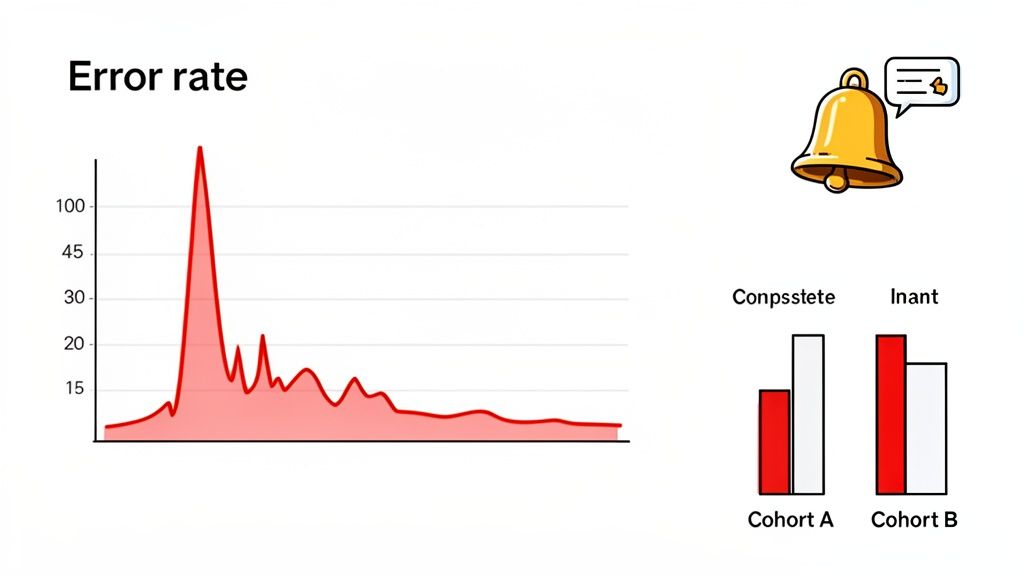
Without proper observability, a misconfigured flag could degrade the user experience silently. For instance, a new feature might introduce a performance bottleneck or an unexpected bug that only affects a specific user segment. Monitoring and alerting, popularized by tools like Datadog and Honeycomb, transforms feature flags from a potential liability into a truly controlled release mechanism.
Actionable Tips for Monitoring and Alerting
Integrating your feature flag system with a privacy-focused analytics and monitoring tool provides a robust safety net. This allows you to correlate feature exposure with system health and user behavior metrics in real-time.
- Set Up Anomaly Alerts: Configure real-time alerts for key metrics. For example, set a rule to trigger a Slack notification if the error rate for the
feat_new_checkoutcohort exceeds your baseline by 5%. - Monitor Business KPIs: Track key business metrics per flag variant. An alert can notify you if the conversion rate for variant B drops 20% compared to the control group, indicating a negative impact.
- Track Flag Performance: Monitor the performance of your feature flagging system itself. Alert on operational metrics like a sudden increase in flag evaluation latency above 100ms.
- Combine Tooling: Integrate alerts from your feature flag platform (e.g., for flag state changes) with application performance and error tracking alerts for full-stack observability.
This level of vigilance ensures that your releases are not only controlled but also continuously validated against performance and business outcomes.
7. Document Flag Purpose, Ownership, and Decision Criteria
One of the most overlooked feature flagging best practices is establishing a rigorous documentation standard. As teams grow and flags multiply, undocumented flags become a significant source of technical debt and confusion. Clear documentation captures why a flag exists, who owns it, what success looks like, and the criteria for removing it or rolling it out fully.
This practice prevents the loss of institutional knowledge when team members change roles or leave. It transforms flags from mysterious toggles into transparent, manageable components of your software. Companies like GitLab and Etsy have championed this documentation-driven approach to maintain clarity and enable asynchronous collaboration across distributed engineering teams.
Actionable Tips for Flag Documentation
Integrating documentation directly into your workflow is key. For teams using a privacy-focused tool like Swetrix, this means linking analytics insights directly to the flag's lifecycle.
- Create a Standard Template: Use a consistent template for all new flags, including fields for owner, creation date, linked Jira/GitHub issue, success metrics, and a cleanup date. For example:
Flag: 'feat_new_checkout_flow'. Owner: Alex (Product). Success Metric: Cart abandonment rate decreases by 5%. Cleanup by: Q3 end. - Define Clear Decision Criteria: Explicitly state what conditions will trigger a 100% rollout or an immediate rollback. For instance:
Rollout if: Conversion rate improves by >3%. Rollback if: Page load latency increases by >200ms. - Link to Live Metrics: Attach links or screenshots from your Swetrix dashboards directly to the flag's documentation. This provides a clear, data-backed history of the feature's performance and impact.
- Document Learnings at Retirement: When a flag is removed, add a final note summarizing the outcome. This turns every feature release into a learning opportunity, capturing valuable insights for future experiments.
8. Prevent Flag Interdependencies and Conditional Logic Complexity
One of the most critical feature flagging best practices for maintaining a clean and understandable codebase is to avoid flag interdependencies. When one feature flag's behavior is contingent on the state of another (e.g., if (flagA && flagB)), you create a complex web of logic that is difficult to test, reason about, and safely remove. This complexity debt can quickly spiral, leading to unpredictable bugs and slowing down development.
This principle is heavily influenced by the Unix philosophy of "do one thing and do it well." Each flag should control one distinct, isolated piece of functionality. This ensures that enabling or disabling a feature has a predictable and contained impact. For scaling teams where code velocity is paramount, keeping flags independent is essential for preventing tangled logic that hinders progress and introduces unnecessary risk.
Actionable Tips for Flag Independence
To enforce this practice, you must be disciplined during both development and code review. Using a tool like Swetrix for A/B testing can help by encouraging you to measure the impact of each change independently, reinforcing this separation.
- Isolate Functionality: Design flags to control a single, self-contained feature. For an e-commerce checkout, create separate flags for a new payment provider, a new shipping calculator, and a redesigned confirmation page, rather than one monolithic "new checkout" flag.
- Prohibit Nested Checks: Establish a strict rule during code reviews to reject any code that checks the state of one flag inside the conditional block of another.
- Coordinate Through Data: If two features need to interact, they should do so through shared data or backend service states, not by directly checking each other's flags. This decouples their release lifecycles.
- Measure Independently: Use separate custom events in your analytics to track user interaction with each feature controlled by a flag. This provides clear, unambiguous data on the performance of each change in isolation.
9. Ensure Privacy-Compliant Flag Evaluation and Data Handling
A critical aspect of feature flagging best practices involves managing user data responsibly during flag evaluation. When flags use user attributes to make targeting decisions (e.g., location, subscription tier, or user ID), you enter the realm of data processing, which is governed by strict privacy regulations like GDPR, CCPA, and HIPAA. Ensuring your flag implementation respects these laws is non-negotiable.
This practice requires treating user attributes used in flag rules with the same care as any other personal data. For instance, a healthcare application must avoid using Personally Identifiable Information (PII) directly in flag rules to maintain HIPAA compliance. Similarly, for users in the EU, you must have a legal basis, like explicit consent, before using their email domain to target a beta feature. This privacy-first approach builds user trust and avoids costly legal penalties.
Actionable Tips for Privacy-Compliant Flagging
To implement this correctly, integrate privacy by design into your feature flagging lifecycle. This aligns perfectly with privacy-focused analytics tools like Swetrix, which provides a cookieless, privacy-first foundation for your user data needs.
- Minimize Data Collection: Only collect the absolute minimum user attributes necessary for flag targeting. Avoid collecting sensitive data if a less invasive attribute (like an anonymous session ID) will suffice.
- Leverage Anonymous Data: Use Swetrix's privacy-centric geolocation (based on anonymized IP data, not precise tracking) for regional rollouts. For feature adoption metrics, rely on anonymous session tracking instead of tying usage back to specific user profiles.
- Document Data Flows: Maintain clear documentation of what data is used for flag evaluations in your privacy impact assessments and data processing agreements. This is a core requirement for GDPR compliance on your website.
- Conduct Regular Audits: Review your feature flag rules quarterly to identify and remove any that collect or process unnecessary PII, ensuring your system remains lean and compliant over time.
10. Implement Feature Flag Performance Testing and Load Validation
A crucial, often-overlooked feature flagging best practice is to rigorously test the performance impact of your flag evaluation logic. Every feature flag introduces a small amount of latency to an application's request cycle. While milliseconds may seem insignificant, this overhead can compound in high-traffic systems, leading to degraded user experiences and potential performance bottlenecks.
This practice involves proactively load testing and benchmarking your feature flagging system to ensure it can handle production-level traffic without causing slowdowns. It's about treating your flagging infrastructure as a critical, performance-sensitive component of your application. Companies like Cloudflare and Google, obsessed with edge performance and Core Web Vitals, have institutionalized this level of performance validation to protect user experience at scale.
Actionable Tips for Performance Testing
Integrating performance testing into your development lifecycle ensures that your feature flags enhance, rather than hinder, your application's responsiveness. Using a real-time analytics tool like Swetrix can help you directly measure the impact on real users.
- Establish a Performance Budget: Define an acceptable latency for flag evaluation (e.g., p99 latency must be under 2ms). This creates a clear success metric for your tests.
- Monitor Core Web Vitals: Use real user monitoring (RUM) to track how flag evaluations affect key metrics like Largest Contentful Paint (LCP) and Interaction to Next Paint (INP).
- Create Synthetic Benchmarks: Develop automated tests that simulate high-load scenarios, measuring flag evaluation latency with both simple and complex targeting rules.
- Test Failure Scenarios: Simulate an outage of your feature flag service to validate that your SDK's caching or fallback mechanisms work correctly without adding significant latency.
By making performance a primary concern, you ensure your feature flagging system remains a powerful enabler of agility, not a source of technical debt and user friction.
12. Use Flags for Performance Testing and Capacity Planning
Feature flags are not just for user-facing changes; they are an essential tool for infrastructure and performance testing. This practice involves wrapping new, performance-intensive code, such as a refactored algorithm or a new database query, in a feature flag. This allows you to safely test its impact on your production environment without affecting the entire user base.
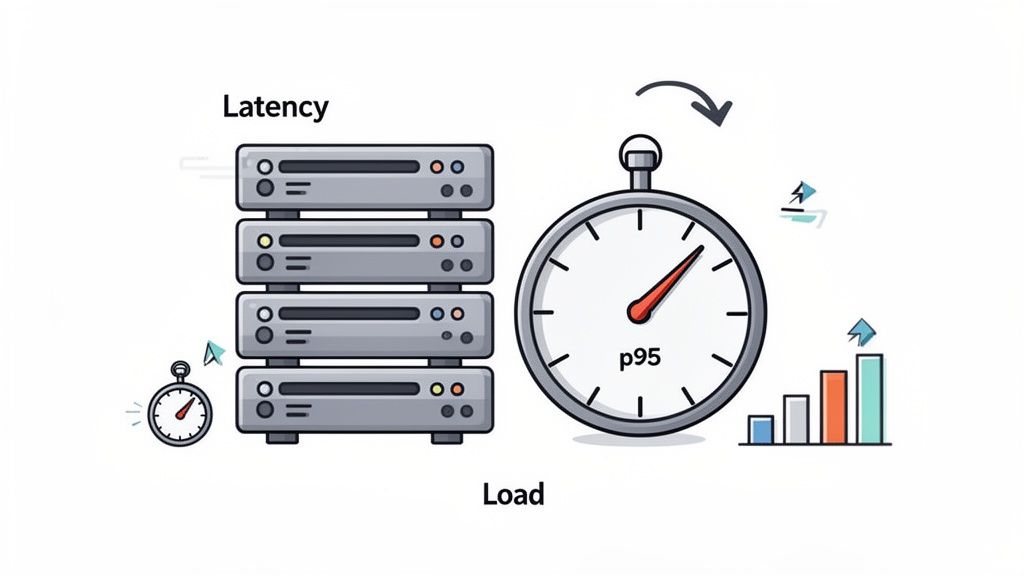
This method lets you conduct A/B performance tests by enabling the new code path for a small percentage of traffic. By monitoring system-level metrics like CPU load, memory usage, and database query times, you can gather real-world data on its efficiency. This is one of the most effective feature flagging best practices for de-risking major backend changes and validating that new infrastructure is ready for full-scale traffic.
Actionable Tips for Performance Testing
Integrating flags with observability tools is key to measuring performance accurately and safely.
- Target Internal or Low-Impact Segments First: Begin by enabling the feature flag only for internal users or during off-peak hours to minimize potential customer impact.
- Measure Before and After: Establish a clear performance baseline before enabling the flag. Monitor key metrics as you gradually increase traffic to the new code path.
- Use Operational Flags: Design these flags specifically for infrastructure changes. They are often short-lived and tied to a specific performance or capacity goal.
- Prepare an Instant Rollback: Ensure you can disable the flag immediately if you observe a negative impact on system stability, such as increased latency or error rates.
12-Point Feature Flagging Best Practices Comparison
| Technique | 🔄 Implementation Complexity | ⚡ Resource Requirements | 📊 Expected Outcomes | 💡 Ideal Use Cases | ⭐ Key Advantages |
|---|---|---|---|---|---|
| Implement Gradual Rollout Strategies | High — rollout infra, rollback logic | Significant — feature flags, monitoring, ops | Minimized blast radius; validated releases | Risky changes; large user bases; performance-sensitive releases | ⭐⭐⭐⭐ Minimizes risk; enables early feedback |
| Establish Clear Feature Flag Naming Conventions | Low — team agreement, naming rules | Low — documentation, linters | Improved readability and maintainability | Teams with many flags; startups scaling quickly | ⭐⭐⭐ Faster onboarding; reduces naming conflicts |
| Define Clear Flag Lifecycle and Retirement Processes | Medium — policy + tooling | Moderate — reminders, audits, owners | Reduced technical debt; cleaner codebase | Long-lived products; open-source projects | ⭐⭐⭐⭐ Prevents code bloat; ensures cleanup |
| Integrate Feature Flags with A/B Testing Frameworks | Medium–High — stats + mapping | Moderate–High — analytics, sample sizing | Data-driven decisions; measured conversion impact | Product optimization; marketing experiments | ⭐⭐⭐⭐ Quantifies impact; supports confident rollouts |
| Use Contextual Flag Evaluation for Sophisticated Targeting | High — rules engine, attribute management | High — reliable attribute data, validation | Precise segmentation without code deploys | Multi-tenant SaaS; enterprise targeting; betas | ⭐⭐⭐⭐ Fine-grained control; tailored rollouts |
| Establish Monitoring and Alerting for Flag-Related Issues | Medium — alerting rules, baselines | Moderate — monitoring, integrations, playbooks | Fast detection; reduced MTTR; automated rollback | Mission-critical features; rapid releases | ⭐⭐⭐⭐⭐ Detects issues quickly; prevents cascades |
| Document Flag Purpose, Ownership, and Decision Criteria | Low–Medium — templates and upkeep | Low — docs, links, templates | Clear ownership; auditable decisions | Distributed teams; compliance-focused orgs | ⭐⭐⭐ Accountability; preserves institutional knowledge |
| Prevent Flag Interdependencies and Conditional Logic Complexity | Medium — refactor + review discipline | Moderate — testing matrix, code review time | Simpler testing; fewer unexpected interactions | Rapidly scaling codebases; high-velocity teams | ⭐⭐⭐⭐ Easier reasoning; clearer metrics |
| Ensure Privacy-Compliant Flag Evaluation and Data Handling | High — legal review + privacy design | High — privacy engineering, audits | Compliance; maintained user trust; lower legal risk | Regulated industries; privacy-conscious markets | ⭐⭐⭐⭐ Avoids fines; preserves user trust |
| Implement Feature Flag Performance Testing and Load Validation | Medium–High — load tests, benchmarks | Moderate–High — testing tools, infra | Prevents latency regressions; graceful fallback | High-traffic sites; real-time or latency-sensitive apps | ⭐⭐⭐⭐ Ensures performance budgets; scalable behavior |
From Practice to Proficiency: Building Your Flagging Culture
We've journeyed through a comprehensive map of feature flagging best practices, moving from foundational principles to advanced strategic applications. The path to mastering feature flags isn't about simply flipping a switch; it's about fundamentally changing how your organization builds, tests, and releases software. By adopting these practices, you transform feature flags from a simple toggle into a powerful engine for controlled, data-driven innovation and risk mitigation.
At its core, this journey is about moving from isolated tactics to a cohesive, organization-wide strategy. We've seen how a simple discipline like a clear naming convention (Practice #2) can prevent catastrophic confusion, and how a proactive flag lifecycle process (Practice #3) is the only real defense against the crushing weight of technical debt. These aren't just housekeeping tasks; they are the bedrock of a scalable and sustainable flagging system.
Unifying Strategy and Execution
The true power of these best practices is realized when they are integrated. Consider how gradual rollout strategies (Practice #1) become exponentially more effective when paired with robust monitoring and alerting (Practice #6). A canary release is only as good as your ability to detect when the canary has stopped singing. Similarly, sophisticated contextual targeting (Practice #5) is only valuable if your flag evaluation and data handling are privacy-compliant (Practice #9), ensuring you build trust while you innovate.
The key takeaways from our exploration include:
- Proactive Governance is Non-Negotiable: Don't wait for flag debt to become a problem. Establish clear ownership, documentation standards (Practice #7), and retirement processes from day one.
- Data is Your Co-Pilot: Integrating flags with A/B testing frameworks (Practice #4) and performance validation (Practice #10) turns releases from a "hope-and-pray" exercise into a scientific process. You're no longer guessing; you're measuring.
- Simplicity Scales, Complexity Fails: Vigorously avoiding flag interdependencies (Practice #8) is crucial. A complex web of conditional flags is a future outage waiting to happen. The goal is to control features, not to create a second, hidden logic layer in your application.
Your Actionable Next Steps
Mastering the art and science of feature flagging is a marathon, not a sprint. Don't feel overwhelmed by the need to implement all twelve practices at once. Instead, build momentum by taking incremental, high-impact steps.
- Start with Cleanup and Clarity: If you already use flags, conduct an audit. Identify stale or undocumented flags and establish a clear naming convention and lifecycle process immediately. This initial cleanup provides a solid foundation.
- Enhance Your Rollout with Data: Select your next significant feature release. Commit to using a gradual rollout strategy (like a 10% canary release) and integrate it with your analytics to measure its direct impact on key user behavior and system performance metrics.
- Champion a Culture of Ownership: Create a simple, accessible documentation template for every new flag. Make it a mandatory part of the pull request process. This single cultural change will dramatically improve visibility and accountability across your entire engineering organization.
Ultimately, adopting these feature flagging best practices is about more than just shipping code safely. It’s about building a resilient, adaptable, and data-informed engineering culture. It’s about giving your product teams the confidence to experiment, your marketing teams the ability to launch coordinated campaigns, and your entire organization the agility to respond to market changes with precision and speed. You are not just managing features; you are engineering a competitive advantage.
Ready to validate your feature rollouts with powerful, privacy-first analytics? Swetrix provides the A/B testing and event-tracking capabilities you need to measure the real-world impact of your flagged features, all while respecting user privacy. Start making data-driven decisions and release with confidence by exploring Swetrix today.