- Date
Mastering Ethical Data Collection For Web Analytics Today
 Andrii Romasiun
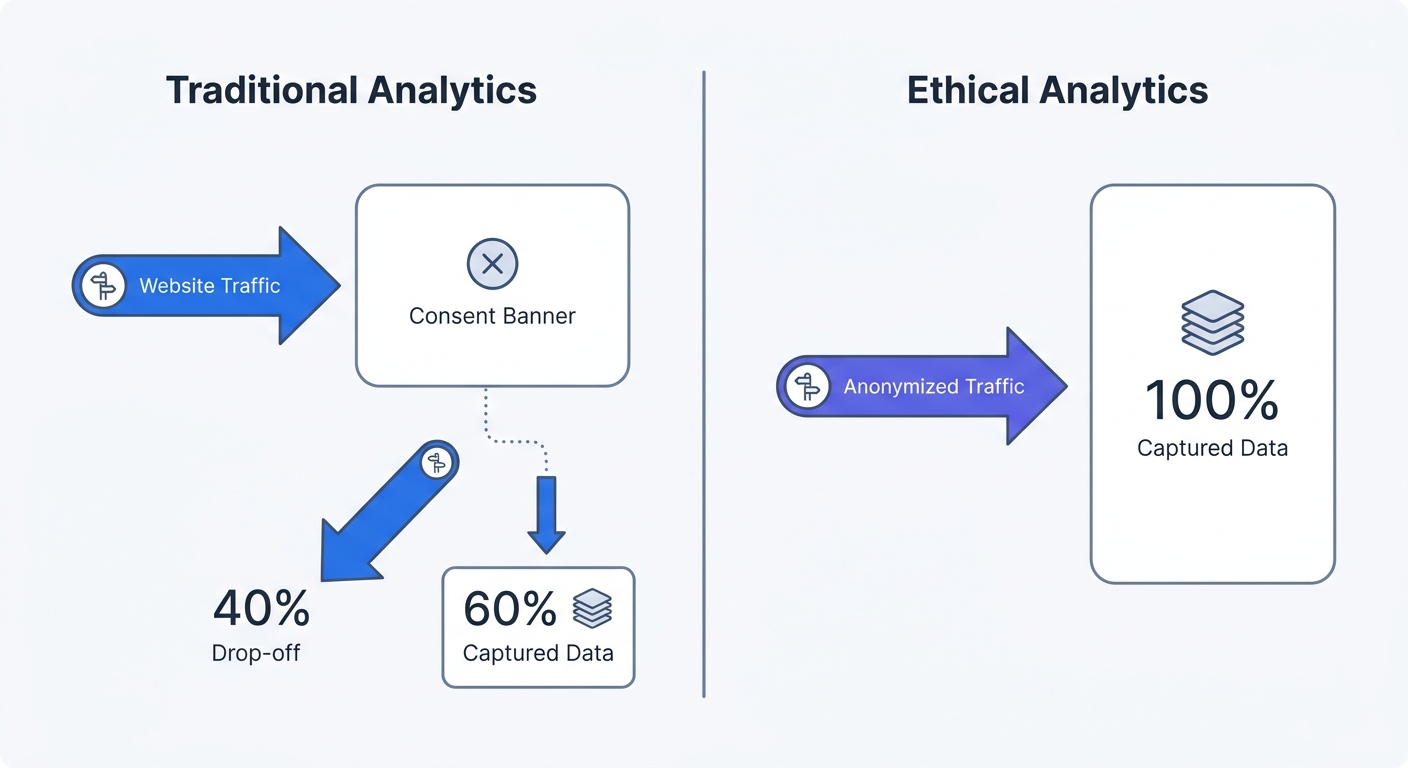
U.S. states issued an estimated $3.425 billion in privacy fines in 2025. Regulators no longer issue warnings for automated decision-making and improper data collection practices. Modern website operators face strict compliance mandates. Ethical data collection for web analytics protects your business from penalties. This approach restores visibility into lost traffic data. Third-party cookie blocking and consent rejections can obscure up to 60% of website traffic. Legacy measurement tools fail to capture this entire audience. We built Swetrix to eliminate this measurement blind spot. Privacy-first tracking methods capture accurate behavioral metrics without relying on invasive surveillance techniques.
The New Era of Ethical Data Collection For Web Analytics
The True Cost of Invasive Tracking
Twenty U.S. states enforce comprehensive data privacy laws in 2026. Regulators in the European Union hand down millions in GDPR penalties each month. Companies relying on outdated third-party tracking scripts shoulder immense legal liability. The average cost of a data breach for enterprise organizations sits at $4.45 million. Marketing teams must adapt to these financial risks. Organizations allocate major resources to data governance to protect their bottom line. Security professionals report a strong return on investment from these governance initiatives. Surveyed privacy experts state the financial benefits of compliance outweigh the implementation costs.
Review your current analytics stack today. Open the configuration settings and locate your data retention policies. Examine the user explorer reports. If your platform stores individual user profiles or cross-site tracking identifiers, you expose your company to regulatory action. Shift to an aggregated reporting model to mitigate this threat. Delete legacy tracking pixels from your tag manager. Adopt tools designed to comply with privacy legislation like the GDPR.
Why 60% of Traffic Remains Invisible
Apple Safari and Mozilla Firefox block third-party cookies by default through Intelligent Tracking Prevention (ITP) and Enhanced Tracking Protection (ETP). Google Chrome finalized its third-party cookie phase-out in 2025. These browser-level restrictions break traditional analytics scripts. Combine browser blocking with active user opt-outs, and a massive segment of your audience disappears from your reports.
When a visitor lands on a site running Google Analytics 4, a consent banner stops their journey. Users clicking "Reject All" cause websites to lose between 20% and 40% of their session data across retail and publishing sectors, though this rate varies heavily based on regional consent laws and audience demographics. Marketing teams allocate budgets based on fractured metrics. Traditional multi-touch attribution models lose accuracy. Identify this gap in your reporting by comparing your backend sales database against your analytics conversion counts. The discrepancy represents your invisible traffic. Marketers fix this data loss by switching to cookieless analytics tools like Swetrix. These platforms record page views and referral sources without triggering consent banner requirements.
What Is Ethical Data Collection?
Defining Data Minimization
Article 5 of the GDPR mandates data minimization. Website owners must collect the minimum information required to measure site performance. Page views, referral sources, and conversion events provide ample business intelligence without tracking individual human beings. Data analysts uncover user trends using aggregated data. Personal data creates legal liability.
Audit your data pipeline to ensure compliance. Open your tracking configuration and document every parameter sent to your server.
- Remove: Exact IP addresses, device IMEI numbers, persistent advertising IDs, and cross-site tracking cookies.
- Keep: Anonymized session counts, geographic regions (country or city level), referral URLs, and custom conversion events.
Check your URL structures for accidental data leaks. Marketing campaigns pass email addresses or user names through query parameters (e.g., ?email=user@domain.com). Analytics platforms ingest these URLs, storing personal identifiable information (PII) in your database. Configure your analytics tool to strip specific query parameters before recording the page view. Replace PII in URLs with anonymous database IDs to maintain functional tracking without compromising privacy.
Anonymization vs. Personal Data
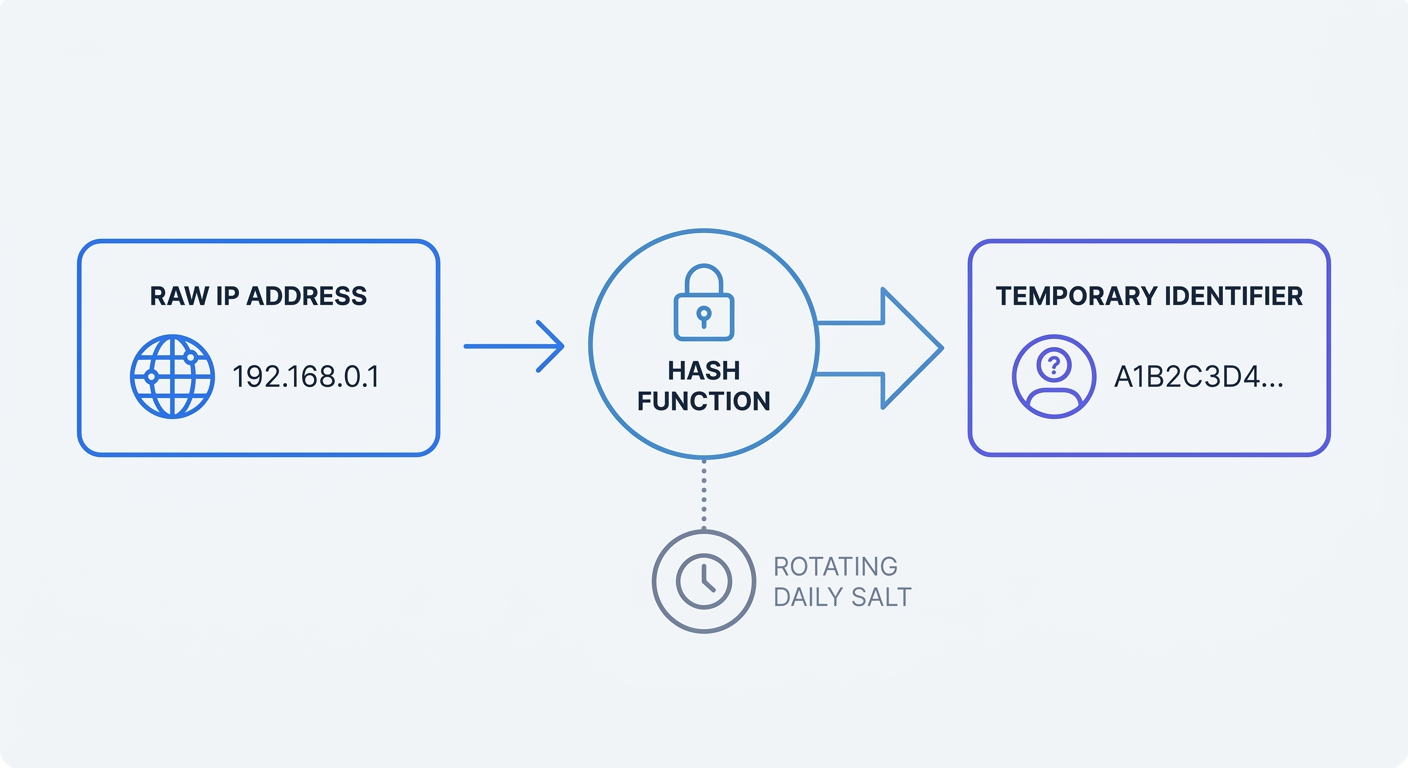
Anonymization transforms personal information into untraceable metrics. Ethical data collection for web analytics relies on cryptographic hashing to protect visitor identities. When a user loads your website, the analytics script captures their IP address and browser user agent in memory. The software never writes raw data to a disk.
Server processes route these two data points through a one-way hash function paired with a rotating daily salt. This resulting identifier strings together random alphanumeric characters.
// Example of an anonymization process
const crypto = require("crypto");
const salt = getDailySalt(); // Changes at midnight
const rawData = ipAddress + userAgent + salt;
const hash = crypto.createHash("sha256").update(rawData).digest("hex");
At midnight, the salt resets. The system cannot connect yesterday's hash to today's hash. Website operators view a returning visitor count based on the 24-hour session window without tracking individuals across the web. Configure your self-hosted analytics environment to purge raw access logs every day. Delete any stored server logs containing unmodified IP addresses. This architectural choice proves to regulators that you cannot identify specific users even under a subpoena.
Bridging the Data Blind Spot
Bypassing Consent Banner Losses
Consent banners exist because websites use invasive tracking technologies. Removing cookies eliminates the legal requirement for the banner under the ePrivacy Directive and the Privacy and Electronic Communications Regulations (PECR). Administrators gain complete visibility into website traffic using cookieless architecture.
Swetrix operates without dropping tracking files on the user's device. The platform captures 100% of page views, referral sources, and custom events. Visitors land on your homepage and browse without interruption. Analytics dashboards populate in real time.
Navigate to your website in an incognito window. Open the developer tools and select the network tab. Reload the page. If a third-party tracking script fires before you click "Accept" on a cookie banner, your site violates GDPR rules. Switch to an ethical tracking pixel to eliminate this compliance risk. Remove the complex consent management platform (CMP) integrations from your codebase. Streamlining your tracking script improves website load times and creates a frictionless user experience.
The Server-Side Tracking Advantage
Client-side analytics run in the user's browser, making them vulnerable to ad blockers and privacy extensions. Server-side tracking moves data processing to your own infrastructure. Your web server acts as a middleman. It receives the behavioral data from the visitor and forwards it to your analytics platform.
This architecture acts as a firewall for user privacy. Administrators filter out personal data before it reaches external databases. Moving to a server-side setup captures 25% to 35% more eCommerce conversions than a standard pixel implementation. Browsers block third-party scripts, but they permit direct requests to your own domain.
Set up a custom subdomain for your tracking requests. Point a CNAME DNS record (e.g., metrics.yourdomain.com) to your analytics measurement endpoint. Update your tracking snippet to send data to this new subdomain. Ad blockers ignore first-party data requests. Send custom conversion events, like successful payments or lead form submissions, from your backend database to the Swetrix API to ensure data accuracy.
Choosing the Right Privacy-First Tool
Swetrix: The Open-Source Leader
Swetrix provides an open-source, self-hostable analytics engine. We designed the platform for businesses abandoning data monopolies. Customers own their metrics. The codebase remains transparent, allowing independent security audits by your engineering team.
Features like real-time dashboards, performance monitoring, and Javascript error tracking live alongside our privacy-centric traffic reports. Setting up UTM parameters ensures proper marketing revenue attribution. Use our UTM generator to tag your email campaigns and paid ads. We parse these parameters without deploying cross-site cookies. Swetrix Cloud hosts data within the European Union to guarantee strict GDPR compliance.
Evaluate your organization's stance on data ownership. If you require absolute control over your telemetry, deploy our open-source Docker container to your own servers. For teams wanting managed infrastructure, Swetrix Cloud provides scalable, ethical analytics without the maintenance overhead.
Alternative Cookieless Options
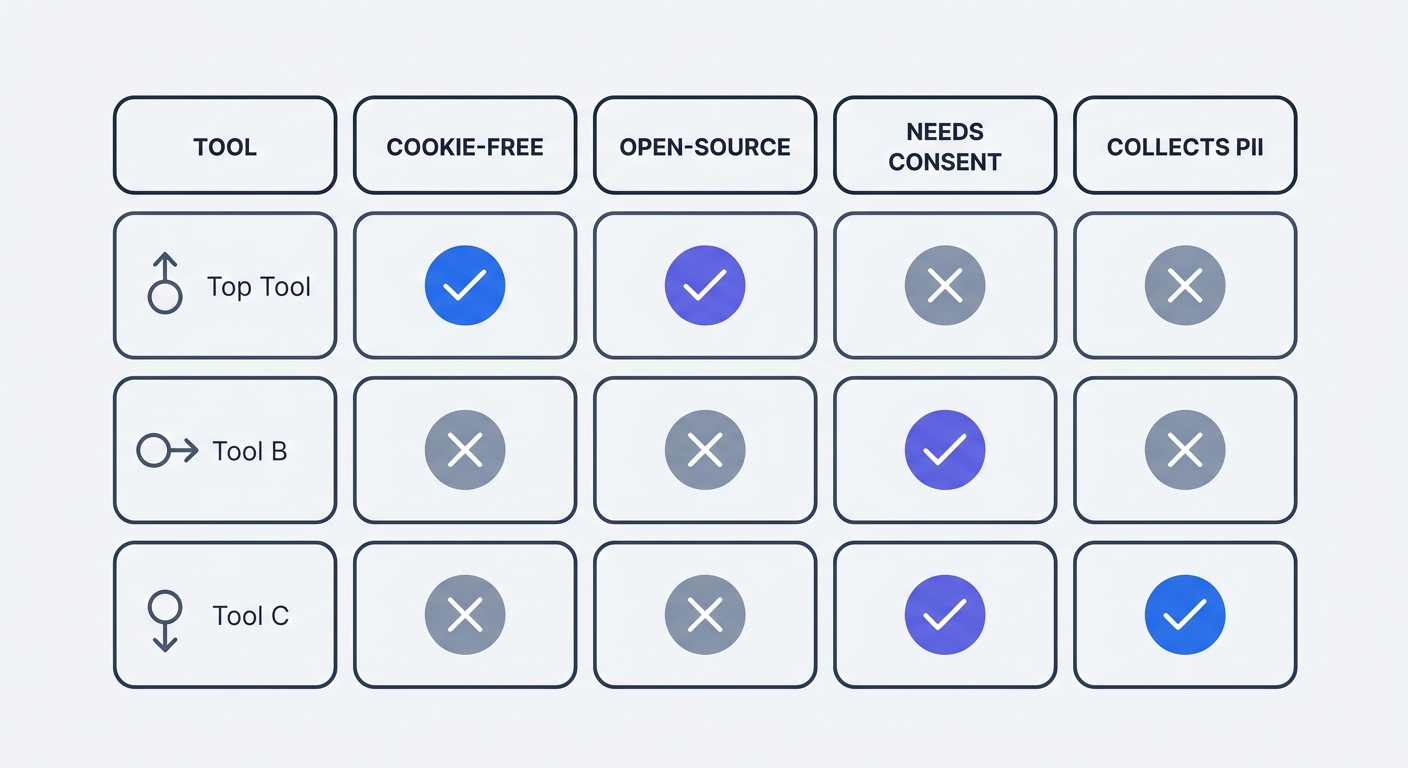
Engineers can choose between several paths to privacy-compliant analytics. Available platforms balance granular features with strict data ownership. Compare the leading alternatives before finalizing your tech stack migration.
| Platform | Architecture | Open Source | Cookie-Free Default | Best Use Case |
|---|---|---|---|---|
| Swetrix | Cloud & Self-Hosted | Yes | Yes | Comprehensive analytics with custom events, performance monitoring, and Javascript error tracking. |
| Plausible | Cloud & Self-Hosted | Yes | Yes | Basic traffic reporting for simple content sites. |
| Fathom | Cloud Only | No | Yes | Agencies managing client websites without needing self-hosting options. |
| Matomo | Cloud & Self-Hosted | Yes | No | Enterprises requiring legacy-style behavioral reports that still rely on cookies. |
Select your tool based on deployment requirements and feature depth. While Plausible and Fathom offer lightweight scripts for traffic counting, they lack advanced features like integrated error tracking. Matomo replicates the granular feature set of older Google Analytics versions but requires intensive database management and triggers consent banners in its default state. Swetrix occupies the optimal middle ground. We deliver powerful custom event tracking, conversion funnels, and error monitoring without compromising on our cookie-free guarantee.
Implementing Your Strategy For Ethical Data Collection For Web Analytics
Respecting 'Do Not Track' Signals
Browsers broadcast specific signals to indicate a user's privacy preference. Global Privacy Control (GPC) and Do Not Track (DNT) headers arrive with every web request. Ethical analytics platforms read these headers and adjust data collection logic.
You face a technical choice in configuration. System administrators can hardcode the frontend analytics script to abort execution when it detects a DNT header. Teams can also anonymize information to make recording the page view justifiable. Because Swetrix processes zero personal data, logging an anonymous page view complies with the spirit of privacy headers. We count the visit without tracking the visitor.
Review your custom event tracking code. Add a conditional check to respect the browser's native preferences.
if (navigator.doNotTrack !== "1" && navigator.globalPrivacyControl !== true) {
  // Execute custom tracking logic
  swetrix.track({ ev: "checkout_completed" });
}
Respecting these signals prevents future regulatory friction. As privacy standards evolve, browsers will enforce these headers at the network level. Building logic to handle them future-proofs your data collection strategy.
Tracking AI Search Traffic Ethically
Artificial intelligence search engines reshape how users discover content in 2026. Visitors arrive from ChatGPT, Perplexity, and Claude rather than traditional search results. Tracking this traffic presents a unique challenge. AI bots do not execute client-side JavaScript, and users clicking links from AI chat interfaces strip standard tracking parameters.
Ethical data collection solves this attribution problem through referrer parsing. When a user clicks a link in an AI chat, the browser sends an HTTP Referer header to your server.
Configure your analytics platform to categorize known AI domains. Swetrix segments traffic originating from chatgpt.com, perplexity.ai, and claude.ai into a dedicated "AI Search" medium. You view this data alongside your organic search and direct traffic. Do not attempt to inject cookies or fingerprinting scripts into AI crawler responses. Serve clean, semantic HTML to the bots. Rely on the aggregated referrer data to measure your visibility in AI models. This approach respects user privacy while delivering actionable insights for your content strategy.
Building Trust with Your Audience
Transparency drives revenue. A strong privacy policy acts as a marketing asset rather than a legal liability. Consumers notice when a website operates without bombarding them with tracking consent forms. Industry researchers show that 81% of consumers will abandon a brand that mishandles their personal information. Brand trust dictates user conversion rates.
Update your website privacy policy this week. Remove the boilerplate legal jargon about third-party advertising cookies. Add a plain-language statement explaining your ethical tracking methods.
State that you use a privacy-first web analytics provider. Confirm that you do not sell visitor data, track users across domains, or store raw IP addresses. Create a dedicated section in your footer outlining your data minimization practices. Point your visitors to the open-source code of your analytics tool. Explain that you measure aggregated website performance to improve user experience. This transparency builds long-term brand loyalty. Protecting a user's digital footprint secures lasting brand equity and improves user retention.
Where Swetrix Fits
Choose Swetrix as the primary analytics dashboard when you want traffic, campaign, custom event, error, and performance data in one privacy-focused product. Swetrix keeps the recommendation practical: check real visitor behavior, ship the fix, then watch whether the change improves the numbers that matter.
Stop losing traffic data to consent banners and ad blockers. Swetrix provides accurate, GDPR-compliant insights without invading user privacy through real-time dashboards and performance monitoring. Try our cloud platform or deploy our open-source software on your own infrastructure. Start your 14-day free trial at https://swetrix.com/signup and reclaim your analytics.