- Date
Accurate Cross Domain Tracking Without Cookies Explained
 Andrii Romasiun
When someone reads a tutorial on your main domain and clicks a button to sign up on your app subdomain, standard analytics tools treat them as two different people. The platform sets a cookie on the blog, but browser security rules prevent the app subdomain from reading it, breaking the session in half. Your dashboard records one bounced visit on the content side and one direct, untrackable conversion on the app side, causing you to lose the connection between the article that convinced them and the revenue they generated. This is why Swetrix was built: to provide seamless cross domain tracking without cookies, ensuring your attribution remains accurate without infringing on user privacy.
Restoring this connection requires a method to carry the user's context across domain boundaries without relying on third-party text files. Cross domain tracking without cookies bridges this gap mechanically by passing anonymous session data directly through links or server endpoints.
The Failure of Traditional Cookie-Based Tracking
The Hidden Cost of Cookie Banners
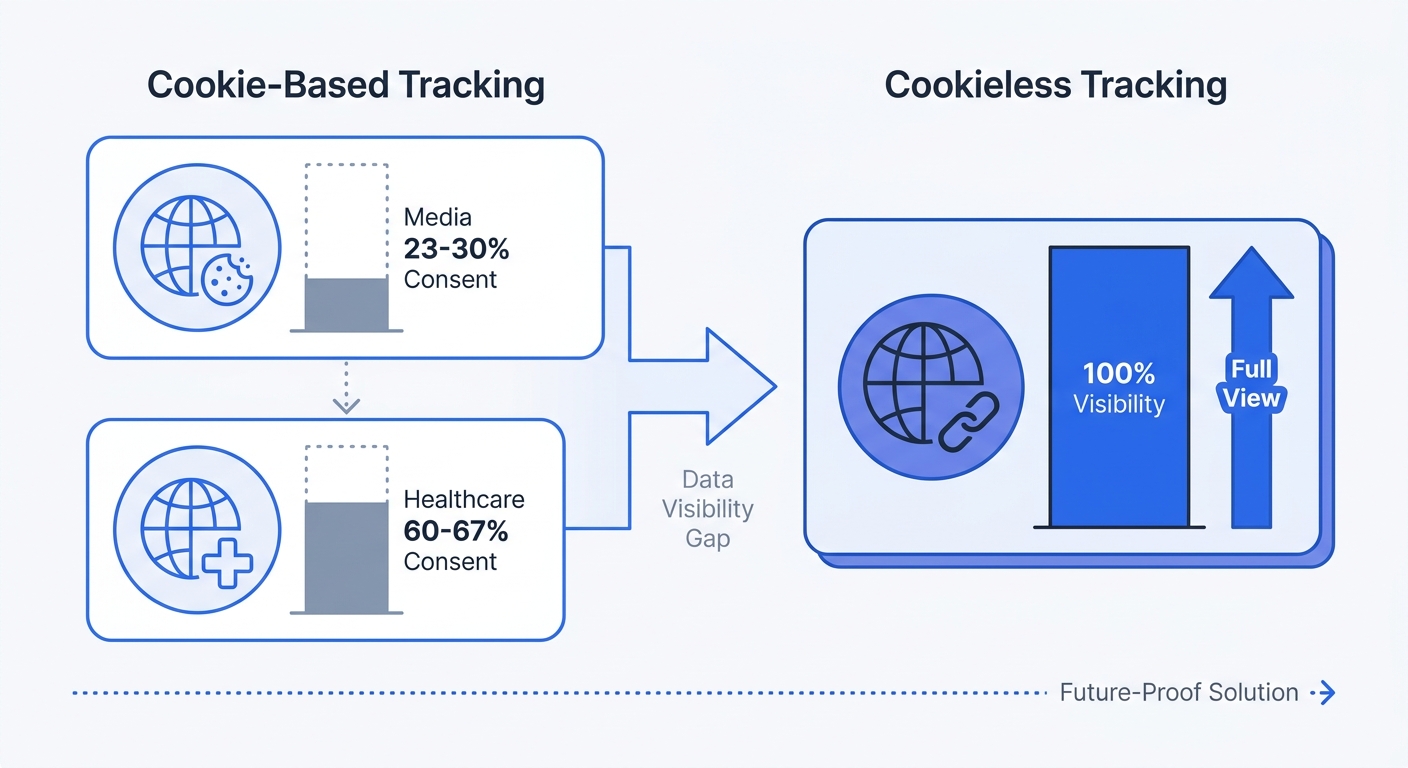
The analytics visibility gap destroys marketing budgets because every data pipeline built on third-party tracking requires a consent banner that bleeds traffic data before the page fully renders. Aggregate global cookie consent rates for e-commerce and media sites fluctuate heavily by industry and audience type, and the situation deteriorates further in privacy-conscious regions. In France and Germany, fewer than a quarter of users accept cookies when presented with a compliant banner featuring equally prominent accept and reject buttons.
Adding to the loss, roughly 33.6% of internet users ignore cookie banners completely across most consumer sectors. Because privacy laws mandate that tracking remains disabled until explicit consent is granted, ignored banners equal lost sessions. Operating an analytics platform like Google Analytics that relies on that "Accept All" click leaves you blind to the majority of your actual audience. You might see 4,000 visitors in your dashboard while your web server handles 10,000, a distortion that forces you to cut profitable campaigns because the attribution data vanished at the consent layer.
The Impact of Ad Blockers and Privacy Frameworks
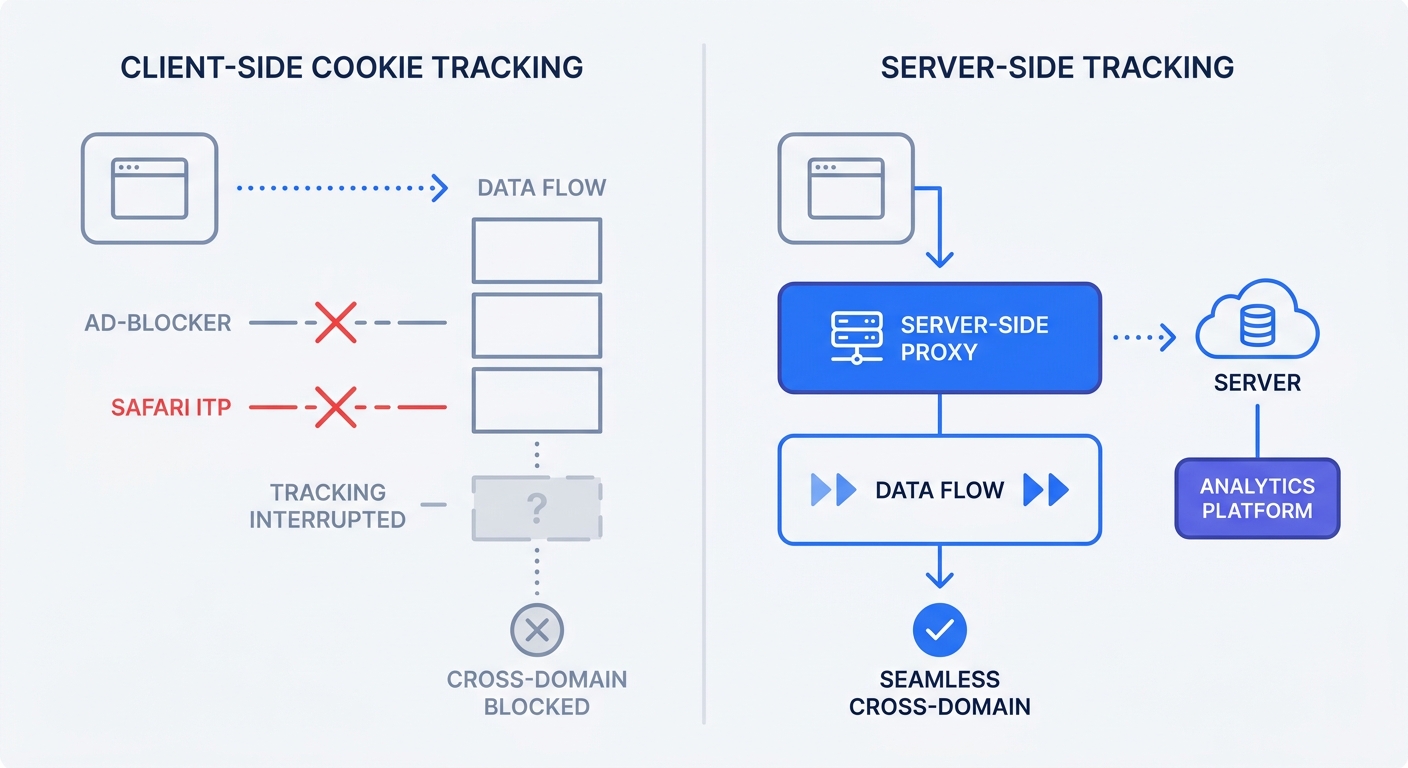
Browser-level restrictions compound the data loss, with Apple's Intelligent Tracking Prevention (ITP) inside Safari blocking 100% of third-party cookies by default. Concurrently, over 42% of internet users globally run active ad blockers on their devices, though this rate can be much higher among younger demographics and tech-centric audiences. These extensions specifically target and block client-side analytics scripts from executing, meaning the traditional tracking pixel fails silently regardless of what the user clicked on the consent banner.
Compounding this data loss, coordinated enforcement by the California Privacy Protection Agency (CPPA) and European Data Protection Board (EDPB) now targets manipulative banner designs. Regulators aggressively fine companies that hide the "Reject All" button, ensuring that artificially inflated consent rates collapse back to reality. Swetrix avoids these pitfalls by utilizing a privacy-first, cookieless approach that bypasses the need for intrusive banners in many jurisdictions.
Calculate the gap between your actual server log hits and your recorded analytics sessions over the last 30 days. Subtracting your reported sessions from your server hits reveals the exact volume of ghost traffic your current setup misses.
The Mechanics of Cross Domain Tracking Without Cookies
Using Link Decoration and URL Parameters
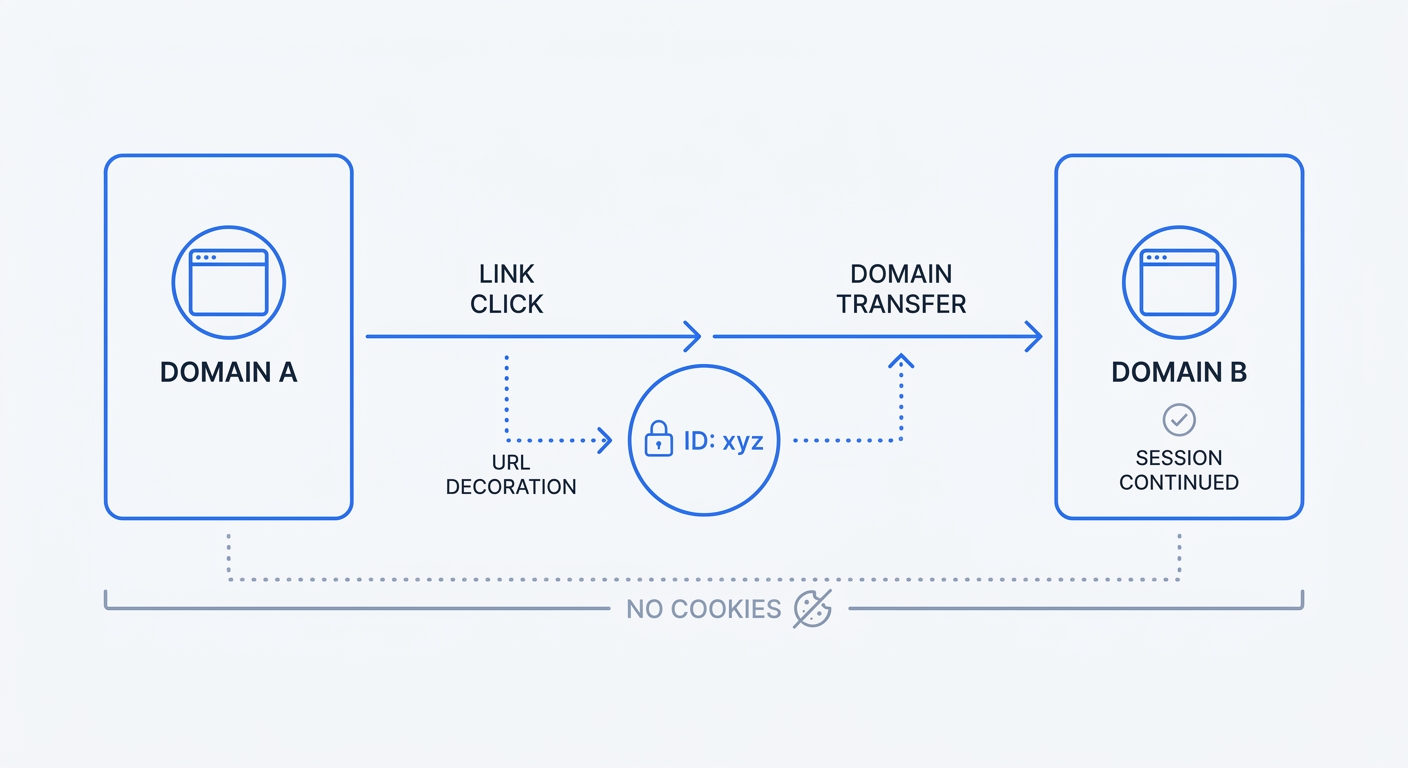
Mechanical alternatives bypass browser storage entirely. Link decoration involves passing the necessary session data directly in the URL string when a user navigates between two properties you own. Instead of dropping a tracker into the browser, your website appends an anonymized identifier to the outbound href attribute.
When a visitor clicks a link from blog.yourdomain.com pointing to shop.yourdomain.com, a script intercepts the click and attaches a short-lived parameter so the link transforms into shop.yourdomain.com/checkout?sw_session_ref=a1b2c3d4. The receiving server reads this parameter from the request, attributes the new pageviews to the existing session hash, and drops the parameter from the visible address bar.
While manual link decoration is effective, Swetrix simplifies this process by automatically handling session continuity through its advanced cookieless architecture, allowing you to maintain an unbroken sequence of events without complex manual coding. This method requires strict boundary controls, requiring the parameter to expire within minutes to prevent contaminated data if the user copies and pastes the decorated link.
Audit your top navigation menus and primary call-to-action buttons. Update the cross-domain links to dynamically append an internal session parameter, verifying your receiving domain processes the tag without throwing a 404 error.
Implementing Server-Side Tracking (SST)
Client-side tracking executes inside the visitor's browser, leaving it vulnerable to ad blockers and ITP restrictions. Server-Side Tracking (SST) moves the data collection off the user's device and onto your infrastructure, acting as a secure intermediary layer.
When a user loads a page, your web server captures the interaction and passes a sanitized data payload directly to your analytics endpoint. Because the browser never downloads a third-party script, ad blockers have nothing to intercept or block. This communication happens backstage, giving you control over what data leaves your server so you can strip IP addresses, user agents, and device fingerprints before the payload reaches the analytics processor.
For those who require ultimate control, Swetrix is an open-source platform, meaning you can self-host the entire infrastructure on your own servers to ensure that no data ever leaves your perimeter.
Managing GDPR and Global Privacy Regulations
Cookieless Doesn't Always Mean Compliant
Removing cookies solves only part of the regulatory puzzle because the ePrivacy Directive regulates any information stored on or accessed from a user's terminal equipment. This legal framework covers local storage, session storage, and browser fingerprinting identically to cookies. Abandoning text files but deploying hardware fingerprinting scripts to single out an individual device based on its installed fonts and graphics card still violates the law.
With over 140 countries enforcing data protection laws as of early 2025, hunting for technical loopholes carries severe financial risk. Regulators run automated compliance scans across millions of domains, catching the 43% of sites that still drop tracking payloads without valid consent. Relying on obscure browser APIs to uniquely identify users without their permission guarantees an eventual compliance failure.
Data Minimization as a Strategic Asset
The only sustainable compliance strategy requires a shift toward data minimization. GDPR Article 5(1)(c) dictates that organizations must collect only the data necessary for their stated purpose. You need to know which campaigns drive revenue, how users navigate between domains, and where landing pages leak traffic, but none of these insights require storing Personally Identifiable Information (PII) or profiling individuals across the broader internet.
Cookieless tracking aligns directly with data minimization. Measuring aggregate behavioral trends instead of tracing specific individuals eliminates the legal liability of managing toxic data sets. Swetrix embodies this by providing real-time dashboards and performance monitoring that focus on high-level utility without compromising individual user privacy.
Review your current analytics payload in your browser's network tab, then identify and strip any custom dimensions that pass granular device information, precise location coordinates, or persistent user IDs to external servers.
The Swetrix Approach to Cookieless Analytics
Restoring 100% Traffic Visibility
Legacy platforms like Google Analytics rely on statistical modeling to guess what the missing audience did, but Swetrix eliminates the visibility gap by capturing the real data directly. As a privacy-focused, open-source web analytics platform, Swetrix uses a cookieless architecture that refuses to deploy invasive trackers or persistent device files.
Because the tracking mechanism respects user privacy by design, it does not legally require an intrusive consent banner in most jurisdictions. You track 100% of your top-level website traffic, accurate to the exact server hit, while complying with GDPR, CCPA, and PECR. The platform captures pageviews, custom events, performance metrics, and even error tracking in real time.
Swetrix maps user journeys across domains by utilizing hashed, short-lived session identifiers that combine a daily randomized salt with anonymized request data. They automatically expire and reset, meaning the data cannot be reverse-engineered or used to build a persistent profile of a visitor. For businesses managing multiple web properties, this system ensures unbroken user flows from the marketing site to the application without relying on third-party syncs. Your dashboard displays the actual source of your conversions, allowing you to attribute ROI accurately without violating user trust, while Swetrix Cloud processes all data on EU-hosted infrastructure to guarantee complete data sovereignty.
Simple, Compliant Setup Without Dark Patterns
Implementing privacy-first analytics stops the cycle of fighting ad blockers. Swetrix provides a lightweight script that loads quickly and respects Do Not Track (DNT) requests automatically, letting you embed a single snippet across your subdomains. Once you configure your shared project dashboard, the platform handles the cross-domain session continuity through its secure hashing process.
There is no need to implement complex consent mode logic or design manipulative banner layouts to trick users into accepting tracking. The setup gives you the baseline metrics required to run a business, including traffic sources, bounce rates, session duration, and campaign/UTM tracking, without the technical overhead of managing consent states. For teams with strict internal security requirements, Swetrix also offers a fully self-hosted version that keeps the entire data pipeline inside your own server environment.
Create a Swetrix account to access the 14-day free trial. Add both your primary domain and your subdomains to a single project, embed the shared tracking snippet, and let the real-time dashboard capture the traffic your previous tool missed.
Best Practices for a Cookieless Tech Stack
Utilizing First-Party Contextual Data
Relying on anonymous traffic data handles top-of-funnel analytics, but deep funnel tracking requires contextual mapping. When users interact with your subdomains, they often provide verified actions that you can use to link their journey. If a visitor logs into your main portal and navigates to a secure support domain, you already possess a verified connection between those environments.
Instead of forcing a third-party pixel to guess their identity across the gap, use internal database identifiers to generate a hashed, randomized token for the logged-in session or the active shopping cart. Pass this specific token through secure server-to-server requests or hidden form fields when the user transitions between domains. This method relies on first-party contextual data that you explicitly own and control, keeping the mapping internal and invisible to browser restrictions.
Migrating Away from Client-Side Pixels
Every external script loaded in the browser degrades page performance and introduces a new privacy risk. Marketing pixels drag down your Core Web Vitals to negatively impact your search engine rankings, and if a vendor updates their pixel to scrape additional DOM data without your knowledge, you assume the legal liability.
Protecting your infrastructure requires aggressively pruning these client-side integrations. Transitioning to a cookieless model allows you to consolidate your tracking logic. Moving your event tracking to secure server endpoints or relying on a single privacy-by-design script like Swetrix minimizes your exposure. Because a faster website correlates with higher conversion rates, script reduction serves as a revenue-generating technical optimization.
Build a phased migration plan to retire legacy pixels by running a privacy-first analytics script in parallel with your existing setup for two weeks. Compare the data density, verify the cross-domain tracking captures your conversions, and then permanently delete the heavy client-side trackers from your source code.
Stop making budget decisions based on fragmented data and modeled guesses. Swetrix restores accurate cross-domain visibility with lightweight, cookie-free tracking that complies with global privacy laws. Regain control of your analytics, eliminate the need for consent banners, and see what drives your conversions by starting your 14-day free trial of Swetrix today.