- Date
How to Bypass Adblockers for Accurate Web Analytics
 Andrii Romasiun
Browsers like Brave and extensions like uBlock Origin actively target the background scripts that measure user behavior, track conversions, and attribute marketing campaigns. These tools have evolved beyond simple ad suppression to become comprehensive privacy blockers. As of the second quarter of 2025, 29.5% of internet users worldwide activate an ad blocker at least sometimes, equating to an estimated 1.77 billion active users globally based on GWI data published by Backlinko. Older estimates from EMARKETER citing YouGov in 2024 suggested 52% of consumers across 48 global markets had installed such tools on a browser or mobile device. When these native filters block traditional tracking domains, those users disappear from your dashboard. While a typical lifestyle or e-commerce website loses between 15% and 30% of its total visitor data to these filters, platforms catering to software developers or IT professionals often see data loss spike to 50%. Regional variances complicate this baseline further. If you target users in Indonesia, you face a national penetration rate of 40.1%, whereas the European average sits at approximately 40% and the American average lands at 32.5%. This creates a massive blind spot, forcing you to base marketing budgets and technical updates on an incomplete picture. Because default platforms like Google Analytics 4 execute their logic in the visitor's browser, they remain vulnerable to these client-side restrictions. Recovering this dark traffic requires transitioning to a cookieless, server-routed architecture. Swetrix serves as the ultimate bridge between simple, privacy-compliant tracking and advanced product analytics. By moving data collection to your own infrastructure with Swetrix, you can log accurate page views, capture technical errors, and build reliable conversion funnels without triggering filter lists or invading user privacy.

Measuring the Financial Impact of Client-Side Data Loss
Client-side filters distort every metric used to measure growth. When a user clicks a paid search ad but blocks the tracking script on the landing page, the advertising platform records a click while your analytics dashboard records nothing, meaning the session never starts and the conversion never registers. Missing 30% of your conversion data cripples downstream ad optimization efforts for agencies and smaller budgets. This missing data artificially inflates your Cost Per Acquisition. A campaign that generates sales might appear to be failing because half of the conversions happen in the dark, leading you to pause profitable ad sets and bleed revenue based on flawed attribution. Because Swetrix captures these lost events through advanced product analytics like conversion funnels and session replays, you can maintain a realistic view of campaign performance. Transitioning from Google Analytics to a cookieless solution with Swetrix does not mean losing these essential growth data points or technical SEO insights.
Beyond advertising, missing traffic data breaks your understanding of the user journey. If a privacy-focused user completes a multi-step checkout process, traditional trackers drop the session at the first blocked event. Your funnel reports will show a massive drop-off at the first step, which might prompt you to redesign a checkout flow that already works. Consider a software application tracking a three-step signup sequence covering email entry, password creation, and credit card submission. If half the technical audience blocks the script at the email entry phase, the analytics dashboard reports an artificial 50% cart abandonment rate on page one. Missing data also corrupts testing frameworks. If a native browser shield prevents a specific variant from logging successful events, the control group might win a test by error, causing you to deploy inferior user interfaces.
Missing tracking scripts also take error logging and performance metrics with them. Although a broken deployment might cause checkout failures for users on specific browsers, you will not see the corresponding error spikes if those users run strict privacy shields. Enterprise-level network blocking systems complicate this further. These corporate firewalls actively block tracking payloads at the router level, filtering out ad-heavy web traffic to conserve bandwidth. This network-level interference means relying entirely on a vulnerable client-side script degrades your data quality at the exact moment a critical bug hits production, leaving your engineering team scrambling to diagnose issues without underlying system logs.
Maintaining Legal and Ethical Compliance While Routing Data
You might hesitate to implement proxy solutions out of legal concerns, but routing analytics through your own domain is a technical network configuration rather than a compliance violation. The legal boundary defined by regulations like GDPR, CCPA, and PECR centers on what data you collect rather than the routing mechanism used to transmit it. Bypassing ad blockers to log anonymous page views, technical errors, and aggregated user experience events remains strictly compliant with these frameworks.
Compliance breaks when a system collects Personally Identifiable Information without consent. Scraping IP addresses, deploying invasive retargeting cookies, or fingerprinting devices across different websites violates privacy laws regardless of how the payload is routed. An analytics platform that demands access to cross-site tracking markers will fall out of compliance the moment you route its data through a proxy to avoid user consent prompts.
Ethical tracking relies on strict data minimization, which means logging anonymous page views, aggregated user experience events, and server-level technical errors without writing files to the visitor's hard drive. A privacy-first platform like Swetrix automatically hashes visitor data and drops IP addresses before storage so no single user can be re-identified. Content creators and bloggers often use this approach to recover their missing audiences. Writers relying on default setups see deflated traffic numbers and broken referral sources because tech-savvy readers block third-party analytics. By switching to an anonymous tracker, you can recover up to 50% of this dark traffic, providing an accurate dashboard of growth and SEO performance without operating a surveillance network.
People install privacy tools to stop cross-site profiling and intrusive data brokers. Switching to an anonymous, cookieless model respects that intent by removing the surveillance mechanics those tools aim to defeat. This infrastructure delivers accurate business intelligence while giving visitors a secure browsing experience free of persistent tracking cookies.
How Server-Side Architecture Defeats Network Filters
Traditional client-side tracking runs entirely within the user's web browser, relying on the visitor's hardware to execute the code. When a visitor lands on a page, their browser downloads an external JavaScript file from a third-party server. After the script reads the DOM and drops a cookie, it fires an HTTP request back to the analytics provider. Filter lists maintained by the EasyList open-source project actively monitor these outgoing network requests, terminating the connection if the destination URL matches a known tracking domain. Modern extensions like uBlock Origin and Ghostery, alongside built-in browser features like Brave's shields, natively blacklist recognizable domains like googletagmanager.com and google-analytics.com. This failure appears as a net::ERR_BLOCKED_BY_CLIENT message in the developer console.
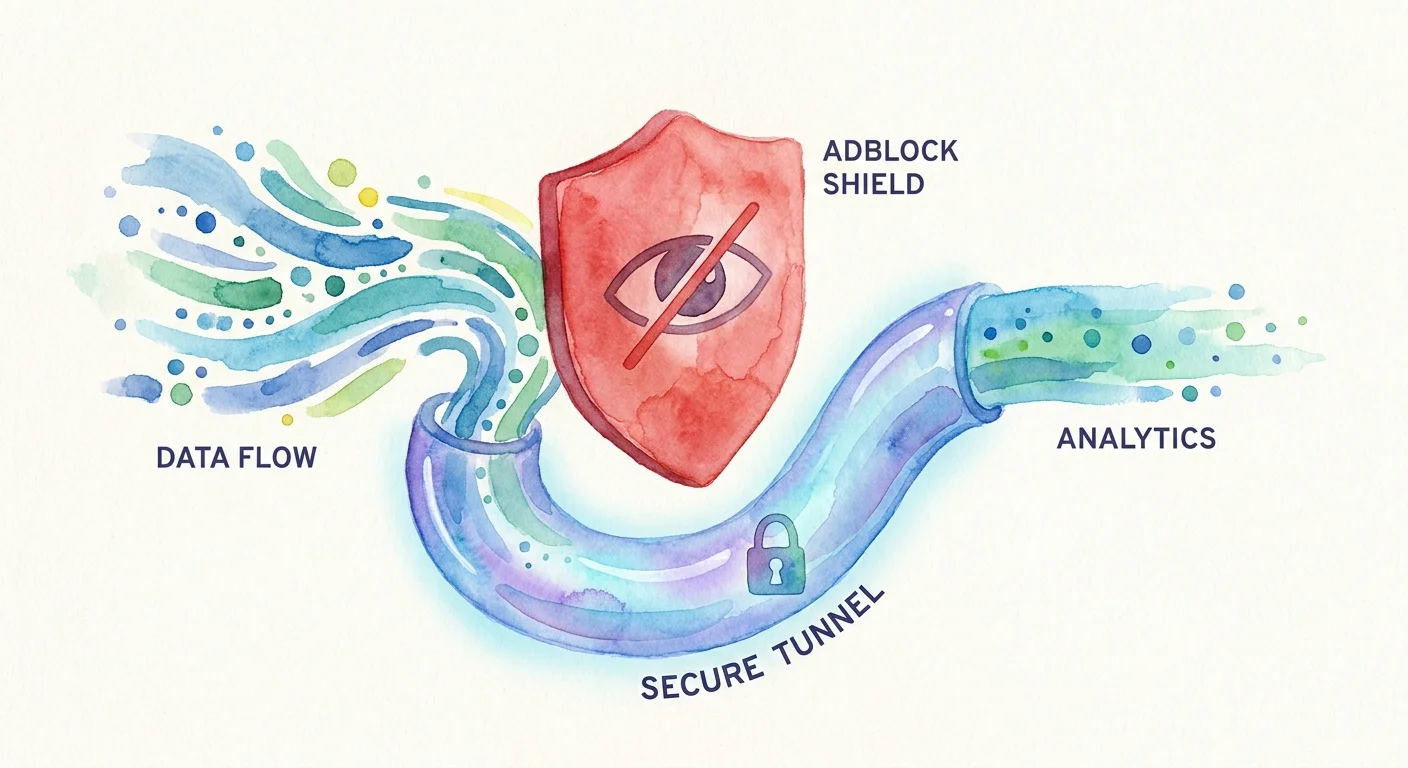
Server-side tracking removes the browser from the decision loop by sending a generic payload to your own infrastructure instead of a third-party server. Your server processes the event, strips out sensitive information, and forwards the sanitized data to the analytics endpoint. Because the initial connection happens between the visitor and your primary domain, browser extensions see the request as standard website functionality. This transparency ensures that your analytics scripts load as intended, which allows Swetrix to capture data that would otherwise be lost to client-side filters. This architecture captures interactions on the web server or proxy layer and hands the sanitized data off to the destination, making the entire process invisible to browser extensions.
| Feature | Client-Side Tracking | Server-Side Tracking |
|---|---|---|
| Execution Location | Visitor's web browser relying on local hardware constraints | Your web server or a first-party managed reverse proxy |
| Vulnerability | Terminated by default EasyPrivacy filter lists and Brave shields | Invisible to browser extensions routing via primary domain |
| Performance Impact | Slows initial page load by demanding multiple external DNS lookups | Minimal rendering impact by loading from a first-party edge network |
| Data Control | Third-party script accesses all available DOM elements automatically | You control the exact sanitized payload forwarded to the endpoint |
| Compliance Setup | Requires complex cookie consent banners to manage local storage writes | Can run entirely cookieless without triggering restrictive legislation |
| Troubleshooting | Errors display as net::ERR_BLOCKED_BY_CLIENT in the local console | Requires checking server access logs or proxy request monitoring tools |
| Payload Interception | Exposed to local network firewalls and VPN packet sniffing | Encrypted HTTPS transit between proxy and final analytics destination |
Technical Methods for Data Recovery
Restoring traffic visibility requires moving the data collection endpoint to a trusted location. You have several technical avenues to accomplish this, ranging from basic DNS records to enterprise tag management systems.
The most efficient method is deploying a managed reverse proxy, which routes tracking requests through a first-party subdomain and masks the payload as native site traffic. First-party reverse proxies have become the dominant alternative to full Server-Side Tracking. To bypass adblockers for web analytics effectively, Swetrix recommends using a first-party subdomain as the primary collection point. You configure a CNAME record in your DNS settings that points a custom subdomain directly to your provider.
Type: CNAME
Name: metrics
Target: proxy.swetrix.com
TTL: 3600
Once the DNS propagates, your website loads the tracking script from metrics.yourdomain.com instead of a third-party URL. The proxy handles the connection and natively strips unnecessary cookies before they reach the endpoint. By appending the visitor's IP address to the X-Forwarded-For HTTP header, the proxy preserves regional data processing capabilities before the analytics server discards the IP.
Organizations managing multiple data streams often deploy server-side tagging environments, which require a dedicated cloud instance to act as a middleman. Implementing a Server-Side Tag Manager container allows you to collect first-party data, filter out personal details, and send only compliant event data directly to external endpoints. While this approach bypasses client-side extension interference, it adds cloud hosting costs and ongoing maintenance overhead to keep the server secure.
Because advanced privacy extensions use heuristic pattern matching to block requests, an extension might flag a custom domain if the URL path resembles a known tracker. Default Google Analytics 4 setups send data to a /g/collect path that triggers modern heuristics instantly, regardless of the domain name attached to it. Blockers now actively look for these specific URL string patterns to terminate connections. Unlike these rigid setups, Swetrix allows for custom loader paths and encrypted payloads that prevent heuristic scanners from identifying the tracking traffic. Defeating these deep-inspection filters requires request encryption and custom loaders that obfuscate the payload structure. Modifying the initial loading script encrypts the data payload being sent to the analytics server, rendering common identifiers unrecognizable to heuristic scanners while keeping the core event data intact.
Selecting Neutral Subdomains to Evade Heuristic Scanners
Setting up a proxy solves the domain mismatch, but naming conventions determine whether the connection survives heuristic filtering. Browser extensions scan every outgoing request for specific character strings, meaning the connection will fail if your custom subdomain contains trigger words.
Avoid any terminology associated with marketing, advertising, or data collection. Because the regex engines powering privacy extensions aggressively flag strings like track, analytics, or pixel, subdomains such as track.yourdomain.com alert filters immediately. Using these recognizable terms defeats the purpose of deploying a reverse proxy.
Building your infrastructure with neutral, functional terminology ensures the browser treats the request as a standard application component. Swetrix assists this process by allowing for custom subdomain configurations that blend into normal network traffic by mimicking native programming interfaces. Subdomains like metrics.yourdomain.com, api.yourdomain.com, or ping.yourdomain.com blend into normal network traffic by mimicking native programming interfaces. Neutral white-labeling solves specific network challenges in enterprise software environments. Business-to-business companies need to embed analytics into their own software-as-a-service platforms for their clients. These applications often deploy behind rigid corporate firewalls and enterprise VPN blockers that mandate strict security policies. Masking the tracking domain behind a neutral proxy allows these platforms to white-label a custom domain proxy, such as api.theircustomdomain.com. Because the requests never ping a known third-party tracking server, they pass through aggressive corporate firewalls, allowing you to log feature usage and error rates reliably without triggering alerts on strict client networks.
Recovering Your Lost Traffic Data with Swetrix
Switching to a server-routed architecture does not require building and maintaining the proxy infrastructure yourself. As a Google Analytics alternative, Swetrix provides the technical routing tools required to restore your data natively. The platform serves as the ultimate bridge between simple, privacy-compliant tracking and advanced product analytics. Because transitioning from Google Analytics to a cookieless solution does not mean losing essential growth data, Swetrix provides features like conversion funnels, session replays, and technical SEO insights within a privacy-first framework.
Privacy-conscious developers detest the bloat of traditional trackers, which harm page performance and bloat the Document Object Model. You can escape this heavy architecture by deploying a lightweight, cookieless script through a managed edge proxy. Because the script caches at the edge and avoids complex client-side execution, your application maintains optimal performance scores while recording every unique visit. This setup grants full visibility into your traffic without forcing visitors into a third-party surveillance network, matching the ethical ethos of the open-source community.
This restored visibility fixes broken campaign data. Recovering the traffic previously hidden by extensions realigns Cost Per Acquisition metrics with actual performance, allowing you to evaluate ad spend and optimize campaigns based on complete attribution models. Swetrix also delivers enterprise-grade product analytics in an anonymized environment so you can run conversion funnels, monitor user flows, and deploy session replays without deploying intrusive cookie consent banners.
When managing website redesign projects or handling enterprise migrations, you can configure white-labeled custom domains directly within the dashboard. The platform automatically manages cookie stripping, header parsing, and anonymous hashing, ensuring every click registers while keeping your site legally compliant.
Stop losing traffic data to browser extensions and filter lists. By tracking growth with a privacy-first, cookieless platform, you maintain accurate attribution across your entire user base. Try Swetrix today and restore your analytics visibility without compromising user trust.