- Date
A Guide to Business Analytics Software Comparison
 Andrii Romasiun
Picking the right business analytics software isn't just about counting clicks anymore. It's about making smart, data-backed decisions while respecting your users' privacy. That single idea is the real dividing line in any modern business analytics software comparison, separating the old guard from the platforms actually built for today's world.
The best tool for your business will strike a perfect balance between powerful insights and ethical data handling.
Finding Your Way in the Analytics Maze
The hunger for sharp, usable data has never been greater, and it's completely changed how companies think about analytics. We've moved past the era of vanity metrics. Today’s teams need tools that draw a straight line from user behavior to actual business results.
This fundamental shift has lit a fire under the market. The global business analytics software market was valued at USD 394.55 billion in 2024 and is expected to rocket to USD 1,648.59 billion by 2035. That's a compound annual growth rate of 13.88%, a staggering figure that shows just how essential these tools have become. You can dig into the specifics in the full market research report on business analytics software trends.
This explosive growth means you have more options than ever, but it also makes the decision-making process a lot trickier.
The Pillars of a Smart Analytics Choice
When you're comparing platforms, you have to look beyond the flashy feature lists. The right tool has to fit your company's values, your team's technical skills, and your long-term goals. I always tell people to evaluate tools based on a few core pillars:
- A Privacy-First Foundation: Was the tool designed from the ground up to comply with GDPR, CCPA, and other privacy laws? Cookieless tracking and data anonymization aren't just nice-to-haves anymore; they're essential for earning and keeping user trust.
- Insights You Can Actually Use: Does the platform give you clean, intuitive dashboards? The point isn't just to hoard data—it's to quickly understand it so you can make better product and marketing moves.
- Smooth Integration and Deployment: How much of a headache will it be to get this tool into your existing stack? You need to look for flexible options like cloud vs. self-hosted and solid APIs that let you connect to the other services you rely on.
- The Real Cost of "Free": A "free" tool is almost never truly free. You have to factor in the hidden costs: the engineering time for a complex setup, the risk of massive compliance fines, and the strategic cost of handing your customer data over to a third party.
Here’s a great example of a modern, privacy-focused dashboard from Swetrix that gets this right, focusing on clarity over clutter.

Right away, you see the essentials: live visitors, bounce rate, and top pages, all without information overload. This design philosophy is what separates the best new tools—they aim to make data useful for everyone, from developers to marketers. By zeroing in on the metrics that matter, these platforms help teams make faster, more confident decisions.
Comparing the Top Business Analytics Platforms
Picking the right analytics platform in such a crowded market is tough without a clear framework. A real business analytics software comparison has to go deeper than a simple feature checklist. You need to look at the core philosophy behind each tool—how they see data privacy, what insights they focus on, and who they’re really building for.
Here, we'll break down how Swetrix stacks up against three heavy hitters: Google Analytics, Matomo, and Plausible. This isn’t about finding a single “best” tool. It’s about finding the right fit for you, whether you’re a startup founder chasing growth, a product manager fine-tuning user journeys, or a developer who needs full control over your data.
The Core Philosophies at a Glance
Each platform has a completely different take on analytics. Google Analytics (GA4) is the data maximalist. It’s built to capture every possible user interaction to feed its massive advertising ecosystem. It’s incredibly powerful, but that power comes with complexity and, for many, serious privacy concerns.
On the other side of the fence, you have tools like Swetrix, Matomo, and Plausible. They lead with a privacy-first promise, building their platforms as ethical alternatives that flat-out reject cookies and invasive tracking.
At their core, privacy-focused analytics tools operate on a simple but powerful premise: you can understand your audience and grow your business without compromising user trust or violating data protection laws. This isn't a feature; it's a foundational principle.
This one difference in philosophy shapes everything else—from the user interface to the data architecture—making it the most critical place to start your comparison.
Data Privacy and Compliance Models
The biggest dividing line between these tools is their approach to data privacy. This single factor has massive implications for staying compliant with regulations like GDPR and CCPA.
- Google Analytics (GA4): Runs on a complex, event-based model that still leans on cookies and other identifiers. While GA4 gives you more controls than its predecessor, its data processing is deeply tangled with Google's ad network, making true GDPR compliance a constant headache. All data is processed on Google's servers, mostly in the US.
- Matomo: Gives you a choice: cloud or on-premise (self-hosted). The self-hosted version offers 100% data ownership, making it a fantastic choice for organizations with strict data sovereignty rules. It can be configured to be completely cookieless.
- Plausible: A lightweight, open-source platform that is strictly cookieless. It’s designed from the ground up for simplicity and compliance, collecting no personally identifiable information (PII). Its data is hosted in the EU.
- Swetrix: Just like Plausible, Swetrix is cookieless by design and built for privacy. It also offers both a managed cloud version and a self-hosted option, giving you the same data ownership benefits as Matomo but with a more modern toolkit that includes performance monitoring and error tracking.
For any business that can’t afford to gamble on compliance, the choice between a tool like GA4 and a privacy-first alternative is becoming a no-brainer. You can explore more options in our guide to the top site analytics tools.
Essential vs. Advanced Analytics Features
Beyond privacy, it all comes down to what you can do with the tool. All these platforms cover the basics like pageviews and traffic sources, but their advanced features are worlds apart.
Swetrix really stands out by bundling a whole suite of tools into one package. It goes way beyond traditional web analytics to include:
- Performance Monitoring: Keep an eye on Core Web Vitals and other real-user performance metrics.
- Error Tracking: Catch and log frontend JavaScript errors as they happen in the wild.
- A/B Testing: Run experiments and optimize conversions right inside the platform.
- Revenue Analytics: Connect user behavior directly to revenue with Stripe and Paddle integrations.
Google Analytics has immense power, but unlocking it often means wrestling with Google Tag Manager and connecting to other Google Cloud services. Matomo is super extensible thanks to a marketplace of paid plugins, but that can quickly add cost and complexity. Plausible is intentionally lean, focusing purely on essential web metrics and skipping extras like performance monitoring to keep things simple.
This market is huge, but there's a growing appetite for focused innovators. In 2024, the global Analytics and BI software market hit USD 20.3 billion, with the top 10 vendors owning 64.1% of it. While giants like Salesforce and Microsoft lead the pack, the demand for privacy-first, all-in-one solutions is creating massive opportunities. You can get more details from this in-depth market forecast.
The table below gives you a clear, side-by-side look at how these platforms stack up on the features that matter most to modern teams.
Business Analytics Software Feature Comparison
| Feature/Criteria | Swetrix | Google Analytics (GA4) | Matomo | Plausible |
|---|---|---|---|---|
| Privacy Model | Cookieless, Privacy-First | Cookie-Based, Complex | Cookieless Option | Strictly Cookieless |
| Data Ownership | Cloud or Self-Hosted | Google-Owned | Cloud or Self-Hosted | Hosted in EU |
| Real-Time Dashboard | Yes, Instant Updates | Yes, with Delays | Yes | Yes |
| User Flow Analysis | Yes, Visualized Journeys | Yes, Path Exploration | Yes, with Plugin | No |
| Performance Monitoring | Yes, Built-In | No (Requires other tools) | Yes, with Plugin | No |
| Error Tracking | Yes, Built-In | No | No | No |
| A/B Testing | Yes, Built-In | Via Google Optimize (sunset) | Yes, with Plugin | No |
| API Access | Yes, Full API | Yes, Data & Admin APIs | Yes | Yes, Limited API |
A Deep Dive on Privacy and Data Compliance
In any serious comparison of business analytics software, data privacy isn't just a checkbox feature anymore. It's the bedrock of customer trust and, frankly, regulatory survival. When you get past the marketing fluff, the architectural differences between platforms tell the real story about their commitment to protecting user data. The choice between cookieless tracking and old-school cookie-based methods has massive implications for your business.
Take a platform like Google Analytics, for example. It operates by dropping a small file on a user's browser—a cookie. This file can follow them across sessions and even different websites, building a detailed profile that's a goldmine for advertisers but also deeply invasive. This model is inherently risky from a compliance standpoint and forces you to use those annoying consent banners that everyone just clicks away.
On the other hand, platforms built with privacy-by-design, like Swetrix, work without cookies. The focus shifts to anonymized event data. This approach respects user privacy from the get-go, makes legal compliance way simpler, and helps you build a more transparent relationship with your audience.
This chart breaks down the fundamental privacy approaches of three major analytics platforms.
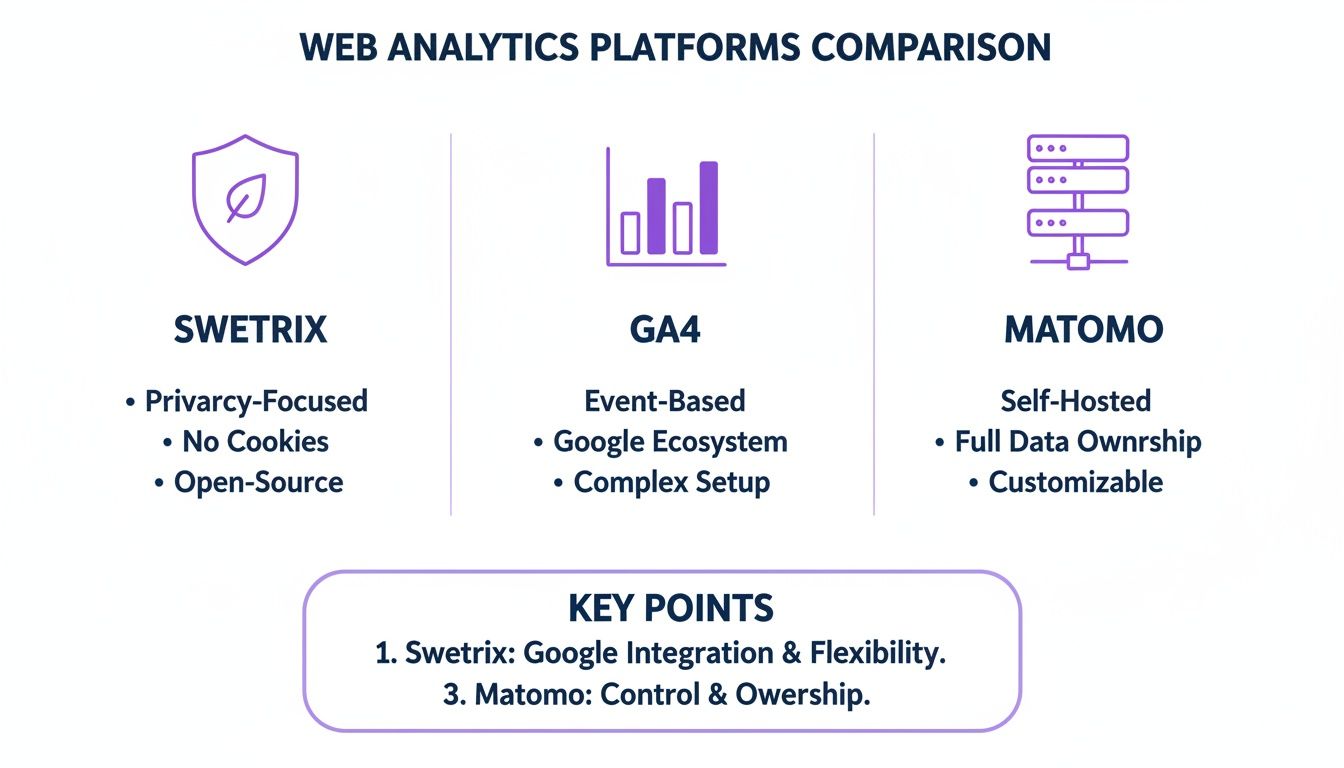
As you can see, tools like Swetrix have a privacy framework baked in, while others either require a ton of configuration or come with built-in data ownership problems.
The Power of Data Ownership
Beyond just the tracking method, the question of who actually owns your data is critical. When you use a hosted service, especially a "free" one, you're often paying with your users' data. That data can be aggregated, analyzed, and used in ways you have zero control over, which opens up some significant business risks.
Self-hosted solutions completely flip this script. By deploying an analytics platform on your own servers, you gain total data sovereignty.
- Full Control: You decide where your data lives, who can touch it, and how it’s secured. This is non-negotiable for industries with strict data residency rules, like healthcare or finance.
- Enhanced Security: Your data stays within your own secure environment, which drastically reduces its exposure to third-party data breaches.
- No Data Sampling: You get 100% of your data. You avoid the sampling that huge platforms often use to manage their processing loads, which can skew your insights.
Platforms like Swetrix and Matomo give you this flexibility. They offer a convenient cloud version for teams that want to start fast and a self-hosted option for those who need absolute control. This dual-offering model lets a business scale its data strategy without having to sacrifice its privacy principles down the road.
A privacy-by-design architecture isn't just a defensive move to avoid fines. It's a proactive strategy that turns user trust into a powerful competitive advantage, building long-term customer loyalty in an increasingly privacy-conscious world.
Navigating the Regulatory Landscape
Regulations like GDPR in Europe and CCPA in California have permanently changed the game for data collection. Getting it wrong can lead to staggering fines—we're talking up to 4% of a company's global annual revenue. This makes choosing a compliant analytics tool a critical business decision, not just a tech one.
A cookieless, privacy-first platform makes this challenge much easier to handle. Since no personally identifiable information (PII) is collected by default, the burden of proving compliance is significantly lower. It's an approach that lets you gather the insights you need while staying firmly on the right side of the law. For a closer look at the specifics, our guide on achieving GDPR compliance for websites lays out the practical steps.
Think about it in a real-world scenario. An e-commerce store using a privacy-first tool can analyze product page performance and checkout funnels without tracking individual users all over the web. They get the insights needed to boost conversions while respecting every customer's data. It’s a win-win that builds both revenue and reputation.
Finding the Right Analytics for Your Team's Workflow
The best analytics software isn't the one with the longest feature list. It's the one your team actually uses—the one they open up to solve real problems because it feels like a natural part of their day, not another clunky obligation.
Different roles have wildly different needs, so a one-size-fits-all approach to comparing platforms is bound to fail. This is why we need to look at this through the lens of the people who will be in the driver's seat. By matching a platform's capabilities to the day-to-day grind of specific teams, you can see which one truly fits your company's rhythm.
Let's break down what an ideal analytics tool looks like for four key groups.
For Startup Founders and Indie Makers
Founders wear a lot of hats, and their analytics tool has to do the same. They need a single source of truth that connects user behavior directly to the bottom line, all without a massive learning curve or a bill that gives them a heart attack. Simplicity, scalability, and financial clarity are everything.
For this crew, the perfect platform offers:
- Integrated Revenue Analytics: Direct links to payment processors like Stripe are a game-changer. Founders need to see which blog post or new feature is actually driving sales, not just page views.
- Predictable Pricing: Cash flow is king in a startup. Tools with transparent, usage-based pricing that grows with you are infinitely better than those with confusing enterprise tiers and hidden fees.
- An All-in-One Dashboard: A founder doesn't have time to stitch together data from five different tools. A platform like Swetrix that rolls web analytics, performance monitoring, and error tracking into one place is a massive win for efficiency.
A founder’s goal is to get the most insight with the least amount of friction. They need a tool that quickly answers the big questions—"Where are my best customers coming from?" and "Is that new feature making us money?"—without needing a data science degree to figure it out.
Any platform that requires a ton of setup or complex integrations just to get a complete picture is a productivity killer for a lean team.
For Product Teams and UX Researchers
Product managers live and breathe the user journey. Their main job is to understand exactly how people interact with the product so they can spot friction, test new ideas, and build a better development roadmap. For them, analytics is all about behavior.
What product teams are really looking for:
- Funnel Analysis: The power to build and visualize multi-step funnels is non-negotiable. It’s the only way to see exactly where users are dropping off during crucial moments like onboarding or checkout.
- User Flow Visualization: Seeing the actual paths users carve through an app often uncovers bizarre, unexpected behaviors and highlights huge opportunities for improvement.
- A/B Testing Capabilities: To make smart, data-driven decisions, product teams have to run controlled experiments. Having this capability built right into the analytics platform closes the loop between a hypothesis and a validated result.
Sure, a tool like Google Analytics can give you some of this data, but it's often fragmented. A product-centric platform presents this information with context, making it far easier to answer questions like, "Did our latest UI tweak actually improve the signup conversion rate?"
For Developers and DevOps Teams
Developers need data that helps them build, ship, and maintain better software. They care less about marketing attribution and a whole lot more about application health, performance, and the integrity of the data pipeline.
The right analytics tool for a developer is one that provides:
- A Robust API: A solid API lets developers pull analytics data into custom dashboards, internal tools, or other applications, making the data far more powerful.
- Real-User Monitoring (RUM): Devs need to see how the application performs in the wild, not just on a test server. Monitoring Core Web Vitals helps them hunt down and fix bottlenecks that are ruining the user experience.
- Open-Source and Self-Hosting Options: The ability to self-host gives a team total control over data security and compliance. An open-source codebase means full transparency and the freedom to customize the tool for specific needs.
This is where platforms like Swetrix and Matomo really start to pull away from the pack, offering the kind of flexibility that technical teams require.
The demand for compliant, flexible tools isn't just a niche concern; it's a global trend. North America currently leads the business analytics software market, accounting for 55% of worldwide revenue. This is largely fueled by tech hubs in the US, where the industry was projected to hit USD 33.6 billion by 2025 across nearly 1,000 different firms. You can dig deeper into these industry statistics and insights.
For Digital Agencies
Agencies are constantly juggling multiple clients, each with their own goals and reporting demands. Their perfect analytics platform has to be efficient, scalable, and client-friendly, letting them manage everything from a single command center.
Here's what agencies can't live without:
- Multi-Site Management: A centralized dashboard to view and manage all client websites is a non-negotiable time-saver.
- White-Label and Sharable Reports: The ability to generate clean, professional reports branded for the agency is crucial for showing clients the value they're getting.
- Team Collaboration: Granular user permissions let agencies give clients view-only access to their own data without risking the security of other accounts.
When you match the tool to the team that will use it, you guarantee the platform becomes a vital part of your success—not just another subscription on the company card.
Evaluating Deployment Models and Total Cost
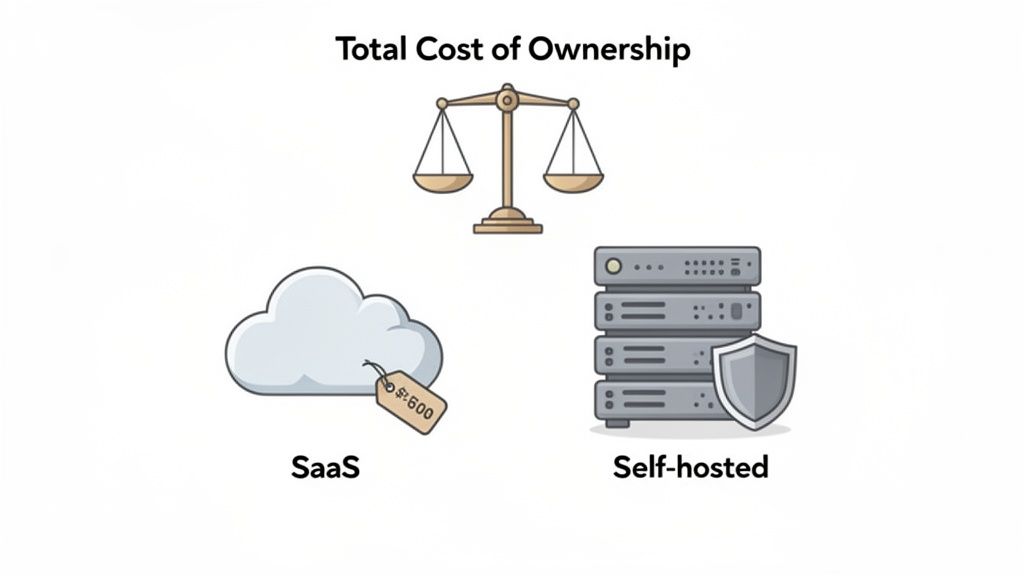
When you're comparing business analytics software, the sticker price is just the start of the story. The real financial picture is the Total Cost of Ownership (TCO), which includes everything from server fees for a self-hosted setup to the developer hours needed to keep a cloud service running smoothly.
The first big decision you'll face is the deployment model: SaaS (Software-as-a-Service) or self-hosted. Each has its own distinct trade-offs between convenience, control, and what you’ll actually spend in the long run.
The SaaS Model: Simplicity and Predictability
For most businesses, especially startups or teams without a dedicated IT crew, SaaS is the path of least resistance. You pay a recurring fee, and the provider takes care of all the messy backend stuff—servers, security, updates, and maintenance.
This model is fantastic for predictable costs and getting started right away. Platforms with clear, usage-based pricing let your costs scale naturally with your traffic, so you aren't stuck with a massive enterprise contract from day one. Of course, the trade-off for this convenience is data control, since your analytics live on someone else's servers.
The Self-Hosted Model: Control and Sovereignty
Self-hosting gives you the ultimate prize: 100% data ownership and control. When you run the analytics software on your own servers, you have complete data sovereignty. This is a non-negotiable for businesses in heavily regulated fields like finance or healthcare, as it cuts out any third-party access to sensitive user information.
But all that control comes with a different kind of cost.
- Infrastructure Costs: You're on the hook for the server hardware, whether it's in your own office or rented from a cloud provider like AWS or DigitalOcean.
- Maintenance Overhead: Your tech team is now responsible for installation, security patches, updates, and fixing things when they break. Those engineering hours add up to a real operational expense.
- Scalability Management: As your traffic grows, you have to scale your server resources to keep up. That means more planning and a bigger budget.
For teams with the right technical chops, the long-term security and customization benefits can easily justify the initial setup and ongoing work. We've actually put together a deep dive on what's involved in our guide to setting up self-hosted web analytics.
The choice between SaaS and self-hosted is a strategic one. You have to decide what matters more: the immediate ease and predictable budget of a managed service, or the long-term value of having total control over your own data.
Unpacking the "Free" Analytics Trap
Finally, let's talk about the "free" model made famous by tools like Google Analytics. You might not pay a subscription fee, but you pay with your data. That data feeds a gigantic advertising machine, and the tool's complexity often creates hidden costs, like hiring expensive consultants or spending weeks on team training.
When you're calculating the true cost, look at everything: subscription fees, server expenses, developer time, and the business risk of your data being used by someone else. A platform like Swetrix, which gives you both a fairly priced SaaS plan and a self-hosted option, lets you pick the model that actually fits your budget, team, and goals.
So, How Do You Choose?
When it comes down to it, picking the right analytics tool isn't about finding the one with the longest feature list. It’s about answering one simple question: what’s the one thing you absolutely cannot compromise on? Each platform we’ve looked at is a champion in its own right, but your final decision needs to lock in with what truly drives your business forward.
Is your brand built on a foundation of absolute user trust and privacy? If that’s a non-negotiable for you, then the path is pretty clear. A cookieless, privacy-first tool like Swetrix or Plausible isn't just a "nice-to-have"—it's a core part of your strategy that respects users and keeps you ahead of regulations.
Matching the Right Tool to Your Team's Mission
But what if your main goal lies elsewhere? Let’s break down where each tool really shines, so you can map your needs directly to the best solution.
- For Total Data Sovereignty and Privacy: If you want complete control over your data, Swetrix and Matomo are the leaders. Their self-hosting options and cookieless designs mean your data stays yours, period.
- For Simplicity and Speed: Plausible is designed for teams that need essential web metrics without the fluff. It’s incredibly straightforward and gets you the insights you need in seconds.
- For the All-in-One Developer Hub: This is where Swetrix pulls away from the pack. It combines web analytics, performance monitoring, error tracking, and A/B testing into one cohesive toolkit, saving you from juggling multiple subscriptions.
- For Deep Integration with Google Ads: If your business lives and breathes inside Google's advertising ecosystem, Google Analytics is hard to escape. It's the default choice for a reason, even with its serious privacy drawbacks.
The best analytics platform isn’t the one with the most bells and whistles. It’s the one that solves your biggest problem with the least friction. Your goal is to find the tool that empowers your team and respects your users.
With that in mind, you can move from comparing features to confidently implementing a solution. You'll know you’ve picked a partner that’s genuinely the right fit for the job.
Frequently Asked Questions
When you're deep in a business analytics software comparison, a few specific questions always seem to pop up. Let's tackle some of the most common ones to help you clear up those final details before you make a decision.
What's the Real Advantage of Going Cookieless?
The biggest win is respecting user privacy while making your life easier. Cookieless analytics tools don't need to store tracking files on a visitor's device, which means you can ditch those annoying cookie consent banners. This immediately helps with regulations like GDPR.
On top of that, it builds trust with your audience. As a bonus, since many ad-blockers are designed to zap cookie-based scripts, this approach often leads to more complete and accurate data.
How Hard Is It to Actually Move Away From Google Analytics?
Honestly, the technical part is pretty simple. It really just comes down to adding a new tracking script to your website.
The main catch is that you can't import your old data from Google Analytics because the platforms structure everything differently. What most people do is run both tools side-by-side for a month or so. This lets you get comfortable with the new system without losing your data stream. Most alternatives have great documentation to help you recreate your key events and goals.
The most important part of migration is not the technical setup, but redefining your success metrics. This is a chance to move from vanity metrics to actionable KPIs that truly reflect business health.
Should a Small Business Really Consider Self-Hosting?
It's a definite "it depends." The appeal of self-hosting is total control and ownership over your data—a huge plus for privacy-conscious businesses. You know exactly where your information lives.
The tradeoff is the technical heavy lifting. You're responsible for setting up the server, keeping it secure with updates, and performing all the maintenance. If you don't have someone on your team who's comfortable with that, a hosted (cloud) solution is almost always the more practical choice. You get all the powerful features without the operational headache.
Ready to see how a privacy-first, all-in-one analytics platform can change the way you see your business? Explore Swetrix and start your free 14-day trial to get the data you need without compromise.