- Date
Best Matomo Alternatives for Privacy in 2026
 Andrii Romasiun
A website operator in Austria installed Google Analytics 4 in 2024. The Austrian Data Protection Authority reportedly fined them €10,000 in 2026 for unlawful data transfers to the United States. The operator had implemented Standard Contractual Clauses and believed they were compliant. They were wrong.
Privacy regulations tightened across Europe and North America throughout 2025 and 2026. Enforcement agencies stopped issuing warnings and started collecting fines. Matomo positioned itself as the privacy-first alternative to Google Analytics, but configuration complexity and performance overhead pushed many teams to look elsewhere.
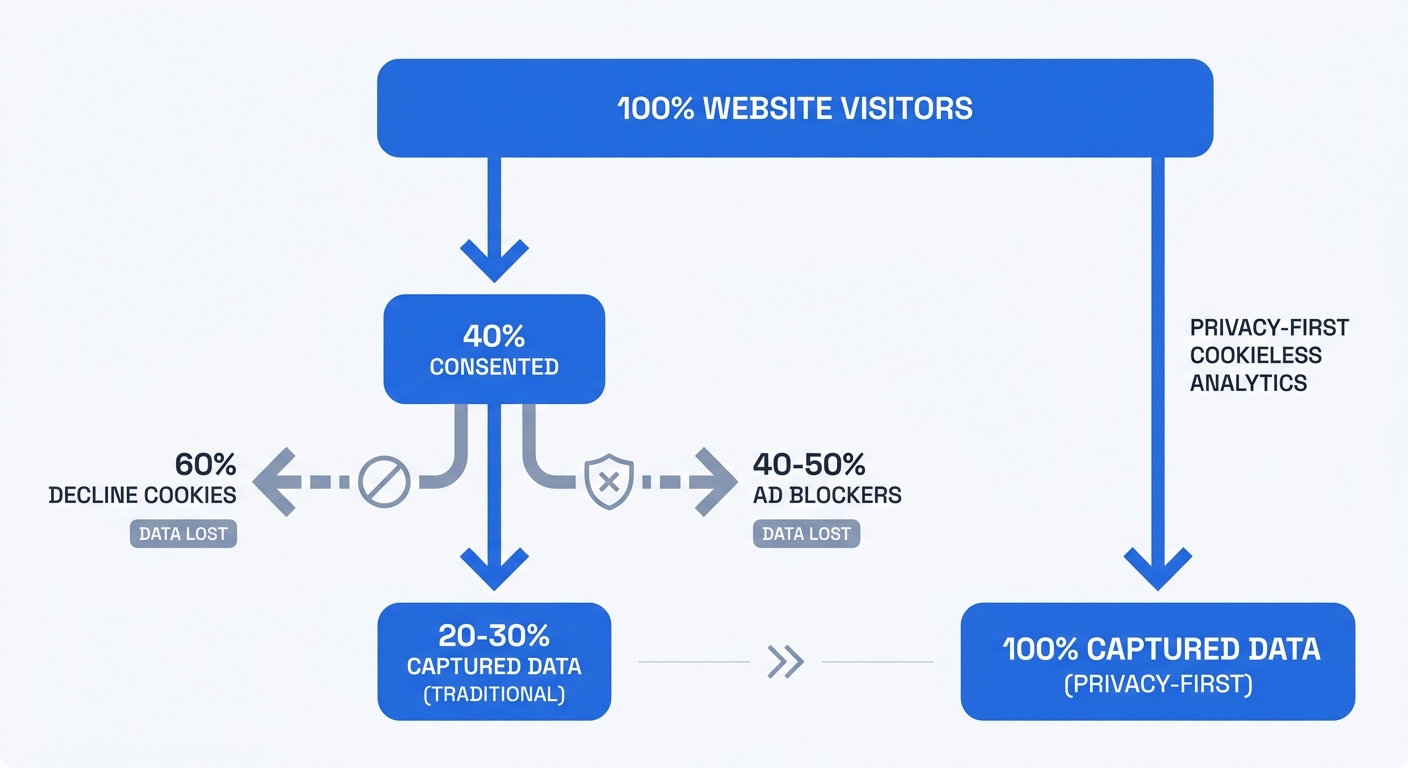
Modern privacy-focused analytics platforms like Swetrix now typically capture more complete data than traditional tools because they don't require consent banners. When 60% of users decline cookie consent, traditional analytics lose 60% of their traffic data. Cookieless platforms can capture significantly more visitors (though some may still be blocked by network-level filtering or users with JavaScript disabled).
Why Privacy-Focused Analytics Matter More Than Ever
The Regulatory Environment Has Changed
The global data privacy software market reached $5.37 billion in 2025 and will grow to $45.13 billion by 2034, exhibiting a 35.5% compound annual growth rate. This growth reflects regulatory expansion, not voluntary adoption.
Data Protection Authorities issued 2,245 GDPR fines totaling €5.65 billion by March 2025. The average fine reached €2.36 million. In March 2025, the California Privacy Protection Agency announced a $632,500 Honda settlement addressing privacy request processes and other CCPA requirements. Eighteen state privacy laws are now active across the United States.
The UK's Data Use and Access Act began entering force in 2026. Passed in June 2025, the act updates UK GDPR with new lawful bases for data processing, relaxed consent requirements for analytics cookies, and reduced subject rights request burdens. France's CNIL reportedly introduced a self-assessment framework for analytics tools. The EU's Digital Omnibus initiative proposes amendments to GDPR and the ePrivacy Directive.
Only 20% of companies believe they're fully GDPR compliant. Fifty-three percent are still implementing compliance measures. Twenty-seven percent haven't started. The average U.S. data breach cost $10.22 million in 2025. Compliance gaps carry financial risk.
Check your current analytics setup against GDPR Article 6 lawful bases. If your tool collects personal data or uses cookies, you need explicit consent or a valid legal basis. Most traditional analytics platforms fail this test.
Traditional Analytics Are Losing Data Quality
Nearly 60% of users decline cookie consent pop-ups. Traditional analytics platforms that require consent lose visibility into 60% of website traffic. Ad blockers compound the problem. Forty to fifty percent of web users run tracker blockers that render Google Analytics blind to half your audience.
Privacy-first tools that don't require consent typically capture significantly higher coverage. A website with 10,000 monthly visitors might see only 4,000 in Google Analytics after consent declines and ad blocker filtering. The same site using cookieless analytics can see substantially more, though some visitors may still be blocked by network-level filtering or have JavaScript disabled.
Server-side tracking adoption reached 72% among B2B companies in 2026. These implementations report an average 45% data quality improvement over client-side-only approaches. First-party data strategies deliver 3.2x better customer retention rates and 1.7x higher marketing ROI compared to third-party cookie dependence.
Calculate your data loss. Compare your server logs or CDN analytics to your Google Analytics visitor count. The gap represents invisible traffic. If the gap exceeds 30%, your decisions rest on incomplete data.
Trust Drives Business Results
Eighty-five percent of adults worldwide want better online privacy protection. Eighty-one percent of consumers factor trust into purchase decisions. Forty-eight percent stopped buying from a company due to privacy concerns.
Privacy-first analytics builds brand differentiation in crowded markets. Transparency about data collection creates deeper trust than generic privacy policies. Ninety-nine percent of organizations report tangible benefits from privacy investments. Thirty-eight percent now spend $5 million or more on privacy programs.
Audit your analytics privacy policy. If it mentions cookies, third-party data sharing, or personal data collection, users notice. Switching to a cookieless platform lets you remove the consent banner and state that you collect no personal data.
What Makes Matomo Fall Short on Privacy
Matomo's Cookie and Consent Requirements
Matomo uses cookies by default. The platform collects personal data for session recordings, heatmaps, and user profiles. This triggers GDPR consent requirements. Visitors who decline the banner disappear from your reports.
Matomo has a 3.55% market share in the web analytics market. Over 390,345 companies worldwide use Matomo, with strongest adoption in Germany, France, and the Netherlands where GDPR enforcement is strictest. The European Commission itself uses Matomo for privacy-compliant analytics.
Default Matomo installations track IP addresses, set persistent cookies, and store user identifiers. These practices require explicit consent under GDPR Article 6 and ePrivacy Directive requirements. The Article 29 Working Party, the authoritative EU body that preceded the European Data Protection Board, stated that analytics require consent unless configured to avoid personal data collection.
Check your Matomo configuration. Open Settings > Privacy > Anonymize Data. If IP anonymization is disabled, cookie usage is enabled, or session recordings are active, you're collecting personal data and need a consent banner.
Configuration Complexity for True Privacy
Matomo can operate without cookies and personal data, but the configuration requires ongoing maintenance. You must anonymize IP addresses, disable cookies, mask URLs and form inputs, configure data retention policies, and handle historical data deletion requests.
IP anonymization replaces full addresses like 192.168.1.011 with masked versions like 192.168.1.xxx. Cookie disabling prevents persistent identifiers across sessions. URL masking removes query parameters that might contain personal information. Form input masking strips sensitive data from tracked events.
Each configuration step adds complexity. A misconfigured setting reintroduces personal data collection and invalidates your consent-free setup. Updates to Matomo or plugins can reset privacy settings to defaults. Maintaining compliance requires regular audits and testing.
Document your Matomo privacy configuration in a checklist. Assign someone to verify settings quarterly. If your team lacks the technical capacity to maintain this configuration, a cookieless-by-default platform eliminates the maintenance burden.
Performance Impact on Your Site
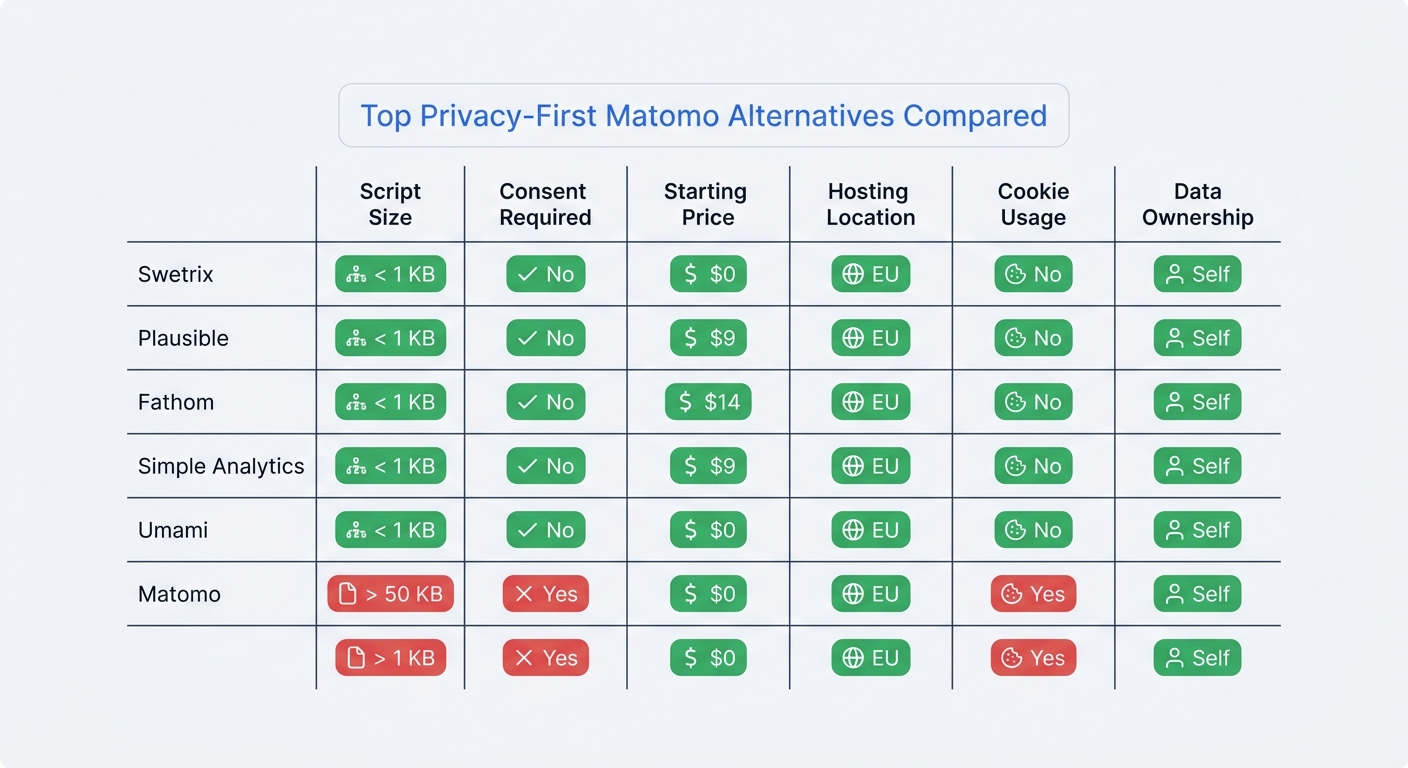
Matomo's tracking script weighs 22KB gzipped. Swetrix delivers a sub-1KB script, making it nearly 22 times smaller. Script size affects page load time, Core Web Vitals scores, and SEO rankings.
Heavy JavaScript payloads delay Time to Interactive and First Input Delay. Google's Core Web Vitals became a ranking factor in 2021 and remain critical in 2026. Reducing JavaScript improves performance metrics and conversion rates.
A 22KB analytics script on a mobile connection adds measurable delay. Users on 3G networks or throttled connections notice the lag. Faster sites convert better. Amazon found that every 100ms of latency cost 1% of sales.
Measure your current analytics script impact. Open Chrome DevTools, navigate to the Network tab, and filter by JavaScript. Check the size and load time of your Matomo script. Compare it to lightweight alternatives. If Matomo adds more than 100 ms to page load, switching to a smaller script improves user experience and SEO.
Top Privacy-First Matomo Alternatives Compared
Swetrix: The Modern Privacy-First Choice
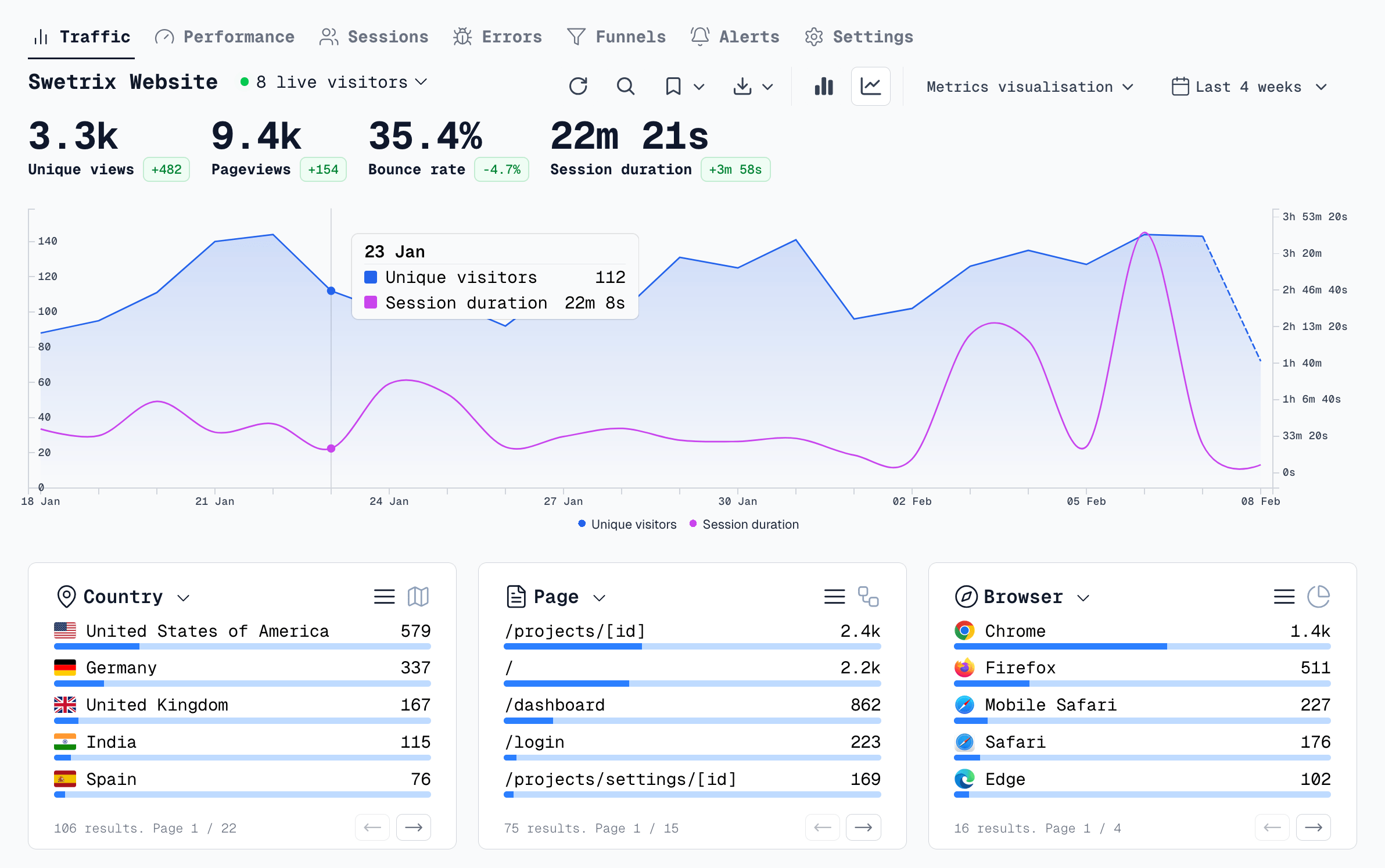
Swetrix combines true privacy with powerful features that traditional platforms require cookies to deliver. The platform collects zero personal data, uses no cookies, and requires no consent banners. GDPR and CCPA compliance is built in from the first page view.
The Swetrix script weighs under 1KB. EU hosting ensures data residency compliance. Real-time dashboards update as visitors browse your site. Campaign tracking with UTM parameters works without cookies by using temporary session identifiers. Custom events track conversions, form submissions, and user actions without storing personal information.
Swetrix typically captures significantly higher coverage because it doesn't need consent. A site with 10,000 monthly visitors can see substantially more in Swetrix, while the same site using Google Analytics might see only 4,000 after consent declines and ad blocker filtering. More complete data produces better decisions.
Performance monitoring and error tracking integrate into the analytics dashboard. Shared dashboards let you give clients or stakeholders access without creating separate accounts. The platform supports self-hosting for teams that need complete data control or cloud hosting for teams that want managed infrastructure.
Swetrix is open source, giving you full transparency into how your data is processed. The codebase is available for audit, modification, and self-deployment. This openness builds trust and ensures no hidden tracking mechanisms exist in the code.
Swetrix pricing starts at 100,000 events per month for $19/month or $190/year. A 14-day free trial lets you test the platform with your traffic before committing. Install the script, verify data accuracy, and compare metrics to your current tool during the trial period.
Plausible Analytics: Lightweight and EU-Hosted
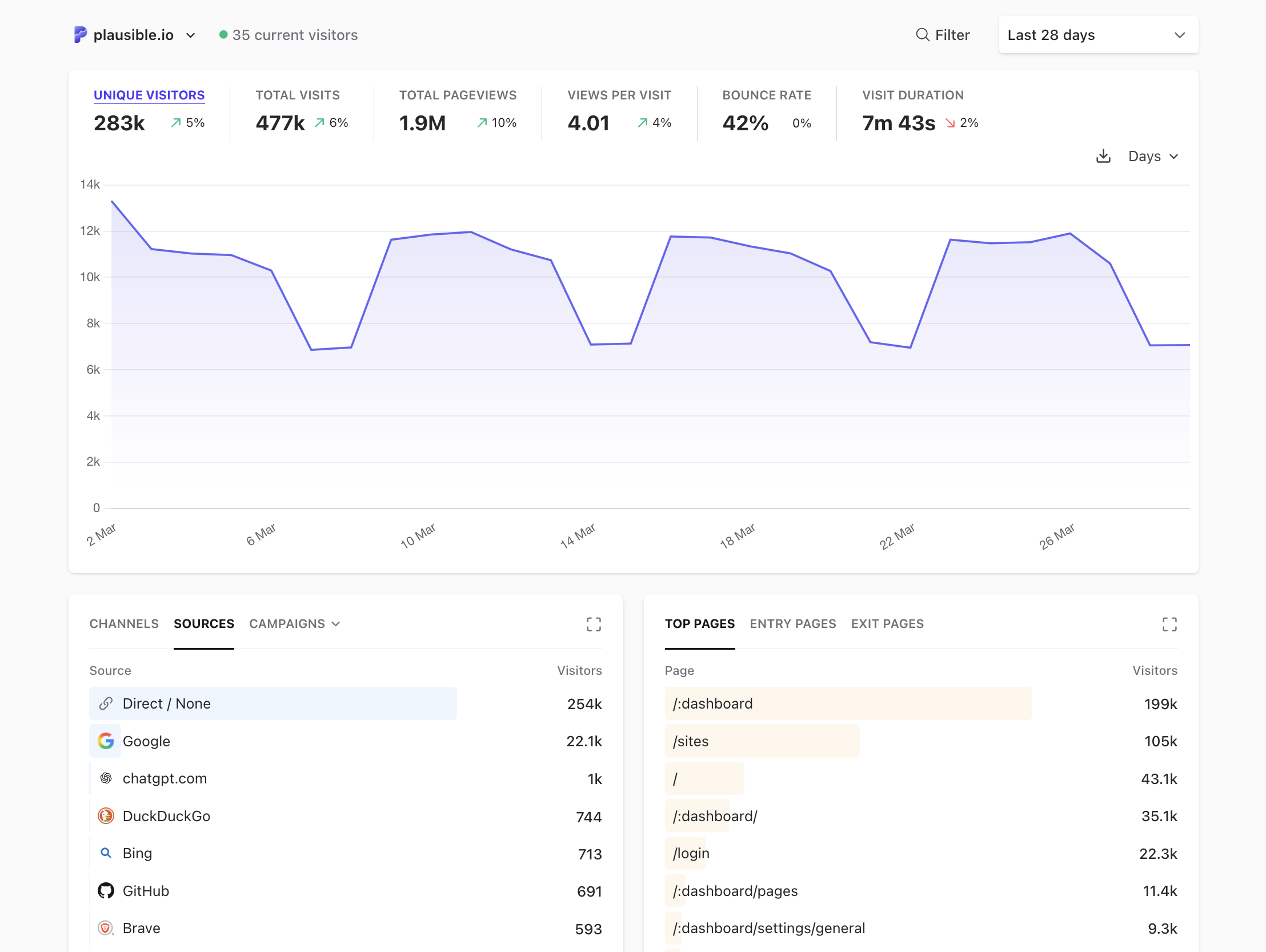
Plausible launched in 2019 and grew as a GDPR-compliant Google Analytics alternative. The platform uses a 2.5KB script, processes data on EU infrastructure, and operates on a cookieless model.
Plausible processes data under GDPR Article 6(1)(f) legitimate interest. The platform uses pseudonymization and anonymization techniques that preserve privacy while delivering actionable insights. No explicit consent is required because Plausible collects no personal data for advertising or cross-site tracking.
Plans start at €9/month for 10,000 monthly page views. Pricing scales by traffic volume. The dashboard shows page views, referrers, top pages, countries, devices, and browsers. Goal tracking measures conversions without cookies. CSV imports preserve historical data when migrating from Matomo or Google Analytics.
Plausible's EU hosting addresses data residency requirements for European organizations. All visitor data stays on European-owned infrastructure. This eliminates the Schrems II data transfer concerns that triggered regulatory action against Google Analytics.
Fathom and Simple Analytics: Cookieless Simplicity
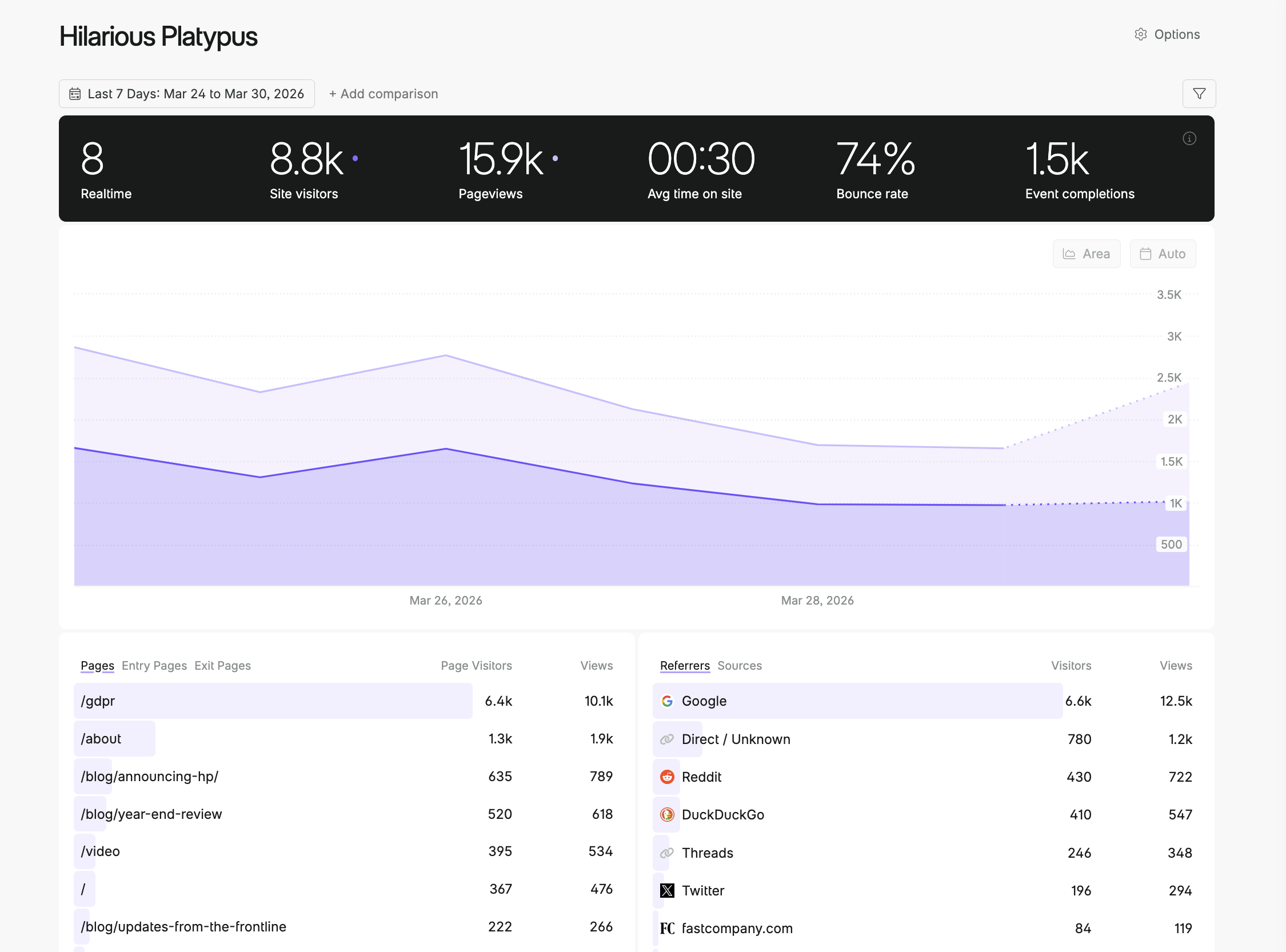
Fathom Analytics positions itself as the simple, fast alternative for entrepreneurs who value privacy and clean data. The platform operates on a cookieless tracking model. No consent banners appear on your site. The dashboard provides metrics without complexity.
Fathom focuses on core analytics: page views, referrers, time on site, and goals. The interface removes clutter and presents data clearly. Teams that don't need heatmaps, session recordings, or advanced segmentation find Fathom sufficient for traffic analysis and conversion tracking.
Simple Analytics offers a privacy-first approach with ad-blocker bypass technology. The platform collects zero personal data and hosts in the EU. GDPR, CCPA, and PECR compliance is automatic. The ad-blocker bypass ensures accurate metrics even when visitors run tracker blockers.
Both platforms charge monthly fees based on page view volume. Fathom and Simple Analytics target teams that prioritize simplicity over feature depth. If your analytics needs center on traffic sources, popular content, and conversion rates, either platform delivers those metrics without privacy compromises.
Umami and Self-Hosted Options
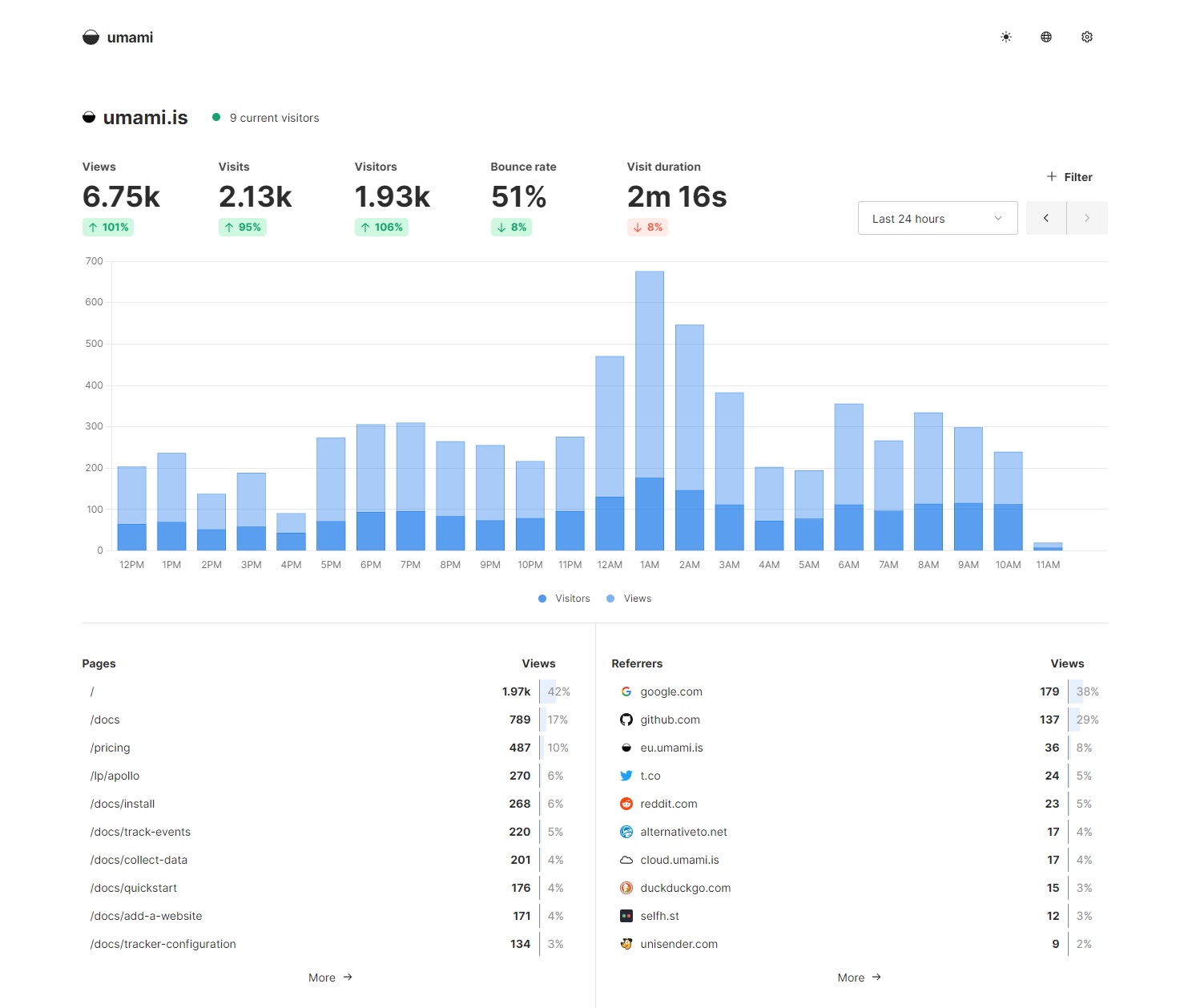
Umami strikes a balance between simplicity and capability. The platform offers more features than basic alternatives without Matomo's complexity. Visitors stay anonymous. GDPR compliance is built in from the start.
Umami is a favorite in the software development community. The platform is available as a cloud-based freemium plan or as a self-hosted solution. Self-hosting gives you maximum data control and customization. A $5/month VPS handles most small-to-medium sites. High-traffic sites need more resources, but cost stays predictable. You pay for servers, not events.
Self-hosted solutions require maintenance and security effort. You manage updates, backups, database optimization, and server security. Cloud-based options eliminate this operational burden but involve trade-offs in data residency and control.
Piwik PRO spun out of Matomo in 2013 and targets users in strict regulatory environments. The platform includes web, mobile, and product analytics plus tag and consent management. Enterprise features include data governance controls, custom data retention policies, and dedicated support.
Compare your technical capacity to the maintenance requirements of self-hosting. If your team runs production infrastructure, self-hosting Umami or Matomo gives you complete control. If you lack DevOps resources, cloud-hosted platforms like Swetrix eliminate operational overhead while delivering the same privacy guarantees.
Key Features to Look for in Privacy Analytics
Cookieless Tracking Technology
Cookieless tracking creates temporary session identifiers by hashing visitor data without storing persistent identifiers. The hash changes with each session. No cross-session or cross-site tracking occurs.
Server-side tracking moves data collection from the user's device to your server. This reduces client-side JavaScript, improves page load times, and bypasses ad blockers. First-party data collection gathers insights from website visitors rather than relying on third-party trackers.
Privacy-friendly fingerprinting uses anonymized session data instead of personally identifiable information. The technique combines user agent, screen resolution, and timezone to create a temporary session identifier. No personal data is stored. Statistical modeling estimates user behavior using aggregated, non-personal analytics data.
Evaluate each platform's tracking methodology. Ask how session identification works, whether any personal data is collected, and how the platform handles data retention. Platforms that answer these questions with technical documentation demonstrate privacy commitment.
Data Minimization and Anonymization
Data minimization means collecting only the information you need. Traditional tools track every click, mouse movement, and scroll depth. Privacy-first tools collect page views, referrers, and conversions—the metrics that drive decisions.
IP anonymization removes or hashes personally identifiable information. Privacy-centric tools hide personal details so no one can identify the visitor. The tool saves addresses as 192.168.1.xxx instead of full IPs like 192.168.1.011. The data isn't linked to a specific person or computer.
Anonymized data is not identified or identifiable. GDPR Recital 26 states that anonymized data is not personal data and falls outside privacy protection scope. Processing anonymized data for analytical purposes avoids legal basis problems.
Review your current analytics data. Check whether you use 90% of the collected metrics. If most reports focus on traffic sources, popular pages, and conversion rates, you don't need granular user-level tracking. Switch to a platform that collects only what matters.
EU Hosting and Data Residency
EU hosting addresses GDPR Chapter V international data transfer requirements. The Austrian Data Protection Authority ruled in February 2022 that Google Analytics violates GDPR data transfer rules. France's CNIL reached the same conclusion. The Cologne District Court confirmed in August 2025 that Google Analytics use violated GDPR requirements.
Platforms hosted in the EU process data on European-owned infrastructure. This eliminates Schrems II concerns about U.S. intelligence access to European data. EU hosting is strongest in countries where GDPR enforcement is strictest: Germany, France, and the Netherlands.
Data residency requirements vary by industry and jurisdiction. Healthcare organizations subject to HIPAA need U.S. hosting. Financial services firms face sector-specific data localization rules. Government agencies often require domestic hosting.
Verify where your analytics data is stored and processed. Check the platform's data processing agreement for hosting locations and subprocessor lists. If your organization operates in the EU or serves EU customers, EU hosting simplifies compliance and reduces regulatory risk.
How to Migrate from Matomo Without Losing Data
Running Parallel Analytics During Transition
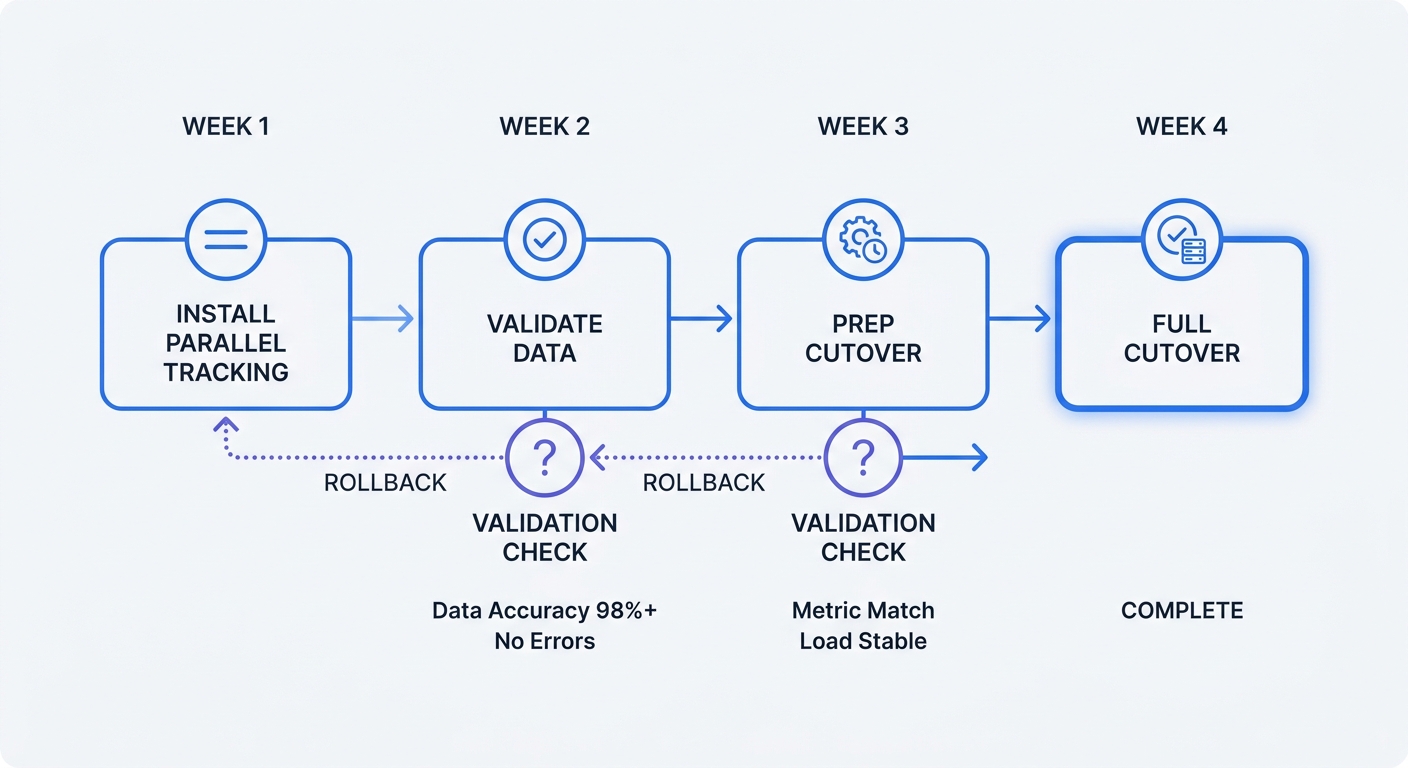
Install your new analytics platform alongside Matomo. Run both tools in parallel for 2-4 weeks. This overlap period lets you compare metrics, validate accuracy, and build confidence before cutting over.
Track the same key metrics in both platforms: sessions, users, page views, bounce rate, conversions, and revenue. Export weekly reports from each tool and compare the numbers side by side. Investigate discrepancies larger than 10%.
Common discrepancies include bot filtering differences, session timeout definitions, and attribution model variations. Matomo might count a session as 30 minutes of inactivity while your new platform uses 15 minutes. Document these methodology differences for stakeholders.
Create a validation checklist. Verify that UTM parameters populate, custom events fire on the right triggers, conversion goals track accurately, and revenue attribution matches your source of truth. Test each critical metric before relying on the new platform for decisions.
Swetrix's real-time dashboard makes validation straightforward. Trigger a conversion on your site and watch it appear instantly in both platforms. Compare the attribution, timestamp, and associated metadata. Real-time verification catches configuration errors immediately rather than discovering them weeks later in monthly reports.
Importing Historical Data
Export your historical Matomo data before migration. Matomo supports CSV exports for page views, events, and goals. Some platforms support CSV imports to preserve historical trends.
Historical data import preserves year-over-year comparisons and long-term trend analysis. If you track seasonal patterns or multi-year growth, importing historical data maintains continuity in your reports.
Data import limitations vary by platform. Some tools import only page views and sessions. Others support custom events and conversion goals. Check import documentation before starting the migration to understand what historical data you can preserve.
If historical data import isn't possible or practical, document the cutover date. Add annotations to dashboards marking the migration. Stakeholders need to know when methodology changed to interpret trend breaks.
Validating Accuracy and Dashboards
Rebuild critical dashboards in your new platform during the parallel tracking period. Recreate the reports your team checks daily: traffic sources, top pages, conversion funnels, and campaign performance.
Test each dashboard against Matomo's equivalent report. Verify that numbers match within expected variance. If a metric shows a 20% difference, investigate the root cause before trusting the new platform.
Set up alerts for critical metrics. If daily conversions drop below a threshold or traffic from a key source disappears, you need immediate notification. Configure these alerts during parallel tracking and verify they trigger.
Document any methodology differences for stakeholders. If your new platform counts sessions differently or attributes conversions using a different model, explain the change in writing. Stakeholders who see numbers shift need context to interpret the data.
Full cutover happens when you trust the new platform's data quality and your team can operate independently without Matomo. Remove the Matomo tracking code only after validating accuracy for at least two weeks. Keep Matomo data accessible for historical reference even after cutover.
Making the Business Case for Privacy Analytics
Cost-Benefit Analysis
Swetrix starts at $19/month for 100,000 events. Self-hosted options like Umami cost $5/month for VPS hosting on small-to-medium sites. Matomo is free to self-host but requires maintenance effort and technical expertise.
Calculate total cost of ownership. Self-hosted Matomo requires server costs, DevOps time for updates and security patches, database optimization, and backup management. Cloud-hosted privacy platforms include all infrastructure, updates, and support in the monthly fee.
Ninety-nine percent of organizations report tangible benefits from privacy investments. Thirty-eight percent spend $5 million or more on privacy programs. Privacy-focused analytics is a small fraction of total privacy spend but delivers measurable compliance risk reduction.
Compare your current analytics cost to privacy-first alternatives. Include hidden costs: consent management platform fees, legal review time, GDPR compliance audits, and data loss from consent declines. Privacy-first platforms eliminate consent management costs and typically capture significantly higher coverage.
Compliance Risk Reduction
The average data breach costs $10.22 million in the United States. GDPR fines average €2.36 million. The Austrian DPA reportedly fined a website operator €10,000 in 2026 for using GA4 with Standard Contractual Clauses. French and Italian regulators issued similar guidance.
Only 20% of companies believe they're fully GDPR compliant. Fifty-six percent of compliance and risk professionals rank data privacy, protection, and security as their most important compliance issues. Privacy-focused analytics reduces regulatory exposure.
Calculate your compliance risk exposure. Estimate the probability of a GDPR complaint or data breach investigation. Multiply by the average fine in your jurisdiction. Compare this expected value to the cost of switching to a compliant analytics platform.
Privacy-first analytics eliminates the most common GDPR violations: unlawful data transfers, lack of consent, and excessive data collection. Switching platforms removes these risks from your compliance audit checklist.
Performance and SEO Benefits
Lightweight scripts improve Core Web Vitals scores. Google's ranking algorithm considers page experience signals including Largest Contentful Paint, First Input Delay, and Cumulative Layout Shift. Reducing JavaScript payload improves all three metrics.
A 22KB Matomo script versus a 1KB Swetrix script saves 21KB on every page load. Mobile users on slow connections see faster page loads. Faster sites rank higher in search results and convert better.
Privacy-first platforms typically capture significantly higher coverage because they don't require consent. Traditional analytics lose 60% of data to consent declines. More complete data produces better decisions. Better decisions improve conversion rates, customer acquisition costs, and lifetime value.
Measure your current data loss. Compare your server logs to your Google Analytics visitor count. Calculate the percentage gap. If you're losing 40-60% of traffic data, your decisions rest on a minority sample. Privacy-first analytics restores complete visibility.
Privacy regulations tightened in 2026. Enforcement agencies stopped warning and started fining. Traditional analytics platforms lose data to consent declines and ad blockers. Privacy-first alternatives capture complete traffic without consent banners.
Swetrix delivers cookieless analytics with real-time dashboards, campaign tracking, custom events, performance monitoring, and error tracking. The platform is GDPR and CCPA compliant by default. EU hosting ensures data residency compliance. Open-source transparency lets you audit the code. A 14-day free trial lets you test with your traffic.
Start your free trial at swetrix.com/signup and see your complete traffic data without consent banners.