- Date
12 Best Alternatives to Google Analytics for 2026
 Andrii Romasiun
For over a decade, Google Analytics has been the go-to solution for website traffic analysis, largely due to its powerful features and free-tier access. However, its dominance is being challenged by a growing demand for user privacy, simpler interfaces, and more transparent data handling. Many businesses and developers are now actively searching for alternatives to Google Analytics that better align with modern web standards and user expectations.
The shift is driven by several key factors. Increased scrutiny from regulations like GDPR and CCPA has made data privacy a top priority. Users are more aware of tracking, and many find the GA4 interface overly complex for extracting straightforward insights. For many, the need for a lightweight, compliant, and easy-to-use analytics tool has become a pressing business requirement, not just a preference.
This comprehensive guide is designed to help you navigate this new landscape. We will explore 12 of the best alternatives to Google Analytics, from privacy-first platforms like Plausible and Fathom to powerful product analytics tools like PostHog and Mixpanel. You will find a detailed breakdown of each option, covering:
- Key Features: What makes each tool unique?
- Ideal Use Case: Who is this platform built for? (e.g., startups, agencies, developers)
- Pricing: A clear overview of their pricing models.
- Limitations: An honest look at potential drawbacks.
Each entry includes screenshots and direct links, giving you everything needed to make an informed decision. Whether you need a simple dashboard for your blog or a robust, self-hosted solution for your SaaS product, this resource will help you find the perfect analytics platform for your specific needs. Let's dive in and find the right fit for you.
1. Swetrix
Best For: Product-focused teams wanting an all-in-one, privacy-first analytics and experimentation platform.
Swetrix stands out as a powerful, well-rounded choice among alternatives to Google Analytics, especially for teams that prioritize user privacy without sacrificing deep, actionable insights. Its core strength lies in its cookieless, privacy-first architecture, which anonymizes all data and eliminates the need for intrusive cookie consent banners. This approach ensures GDPR compliance by design, a critical consideration given the evolving legal landscape around data privacy. You can find out more by reading Swetrix's analysis on whether Google Analytics is illegal in the EU.
The platform moves beyond basic traffic metrics to deliver a comprehensive suite of tools tailored for product development and growth. It combines real-time dashboards (covering top pages, traffic sources, and UTM campaigns) with advanced features like session analysis, error tracking, and real user monitoring (RUM). This combination provides a holistic view of both user behavior and application performance in one place.
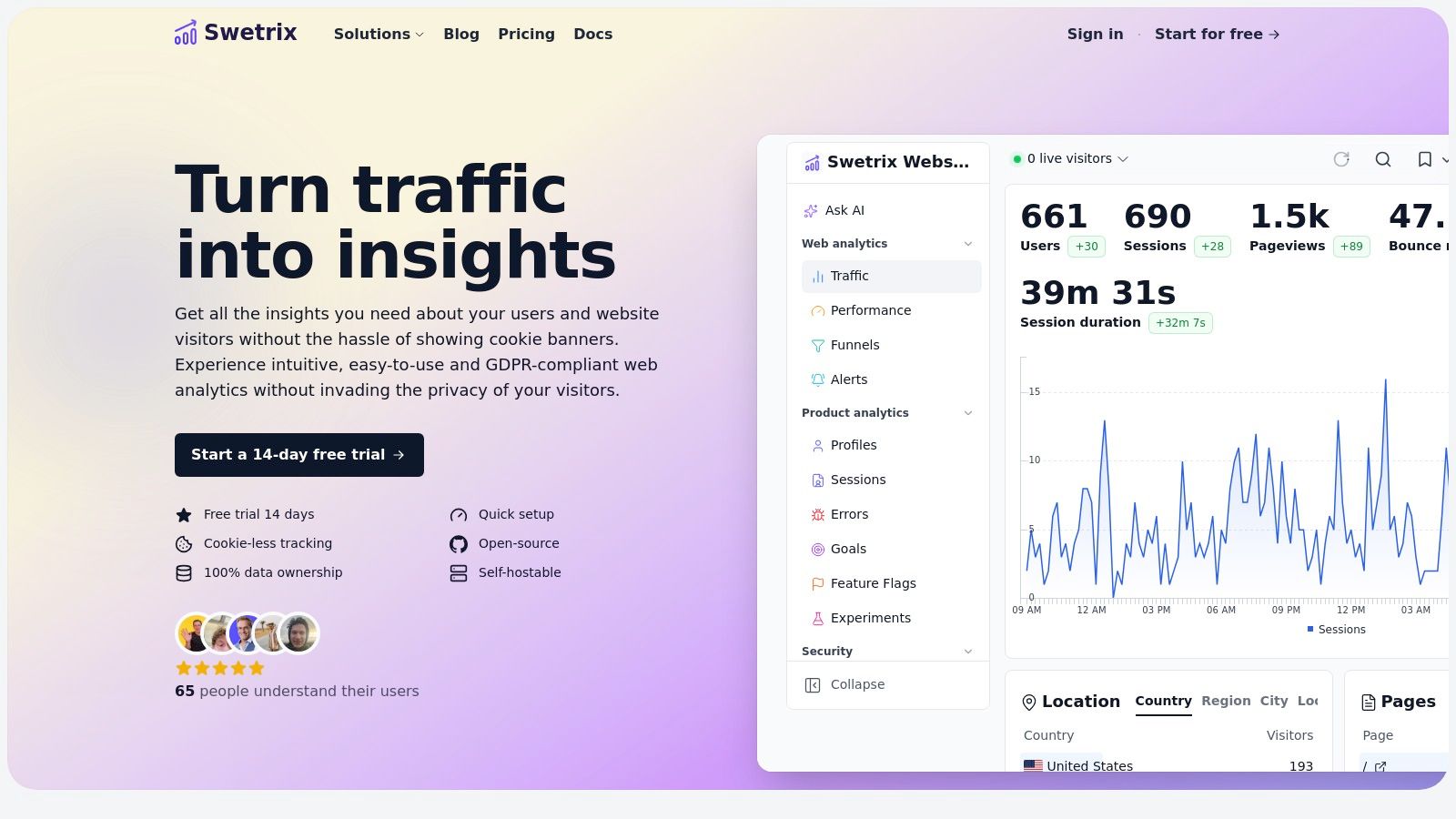
Key Features & Use Cases
- Product & Conversion Optimization: Swetrix includes built-in A/B testing and feature flags, allowing product teams to run statistically sound experiments and safely roll out new features. The funnel analysis and custom event tracking are ideal for identifying drop-off points in user journeys, from onboarding to checkout.
- Revenue Attribution: Direct integrations with Stripe and Paddle enable clear revenue attribution, connecting marketing campaigns and product changes directly to financial outcomes.
- Developer-Friendly Flexibility: For teams that require total control, Swetrix offers an open-source, self-hostable Community Edition. This, combined with a full API and team management features, makes it a flexible solution that can be adapted to specific technical requirements.
- Proactive Monitoring: Integrated alerts for Slack, Discord, and Telegram can notify your team about performance issues or significant changes in traffic, enabling a more proactive approach to website management.
“Clean dashboard, instant understanding of user behavior… Finally, analytics that help me make better decisions.”
— Alper Alkan, Co-founder of Phalcode.
Pricing & Implementation
Swetrix uses a straightforward event-based pricing model for its cloud version, starting at $19/month for 100,000 events, with plans scaling up to 20 million events and custom quoting beyond that. While there's no free-forever cloud plan, a 14-day free trial (no credit card required) allows for thorough evaluation. The self-hosted Community Edition is free, though it requires your own infrastructure and maintenance resources.
| Feature | Details |
|---|---|
| Privacy Focus | Cookieless, anonymous data collection; GDPR-compliant by default. |
| Core Analytics | Real-time dashboards, user flows, session analysis, error tracking, RUM. |
| Advanced Features | Funnels, A/B testing, feature flags, custom events, revenue attribution (Stripe/Paddle). |
| Hosting Options | Fully managed Cloud (SaaS) or a free, open-source Community Edition for self-hosting. |
| Pricing | Cloud plans are event-based, starting at $19/month. Self-hosted version is free. |
| Ideal For | Startups, product teams, developers, and agencies needing a powerful, privacy-centric toolkit. |
| Website | swetrix.com |
2. Plausible Analytics
Plausible Analytics has carved out a significant niche as a leading lightweight and open-source alternative to Google Analytics. It’s designed from the ground up to be simple, privacy-focused, and fast. The core value proposition is its ability to provide essential website traffic metrics without using cookies or collecting any personal data, ensuring automatic compliance with GDPR, CCPA, and PECR.
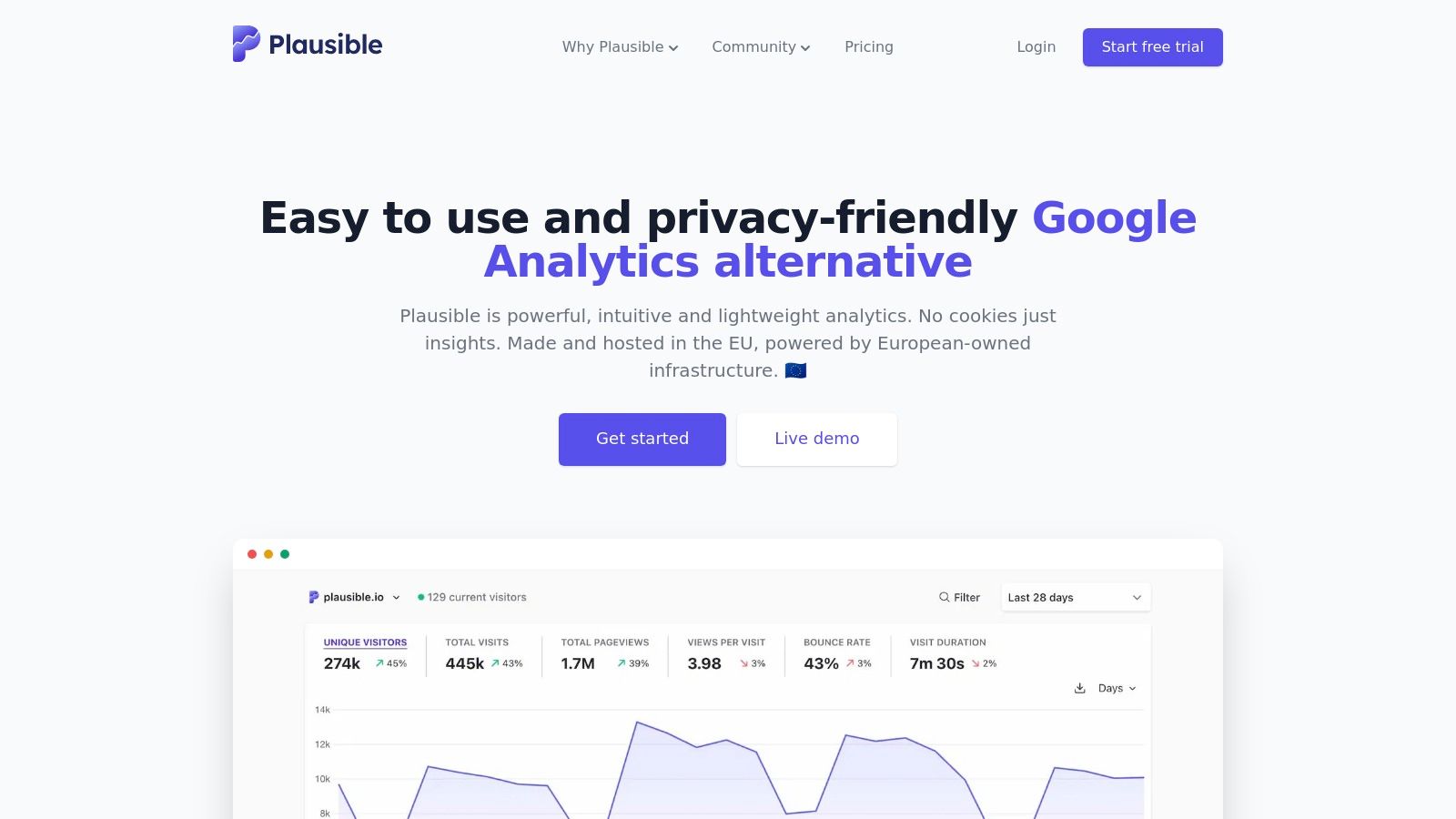
The platform’s standout feature is its single-page dashboard, which presents all key metrics in one clean, intuitive view. This makes it exceptionally easy for startup founders, marketers, and indie makers to understand website performance at a glance without navigating complex menus. You can learn more about how a well-designed web analytics dashboard can streamline your workflow.
Key Features and Implementation
Plausible’s implementation involves adding a tiny (<1 KB) script to your site, which has a negligible impact on page load times. Its cookieless tracking is a major advantage for privacy-conscious brands.
- Custom Events & Goals: Track conversions like button clicks, form submissions, and downloads without writing complex code.
- UTM Campaign Tracking: Easily monitor the performance of your marketing campaigns directly within the dashboard.
- Self-Hosting Option: For ultimate control, developers can self-host Plausible on their own infrastructure, a key differentiator from many hosted-only competitors.
Pricing and Ideal Use Case
Plausible offers transparent, usage-based pricing starting at $9/month for up to 10,000 monthly pageviews on their hosted plan. It's an excellent choice for businesses that prioritize user privacy and need straightforward, actionable data without the complexity of Google Analytics. Its simplicity, however, means it lacks the deep, ad-hoc data exploration capabilities of more robust platforms.
3. Fathom Analytics
Fathom Analytics positions itself as a simple, privacy-first alternative to Google Analytics, built for entrepreneurs, creators, and agencies who value data privacy and a streamlined user experience. It operates entirely without cookies and is fully compliant with GDPR, CCPA, and PECR out of the box, often eliminating the need for annoying cookie consent banners. This focus on privacy is central to its brand, ensuring visitor data is never sold or used for advertising.
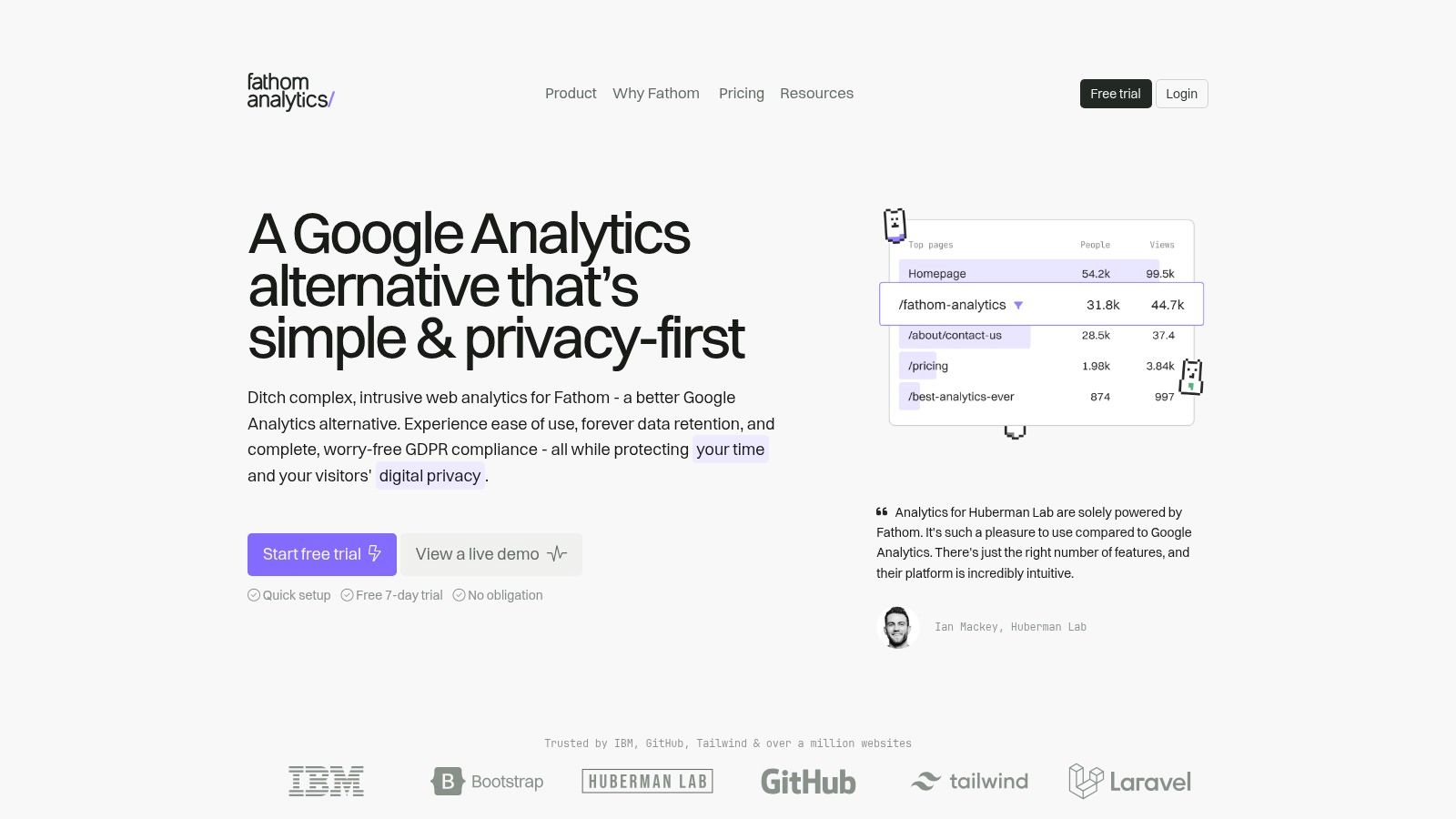
The platform is known for its incredibly clean, single-page dashboard that presents all vital metrics clearly and concisely. Fathom's design philosophy prioritizes essential data over exhaustive reports, making it easy for users to get actionable insights without being overwhelmed by complexity. This makes it an ideal choice for those who find GA’s interface cumbersome.
Key Features and Implementation
Getting started with Fathom is straightforward, requiring only the addition of a lightweight tracking script to your website. Because it’s cookieless, the setup is often simpler from a legal and user-experience perspective. It seamlessly integrates with major CMS platforms and frameworks.
- Generous Site Limits: Most plans include tracking for up to 50 different websites, making it highly cost-effective for agencies and portfolio creators.
- Event and Ecommerce Tracking: Monitor key conversions such as sales, sign-ups, and downloads with simple event tracking and an available API.
- Data Ownership & Retention: Fathom ensures you own your data, with paid plans offering forever data retention.
Pricing and Ideal Use Case
Fathom Analytics offers pricing based on monthly pageviews, starting at $14/month for up to 100,000 pageviews, with an annual discount available. While there is no free-forever plan, the generous site limit offers significant value. It’s a perfect fit for freelancers, agencies, and businesses that need reliable, privacy-compliant analytics for multiple properties without the steep learning curve of more complex tools. However, it lacks the deep product analytics capabilities found in platforms like Mixpanel.
4. Matomo
Matomo stands as one of the most powerful and comprehensive open-source alternatives to Google Analytics, offering a feature set that closely rivals GA itself. It provides two primary deployment options: a cloud-hosted SaaS version and a free, self-hosted on-premise solution. This flexibility allows organizations to maintain complete ownership and control over their data, ensuring 100% data privacy and compliance with strict regulations like GDPR.
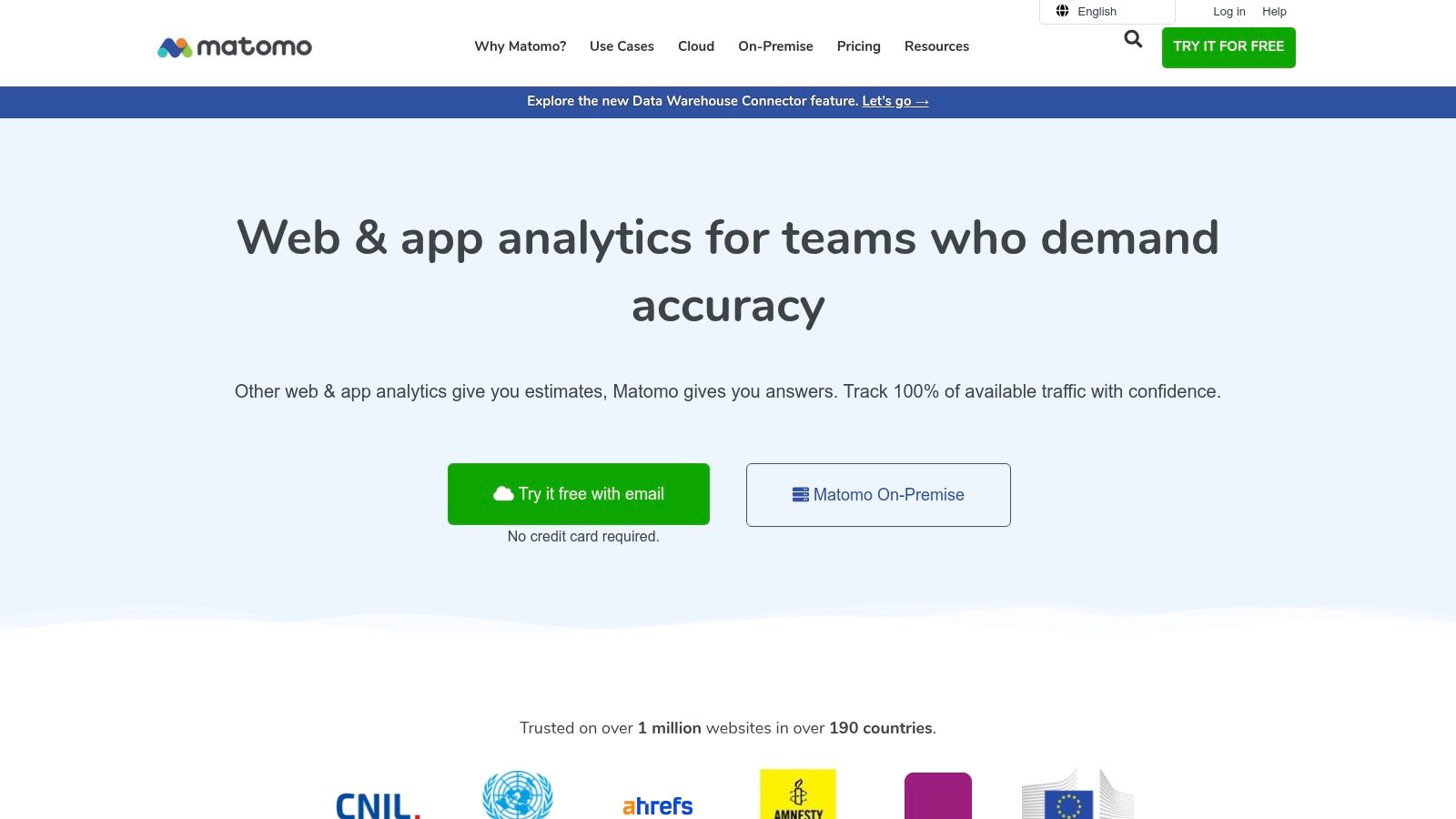
The platform is designed for users who need deep analytical capabilities without sacrificing data sovereignty. Matomo delivers unsampled data, customizable reports, and advanced features like funnels, heatmaps, and session recordings. Its built-in tag manager and consent management tools further streamline the process of achieving compliance while gathering crucial user insights.
Key Features and Implementation
Matomo can be added to your site via a standard tracking code, with options for both cloud and on-premise setups. The self-hosted version offers unlimited potential but requires technical resources for setup and maintenance. You can learn more about the benefits and considerations of self-hosted web analytics to see if it's right for you.
- Google Analytics Data Importer: A key feature that allows for a seamless migration by importing historical data directly from your GA account.
- Comprehensive Feature Suite: Offers funnels, cohorts, heatmaps, A/B testing, and session recordings, making it a true GA replacement.
- No Data Sampling: Provides 100% accurate reporting by processing all of your raw data, regardless of traffic volume.
Pricing and Ideal Use Case
The self-hosted version of Matomo is free, with costs limited to your own server infrastructure and any premium add-on features. The cloud-hosted plan starts at €19/month (approx. $20 USD) for up to 50,000 monthly hits. Matomo is ideal for large organizations, government agencies, and businesses in regulated industries that require full data ownership and a feature-rich analytics platform. Its complexity and resource requirements make it less suitable for users seeking a simple, lightweight solution.
5. Piwik PRO
Piwik PRO positions itself as an enterprise-grade analytics suite built for organizations with stringent privacy and security requirements. It offers a comprehensive platform that combines analytics with a Tag Manager, Consent Manager, and a Customer Data Platform, making it one of the more robust alternatives to Google Analytics for regulated industries like healthcare, finance, and government. Its core strength lies in providing a complete, privacy-compliant data stack.
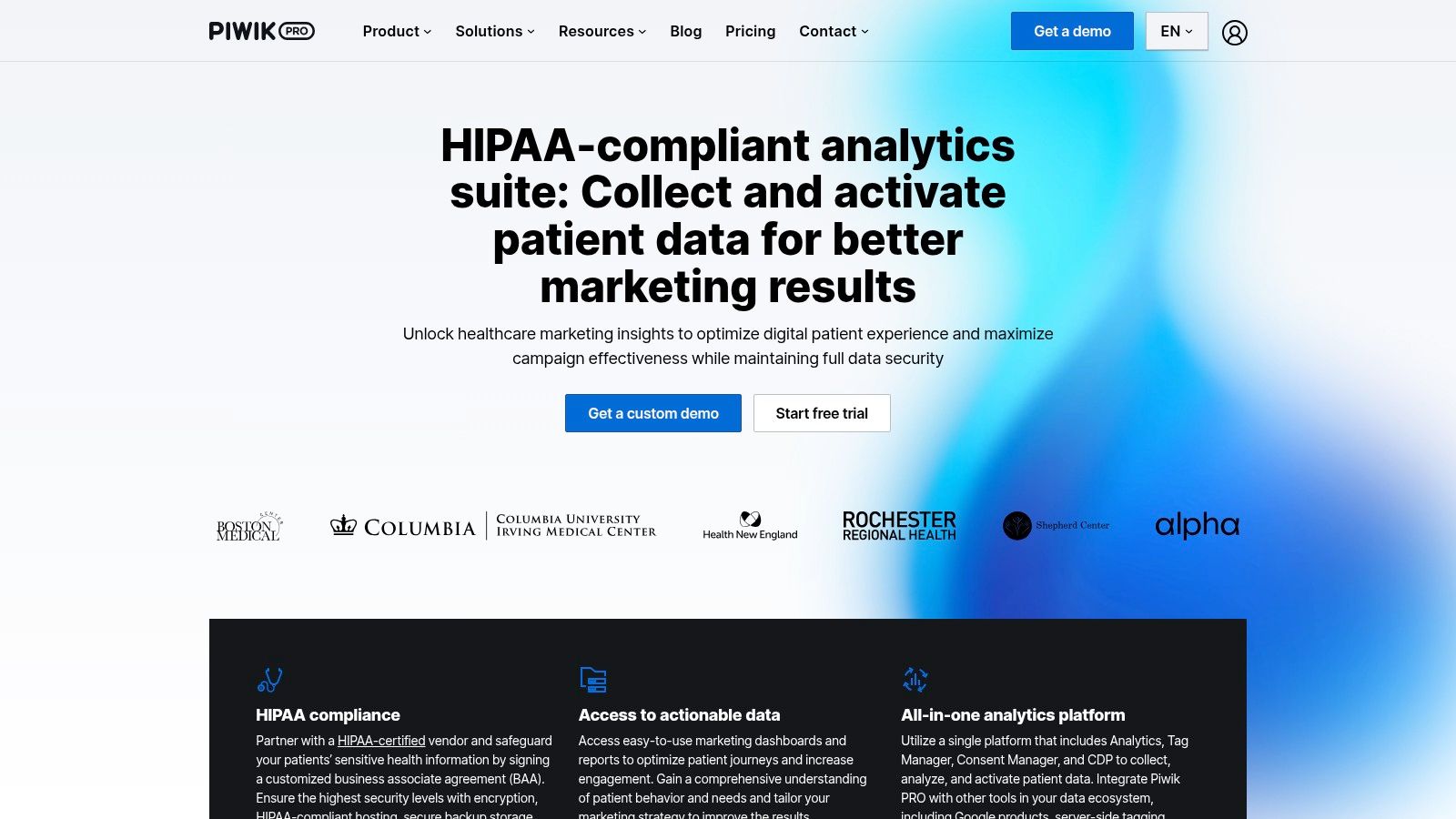
The platform is designed for deep data analysis while ensuring full compliance with GDPR, HIPAA, and CCPA. Unlike many leaner tools, Piwik PRO offers granular control over data residency, with hosting options in the EU and private cloud deployments for maximum data sovereignty and security.
Key Features and Implementation
Implementation involves a more integrated setup than simple analytics scripts, often utilizing its built-in Tag Manager and Consent Management Platform (CMP). This all-in-one approach simplifies the compliance and data collection workflow for larger organizations.
- Integrated Privacy Suite: Combines analytics with a fully-featured Consent Manager and Tag Manager for seamless GDPR and CCPA compliance.
- Flexible Hosting: Offers EU-based cloud hosting or private cloud options to meet specific data residency and security needs.
- Enterprise-Ready Features: Provides unsampled data, long data retention periods, and dedicated onboarding and support services for a smooth transition.
- Data Activation: Allows users to activate collected data for remarketing or personalization efforts while respecting user consent.
Pricing and Ideal Use Case
Piwik PRO offers a free Core plan with a 500k monthly action limit and 14 months of data retention. The paid Enterprise plan is custom-priced and unlocks the full suite of features, including the Customer Data Platform and advanced support. It's an ideal solution for medium-to-large enterprises, especially those in highly regulated sectors that need a powerful, compliant, and fully integrated analytics platform with extensive support and hosting flexibility. The comprehensive feature set may be overly complex for smaller businesses or startups.
6. Simple Analytics
Simple Analytics is a clean, straightforward, and privacy-first web analytics tool that lives up to its name. It focuses on providing essential insights without complexity, making it a strong contender among alternatives to Google Analytics for those who value simplicity and GDPR compliance. A core tenet is its commitment to privacy; it uses no cookies and stores all data exclusively within the EU (specifically, the Netherlands), ensuring compliance by default.
 for up to 100,000 pageviews, with long data retention on all paid plans. It's an ideal choice for SMBs, indie makers, and public institutions that need reliable, privacy-respecting metrics without the overwhelming features of larger platforms. While it excels at core web analytics, teams needing deep product analytics might find it lacks the advanced segmentation found in tools like Mixpanel or PostHog.
7. Umami (Umami Cloud)
Umami has gained significant popularity as a simple, fast, and privacy-respecting open-source alternative to Google Analytics. It provides a clean and straightforward way to collect essential web traffic data without compromising user privacy. For teams who appreciate open-source transparency but prefer a managed solution, the official Umami Cloud offers a hassle-free, scalable SaaS option.
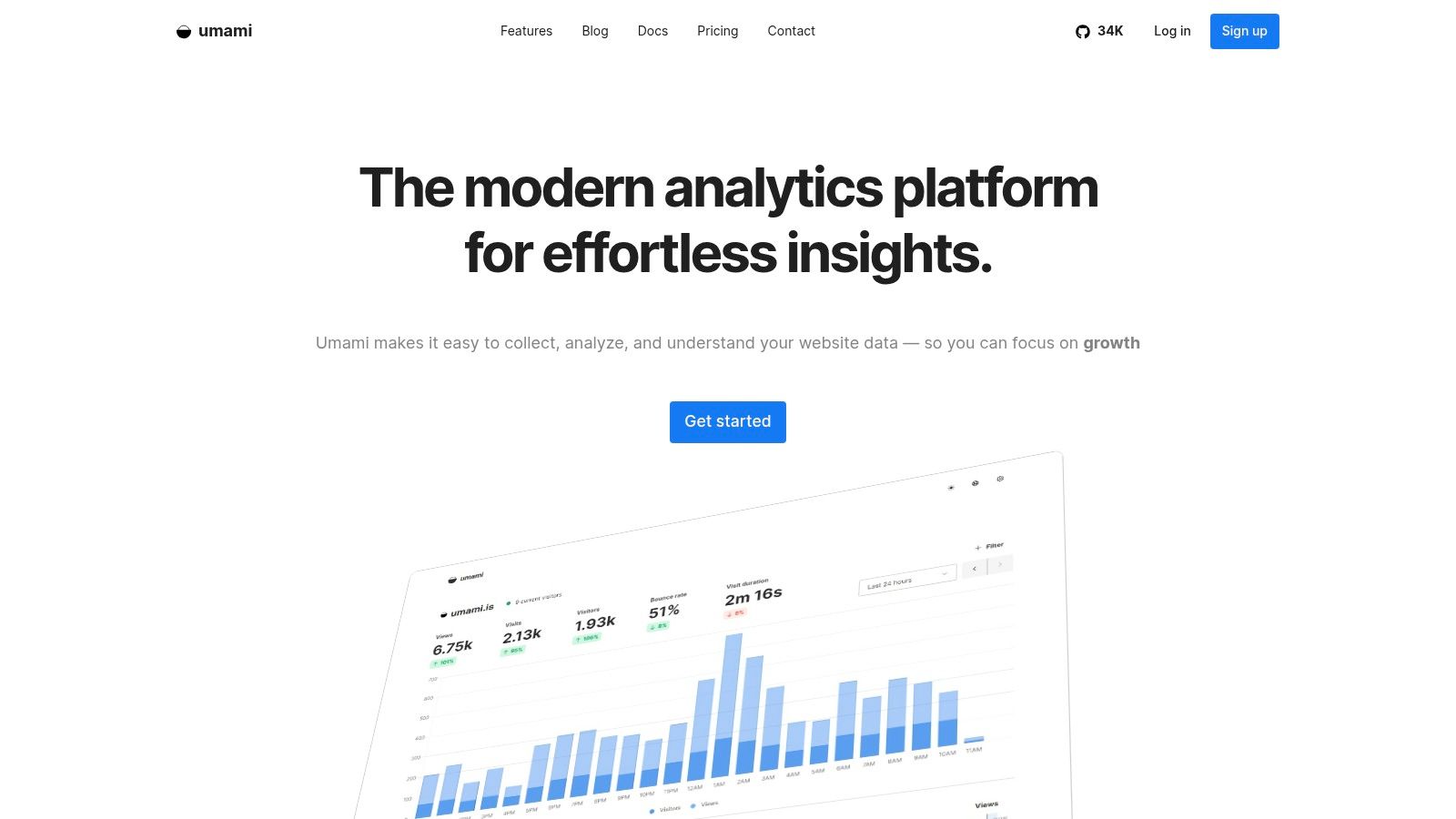
The platform is built for developers and privacy-conscious businesses, focusing on providing just the metrics you need in a single-page dashboard. This approach avoids the overwhelming complexity of Google Analytics and ensures you can quickly understand your website’s performance. Its core philosophy is to give you ownership of your analytics data, whether you choose to self-host or use their cloud service.
Key Features and Implementation
Umami is easy to implement with a single, lightweight tracking script that won't slow down your website. Its cookieless tracking model ensures automatic compliance with privacy regulations like GDPR and CCPA, a major draw for modern websites.
- Official Managed Cloud: The Umami Cloud plan handles all infrastructure, updates, and scalability, offering a convenient, hands-off experience.
- Self-Hosting Flexibility: Developers can self-host Umami on their own servers for complete control, data ownership, and cost management.
- Easy Migration: The open-source nature allows for seamless migration between a self-hosted instance and the managed Umami Cloud, providing long-term portability.
Pricing and Ideal Use Case
Umami Cloud offers usage-based pricing, starting at $9/month for up to 100,000 monthly events. The self-hosted version is free, requiring only your own infrastructure costs. Umami is ideal for developers, startups, and agencies that value data ownership and want a clear, no-frills analytics tool. While it lacks the deep marketing attribution features of enterprise platforms, its strength lies in its simplicity, performance, and flexibility. You can learn more at umami.is.
8. Pirsch Analytics
Pirsch Analytics is a privacy-first, cookieless web analytics platform designed with simplicity and powerful features for small to medium-sized businesses. Made and hosted in Germany, it offers a compelling blend of essential metrics, GDPR compliance, and developer-friendly tools. The core philosophy is to provide actionable insights without compromising user privacy, making it a strong contender among modern alternatives to Google Analytics.
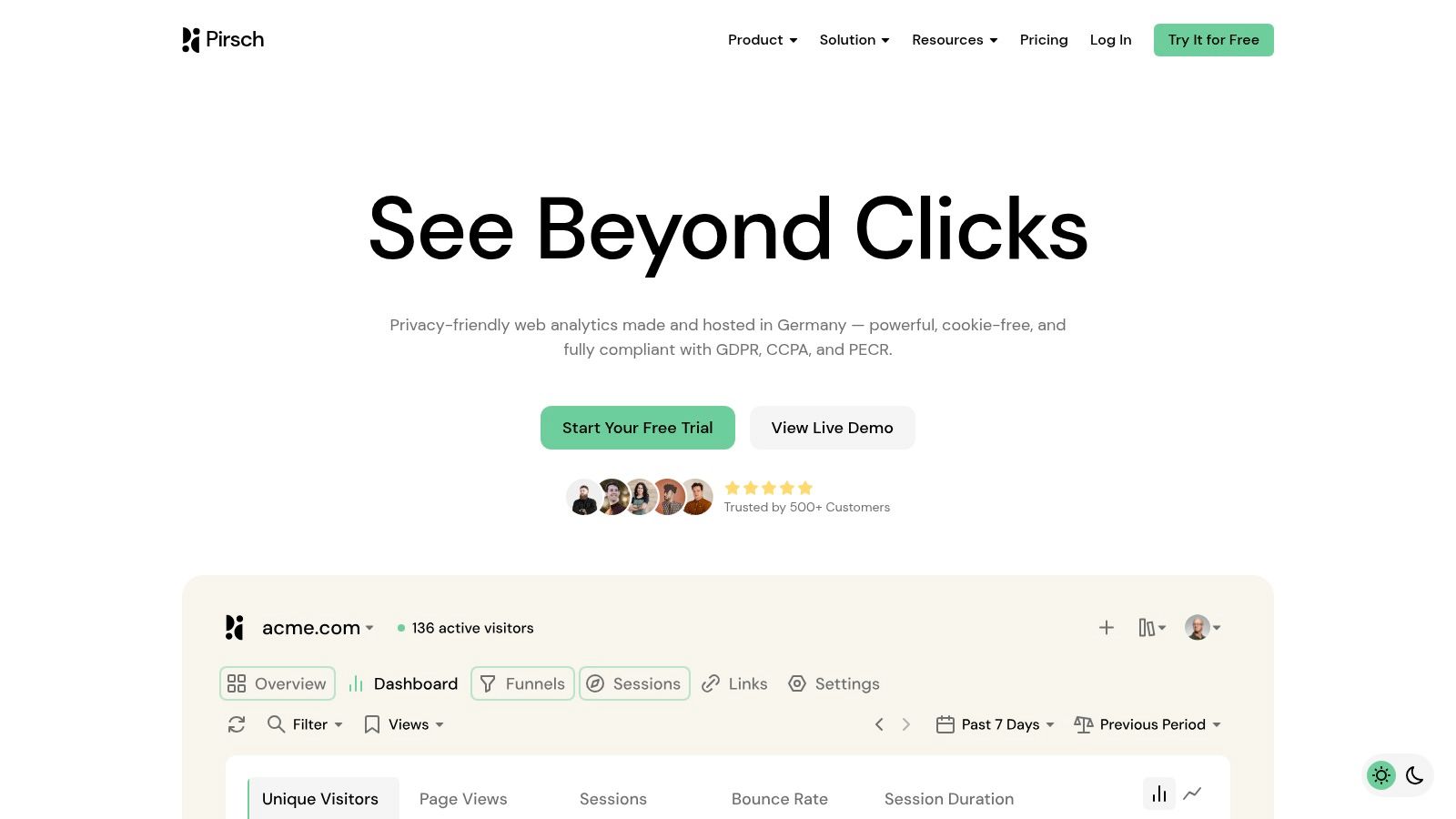
The platform is recognized for its clean user interface and its very lightweight script (<1 KB), which ensures minimal impact on website performance. Pirsch stands out by offering features often reserved for higher-priced tiers, such as unlimited data retention and API access, even on its most affordable plans.
Key Features and Implementation
Getting started with Pirsch involves adding a simple script tag to your website's header, with integrations available for popular frameworks and CMS platforms. Its cookieless tracking model ensures immediate compliance with privacy regulations without needing annoying cookie banners.
- Event Tracking & Conversions: Easily set up and track custom events and conversion goals to measure user actions that matter to your business.
- Developer-Friendly: Provides a full-featured REST API, SDKs, and even a Google Analytics importer to help with migration.
- White-Labeling & Multi-Site: Agencies and freelancers can use their own branding and manage multiple client websites from a single account. A built-in URL shortener is also included.
Pricing and Ideal Use Case
Pirsch offers a very competitive pricing structure starting at just $5/month for up to 10,000 monthly pageviews, making it highly accessible for startups and personal projects. Its straightforward upgrade path and generous feature set provide excellent value. It is an ideal solution for agencies, SaaS companies, and developers who need a privacy-respecting, scalable, and cost-effective analytics tool without the enterprise-level complexity of platforms like Matomo.
9. PostHog
PostHog positions itself as an all-in-one, open-core product analytics platform designed for engineers and product teams. It goes far beyond traditional web analytics by bundling event analytics, session replay, feature flags, A/B testing, and user surveys into a single, integrated toolkit. This comprehensive approach allows teams to replace multiple separate vendors, creating a unified view of the entire user journey from acquisition to feature adoption.
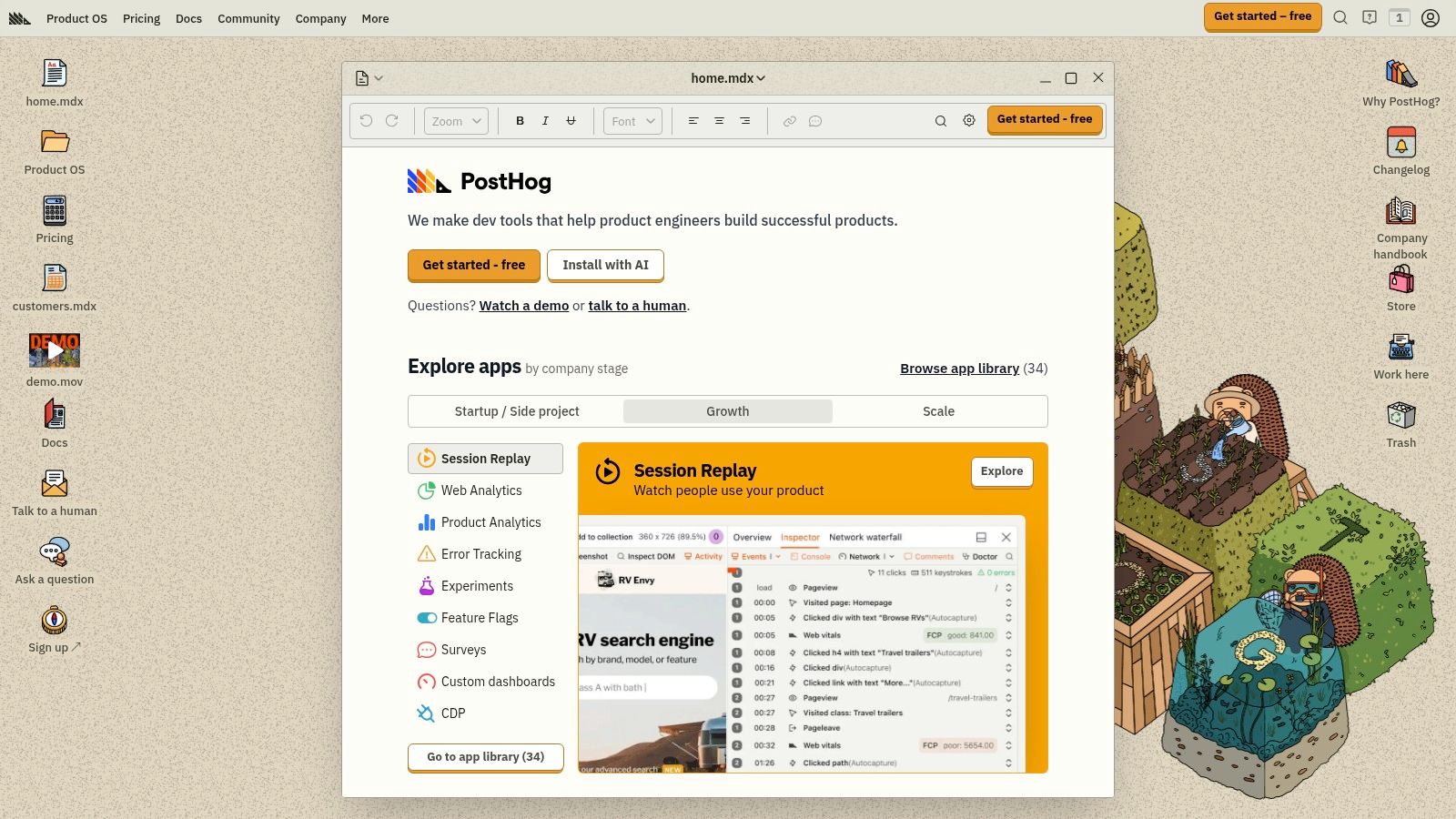
The platform is built to provide deep product insights, enabling teams to not only see what users are doing but also to understand why. With features like session replay, you can watch user sessions to identify friction points, while feature flags allow you to safely roll out new features and measure their impact directly. This makes it one of the more powerful alternatives to Google Analytics for product-led companies.
Key Features and Implementation
PostHog can be implemented via its hosted cloud service or self-hosted for maximum data control. The platform uses a single snippet or SDK to capture a wide range of data automatically, which can then be used across its entire suite of tools.
- Product Analytics Suite: Includes funnels, trends, retention analysis, and user paths to deeply understand user behavior.
- Session Replay & Heatmaps: Visually diagnose UI issues and understand user interactions without guessing.
- Feature Flags & A/B Testing: Safely deploy new features to specific user segments and run experiments to validate product changes.
Pricing and Ideal Use Case
PostHog offers a generous free tier that includes up to 1 million events, 15,000 session replays, and 1 million feature flag requests per month. Paid plans operate on a transparent, usage-based model with calculators available at posthog.com. It’s ideal for product teams and engineers who need an integrated solution for analytics and experimentation. While its breadth can be complex for simple websites, it provides immense value for companies aiming to build better products through data.
10. Mixpanel
Mixpanel is a powerful, event-based product analytics platform designed to help companies understand user behavior in complex digital products like SaaS applications and mobile apps. Rather than focusing on pageviews, it tracks the specific actions users take over time, making it one of the more advanced alternatives to Google Analytics for product-led growth. It excels at answering questions about user engagement, feature adoption, and long-term retention.
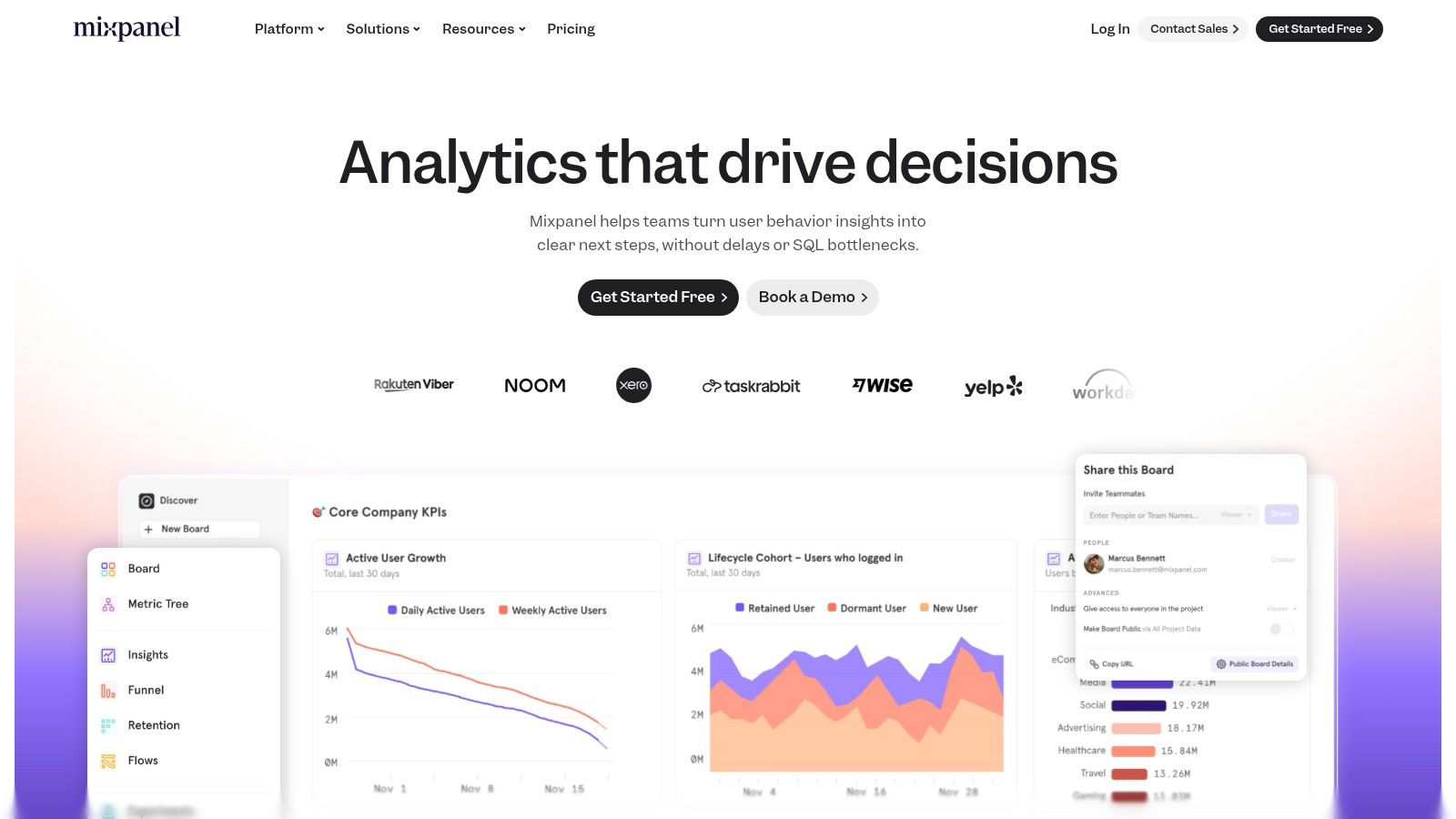
The platform’s strength lies in its sophisticated reporting tools for funnels, user flows, and cohort analysis. This allows product teams to pinpoint exactly where users drop off, identify the behaviors of their most valuable customers, and measure the impact of product changes on user retention. Its mature documentation and extensive library of integrations make it a reliable choice for teams that need to scale.
Key Features and Implementation
Implementation requires developers to send event data to Mixpanel via its SDKs or API. While more involved than a simple script, this approach enables highly granular and customized tracking.
- Self-Serve Analysis: Users can build detailed funnels, flow diagrams, and retention tables to explore user journeys without needing to write SQL.
- Cohort Analysis: Group users based on shared characteristics or actions to understand how different segments behave over their lifecycle.
- Scalability: The platform is built to handle extremely high event volumes, making it suitable for products with millions of users.
Pricing and Ideal Use Case
Mixpanel offers a generous free plan that includes up to 20 million events per month, making it accessible for early-stage startups. Paid plans offer more advanced features and scale with event volume. It is the ideal solution for product managers, data analysts, and growth teams in SaaS and mobile app companies who need deep, user-centric insights that go far beyond traditional web analytics. However, its per-event pricing can become costly at scale, and it's not a direct, privacy-first replacement for simple website traffic analysis.
11. Amplitude
Amplitude positions itself less as a direct website analytics tool and more as a comprehensive digital analytics platform built for product-led growth. It’s designed for product and growth teams who need to understand the entire user journey, from acquisition to retention, by analyzing user behavior across web and mobile applications. It moves beyond simple pageviews to focus on event-based tracking that reveals how users interact with product features.
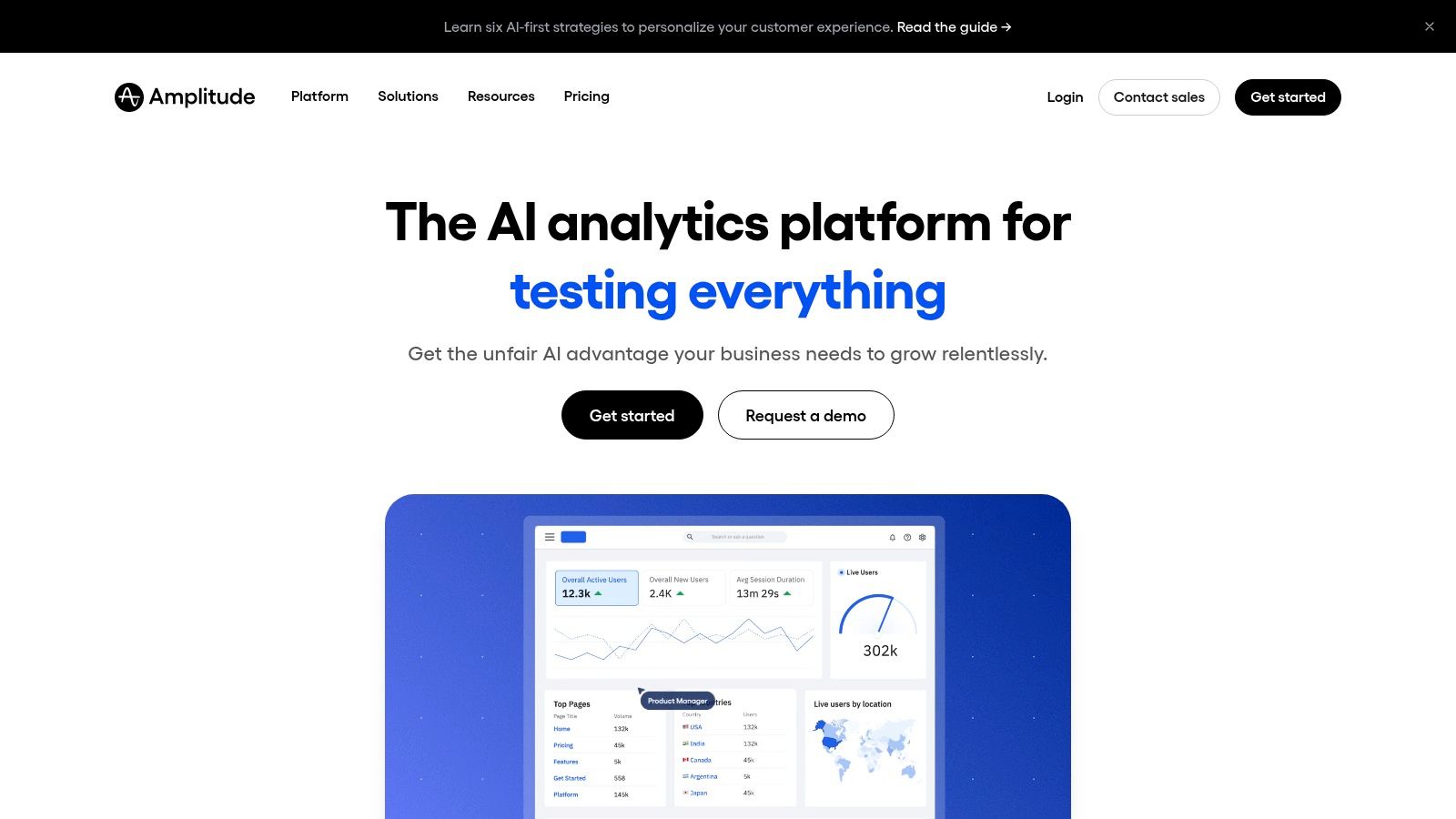
The platform's strength lies in its integrated suite of tools that combine analytics with action. Unlike traditional web analytics, Amplitude bundles product analytics with session replay, feature flagging, and A/B testing capabilities. This allows teams not only to analyze user behavior but also to experiment with new features and personalize user experiences within the same ecosystem, making it a powerful alternative to Google Analytics for product-centric organizations.
Key Features and Implementation
Implementation involves integrating Amplitude’s SDKs (available for web, iOS, and Android) and defining a tracking plan for key user events. Its power is unlocked through deep, event-based data.
- Integrated Product Suite: Combines analytics, session replay, experimentation, and feature flags in one platform.
- Deep User Analysis: Create complex cohorts, behavioral funnels, and retention charts to understand user engagement.
- Extensive Integrations: Connects with dozens of sources and destinations, from data warehouses to marketing automation tools.
Pricing and Ideal Use Case
Amplitude offers a generous free tier that includes up to 10 million events per month, making it accessible for startups to begin tracking user behavior. The paid "Plus" plan provides unlimited analytics features and a clearer pricing model, though enterprise contracts can become expensive at scale. It is the ideal choice for product teams at SaaS companies and mobile apps that need to deeply understand user engagement, run experiments, and drive product adoption. Its focus is less on traditional web traffic metrics and more on product interaction analysis.
12. G2 (Google Analytics Alternatives & Competitors category)
While not an analytics tool itself, G2’s dedicated category for Google Analytics alternatives serves as a vital research hub and marketplace. It aggregates dozens of platforms, providing a comprehensive, vendor-agnostic overview that is invaluable during the initial discovery and shortlisting phase. It allows teams to compare tools based on validated user reviews, feature sets, and market presence, cutting through marketing jargon to reveal real-world user satisfaction.
The platform excels at providing social proof and direct user feedback, which can be critical for securing buy-in from stakeholders. Instead of relying solely on vendor claims, you can see how peers in similar industries rate specific features, ease of use, and customer support. This makes it an essential first stop before diving deeper into demos and trials with specific alternatives to Google Analytics.
Key Features and Implementation
G2 centralizes the research process, allowing users to filter competitors based on specific needs like A/B testing, session replay, or compliance features.
- User Reviews & Ratings: Access authentic, in-depth reviews from verified users, offering insights into the pros and cons of each platform.
- Side-by-Side Comparisons: Directly compare up to four competitors on key attributes, including features, ratings, and pricing models.
- Category-Specific Filters: Narrow down the extensive list of alternatives to Google Analytics by company size, industry, or required functionalities like segmentation and funnel analysis.
Pricing and Ideal Use Case
Access to G2 is free for buyers. Its value lies in streamlining the procurement process for marketing and product teams tasked with finding and vetting new software. It’s an ideal resource for anyone building a business case for a new analytics tool. However, remember that top placements can sometimes be influenced by vendor ad spend, and all pricing and technical details should be verified on the official vendor websites.
Top 12 Google Analytics Alternatives — Feature Comparison
| Product | Core features | UX & quality (★) | Price & value (💰) | Target audience (👥) | ✨ Unique selling points |
|---|---|---|---|---|---|
| 🏆 Swetrix | Real-time dashboards, RUM, session analysis, funnels, feature flags, Stripe/Paddle revenue | ★★★★☆ · intuitive, privacy-first | 💰 Usage-based cloud; 14‑day trial; self-host Community (free) | 👥 Startups, PMs, growth teams, developers, agencies | ✨ Cookieless & anonymous-only, open-source self-host, experiments & alerts |
| Plausible | Lightweight dashboards, events, UTM reporting, API | ★★★★☆ · very simple & readable | 💰 Usage-based hosted; self-host free | 👥 Small startups, blogs, SMBs | ✨ Extremely lightweight, easy setup, transparent billing |
| Fathom | Cookieless tracking, e‑commerce events, API, CMS integrations | ★★★★ · minimal & compliant | 💰 Flat tiers; annual discounts | 👥 Agencies, creators, SMBs | ✨ Minimal UI, many sites per plan, privacy-focused |
| Matomo | Full analytics: funnels, cohorts, consent tools, GA importer | ★★★★ · feature-rich, heavier to run | 💰 Cloud plans + free self-host (complex pricing) | 👥 Enterprises, regulated orgs, teams needing data ownership | ✨ On-premise control, no sampling, GA migration tools |
| Piwik PRO | Analytics + Tag Manager + Consent Management, EU hosting | ★★★★ · enterprise-grade support | 💰 Enterprise pricing (private cloud options) | 👥 Regulated sectors (health, finance, public) | ✨ Compliance-first suite with onboarding & private cloud |
| Simple Analytics | Events, goals, trendlines, EU data residency, exports | ★★★★ · clean & approachable | 💰 Simple tiered pricing | 👥 Indie makers, SMBs, public institutions | ✨ Public dashboards, ad-block bypass, long retention |
| Umami (Umami Cloud) | Cookieless OSS analytics, managed cloud + self-host | ★★★★ · developer-friendly | 💰 Self-host free; cloud usage-based | 👥 Developers & teams wanting OSS transparency | ✨ Official managed cloud + easy portability to self-host |
| Pirsch | Events, funnels, session analysis, white-label, API | ★★★★ · value-focused | 💰 Low starting price; generous features | 👥 Small–medium sites, agencies | ✨ White-label, unlimited retention, built-in URL shortener |
| PostHog | Event analytics, session replay, feature flags, experiments | ★★★★★ · broad product toolkit | 💰 Generous free tier; usage-based scaling | 👥 Product teams, startups → scaleups | ✨ Replace multiple vendors; extensible add-ons (AI/LLM) |
| Mixpanel | Funnels, retention, cohorts, insights, session replay | ★★★★★ · robust querying & scale | 💰 Free tier; per-event pricing beyond limits | 👥 SaaS & mobile product teams | ✨ Mature analytics, templates, integrations, high-scale |
| Amplitude | Product analytics, experiments, session replay, flags | ★★★★★ · enterprise-grade analysis | 💰 Free tier limits; Plus for enterprise features | 👥 Product-led companies, growth teams | ✨ End-to-end experimentation + analytics at scale |
| G2 | Vendor reviews, side-by-side comparisons, category filters | ★★★★ · crowdsourced feedback | 💰 Free to browse; vendor-promoted listings | 👥 Buyers, procurement, stakeholder shortlisting | ✨ Broad vendor-agnostic reviews & procurement insights |
Choosing Your Next Analytics Partner
Navigating the landscape of alternatives to Google Analytics can feel overwhelming, but it's a journey that leads to greater data control, enhanced user privacy, and more focused insights. Throughout this guide, we've explored a diverse range of tools, from the privacy-centric simplicity of Plausible and Fathom to the enterprise-grade power of Piwik PRO and the product-focused depth of PostHog and Mixpanel. The key takeaway is that a one-size-fits-all solution no longer dominates the analytics space.
Your "best" choice is entirely dependent on your unique context. The decision to switch is not just about replacing a tool; it's about fundamentally rethinking your approach to data. You're moving from a default option to a deliberate, strategic choice that aligns with your company's values and operational needs.
Recapping Your Options: The Core Decision Points
As you finalize your decision, reflect on the primary drivers behind your search for a Google Analytics alternative. Your core motivation will guide you to the right category of tools.
- For Unwavering Privacy and Simplicity: If your main goal is GDPR compliance and a clean, lightweight dashboard that respects user privacy without compromise, your top contenders are Plausible Analytics, Fathom Analytics, and Simple Analytics. These tools excel at providing essential traffic metrics without cookies or personal data collection.
- For Full Control and Data Ownership: Developers, DevOps teams, and organizations with strict data sovereignty requirements should look toward self-hosted solutions. Matomo offers a comprehensive, open-source alternative that you can run on your own infrastructure, while Umami provides a sleek, minimalist option for those who want to own their data stack completely.
- For Deep Product and User Behavior Insights: When basic traffic metrics aren't enough, and you need to understand user journeys, conversion funnels, and feature adoption, product analytics platforms are your best bet. PostHog stands out with its all-in-one, open-source approach, combining analytics with session replay and feature flags. Mixpanel and Amplitude offer powerful, specialized tools for sophisticated cohort analysis and event-based tracking.
A Practical Framework for Making Your Final Choice
Moving from a shortlist to a final decision requires a structured evaluation. Don't just rely on feature lists; get your hands on the tools and see how they fit into your daily workflow.
- Define Your "Must-Have" Metrics: What specific data points are non-negotiable for your team? Is it bounce rate, time on page, conversion funnels, or custom event tracking? Create a checklist and measure each potential tool against it.
- Run a Pilot or Trial: Nearly every tool on this list offers a free trial or a generous free tier. Install the tracking script on a staging site or a low-traffic section of your live site. This is the only way to truly assess ease of implementation, data accuracy, and user interface intuitiveness.
- Evaluate the Total Cost of Ownership: For self-hosted options, factor in server costs, maintenance time, and security updates. For hosted solutions, carefully examine the pricing tiers and predict where your traffic levels will be in six to twelve months to avoid unexpected costs.
- Consider Your Team's Technical Skillset: How easy is it for a non-technical marketing team member to build a report? Does it require developer assistance to set up custom event tracking? The right tool empowers your entire team, not just the data experts.
Ultimately, the best alternatives to Google Analytics are the ones that provide clear, actionable data without ethical compromises or unnecessary complexity. The goal is to spend less time wrestling with a convoluted interface and more time making data-informed decisions that grow your business. By choosing a partner that aligns with your specific needs-whether it's privacy, control, or deep product insights-you are setting a new, more transparent standard for how you understand your audience.
Ready to move beyond basic web analytics and embrace a tool that combines privacy, powerful features, and flexibility? Swetrix offers a comprehensive, all-in-one platform that serves as a powerful alternative to Google Analytics, complete with web analytics, product insights, A/B testing, and feature flags. Start your free trial at Swetrix and see how actionable, privacy-first analytics can transform your business.