- Date
What Is Revenue Attribution Your Guide to Measuring Marketing ROI
 Andrii Romasiun
So, you just made a sale. Fantastic. But do you really know why it happened? Was it that blog post your team published last month? The paid ad they saw on social media yesterday? Or the email newsletter they opened this morning?
That's the million-dollar question, and revenue attribution is how you answer it. It’s the process of connecting the dots between your marketing efforts and the money hitting your bank account.
Connecting Marketing Actions to Real Revenue
Let's break it down. Think of the customer's path to purchase as a series of breadcrumbs. Revenue attribution is the practice of tracking that trail to see exactly which breadcrumbs—blog posts, ads, social media interactions, you name it—led them to the final destination: a sale.
Instead of just looking at vanity metrics like clicks or impressions, you start asking the real question: "What actually convinced someone to buy?" This gives you a clear, data-backed picture of what's working and what's just making noise. It systematically assigns credit to the marketing touchpoints that influence a customer's decision to open their wallet.
For a deeper dive into how the market is shifting, it's worth reading the latest industry reports on attribution models.
When you get this right, it completely changes the game. Suddenly, you can:
- Optimize Your Marketing Spend: Stop throwing money at campaigns that feel right and start investing in channels that prove they generate income. You can confidently cut the dead weight and double down on your winners.
- Understand the Customer Journey: You'll see the whole picture—how a customer first discovers you, what content nurtures their interest, and what finally pushes them over the edge. This insight is gold for refining your messaging.
- Prove Marketing ROI: This is the big one. You can finally walk into a meeting with hard data and show that the marketing team isn't just a cost center; it's a powerful revenue driver.
By understanding which channels contribute most effectively at different stages, you can make smarter decisions about your budget, content, and overall strategy. It’s about replacing guesswork with growth.
This isn't just a "nice-to-have" framework anymore. It's essential for any business that wants to grow efficiently. Especially as online privacy rules get stricter, having a reliable way to measure performance without creepy tracking is more critical than ever. It's the foundation for building sustainable, profitable growth.
2. A Closer Look at the Most Common Revenue Attribution Models
Think of choosing a revenue attribution model like picking the right camera lens. A wide-angle lens gives you the full picture, while a zoom lens focuses on one crucial detail. Neither is automatically "better"—it all depends on what you need to see. Different models are built to shine a light on different parts of the customer's journey, and your choice will directly shape how you measure what's working.
Let's walk through the most common options to help you figure out which one fits your business. The best model is one that aligns with your sales cycle, your core business goals, and the specific questions you're trying to answer.
This visual shows the basic idea: marketing efforts prompt customer actions, which, in turn, generate revenue.
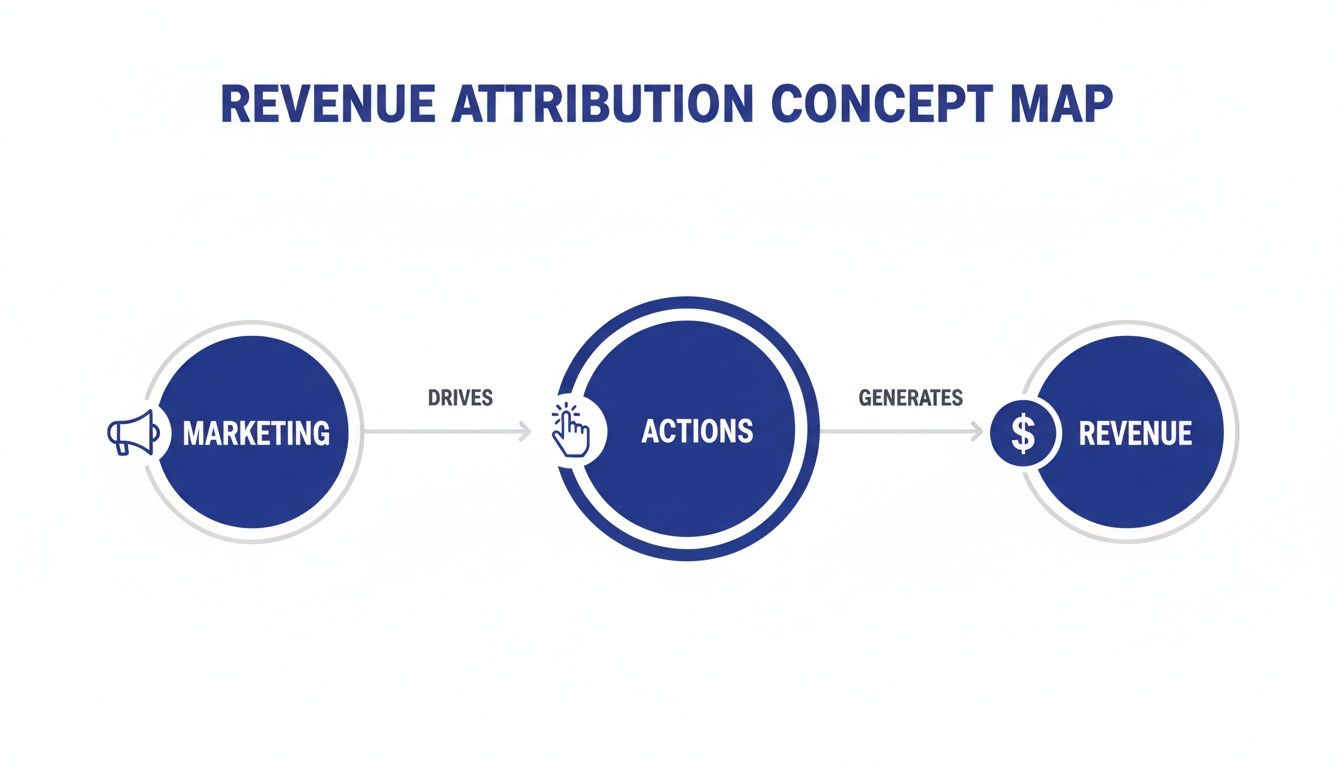
As you can see, the path from discovery to purchase is rarely a straight line. That's precisely why understanding the different ways to assign credit is so important.
The Good, the Bad, and the Single-Touch Models
Single-touch models are the simplest of the bunch. They're easy to wrap your head around because they give 100% of the revenue credit to a single interaction. While they offer a clean, straightforward answer, that simplicity is also their greatest weakness—they completely ignore every other touchpoint that nudged the customer along.
- First-Click Attribution: This one is all about "The Opener." It gives all the credit to the very first interaction a customer had with you. If their journey started with a Google Ad, that ad gets all the glory, even if they later read a blog post and clicked an email to buy. It's great for identifying which channels are best at generating brand awareness.
- Last-Click Attribution: On the flip side, this model is all about "The Closer." It gives all the credit to the final touchpoint right before the sale. If a customer converts after clicking a link in an email, that email gets all the credit. It’s useful for pinpointing what finally pushes customers over the finish line, but it overlooks everything that got them there.
Single-touch models are a decent starting point, especially if you have a short sales cycle. But they tell an incomplete story. It’s like crediting only the striker who scored the goal and ignoring the defenders and midfielders who passed them the ball.
Getting a Fuller Picture with Multi-Touch Models
For most companies today, the path to purchase is a winding road, not a direct flight. Multi-touch models embrace this reality. They work by spreading the credit across multiple touchpoints, giving you a much more balanced—and accurate—view of what’s really driving sales.
Comparing Popular Revenue Attribution Models
To make sense of the options, it helps to see them side-by-side. This table breaks down how the most common models work, what they're best for, and where they tend to fall short.
| Attribution Model | How It Distributes Credit | Best For | Biggest Drawback |
|---|---|---|---|
| First-Click | 100% credit to the first touchpoint. | Understanding top-of-funnel channels that generate awareness. | Ignores all mid- and bottom-funnel activities. |
| Last-Click | 100% credit to the last touchpoint before conversion. | Identifying channels that are strong "closers." | Overlooks everything that built initial interest and trust. |
| Linear | Credit is split equally among all touchpoints. | Getting a simple, balanced view of the entire customer journey. | Treats a quick glance at a social post the same as a deep-dive webinar. |
| Time-Decay | More credit goes to touchpoints closer to the sale. | Businesses with long sales cycles where late-stage nurturing is key. | Can undervalue critical, early-stage awareness efforts. |
| U-Shaped | Gives 40% to the first touch, 40% to lead conversion, and 20% to the middle touches. | Teams focused on lead generation and understanding what brings people in and what converts them. | Focuses heavily on just two major milestones, potentially undervaluing middle-funnel engagement. |
Ultimately, the goal is to choose a model that gives you actionable insights. A simple model that you can act on is far more valuable than a complex one that just creates confusion.
Linear Model
The Linear model is the most democratic of the multi-touch approaches. If a customer read a blog post, saw a social ad, and then clicked an email before buying, each of those three touchpoints gets an equal 33.3% of the credit. It’s fair, simple to explain, and ensures no interaction is left out, providing a solid baseline view of the entire journey.
Time-Decay Model
This model works on a pretty intuitive principle: the closer an interaction is to the sale, the more influential it probably was. It gives more credit to recent touchpoints and progressively less to earlier ones. This approach is particularly useful for companies with longer consideration periods, where the final nurturing and closing activities are crucial for sealing the deal.
U-Shaped Model
The U-Shaped model (also known as the Position-Based model) champions the two most important bookends of the journey: the first touch that brought someone in ("The Opener") and the touch that converted them into a lead ("The Turning Point"). It typically assigns 40% of the credit to each of these key events, then distributes the remaining 20% across all the interactions that happened in between. This is a fantastic fit for businesses that place a high value on both generating initial awareness and converting that interest into a qualified lead.
Why Revenue Attribution Is a Game Changer for Your Business
Knowing the different models is one thing. Actually connecting attribution to business growth? That's where the real power is. Revenue attribution isn't just another report to file away; it's a strategic tool that replaces guesswork with confident, data-backed decisions.
With it, you finally get undeniable proof of marketing's impact on the bottom line. This simple shift turns the marketing department from a perceived "cost center" into a well-documented revenue driver. Suddenly, you can justify your budget not with vanity metrics, but with hard data showing exactly how marketing investments become sales. You're no longer flying blind—you have a map showing which paths lead straight to profit.
Optimize Your Spend and Maximize ROI
One of the most immediate wins from getting attribution right is the ability to fine-tune your marketing budget with near-surgical precision. You can finally stop spreading resources thinly across every channel and just hoping for the best. Instead, you can see which specific strategies are actually delivering a return.
This clarity empowers you to make decisive moves. You can confidently pull funds from an underperforming social channel that gets a lot of clicks but no actual customers and pour that money into a content funnel that's proven to convert. A single, informed decision like that can dramatically boost your overall marketing ROI.
By tying every touchpoint back to revenue, you can focus on the activities that genuinely move the needle. You might find out that while one flashy ad campaign gets thousands of impressions, it’s a simple email sequence to warm leads that quietly drives your most valuable sales.
This level of insight ensures every single dollar is working as hard as it possibly can.
Deeper Insights and a Stronger Customer Journey
Beyond just optimizing your budget, revenue attribution gives you a detailed map of the entire customer journey. It shows you every interaction, every click, every touchpoint, letting you pinpoint what's truly effective.
This granular view helps you answer the critical questions that unlock growth:
- Which content actually works? Finally understand which blog posts or case studies are most influential in a buyer's final decision.
- What does the ideal journey look like? Trace the common paths your highest-value customers take from discovery to purchase.
- Where are the friction points? See exactly where potential customers are dropping off, so you can fix the leaks in your funnel.
The demand for this kind of clarity is driving massive industry investment. The global marketing attribution software market was valued at USD 4.74 billion in 2024 and is projected to more than double to USD 10.10 billion by 2030, as more and more businesses move beyond simplistic models. You can discover more about the trends in the attribution software market to see how this shift is playing out on a global scale.
Ultimately, attribution gives you a blueprint for success. It helps you refine your messaging and create a smoother path that guides more customers toward a purchase. For a closer look at this, check out our guide on how to measure marketing campaign effectiveness.
Navigating the Challenges of Modern Attribution
Putting a revenue attribution strategy in place is a massive win, but it’s rarely as simple as flipping a switch. The road to clear, actionable insights is almost always paved with a few predictable bumps. The key is to anticipate these hurdles so you can build a resilient system from the ground up.
Instead of getting caught off guard, you can design your processes to handle them from day one. Let’s walk through the most common obstacles you're likely to face.
Overcoming Disconnected Data Silos
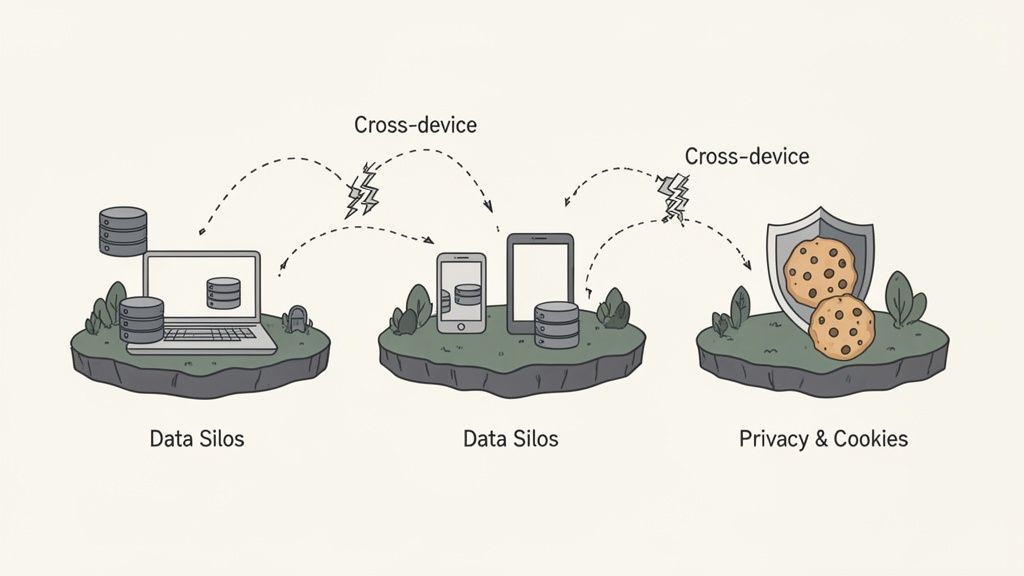
One of the biggest roadblocks to getting attribution right is fragmented data. Think about it: your customer information is probably scattered across a dozen different platforms—your CRM, your email tool, Google Ads, and social media ad managers. When these systems don't talk to each other, you’re left with a disjointed and incomplete picture.
It’s like trying to assemble a puzzle when all the pieces are stored in separate boxes. You can never see the whole picture. The fix is to establish a single source of truth where all this data can come together. This breaks down the silos and gives you a holistic view of every single touchpoint.
The Cross-Device Customer Journey
The modern customer journey is anything but linear. A potential buyer might see your ad on their phone during their commute, do some research on their work laptop, and finally pull the trigger on their tablet at home. If you can't connect these interactions, you're missing huge parts of the story.
This cross-device puzzle can throw off even the most sophisticated attribution models. Stitching together a user's activity across their different devices is a huge technical challenge, one that's only getting harder as privacy regulations get tighter.
The modern customer path is fragmented by design. Without a way to connect the dots across devices, you might mistake one long, considered journey for three separate, low-intent visits, completely misinterpreting user behavior.
The New Era of Privacy and Cookieless Tracking
Perhaps the biggest challenge of all is the massive shift in the privacy landscape. The phase-out of third-party cookies and the rise of regulations like GDPR are fundamentally rewriting the rules of tracking. The old ways of following users around the web are on their way out. Fast.
This means businesses have to find new, privacy-first ways to understand their customers. It’s a mandatory shift toward solutions that rely on:
- First-party data that you collect directly from your audience with their consent.
- Cookieless tracking methods that respect user privacy from the start.
- Data modeling to intelligently fill in the gaps where direct tracking is no longer possible.
Getting a handle on this new environment isn't optional—it’s essential for building a sustainable, future-proof approach to attribution. It forces us to be more transparent and ethical, pushing everyone toward smarter, more respectful analytics.
How to Put Revenue Attribution Into Practice (Without Creeping on Your Customers)
So, how do we get from the theory of revenue attribution to actually using it? The good news is, you don't need to choose between getting powerful revenue insights and respecting user privacy. Modern, privacy-first analytics lets you have both.
The secret is to build your measurement strategy on a foundation of cookieless tracking. Instead of relying on those third-party cookies that shadow users across the internet, this approach focuses on anonymized, event-based data collected only on your site. It’s a way to understand the customer journey while keeping user trust intact.
Connect Your Revenue Directly to Marketing Events
The clearest path to understanding what works is to tie your sales data directly to user actions. Modern analytics platforms can integrate seamlessly with payment processors like Stripe and Paddle, forging an unbroken link from the first ad a customer sees to the moment they click "buy."
This kind of integration removes the guesswork. You can see with certainty which marketing channel, specific campaign, or landing page brought in a particular sale. It’s a straight line from effort to income.
For example, a tool like Swetrix gives you a clean, privacy-focused dashboard to visualize core metrics like revenue, lifetime value (LTV), and new customers.
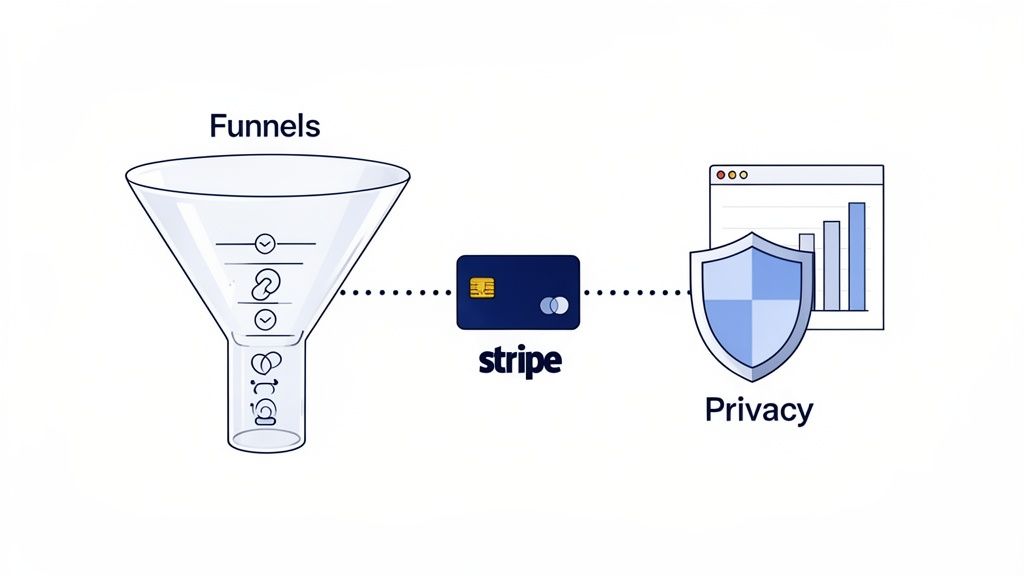
The dashboard shows you the outcome—the revenue and LTV—so you can easily work backward to see which marketing funnels and user actions are driving those critical business results. This direct connection is the bedrock of accurate revenue attribution, turning abstract numbers into tangible financial results.
Map the Customer Journey with Custom Goals and Funnels
Beyond just tracking the final sale, a smart attribution setup also means monitoring all the small, crucial steps a user takes on their way to becoming a customer. This is where custom goals and funnel analysis come in handy.
Think of these as the breadcrumbs customers leave behind. You can set up goals to track key micro-conversions that signal intent, long before a credit card ever comes out.
- Goal Tracking: Define specific actions that matter, like a newsletter signup, a whitepaper download, or the start of a free trial.
- Funnel Analysis: Create visual funnels to map out a sequence of steps, such as from a landing page -> to the pricing page -> to checkout.
This process immediately shows you where the leaks are. If you discover a 70% drop-off rate between the "add to cart" step and the final purchase, you’ve found your #1 priority for optimization. For anyone just starting out, you can dig deeper into how privacy-friendly analytics make these insights possible without compromising user data.
By combining direct revenue integration with detailed funnel analysis, you get the best of both worlds: a high-level view of what's making you money and a granular understanding of the user behaviors that drive it.
This dual approach gives you a complete, actionable picture of your marketing performance. It helps you make smarter decisions that not only grow your revenue but also build lasting trust with your audience by respecting their privacy from start to finish. That’s the real blueprint for sustainable growth.
Your Action Plan for Getting Started with Revenue Attribution
Alright, it’s time to move from theory to action. Implementing revenue attribution can feel like a massive project, but it doesn't have to be. Let's break it down into a practical roadmap you can actually follow without getting bogged down.
Define Success and Choose Your Tools
First things first: what does a "win" actually look like for you? Is it a customer hitting "buy now"? A signed contract for a new subscription? A qualified demo booked with your sales team? Get crystal clear on this, because your definition of success is the bedrock of your entire strategy.
With that defined, you can pick an attribution model that actually mirrors how your customers behave. If you sell low-cost items with a short sales cycle, a simple last-click model might be all you need. But for anything more complex, you'll want to explore a multi-touch model to see the whole journey. From there, you'll need a privacy-first analytics tool that plays nice with your payment processors and marketing platforms.
The secret to getting this right is to start small. Don't try to boil the ocean. Pick one or two of your most important marketing channels and focus on mastering the tracking process there. Once you have that down, you can expand.
Finally, make looking at your data a regular, scheduled habit. The whole point of this is to gain insights that help you make better decisions. Consistently tracking your campaigns is a huge part of this—for a deep dive, check out our guide on using UTM parameters. This cycle of tracking, analyzing, and tweaking is what really fuels smarter, data-driven growth.
Common Questions About Revenue Attribution
As you start digging into revenue attribution, questions are going to pop up. It's a complex field, after all. Here are some straightforward answers to the questions we hear most often from teams just getting their feet wet.
Which Attribution Model Is Best for B2B Companies?
Let's be honest: the B2B customer journey is a marathon, not a sprint. It often involves multiple decision-makers, several departments, and dozens of touchpoints over weeks or even months. Because of this, simplistic models like First-Click or Last-Click just don't cut it. They completely ignore all the crucial nurturing that happens in the middle.
Multi-touch models give you a far more accurate picture of what's really going on.
- W-Shaped Model: This is often a fantastic fit for B2B. It gives credit to three pivotal moments: the first touch (awareness), the lead creation (interest), and the opportunity creation (consideration). This structure beautifully mirrors a typical B2B sales funnel.
- Time-Decay Model: This one is also incredibly useful. It assigns more credit to the interactions that happen closer to the final sale, correctly recognizing that those final pushes are often what get a deal across the finish line.
Ultimately, these models provide a much more balanced view of the long, considered buying process common in B2B.
How Do I Track Offline Marketing Channels?
Figuring out the ROI on a trade show sponsorship or a print ad campaign can feel like a guessing game, but it doesn't have to be. The trick is to build a digital bridge that connects that real-world interaction back to your online analytics.
The most reliable way is to use unique identifiers for each offline campaign:
- Dedicated Landing Pages: Create a simple, memorable URL specifically for an event or ad, like
yoursite.com/conference2024. - Unique Promo Codes: Offer a special discount code that's only found on a physical flyer or in a magazine ad.
- QR Codes: These are perfect for print materials. A quick scan can take a user directly to a landing page with tracking tags already embedded in the URL.
And never underestimate the power of simply asking, "How did you hear about us?" during the sales or onboarding process. Logging that information in your CRM is a low-tech but highly effective way to connect the dots.
Ready to stop guessing and start knowing which marketing efforts drive real revenue? Swetrix provides a clear, privacy-first analytics platform that connects your marketing actions directly to sales. With cookieless tracking and seamless Stripe integration, you can finally prove your ROI with confidence. Start your free trial at https://swetrix.com.