- Date
Guide: What Is Data Minimization Principle For Marketers
 Andrii Romasiun
A visitor downloads a whitepaper from your website. The landing page form demands their phone number, job title, company revenue, and home address. Six months later, a database vulnerability exposes this information to the public internet. Regulators investigating the breach will penalize you for requiring a physical location to deliver a digital file.
Understanding what is data minimization principle prevents catastrophic compliance failures. Regulators fine companies for hoarding extraneous customer information. Collecting excess user data increases storage costs, alienates privacy-conscious buyers, and magnifies the legal fallout during security breaches.
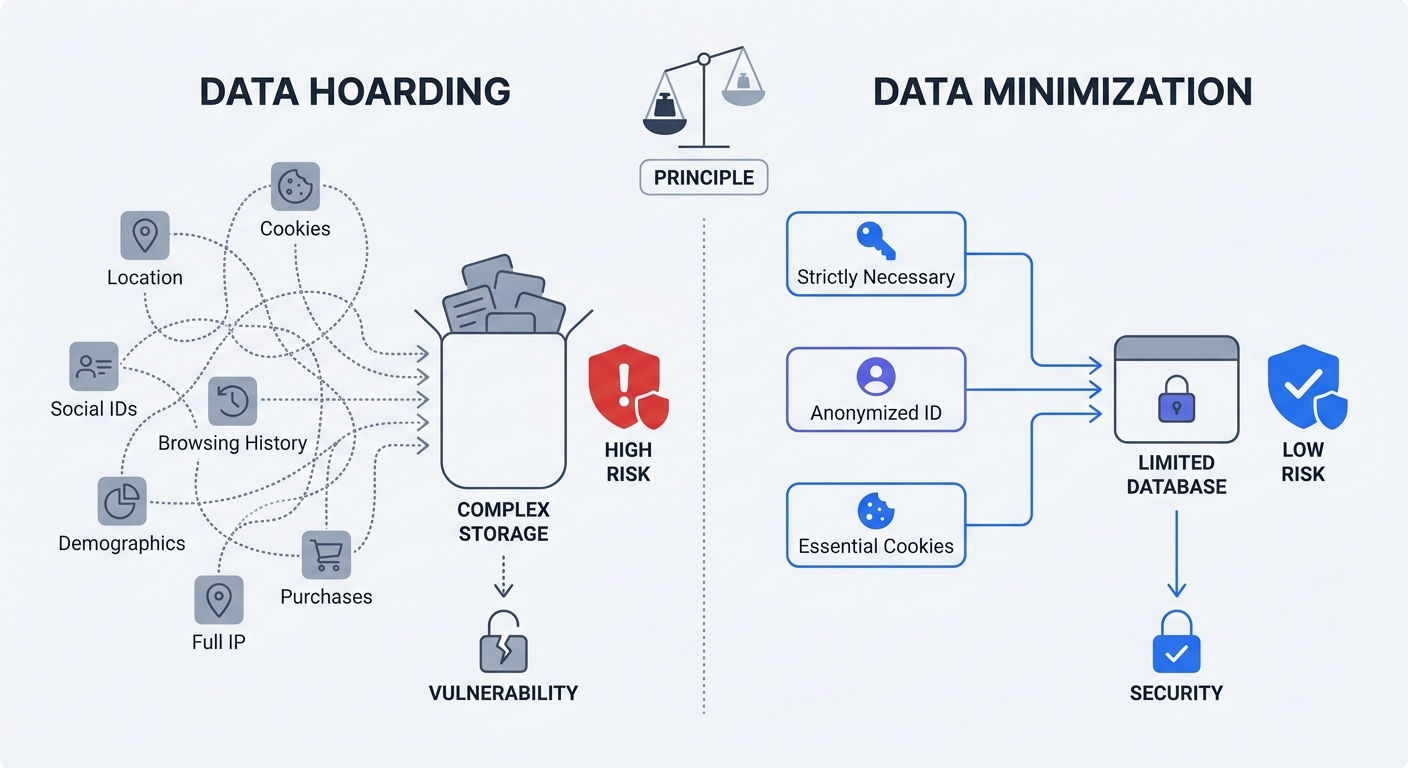
Treat personal data as toxic waste to protect your business. Collect the minimum amount required to complete a specific task. Delete the information the moment that task finishes.
Defining the Core Rule
What Is Data Minimization Principle?
Data minimization restricts organizations to collecting and processing the exact personal data required to achieve a stated business purpose. Article 5(1)(c) of the General Data Protection Regulation (GDPR) mandates that personal data must be "adequate, relevant and limited to what is necessary in relation to the purposes for which they are processed."
Companies cannot gather information to store for speculative future use. A physical product purchase requires a shipping address and payment details. Asking for gender or marital status during checkout violates the regulation.
The Three Core Elements: Adequacy, Relevance, and Necessity
Regulators evaluate data collection practices against three distinct criteria. Failing a single category triggers non-compliance fines.
| Element | Definition | Practical Example |
|---|---|---|
| Adequacy | Collect enough data to fulfill the intended purpose without falling short. | Requesting a ZIP code but failing to ask for the street address makes physical delivery impossible. |
| Relevance | Ensure the requested information has a logical link to the business goal. | Demanding a user's date of birth to subscribe them to an email newsletter lacks a logical link to the service. |
| Necessity | Hold no excess data and establish time limits for retention. | Deleting a user's payment information from the database after a one-time transaction clears the payment gateway. |
Global Legal Frameworks: GDPR and CCPA
The California Consumer Privacy Act (CCPA) and the California Privacy Rights Act (CPRA) enforce minimization standards for businesses operating in the United States.
By 2026, 20 U.S. states operate under active privacy legislation. Indiana, Kentucky, and Rhode Island enforce statutes that mirror the European model. Multi-state operators face legal exposure if they attempt to maintain separate privacy standards for different geographic regions. Standardize operations to meet the most rigorous global requirement to streamline compliance and reduce overhead.
Action Step: Review your current data collection web forms. Open every contact, signup, and checkout page. List every requested field in a spreadsheet. Justify each field against the three core elements. Delete any input box failing the relevance or necessity test.
Why Data Hoarding Is a Costly Liability
Record GDPR Fines and Breach Surges
Data storage creates financial risk. Regulators penalize companies that mismanage consumer information. A CMS.Law analysis of GDPR enforcement reveals that non-compliance with general data processing principles, which includes data minimization, accounts for half of the ten highest privacy fines issued.
Cumulative penalties under the European framework reached €7.1 billion by early 2026. Smaller businesses face the same scrutiny as technology giants. Regulators levy the highest average fines against companies in the media, telecommunications, and standard commerce sectors.
Breaches happen with alarming frequency. European data protection authorities log an average of 443 personal data breach notifications every day, though reporting volumes vary significantly by country. Holding expired customer records turns a minor security incident into a major regulatory disaster.
The Trust Deficit With Consumers
Customers prioritize privacy. Intrusive data requests cause friction in the user journey and drive potential buyers to competitors.
A Cisco benchmarking study indicates that 76 percent of internet users refuse to buy from companies they do not trust with their data. This metric spikes higher in finance and healthcare sectors compared to standard retail. Users experience fatigue from endless cookie banners, aggressive retargeting ads, and unprompted SMS marketing messages.
The Positive ROI of Privacy Investments
Privacy drives revenue. Companies streamlining their data architecture report measurable financial gains. The Cisco research shows organizations achieve an average return on investment of 1.6x for every dollar spent on privacy programs, though this return varies depending on company size and industry.
Trimming form fields increases conversion rates. Smaller databases cost less to host and secure. Automated deletion protocols reduce the manual labor required to fulfill "Right to be Forgotten" requests.
Action Step: Calculate the storage and security costs associated with your legacy marketing databases. Propose a data purge project to the executive team using the 1.6x ROI metric to secure approval.
Modern Trends Forcing Data Minimization
The Friction Between Generative AI and Privacy
Artificial intelligence models require massive datasets for training and operation. This requirement conflicts with privacy legislation. Feeding unvetted customer databases into third-party AI tools exposes sensitive personal identifiable information (PII) to unauthorized processing.
Nine out of ten companies expanded their internal privacy programs after integrating generative AI tools into their workflows. Marketers must ensure that chatbots, predictive analytics engines, and content generators do not ingest raw customer data without explicit consent and a documented legal basis.
Shifting to Server-Side Tracking
Browser vendors block third-party tracking scripts. Ad blockers intercept client-side network requests. Marketers lose visibility into campaign performance when relying on legacy tracking methods.
Server-side tracking shifts the data collection process from the browser to your cloud infrastructure. This architecture gives administrators control over the information payload before forwarding it to external vendors.
Administrators configure the server to intercept incoming requests, strip out IP addresses, and send minimized data packets to analytics platforms. This method guarantees third-party vendors never receive raw PII.
Action Step: Audit the AI tools inside the marketing stack. Request data processing agreements (DPAs) from every vendor. Verify the exclusion of prompts and customer inputs from their public model training sets. Initiate a project to migrate core conversion events from client-side pixels to a secure server-side container.
Web Analytics Without the Privacy Risks
Where Traditional Trackers Fail
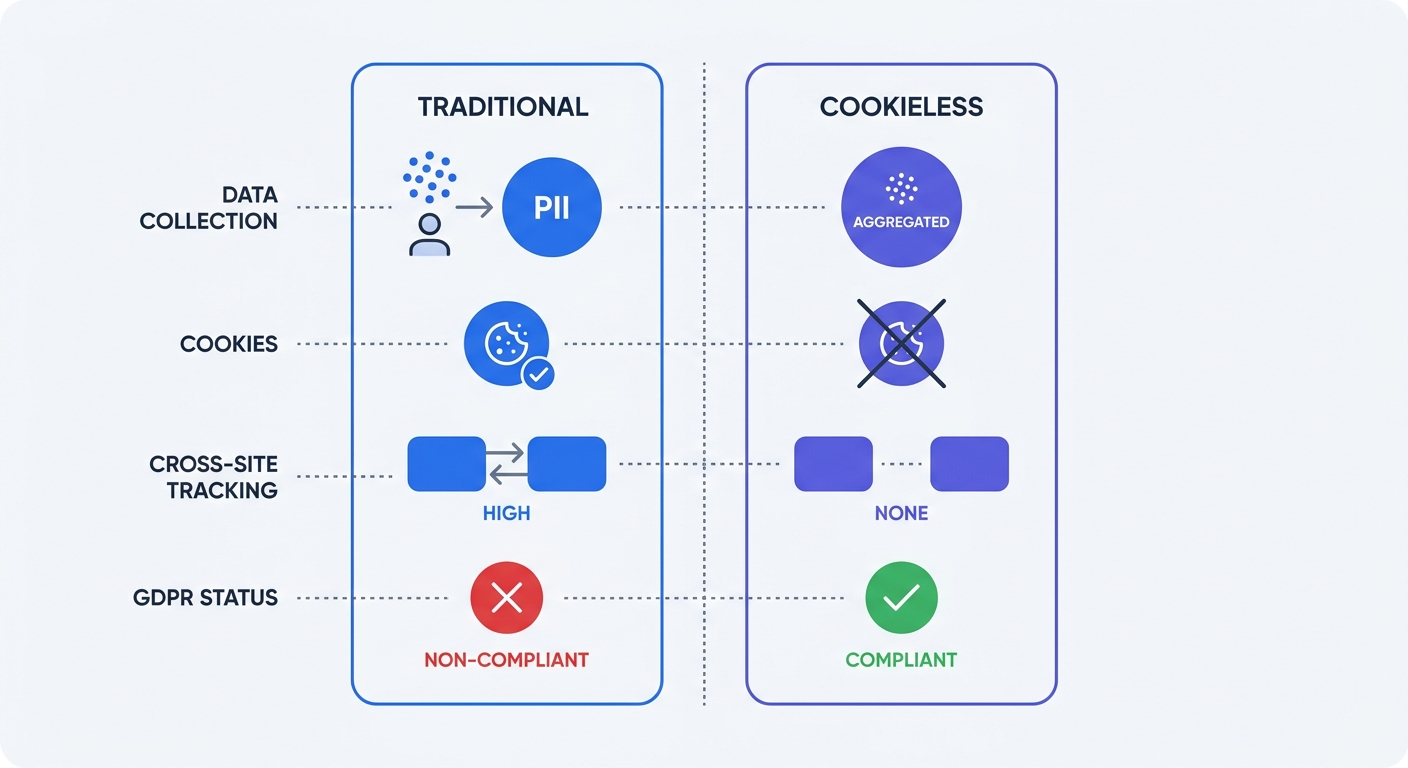
Google Analytics and similar legacy platforms violate the minimization principle. They deploy persistent cookies to build long-term behavioral profiles. These systems track users across multiple domains to log device specifications, demographic inferences, and granular browsing habits.
Measuring website performance operates without this level of surveillance. Counting pageviews identifies which blog post drives the most traffic. Measuring campaign success requires a referral source.
Collecting cross-site identifiers to measure web traffic fails the necessity test. Regulators view the deployment of invasive analytics cookies without explicit prior consent as a breach of GDPR mandates.
The Cookieless Analytics Solution
Marketers can measure return on investment without compromising user privacy. Cookieless analytics platforms process data without storing persistent identifiers on the visitor's device.
Swetrix provides an open-source, privacy-first alternative to legacy trackers. The platform tracks aggregated events rather than profiling individual humans. The system generates a short-lived encrypted hash using the visitor's IP address and a daily rotating salt. This mechanism prevents cross-site tracking and shields user identities.
Adopting a cookieless approach delivers business benefits:
- No Cookie Banners: Eliminate disruptive consent popups from the user interface.
- Faster Page Loads: Replace heavy tracking libraries with a lightweight script that executes in milliseconds.
- Streamlined Compliance: Meet the requirements of GDPR, CCPA, and HIPAA without manual configuration.
Action Step: Remove invasive third-party analytics tags from the website header. Deploy a privacy-focused platform that tracks aggregated metrics. Monitor site speed metrics after removing the legacy scripts.
Best Practices to Enforce Data Minimization
Conducting Routine Data Audits
A Thales Data Threat Report highlights that 33 percent of organizations have complete knowledge of their internal data storage locations.
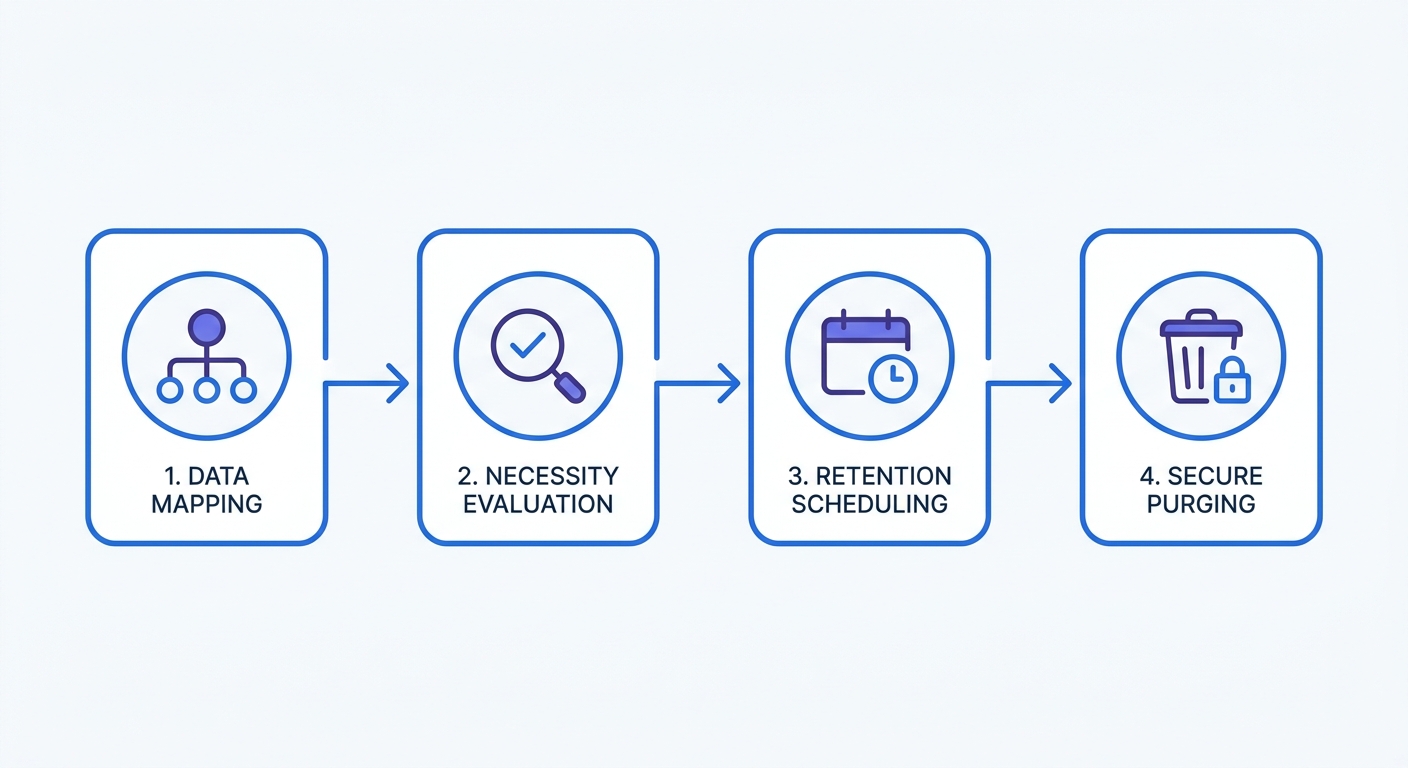
Map the lifecycle of consumer information within the company. Trace a lead from the initial marketing touchpoint through the CRM system, into the billing software, and out to the customer success platform.
Identify redundant data silos. Marketing, sales, and support teams often maintain separate copies of the same customer record. Consolidate these databases to reduce the attack surface.
Automating Retention Schedules
Minimization applies to storage duration. Delete information once it serves its original purpose. Manual database cleanups fail at scale.
Configure automated retention policies. Write database scripts that identify and purge stale records on a predefined schedule.
For a PostgreSQL database, a basic cleanup script looks like this:
DELETE FROM temporary_user_sessions
WHERE last_active_date < CURRENT_DATE - INTERVAL '30 days';
Schedule these commands to run via cron jobs during off-peak hours. Document these retention rules in the public privacy policy.
Adopting Privacy by Design (PbD)
Treat privacy as an engineering constraint. Build minimization into the architecture of new features before writing code.
Use synthetic data for software development and testing. Never copy production databases containing real user information into staging environments. Developers build and test robust applications using generated dummy records that mimic real data structures.
Implement role-based access control (RBAC) across the organization. Provide content writers access to aggregated pageview metrics while restricting their access to payment gateway logs. Limit data visibility to the specific employees who require it to perform their job duties.
Action Step: Schedule a data mapping workshop with engineering and marketing leads. Identify three legacy databases or third-party tools that hold expired customer data. Configure deletion protocols for those systems by the end of the month.
Stop trading user privacy for bloated analytics reports. Measure traffic, track conversions, and optimize campaigns without collecting toxic PII. Swetrix offers a cookie-free, open-source analytics platform that keeps the business compliant and data secure. Start a free Swetrix trial and regain control of the marketing stack.