- Date
What's a funnel: A Simple Guide to Turning Visitors Into Customers
 Andrii Romasiun
So, what exactly is a funnel? In simple terms, it's the path a potential customer takes from the very first time they hear about you to the moment they become a customer. It's a way to map out and understand that journey, guiding people step-by-step from casual interest to a real commitment.
Understanding the Funnel Concept
Think about something as simple as grabbing your morning coffee. You don't just magically appear at the counter, latte in hand. First, you feel the need for coffee (that's awareness). Then you browse the menu (interest), weigh the pros and cons of a latte versus a cappuccino (desire), and finally, you pull out your wallet and pay (action). That entire sequence is a funnel in action.
A marketing or sales funnel applies the same logic to business. It's a model that visualizes the customer journey as a series of stages. The top of the funnel is wide because it catches a broad audience of people who might be interested. As they move through the stages, some will naturally drop off, so the funnel gets narrower. The whole point is to guide as many of the right people as possible to the very bottom—the point where they convert.
A funnel isn’t just some abstract marketing theory; it’s a mirror of how people make decisions. It recognizes that customers rarely buy on impulse. They go through a process of discovery, consideration, and validation before they're ready to commit.
Before we go further, let's quickly break down these core ideas.
Key Funnel Concepts at a Glance
| Concept | Brief Explanation | Real-World Example |
|---|---|---|
| Customer Journey | The complete experience a customer has with a brand, from initial awareness to post-purchase loyalty. | Seeing a social media ad, visiting the website, reading reviews, making a purchase, and receiving follow-up emails. |
| Conversion | The specific action you want a user to take at the end of the funnel. | Completing a purchase, signing up for a newsletter, booking a demo, or downloading a free guide. |
| Drop-off Rate | The percentage of users who leave the funnel at a particular stage without moving to the next one. | 50% of users add an item to their cart but abandon it before starting the checkout process. |
| Top of Funnel (ToFu) | The widest part of the funnel, focused on attracting a large audience and building brand awareness. | Blog posts, social media updates, and infographics that address a broad problem or question. |
| Bottom of Funnel (BoFu) | The narrowest part of the funnel, where prospects are ready to make a decision and become customers. | Case studies, product demos, free trials, and detailed pricing pages. |
Understanding these terms is the first step to seeing why funnels are so powerful. They provide a clear map in what can often feel like a chaotic process.
Why Funnels Are Essential
Trying to market without a funnel is like trying to build a house without a blueprint. You might attract a lot of traffic, but if those visitors don't have a clear path to follow, your efforts will feel random and disconnected. A well-designed funnel gives them that path, making sure every ad, blog post, and email serves a specific purpose.
Here’s why it’s so critical:
You Can Spot the Leaks: By measuring how many people move from one stage to the next, you can see exactly where you're losing them. Is your sign-up form too complicated? Is your pricing page confusing? The funnel tells you where to fix the problems.
It Improves the User's Experience: Building a funnel forces you to walk in your customer's shoes. You start anticipating their questions and creating a smoother, more logical journey that builds confidence at every step.
It Boosts Conversion Rates: When you systematically guide people forward, you remove friction and build trust along the way. This makes it far easier for them to take that final step, whether it's buying your product, booking that demo, or signing up for your service.
The Four Core Stages of a Conversion Funnel
No matter what you're trying to achieve—get a sale, a signup, or a download—every conversion funnel follows a predictable path. It’s all about guiding someone from "Who are you?" to "Take my money!" This journey is often mapped out using the classic AIDA model, which breaks down the customer's mindset into four key stages: Awareness, Interest, Desire, and Action.
If you want to build a funnel that actually works, you need to understand what's going through your customer's head at each of these moments.
Think of it like a real-world funnel. You start with a wide opening and it gets narrower at each step. Not everyone who hears about you will stick around until the end, and that's perfectly normal.
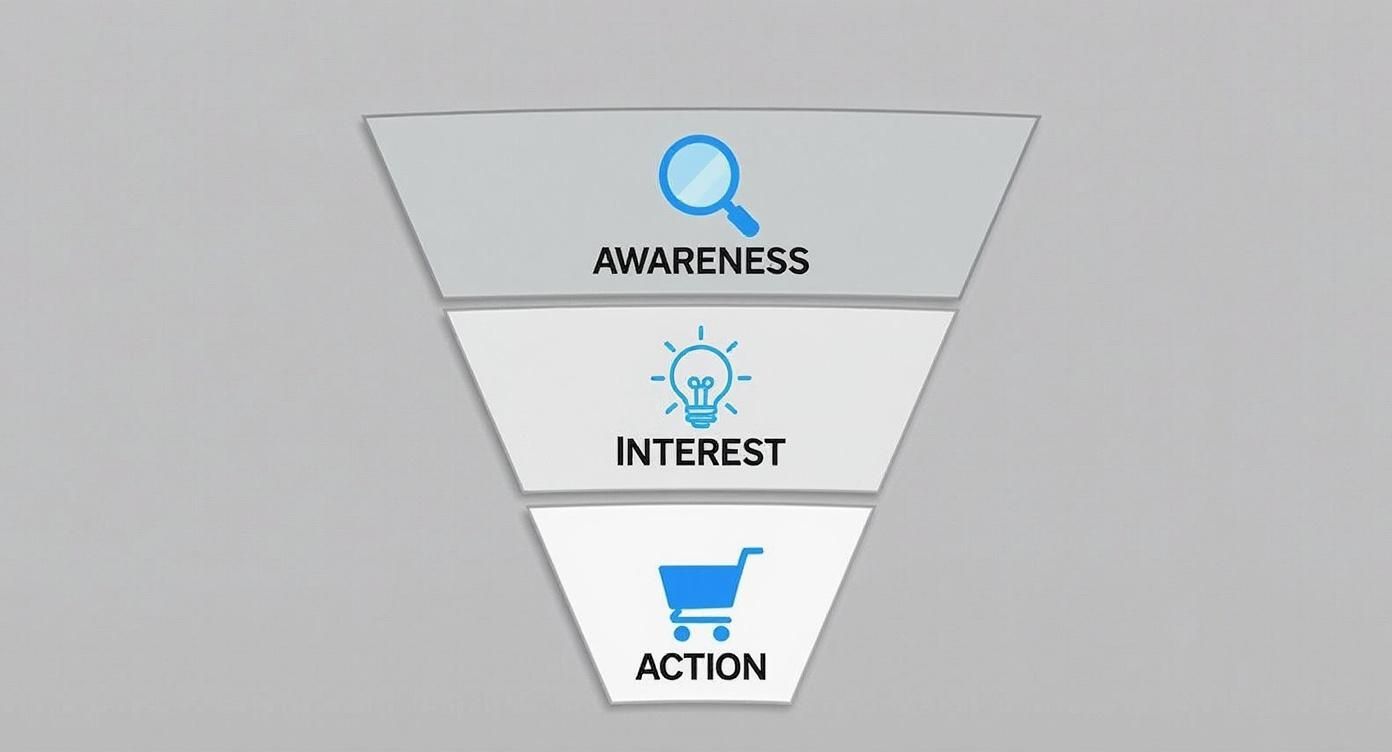
This visual shows that natural filtering process in action. You're sifting through a big audience to find the people who are truly a great fit for what you offer.
Awareness: The First Hello
The Awareness stage is the top of your funnel—the very widest part. This is where people stumble across your brand for the first time. They might not even realize they have a problem you can solve; they just become aware that you exist.
Your only goal here is to make a great first impression and get on their radar. Forget the hard sell. The focus is on grabbing attention.
This is usually done through things like:
- SEO: Writing helpful blog posts that pop up when people search for answers to their questions.
- Social Media: Posting interesting content, cool infographics, or quick videos that stop the scroll.
- Paid Ads: Running targeted campaigns to get your name in front of completely new (but relevant) eyeballs.
Imagine someone googling "how to improve team productivity." They might find your blog post on the topic, and just like that, your project management tool is on their radar. They weren't looking for you, but now they know you're here. If you want to dive deeper into how these first encounters work, check out our guide on customer journey mapping examples.
Interest and Desire: From "Hmm, Interesting" to "I Need This"
Once you've got their attention, the real work begins. You need to turn that initial spark of Interest into a burning Desire for your product. In the Interest stage, people have moved past casual browsing. They're now actively researching their problem and weighing their options.
This is your chance to provide real value and build trust. Think in-depth guides, webinars, or a can't-miss email newsletter. You’re not just a company anymore; you’re becoming a trusted expert.
From there, you transition them into the Desire stage. This is where you connect the dots and show them exactly how your product is the solution to their specific problem. You need to make them want it.
A few powerful ways to do this include:
- Case Studies: Showcasing real results from customers just like them.
- Product Demos: Giving them a behind-the-scenes look at how your solution works.
- Customer Testimonials: Letting happy customers do the selling for you.
Action: Sealing the Deal
Finally, we arrive at the Action stage. You've done the hard work of building awareness, nurturing interest, and creating desire. Now, your potential customer is on the verge of converting. Your job is to make it as easy and compelling as possible for them to take that final step.
The best calls-to-action are specific, create a little urgency, and highlight the value. "Submit" is boring. "Get Your Free Trial" or "Download My Ebook Now" tells the user exactly what they're getting and nudges them to click.
This is the bottom of your funnel, where your efforts either pay off or they don't. It's tough out there—the average sales funnel conversion rate across all industries is just 2.35%. But don't let that discourage you. Businesses that obsessively tweak and optimize each stage can see rates climb well over 5.31%.
Choosing the Right Funnel for Your Business
Your customer’s journey is unique, so why would you use a generic, one-size-fits-all funnel? It just doesn't work. The path someone takes to buy a new pair of sneakers is a world away from the process a company goes through to invest in new enterprise software. The key is to pick a funnel that actually matches your business goals, your product, and the people you’re trying to reach.
Think about a B2B SaaS company. Their strategy might revolve around a free trial funnel. Here, the goal isn't a quick sale; it's all about showing the user how valuable the product is. This journey would likely start on a landing page, move through a frictionless sign-up, and then drop the user into an automated email sequence that guides them through the product’s best features.
Now, flip over to an e-commerce store. Their entire business is built on making sales, right now. They’d be laser-focused on something like a cart abandonment funnel. This kicks in the second someone adds a product to their cart but gets distracted and leaves. The funnel triggers a series of emails with reminders, maybe some customer reviews, or even a small discount to gently nudge them back to finish the purchase.
Common Funnel Types Explored
Before you can pick the right funnel, you need to understand what each type is designed to do. While you can build a funnel for just about anything, most of them fall into a few core categories, each built for a specific kind of customer interaction.
Here’s a quick rundown of some popular types and what they’re good for.
| Funnel Type | Primary Goal | Typical Stages | Best For |
|---|---|---|---|
| Sales Funnel | Drive a direct purchase | Awareness > Interest > Decision > Action | E-commerce, direct-to-consumer products, high-ticket services. |
| Marketing Funnel | Capture and nurture leads | Attract (e.g., blog) > Convert (e.g., ebook) > Nurture (e.g., email) > Qualify | B2B companies, service providers, businesses with long sales cycles. |
| Webinar Funnel | Educate and build authority | Registration > Attendance > Follow-up > Offer | Online courses, coaching programs, complex software demos. |
| Free Trial Funnel | Demonstrate product value | Sign-up > Onboarding > Feature adoption > Upgrade prompt | SaaS products, subscription-based services. |
| Cart Abandonment Funnel | Recover lost sales | Item added to cart > Checkout started > Site abandoned > Recovery emails | Any e-commerce or online store. |
This table gives you a starting point, but remember that the real magic is in tailoring these models to your specific business needs.
The main difference between these funnels often comes down to one simple thing: intent.
A sales funnel is all about getting an immediate "yes," while a marketing funnel is more focused on building a relationship that leads to a "yes" down the road.
As you might expect, performance varies wildly. On a global scale, you’ll see average sales funnel conversion rates land somewhere between 3% and 10%. But dig a little deeper, and the numbers tell a more interesting story. B2B sales funnels often hover between 1% and 5% because the decision-making process is just so much longer and more complex.
On the other hand, B2C funnels tend to see higher conversion rates, typically between 5% and 15%, thanks to those quicker, more impulsive buying cycles. If you want to dive deeper into the data, you can check out these helpful funnel conversion rate benchmarks on vwo.com.
The Key Metrics for Measuring Funnel Performance
Building a funnel without measuring it is like driving with your eyes closed. Sure, you're moving, but are you even going in the right direction? To figure out what’s clicking with your users and what’s not, you have to track the right metrics. Think of them as the vital signs of your funnel's health.
Tracking these key performance indicators (KPIs) is what separates a guessing game from a clear, actionable strategy. They pinpoint exactly where people are sailing through and, more importantly, where they’re hitting roadblocks. This is how you start making smart, data-backed decisions that actually improve your results.
Essential Funnel KPIs to Monitor
To get a complete picture of your funnel’s effectiveness, you need to look at several core metrics together. Each one tells a different part of the story, from a user's first click all the way to their long-term value. Let's break down the must-haves.
Conversion Rate: This is the big one. It’s simply the percentage of users who take the action you want them to at any given stage. For instance, if 1,000 people land on your homepage and 50 sign up for your newsletter, your conversion rate for that step is 5%.
Drop-off Rate: The flip side of conversion. This metric shows you how many users are bailing at each stage. A high drop-off rate on your payment page, for example, is a massive red flag. It could point to anything from confusing pricing to a technical bug.
Cost Per Acquisition (CPA): This tells you exactly how much you're spending to get a single new customer. To figure it out, just divide the total cost of a marketing campaign by the number of people who converted. It’s a crucial reality check for your marketing budget.
Customer Lifetime Value (CLV): This is the total amount of money you can realistically expect to make from one customer over their entire relationship with your brand. A healthy CLV means you’re not just making one-off sales; you’re building a base of loyal, valuable customers.
By tracking both CPA and CLV, you can ensure your acquisition strategy is sustainable. A healthy business model requires your CLV to be significantly higher than your CPA.
Interpreting the Data for Actionable Insights
Metrics are useless numbers on a screen until you turn them into action. Take sales call conversion rates—a key metric in many B2B funnels. The numbers can be all over the place. Smaller deals under $10,000 might close at around 25.73%, but giant deals over $5 million often convert at a much lower 9.09%.
The source of the lead matters, too. Referrals tend to convert at a strong 25.56%, while cold calling often struggles to hit 9.38%. You can dig deeper into these kinds of insights about sales call performance on focus-digital.co.
What this data really shows is that a "good" conversion rate is completely contextual. Instead of chasing some universal number, focus on your own benchmarks and look for opportunities to improve each step of your unique customer journey.
How to Analyze Your Funnel with Swetrix
Knowing your key metrics is one thing, but actually seeing them in action is where the magic happens. A privacy-focused tool like Swetrix helps you move beyond theory and start mapping out your user journey, step-by-step. This turns a bunch of abstract data points into a clear, actionable picture of your customer’s experience.
The first move is to set up your funnel right inside the Swetrix dashboard. Instead of being locked into predefined stages, you get to define each step of your funnel using custom events that actually match your business goals. This flexibility is what lets you build a model that genuinely reflects your process, not someone else's.
Defining Your Funnel Stages
To build a funnel that tells you anything useful, you need to translate your customer journey into trackable actions. What are the absolute must-do steps a user has to take to convert?
For an e-commerce store, it might be a classic four-step process:
- Viewed Product Page: The user lands on a product, showing that first spark of interest.
- Added to Cart: They take the next step, signaling a much stronger intent to buy.
- Initiated Checkout: They've committed and are ready to enter their payment details.
- Completed Purchase: The final conversion—the whole point of the funnel.
By setting up custom events for each of these actions, you're telling Swetrix exactly what path to watch. This creates a simple, visual roadmap of how people are (or aren't) moving from one stage to the next.
A well-defined funnel doesn’t just show you what’s happening; it immediately points you to where the problems are. Seeing a massive 70% drop-off between adding an item to the cart and starting the checkout is a huge red flag that something in that specific step is causing friction.
The visual below shows how Swetrix lays this all out, making it dead simple to spot the biggest leaks in your process at a glance.
The chart clearly shows the conversion and drop-off rates for every stage, turning complex user behavior into something you can understand in seconds. You can instantly see where your user flow is working well and where it needs some serious love.
If you want to dive deeper into turning these visuals into a real strategy, you can learn more about what is funnel analysis in our comprehensive article. This is how you pinpoint the exact moment users are bailing and start making targeted fixes.
Common Funnel Mistakes and How to Fix Them
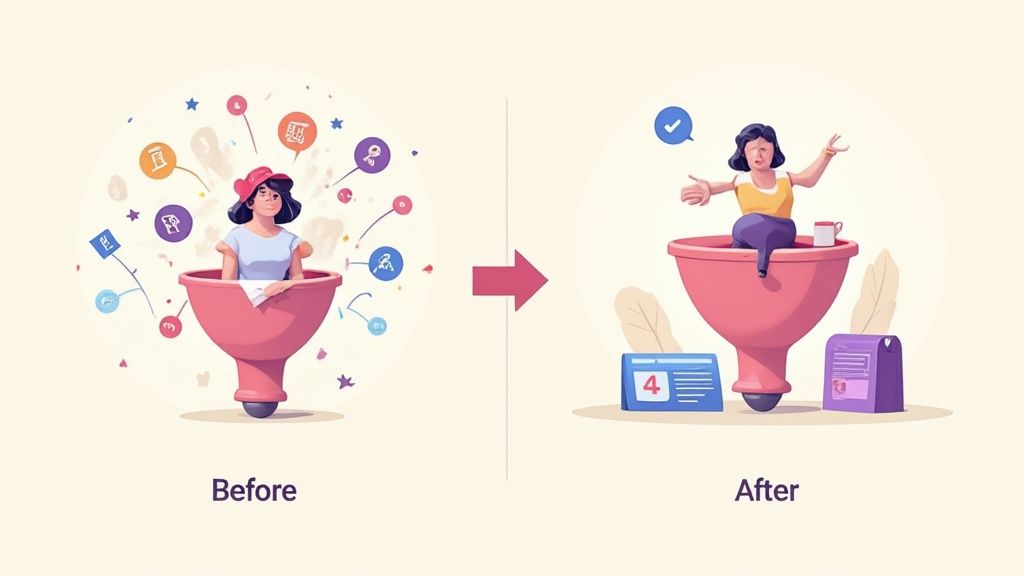
Even the most carefully planned funnels can spring a leak. It happens to everyone. Knowing where the common traps lie is the first step to building a smoother customer journey—one that actually helps people convert instead of frustrating them.
One of the biggest culprits? Too many steps. It’s so easy to do. We think we need all this information, but every extra click or form field is just another chance for someone to get distracted and bounce. The goal is to strip the process down to its absolute essentials.
Then there's the mobile experience, or lack thereof. A huge chunk of your users are on their phones. If your pages are a mess on a small screen—with tiny text or forms that are impossible to fill out—you’re pretty much telling a massive part of your audience to leave.
Overlooking Trust and Clarity
You can have the slickest design in the world, but if people don't trust you, they're not going to hand over their email or credit card number. This is where you have to be loud and clear about your credibility.
Before: A generic checkout page with no security badges, testimonials, or a clear return policy. After: The same checkout page now includes trust signals like "SSL Secured" icons, a customer review, and a satisfaction guarantee.
See the difference? That simple addition makes people feel safer at the most critical moment. A confusing call-to-action (CTA) can be just as damaging. Vague buttons like "Submit" or "Continue" leave users wondering what's going to happen next, creating a moment of hesitation you can't afford.
Here are a few quick fixes for some all-too-common problems:
- Problem: Your sign-up form feels like an interrogation.
- Solution: Just ask for the must-haves. You can always collect more details down the road.
- Problem: People don't grasp what they're getting.
- Solution: Put the key benefits in clear headlines and bullet points, right beside your CTA.
- Problem: The whole experience feels cold and corporate.
- Solution: Weave in customer testimonials or case studies. Show them real people who are happy they chose you.
Nailing these details is what separates a leaky funnel from a high-performing one. For a deeper dive into boosting your numbers, check out these essential conversion rate optimization best practices. By focusing on simplicity, trust, and clarity, you can remove those roadblocks and guide more users all the way to the finish line.
Common Questions About Funnels Answered
You've got the basics down, but a few questions always pop up when people start building their first funnels. Let's tackle some of the most common ones.
How Many Steps Should a Funnel Have?
This is a classic question, and the answer is simple: as few as possible. Every single step you add—another click, another form field, another page—is another chance for someone to drop off. Think of it as an obstacle course; the fewer hurdles, the more people make it to the finish line.
A simple newsletter signup might only need two steps (landing page and confirmation). A checkout process for an online store could reasonably have three or four. The golden rule is to cut out anything that isn't absolutely essential to guiding the user to the final goal.
What's the Difference Between a Marketing Funnel and a Sales Funnel?
Great question. While people often use these terms interchangeably, they actually describe two distinct halves of the customer journey. They work together, but they have different jobs.
Marketing Funnel: This is the top part of the journey. It’s all about casting a wide net to build brand awareness, create interest, and capture leads. The main goal here is to identify a Marketing Qualified Lead (MQL)—someone who's shown enough interest to be worth the sales team's time.
Sales Funnel: This is where the handoff happens. The sales team takes those MQLs and works to turn them into actual paying customers. This part of the process involves things like demos, sales calls, sending proposals, and ultimately, closing the deal.
Think of it this way: the marketing funnel brings people to the door, and the sales funnel walks them through it.
Can I Have More Than One Funnel?
Not only can you, you absolutely should! Relying on a single funnel is like trying to catch all types of fish with just one net. It’s far more effective to create different funnels for different purposes.
For instance, you might have one funnel to attract new customers from your blog content, another designed to upsell existing customers through an email campaign, and a completely separate one just for winning back people who abandoned their shopping carts. Tailoring your funnels to specific audiences and goals is a game-changer.
Ready to see how your own funnels are performing without giving up on user privacy? Swetrix gives you all the tools to pinpoint exactly where people are dropping off and what you can do about it. Start your free 14-day trial and get the insights you need to improve your customer journey.