- Date
What are unique users: A Clear Guide to the Key Web Metric
 Andrii Romasiun
Ever wonder how many actual people visit your website, not just how many times it's been loaded? That’s where the unique users metric comes in.
Think of your website like a local coffee shop. If the same person comes in for their morning coffee every day for a week, that’s five visits, but still only one unique customer. Unique users give you that same clarity, showing you the true size of your audience, not just the volume of their activity.
The Foundation of Audience Measurement
Getting a handle on what are unique users is the first step to truly understanding your website traffic. It’s the metric that cuts through the noise of raw activity to reveal your actual reach.
Metrics like pageviews, which count every single page load, can easily inflate your perception of traffic. A single, super-engaged fan might rack up 50 pageviews in one go, but they are still just one person. To dig deeper into that, you can check out our guide on what are pageviews.
This metric, often called unique visitors, is the bedrock of good analysis for a few key reasons:
- Real Audience Size: It gives you a solid, realistic estimate of how many individual people are actually seeing your content.
- Accurate Conversion Rates: It forms the basis for your most important KPIs. If you made 100 sales, knowing they came from 200 unique users versus 20,000 completely changes the story of your success.
- Deeper User Behavior Insights: It allows you to track retention and loyalty by seeing how many unique users come back over time.
Unique Users vs. Sessions vs. Pageviews
It’s easy to get these terms mixed up, but each one tells a very different part of your website's story. Let’s clear up the confusion.
Unique users count distinct individuals over a set period, usually identified by something like a unique cookie or device ID. This matters because one person can create many sessions and hundreds of pageviews. They’re still just one unique user, and getting that right is critical for everything from audience segmentation to marketing attribution. You can discover more insights about digital trends from DataReportal.
To make this even clearer, let's break down the most common web analytics metrics and see how they stack up against each other.
Key Analytics Metrics at a Glance
This table offers a quick comparison to help you distinguish between unique users and other essential metrics at a glance.
| Metric | What It Measures | Example |
|---|---|---|
| Unique User | An individual person who visits your site. | One person (Jane) visiting your site. |
| Session | A single visit or period of activity. | Jane visits your site on Monday morning. |
| Pageview | A single page being loaded. | Jane views your homepage, then the pricing page. |
Understanding these distinctions is the first step toward moving beyond vanity metrics and into a more nuanced, accurate view of how people are interacting with your site. Each metric has its place, but unique users will always be the starting point for measuring your true audience.
How Analytics Platforms Count Unique Users
So, how do analytics platforms actually know who's visiting your site? It’s not magic; they rely on a few clever technical methods to identify and count individuals. Digging into how this works is key, because it shines a light on both the power and the pitfalls of the unique user metric. It’s also why you’ll never see two different platforms report the exact same number.
The classic, old-school method is all about cookies—those small text files that get stored in a user's browser. The first time someone lands on your site, your analytics tool drops a cookie with a unique ID. On every return visit from that same browser, the tool sees that ID and knows it's a returning user, not a brand-new one.
This simple diagram breaks down how a unique user is the source of all other engagement metrics, like sessions and pageviews.
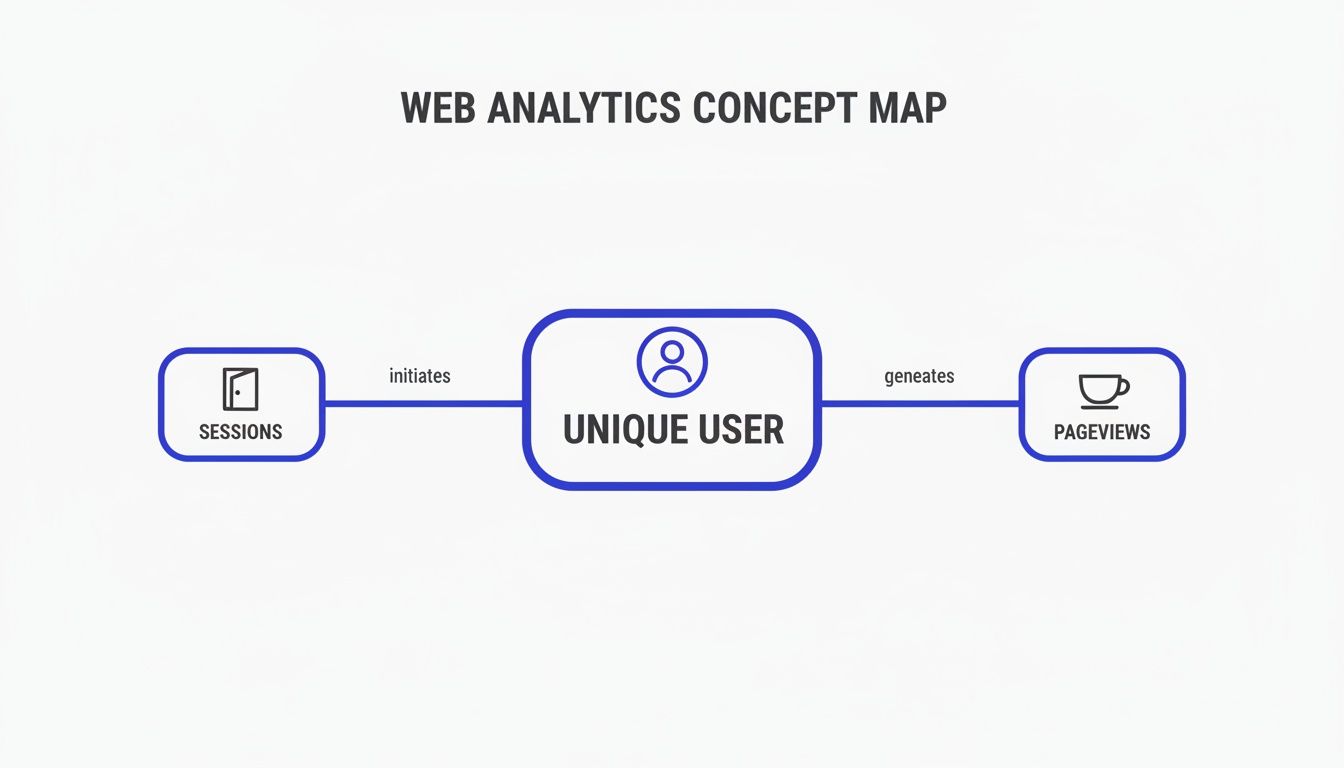
As you can see, one person (the unique user) can kick off multiple visits (sessions) and trigger lots of different interactions (pageviews). That makes the unique user count the foundational metric for understanding your audience size.
Moving Beyond Cookies
For all its simplicity, the cookie-based approach is riddled with problems. If a user clears their cookies, fires up a different browser, or swaps from their laptop to their phone, they’ll get a brand-new cookie and be counted as a new unique user. This inflates your numbers and makes it nearly impossible to map out a single person's true journey with your brand.
To get around these limitations, modern platforms are shifting to a mix of more sophisticated (and often more private) methods:
- Login-Based Tracking: This is the gold standard for accuracy. When someone logs into their account, you can identify them with their unique user ID. This approach works perfectly across every device and browser, giving you a true count of your known user base.
- Device Fingerprinting: This technique pieces together an anonymous identifier from non-personal browser and device settings—things like screen resolution, operating system, and installed fonts. It’s a way to recognize a returning device without relying on cookies.
Privacy-first analytics tools like Swetrix take a different route. They often use cookieless methods, like hashing a user's IP address and browser details to create a temporary, anonymized identifier for a session. This respects user privacy by not storing personal data while still delivering reliable user and session counts.
Probabilistic and Deterministic Models
Behind the scenes, analytics platforms often bundle these different techniques into two main models for identifying people.
Deterministic matching is the straightforward one. It uses a known, concrete piece of data, like an email address or user ID from a login. It's incredibly accurate but has one major catch: it only works for users who are logged in.
Probabilistic matching, on the other hand, is more of an educated guess. It uses algorithms to analyze anonymous data points—like device type, location, and browsing patterns—to predict with high confidence that two different sessions came from the same person. This is crucial for piecing together user behavior across different devices, a challenge we dive into in our guide on effective cross-device tracking.
By blending these methods, platforms can paint a much richer, more complete picture of your unique users. The specific recipe of techniques a platform uses directly shapes the accuracy of its final count, which is exactly why it’s so important to look under the hood and understand the technology powering your numbers.
Why Your Unique User Count Is Never 100% Accurate
Let's get one thing straight: the unique user metric is incredibly useful, but it’s never going to be perfect. No analytics platform can give you an exact, flawless headcount of every single person who interacts with your site or app.
Think of your unique user count as a highly informed estimate. It’s a powerful tool for spotting trends and making smart decisions, not an ironclad census. The reason for this boils down to a few messy, real-world factors that can skew the numbers.

The biggest headache? People today just don't stick to one device.
The Cross-Device Problem
Take a look at your own habits. You might browse an online store on your work laptop, add something to your cart from your phone on the train home, and finally make the purchase on your tablet later that night.
To a classic, cookie-based analytics tool, you don't look like one person. You look like three separate unique users.
This "cross-device problem" is one of the main reasons unique user counts often get inflated. Each device sends out its own signal (a cookie or device ID), and most platforms struggle to piece together the full picture of a single person's journey. The result is an overestimation of your audience size.
A unique user count is not an infallible headcount but a powerful indicator of audience trends. Understanding the common sources of inaccuracy helps you focus on the relative changes and patterns in your data, which is where the true strategic value lies.
Privacy Tools and User Habits
On top of the device-switching, the way people protect their privacy online adds another layer of complexity. These habits almost always lead to overcounting because they stop analytics tools from recognizing someone who has visited before.
Here are the usual suspects:
- Clearing Cookies: When someone clears their browser cookies, they're essentially wiping the slate clean. The next time they visit your site, your analytics tool has no memory of them and issues a brand-new ID, counting them as a new unique user.
- Private or Incognito Mode: These browsing modes are designed for anonymity. They block old cookies and delete new ones the moment the window is closed. This means every single visit from the same person in incognito mode looks like it’s from a brand-new user.
- Ad Blockers & VPNs: Many ad blockers do more than just block ads—they block the analytics scripts that do the counting. VPNs can also make it harder for some systems to recognize returning visitors by masking their location and IP address.
These aren't flaws in your analytics setup; they're just the reality of tracking behavior on the modern web. The table below breaks down these common issues and how they mess with your numbers.
Common Issues in Unique User Tracking and Their Impact
This table breaks down the most frequent challenges in accurately counting unique users and explains how each one can inflate or deflate the final metric.
| Challenge | How It Affects Data | Typical Result |
|---|---|---|
| Cross-Device Usage | One person on a phone and laptop is counted twice. | Overcounting unique users. |
| Cookie Deletion | A returning user is assigned a new cookie. | Overcounting unique users. |
| Private Browsing | Cookies are blocked and deleted after each session. | Overcounting unique users. |
| Ad/Tracker Blockers | The analytics script is prevented from running. | Undercounting (visitor is not counted at all). |
Once you understand these challenges, you can start treating your unique user data with the right perspective. It’s a vital trend indicator, not an absolute truth.
How Unique Users Actually Drive Business Growth
The unique user metric isn't just another number to track on a dashboard. Think of it as the true measure of your business's pulse—it tells you about your health, your reach, and how much of a dent you’re making in the market. For any team serious about growth, understanding what are unique users is non-negotiable. It's the foundational number that turns vague "traffic" into a concrete audience size.
For marketing teams, this metric is everything. It's the bedrock of their entire strategy. It’s how you calculate the real reach of your campaigns, gauge brand awareness, and nail down a precise customer acquisition cost (CAC). Without a solid unique user count, you're essentially flying blind. You have no way of knowing if your ad budget is bringing in fresh faces or just repeatedly pinging the same small group of people.
Product teams are just as reliant on this number. When they roll out a new feature, the first question is always, "What percentage of our user base has actually tried it?" You can't answer that without knowing how many unique users you have in the first place. It's also critical for tracking churn and retention, showing you how many people stick around versus those who show up once and disappear forever.
A unique user count gives context to nearly every other engagement metric. If you had 10,000 unique users last month and made 100 sales, your conversion rate is 1%. That simple bit of math informs everything from sales forecasts to budget meetings.
Turning a Metric Into a Strategy
Let's make this real. Say your website pulled in 50,000 unique users last month. That single number is the launchpad for a whole host of strategic insights:
- Market Share: How does that stack up against your competitors? Or against the total potential market? This gives you a clear snapshot of your current market penetration.
- Growth Potential: Is the number climbing month after month? A steady rise in unique users is a powerful sign that your marketing and content efforts are hitting the mark.
- Audience Engagement: On average, how many sessions does each unique user start? A high ratio points to a loyal, captivated audience that keeps coming back for more.
A quick word of caution: when you're looking at numbers from different channels, remember that not all platforms report data the same way. A campaign that reaches 10 million unique monthly users is connecting with roughly 0.18–0.2% of everyone online, but you can't always make a direct comparison. One platform might report daily active users (DAUs), while another gives you monthly unique visitors. To get a better sense of how these numbers scale, check out the latest social media user statistics from Backlinko.
At the end of the day, tracking unique users provides a clean, unduplicated view of who you're reaching. It's this clarity that lets you graduate from just watching traffic to making smart, data-backed decisions that genuinely fuel your business's growth.
Tracking Users in a Privacy-First World
The ground is shifting beneath our feet in the world of web analytics. For a long time, tracking unique users was all about third-party cookies, but that era is drawing to a close. With privacy laws like GDPR and CCPA gaining traction and browsers actively phasing out these trackers, the old playbook is officially obsolete.
This isn't just a minor tweak; it's a major evolution. Businesses can no longer get away with intrusive tracking methods that ignore user consent. So, the big question is: how do you measure your audience and make smart decisions while putting user privacy first? The answer is to embrace modern, ethical approaches to analytics.
The New Standard: Cookieless Analytics
The future of understanding your user base is cookieless. Instead of relying on files stored in a user's browser, modern platforms are using more innovative and privacy-conscious techniques to get the job done.
This isn't about finding a sneaky workaround for cookies. It’s about a fundamental shift in how we think about data collection. The new focus is on anonymity and aggregation, not individual surveillance. The goal is still to get the directional insights you need, just without crossing the line and compromising anyone's personal information.
"The shift to a privacy-first web isn't a limitation; it's an opportunity to build trust. Effective analytics and ethical data practices are no longer mutually exclusive—they are the new benchmark for a sustainable digital strategy."
Platforms built for this new reality, like Swetrix, prove that you can get accurate metrics without being invasive. By using privacy-safe fingerprinting and anonymized identifiers, these tools provide the data needed for strategic decisions while keeping user anonymity completely intact.
How Privacy-Safe Measurement Works
So, how does a platform identify a unique user without a cookie? It's all about creating a temporary, anonymized identifier based on non-personal information.
Here’s a simplified breakdown of how it usually works:
- Hashing IP Addresses: A user’s IP address is immediately converted into an irreversible string of characters (a hash). This allows the system to recognize a returning session within a short window, like 24 hours, without ever storing the actual IP.
- Anonymized Fingerprinting: This technique combines a few general, non-identifiable browser details—like the operating system, browser type, and language setting—to create a temporary ID. It’s just unique enough to distinguish one user from another during a visit but not specific enough to ever personally identify them.
These methods are designed from the ground up to be non-persistent and anonymous. They give you a reliable count of unique users over a specific period, which is exactly what you need to measure audience size and campaign reach. You can learn more about how to put these ideas into practice in our complete guide to choosing privacy-friendly analytics.
Ultimately, this evolution shows that you don't have to choose between data and privacy. By embracing modern, ethical tools, you can continue to understand your audience, measure growth, and optimize your website—all while building a more trustworthy relationship with your users. The data is just as actionable, but the method is respectful by design.
Turning Unique User Data Into Actionable Insights
So you've got a number for your unique users. Great. But a dashboard full of numbers is just that—numbers. It doesn't mean a thing until you put it to work and use it to make smarter decisions. This metric really starts to shine when you stop just reporting it and start questioning it.
The real magic happens when you slice and dice that total number into smaller, more meaningful groups. Think of it like a detective sorting through clues. You’re not just counting footprints; you’re figuring out who they belong to, where they came from, and where they’re going. This shifts the focus from how many users to which users are driving your growth.
This is how you pinpoint your best-performing channels and start to truly understand how people behave on your site or in your app.
Ask the Right Questions
The first step is to break down your total unique user count by different dimensions. This is where you'll find the patterns and stories that a single, aggregate number completely hides.
- By Traffic Source: Are you getting more new, unique users from organic search than from your paid ads? That’s a huge clue about where to invest your marketing budget.
- By Geolocation: Did you suddenly see a surge of new users from a country you weren’t even targeting? You might have just stumbled upon a new market.
- By Landing Page: Which pages or blog posts are your biggest magnets for first-time visitors? Now you know what kind of content actually pulls a fresh audience in.
The goal is to move from passively looking at reports to actively investigating your data. A simple question like, "Did our latest feature launch bring in a new type of user?" gives you a direct way to measure its impact.
Monitor Trends Over Time
A single unique user count is just a snapshot. The real value is unlocked when you track this metric consistently—week after week, month after month. Watching the trend line is how you connect your team's actions to real-world results.
For example, if you see a 20% month-over-month jump in unique users right after you kicked off a new content strategy, you have solid proof that your efforts are paying off. On the flip side, a slow, steady decline is an early warning system. It tells you something might be off with your product or marketing, giving you a chance to dig in before it becomes a major problem.
By regularly analyzing segments and keeping an eye on trends, you stop asking "what are unique users" and start using that data as a powerful tool. It’s how you move from guessing to making informed, evidence-backed decisions that actually grow the business.
A Few Lingering Questions About Unique Users
Even after you get the hang of it, a few common questions always seem to surface when you start digging into unique user data. Let's tackle them head-on so you can feel confident in your analysis.
What's The Difference Between Unique Users and Sessions?
Think of it like a coffee shop. A unique user is a single customer, and a session is each time they walk through the door.
If one person comes in for their morning coffee every day for a week, that’s one unique user but seven different sessions. A high number of sessions per user is usually a fantastic sign—it means people are coming back for more, which is a gold standard for engagement.
Why Do My Analytics Tools Show Different User Counts?
It’s the classic analyst's headache: you look at two different tools, and the numbers don't match up. This is completely normal, so don't panic. The reason is that every platform has its own secret sauce for identifying people.
One tool might use cookies, another might use a cookieless hashing method, and a third might have a more aggressive bot-filtering system. Other factors that create these discrepancies include:
- How long it takes for a session to "time out."
- Slightly different ways of handling users with ad blockers.
- Whether they are tracking at the device level or trying to stitch together a cross-device view.
This is why tracking trends within a single platform is so much more valuable than comparing raw numbers between tools. Focus on whether your user count is growing by 10% month-over-month in one system, not on why it shows 10,000 users while another shows 11,500.
Does a VPN User Count as a New Unique User Every Time?
It depends on how sophisticated your analytics tool is. If a platform relies heavily on IP addresses, then yes, someone hopping between VPN servers could easily be counted as a new user with each connection.
But smarter systems don't just look at the IP. They use other signals, like browser fingerprints or persistent IDs, to recognize that it's the same person, just with a different digital "mask" on. These platforms are much better at de-duplicating those visits and giving you a truer count.
Is a Unique User The Same as a Unique Visitor?
Yes, these two terms are basically interchangeable today. You'll still see "unique visitor" floating around, which was the go-to phrase back in the early days of the web.
Over time, the industry has shifted toward "unique user" because it's a broader, more accurate term. It covers people interacting with mobile apps and other digital products, not just "visiting" a website. In any modern report, you can assume they mean the same thing.
Ready to see your unique user data with clarity and respect for privacy? Swetrix offers powerful, cookieless web analytics that turns your traffic into actionable insights. Start your 14-day free trial today.