- Date
A Complete Guide to Understanding Your Website Traffic Source
 Andrii Romasiun
A website traffic source is simply how a visitor found your website. Think of it as the specific path they took to land on your digital doorstep. Did they see a sign on the "Google highway"? Did a friend give them your address directly? Or did they follow a link from a social media post?
What Is a Website Traffic Source and Why It Matters
Let's imagine your website is a brand-new specialty coffee shop on a busy street. If there's only one road leading to your shop, your entire business depends on that single route. But what happens if that road suddenly closes for construction? Your stream of customers dries up instantly.
This is precisely why understanding every single website traffic source is so crucial for building a resilient online presence. It's not just about how many people show up; it's about knowing how they got there and what brought them in.
Every channel brings in a different type of visitor with a unique frame of mind. Someone who actively searched Google for "best pour-over coffee kettle" is probably ready to buy. That's a very different mindset from someone who just happened to see a picture of your latte art while scrolling through Instagram. By digging into your traffic sources, you can pinpoint which channels deliver your most valuable, engaged customers.
The Strategic Value of Source Analysis
When you know where your visitors are coming from, you can stop guessing and start making smart, data-backed decisions that actually grow your business. The advantages are tangible:
- Smarter Budget Allocation: You can clearly see which paid campaigns are driving results and which are just burning cash, allowing you to reallocate your budget effectively.
- Refined Content Strategy: Discover which blog posts, guides, or social media updates are pulling in the most organic search traffic. This tells you exactly what kind of content your audience is looking for.
- Stronger Partner Relationships: Identify which referral partners send you high-quality leads, giving you the insight you need to foster those key relationships.
- Deeper Customer Understanding: Learn which channels bring in your most loyal fans—like those who type your URL directly—so you can focus on building that brand loyalty even further.
In short, tracking your website traffic sources is like having a detailed map of your customer's journey. It shows you the most popular routes, the hidden shortcuts, and the roads that lead nowhere, so you can optimize every path for a better experience and, ultimately, better results.
Thankfully, modern analytics tools have made this kind of analysis easier than ever. And with privacy-focused platforms like Swetrix, you can gather these critical insights without using invasive cookies or breaking user trust. This lets you build a powerful marketing strategy while respecting your audience's privacy—a non-negotiable for any reputable brand today.
By understanding where your traffic comes from, you gain the ability to not just get more visitors, but to get the right visitors.
Decoding the 7 Primary Website Traffic Sources
Ever wondered where your website visitors actually come from? Understanding your traffic sources is like being a detective for your own business. Every visitor leaves a trail, and by following it back, you can figure out which marketing efforts are hitting the mark and which are falling flat.
Think of the internet as a city. It has main highways, quiet side streets, and scenic routes all leading to different destinations. Your website is one of those destinations. Identifying the pathways people take to get there—the seven primary traffic sources—is the first step toward boosting visitor flow and attracting more of the right people.
This diagram shows how the most common routes, like search engines, other websites, and direct visits, act as the main entry points to your site.
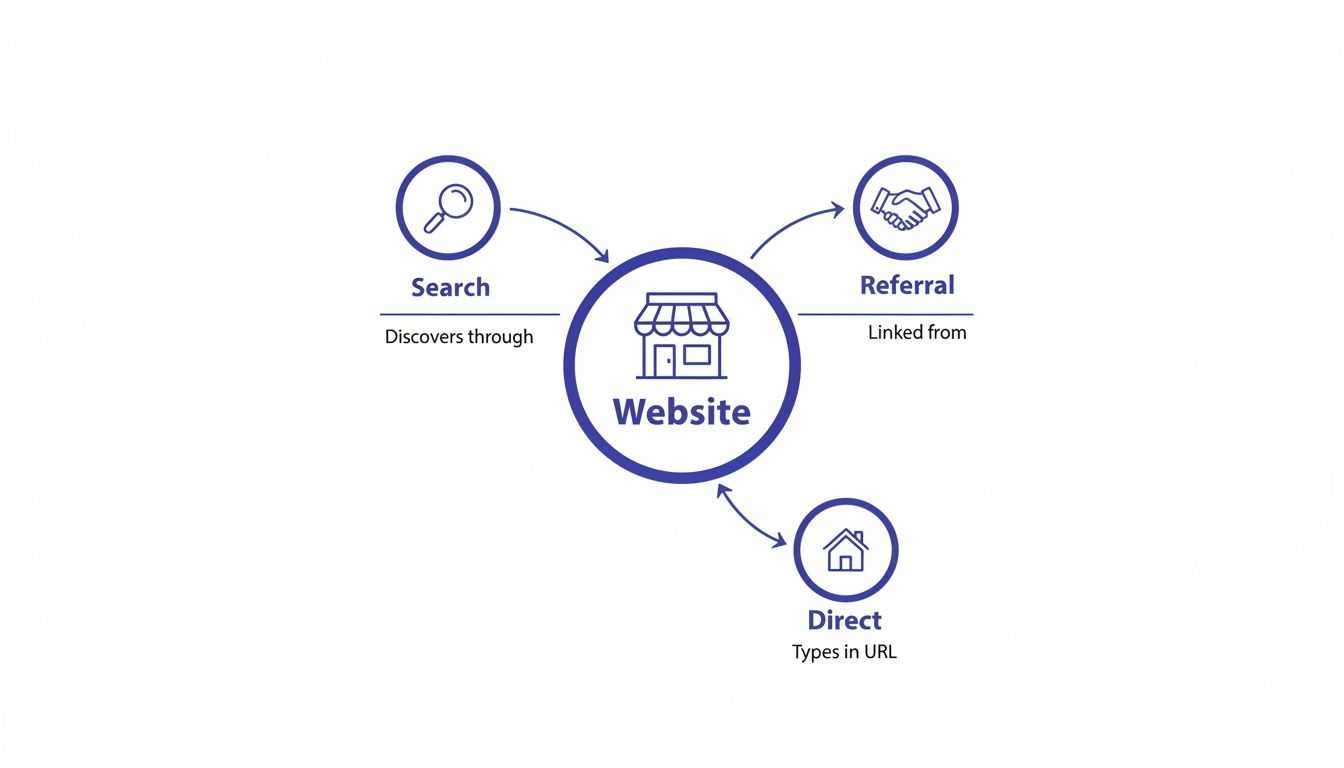
As you can see, each path is distinct. Each one funnels a different type of visitor to your central hub: your website.
1. Organic Search
Organic search is the traffic you earn, not the traffic you buy. These are the visitors who find you after typing a query into a search engine like Google, Bing, or DuckDuckGo and clicking on one of your non-paid, "natural" results.
Think of it as digital word-of-mouth, powered by genuinely helpful content. Someone has a question, they ask a search engine, and if your site has the best answer, you win their click.
This channel is often called the gold standard because it brings in people with high intent. They're actively looking for solutions, which usually means they're more engaged and closer to making a decision. In fact, organic search drives 17% of all website traffic, a massive slice that shows just how powerful a solid SEO strategy can be. For more insights, you can check out website traffic trends from this 2023 study.
2. Direct Traffic
Direct traffic is exactly what it sounds like. It’s people who arrive on your site by typing your URL straight into their browser's address bar or by using a bookmark they've saved. This channel is a fantastic barometer of your brand's strength and customer loyalty.
These aren't newcomers stumbling upon you for the first time. They already know who you are and are seeking you out on purpose.
Key Takeaway: High direct traffic is a great sign. It points to strong brand recall and a loyal following—the digital equivalent of a regular customer walking straight into their favorite coffee shop, no directions needed.
It's worth noting that some traffic gets mistakenly bucketed as "direct" when analytics tools can't figure out where it came from. This so-called "dark traffic" can originate from places like email clients, messaging apps, or even QR codes, muddying the waters a bit.
3. Referral Traffic
When someone clicks a link on another website and lands on yours, that's referral traffic. This isn't from a search engine, but rather from another blog, a news article, or a partner's website that sent some of their audience your way.
Imagine a neighboring business recommending your shop to their own customers. That's referral traffic in a nutshell.
This source is incredibly valuable for a few reasons:
- Borrowed Trust: A link from a respected site acts as an endorsement, passing some of their credibility on to you.
- Qualified Audience: If the referring site is in your niche, its audience is probably already interested in what you have to say.
- SEO Juice: These inbound links, known in the SEO world as "backlinks," are a huge factor in how search engines rank your site.
Keeping an eye on who's sending you traffic can spark ideas for new partnerships and collaborations. To go a bit deeper on this, take a look at our guide on what is a referral source and how to track it.
4. Social Media Traffic
This one is pretty straightforward: it’s any visitor who comes to your site from a social media platform. We’re talking about LinkedIn, X (formerly Twitter), Facebook, Instagram, TikTok—you name it.
This channel can be split into two camps: organic social (from your everyday posts and profile links) and paid social (from the ads you run on these platforms). Social media is brilliant for building a community and driving engagement, but the user intent here is often more about discovery and less about immediate buying.
5. Email Marketing Traffic
Email traffic is made up of visitors who click on a link within one of your email campaigns or newsletters. This is easily one of the most potent channels because you're reaching out to an audience that has already given you permission to contact them.
These users are typically very engaged. They represent a direct line to your most interested fans and customers. By tracking clicks from your emails, you can quickly learn which messages, offers, and calls-to-action are actually working.
6. Paid Search Traffic
Paid search traffic comes from the ads you place on search engine results pages (SERPs). When someone searches for a keyword you're targeting, your ad can appear right at the top of the page, giving you instant visibility.
Unlike organic search, which is a long game, paid search can start delivering highly targeted traffic almost immediately.
Platforms like Google Ads and Microsoft Advertising let you bid on keywords that are crucial for your business. It's an effective strategy for a few key scenarios:
- Jumping the line for high-intent keywords where the organic competition is tough.
- Promoting sales or other time-sensitive offers.
- Getting seen right away while you work on building your long-term organic presence.
The trick is to manage your budget carefully and target your audience precisely to make sure your ad spend is actually making you money.
7. Affiliate Traffic
Affiliate traffic is a special kind of referral traffic. Here, you partner with others (your "affiliates") who promote your products or services to their own audiences using unique, trackable links. In return, you pay them a commission for any visitors or customers they send your way.
This is a performance-based model, which is great because you only pay when you get results, like a completed sale. It's a low-risk way to broaden your reach by tapping into the audiences of influencers, bloggers, and other creators in your field. It works because you’re giving people a real incentive to become advocates for your brand.
Overview of Common Website Traffic Sources
To help tie this all together, here is a quick-glance table summarizing the primary traffic channels, what the typical user is thinking when they arrive, and how to measure success for each one.
| Traffic Source | Description | Typical User Intent | Key Metric to Track |
|---|---|---|---|
| Organic Search | Visitors from unpaid search engine results. | High - Actively seeking answers or solutions. | Keyword Rankings, Organic Conversions |
| Direct | Visitors who type your URL or use a bookmark. | High - Already know and trust your brand. | Direct Sessions, Returning Visitor Rate |
| Referral | Visitors from links on other websites. | Varies - Depends on the referring site's context. | Top Referring Domains, Conversion Rate by Source |
| Social Media | Visitors from social platforms like Facebook or X. | Low to Medium - Browsing, discovery, community. | Engagement Rate, Social-driven Leads |
| Visitors who click links in your email campaigns. | High - Engaged subscribers interested in updates. | Click-Through Rate (CTR), Email Conversions | |
| Paid Search | Visitors from paid ads on search engines. | High - Looking to purchase or take immediate action. | Cost Per Click (CPC), Return On Ad Spend (ROAS) |
| Affiliate | Visitors from a partner's promotional link. | High - Acting on a trusted recommendation. | Conversion Rate, Affiliate-generated Revenue |
Each source tells a different story about your audience and your marketing. By understanding the nuances of each, you can build a more balanced and effective strategy for growth.
How to Accurately Track and Measure Traffic Sources
Knowing the different roads that lead to your website is one thing; accurately mapping them out is another story entirely. To figure out which of your marketing efforts are actually paying off, you need to get more specific than just broad categories. It’s not enough to know someone came from "email"—you need to know they clicked the link in your September newsletter.
Getting this level of detail might sound complicated, but the tools and methods behind it are surprisingly straightforward. By attaching simple "digital name tags" to your links and understanding how analytics tools assign credit, you can turn a fuzzy data picture into a clear, actionable story about your marketing performance.
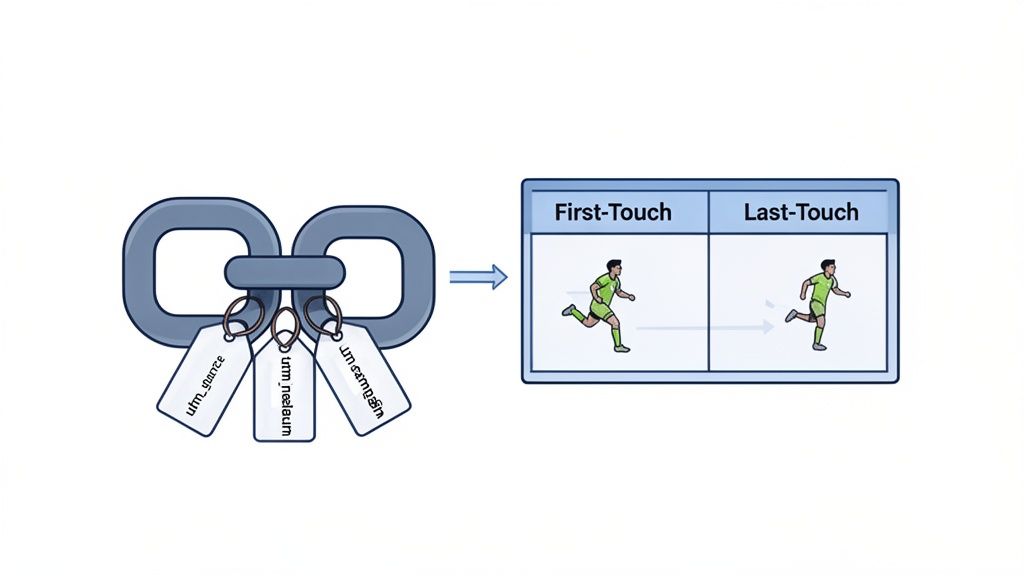
This process is what allows you to connect every marketing action to a concrete result, revealing the true impact of each and every campaign.
Using UTM Parameters: The Digital Name Tags
The secret weapon for super-accurate tracking is something called UTM parameters. Don't let the name scare you off. Think of them as simple labels you tack onto the end of a URL, not as some complex code. These labels tell your analytics tool exactly where a click originated, giving you a crystal-clear view of how your campaigns are doing.
A URL with UTMs looks a little longer, but its job is simple. It’s built to answer three key questions:
- utm_source: Where did this visitor come from? (e.g.,
google,facebook,newsletter) - utm_medium: What kind of link was it? (e.g.,
cpcfor a paid ad,socialfor a post,email) - utm_campaign: Which specific marketing effort is this a part of? (e.g.,
summer_sale_2024,q4_promo)
Let's say you're running a summer sale promotion on Facebook. By tagging your link, you give your analytics platform all the context it needs to properly categorize that website traffic source. For a deeper dive, you can explore this comprehensive guide to using UTM parameters to master your tracking.
This simple act of tagging your links cuts through the guesswork. It also helps you avoid the common headache of "dark traffic," where the true source gets lost and mislabeled as Direct.
Understanding Marketing Attribution Models
Okay, so you're tracking your sources with precision. Now for the next big question: who gets the credit for a conversion? A customer journey is rarely a straight line. They might see a Facebook ad, click an email link a week later, and finally make a purchase after a Google search. So, which website traffic source was responsible for the sale? This is where attribution models come in.
Think of it like a goal in a soccer game. Who deserves the credit?
First-Touch Attribution: This model gives 100% of the credit to the very first marketing interaction a customer had with your brand. It’s like giving all the credit to the defender who made the initial long pass that started the whole play. This is great for understanding which channels are best at generating initial awareness.
Last-Touch Attribution: In this model, 100% of the credit goes to the final touchpoint right before the conversion. It’s the equivalent of crediting only the striker who kicked the ball into the net. As the most common and simplest model, it helps identify which channels are most effective at closing the deal.
While those are the two most basic models, modern analytics platforms also offer more sophisticated options.
Multi-Touch Attribution: This is a more advanced approach that distributes credit across multiple touchpoints in the customer's journey. It recognizes that several interactions often contribute to a final decision, giving you a much more balanced and realistic view of your marketing ecosystem.
The right model for you really depends on your business goals. Are you trying to build brand discovery or drive final sales? Your answer will determine which attribution lens is the most helpful for your analysis.
Automating Tracking with Modern Analytics Tools
Manually building UTMs and debating attribution models can feel like a lot. The good news is, you don’t have to be a data scientist to get these insights. Modern, privacy-first analytics tools like Swetrix are designed to make this whole process intuitive and, for the most part, automated.
Many platforms can automatically parse referral data and categorize your traffic without any manual setup. But for campaign-specific tracking, the real magic happens in dedicated dashboards that bring your UTM data to life.
Instead of getting lost in spreadsheets, you can see at a glance:
- Which campaigns are driving the most traffic.
- Which sources have the best conversion rates.
- The actual revenue generated from a specific email or social media ad.
These tools do the heavy lifting of collecting and organizing the data, which frees you up to focus on what the numbers actually mean. They transform complex tracking data into simple, visual reports, making it easy to spot what’s working and where you need to make a change. It’s all about empowering you to make confident, data-driven decisions without a steep learning curve.
Turning Your Traffic Data into Actionable Insights
Raw data is just a pile of numbers. It’s like having a box full of puzzle pieces—the real value only appears when you start putting them together to see the bigger picture. A well-designed analytics dashboard is what turns those scattered numbers into a clear, compelling story about your website's performance.
This is where you graduate from simply listing your website traffic source categories to actually seeing the trends, patterns, and opportunities hidden inside. A great dashboard doesn't just throw spreadsheets at you; it translates complex information into simple, intuitive visuals that let you make smart decisions at a glance.
Take a look at the dashboard concept below. It’s similar to what we’ve built at Swetrix and is designed to instantly show you where your visitors are coming from.
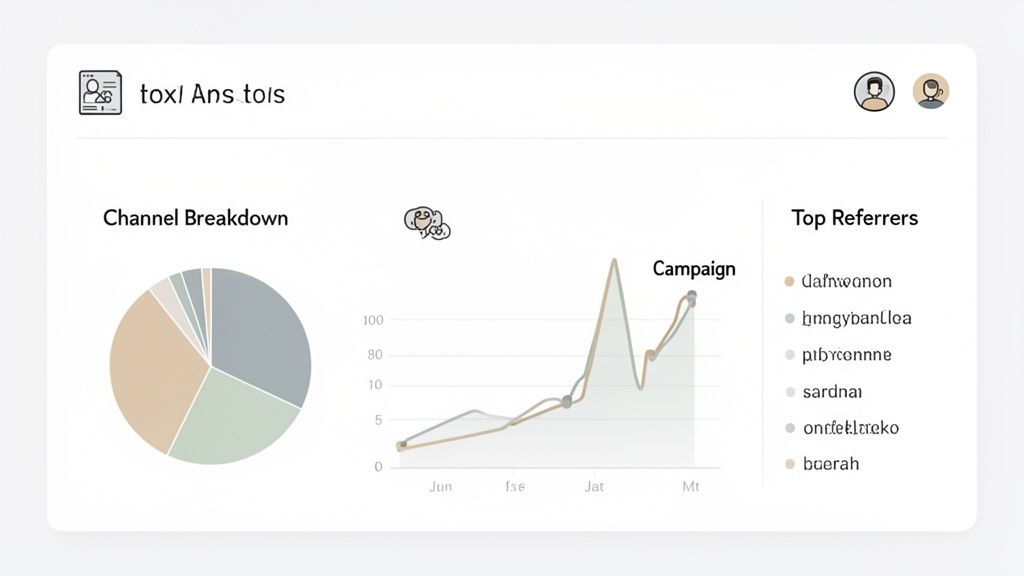
With just one look, you can see your top channels and referring domains broken down into understandable chunks, saving you from having to dig through dense reports to find what matters.
From Data Points to Strategic Decisions
A clean interface should answer your most pressing questions right away. Instead of getting lost in endless rows of data, you can spot critical trends just by looking at a few key charts. This visual approach is all about connecting your marketing efforts directly to tangible results.
For instance, a good dashboard can tell you things like:
- There's a sudden spike in referral traffic, which you can quickly trace back to that guest post you published last week.
- Your latest campaign on X (formerly Twitter) is bringing in more sign-ups than your Facebook ads, even though it got fewer clicks.
- Organic search traffic has been slowly dipping, signaling a potential SEO issue you need to look into.
These aren't just random observations; they are clear signals telling you where to focus your energy. They give you the confidence to double down on what’s working and the clarity to fix what isn’t.
By translating raw numbers into visual stories, a good analytics dashboard closes the gap between collecting data and actually acting on it. You spend less time trying to make sense of the numbers and more time putting those insights to work.
Key Visuals in a Traffic Report
When you log into your analytics platform, your eyes should immediately be drawn to a few core elements that tell the most important parts of your traffic story. A well-structured dashboard makes these components front and center.
Core Dashboard Components:
- Channel Breakdown Chart: Usually a pie or bar chart, this gives you a high-level view of where your traffic comes from (Organic, Direct, Referral, etc.). It’s perfect for seeing if you’re too dependent on a single channel.
- Top Referring Domains List: This simple list is incredibly powerful. It shows you the exact websites sending you the most visitors, helping you identify your best partners and most valuable backlinks.
- Campaign Performance Table: If you’re using UTM parameters, this table is your mission control. It neatly lists your campaigns alongside key metrics like sessions and conversions, letting you compare the performance of different marketing initiatives side-by-side.
These elements work together to give you a complete, holistic picture. If you want more ideas on what makes a great dashboard, check out our guide on building a powerful and intuitive web analytics dashboard.
Ultimately, visualizing your data is about making it human. It’s about finding the story in the statistics—like realizing a blog post you wrote six months ago is suddenly your number-one source of organic sign-ups. Those are the kinds of insights that truly fuel smart, sustainable growth.
Strategies for Growing and Diversifying Your Traffic
Relying on just one source of website traffic is a risky game. It's like building your entire house on a single pillar; it might seem fine for a while, but one crack—say, a sudden Google algorithm update or a change in social media policy—could bring everything crashing down.
Smart growth isn't just about getting more visitors. It’s about building a resilient, diversified portfolio of traffic channels. This approach is your best insurance policy against the unpredictable nature of the internet. By spreading your efforts across multiple streams, you ensure that a slowdown in one area doesn't stall your growth entirely.
Let's dive into some practical strategies to strengthen the channels you already have and build new ones from the ground up.
Fortifying Your Organic Search Presence
For most businesses, organic search is the bedrock of a healthy traffic strategy. It's the gift that keeps on giving, but it demands consistent work to maintain and grow. While it’s tempting to chase broad, high-volume keywords, the real gold is often found in the long tail.
Long-tail keywords are those longer, more specific phrases people type into search engines. They have lower search volume, sure, but they carry much higher intent. Think "best single-serve coffee maker for small kitchens" instead of just "coffee makers."
- Actionable Tip: Fire up a keyword research tool and look for the actual questions your audience is asking. Then, create detailed blog posts or FAQ pages that answer those questions directly. You'll quickly position yourself as a helpful authority.
Don't forget about internal linking, either. It’s one of the most powerful and underused SEO tactics out there. Linking between relevant pages on your own site helps search engines understand your content's structure and passes authority from one page to another, giving your most important pages a nice little boost.
Expanding Through Referral and Partnership Channels
Referral traffic is all about relationships. It’s about getting other respected voices in your industry to point their audience in your direction. The magic of this channel is that it comes with pre-packaged trust—a visitor who clicks through from a site they already follow is coming in warm.
Start by making a list of potential partners. These could be businesses that offer complementary products, influential bloggers, or podcasters who speak to the same audience you do.
The goal isn't just to snag a link; it's to provide genuine value to another creator's audience. When you approach partnerships with a mindset of mutual benefit, you build relationships that drive traffic long-term.
Here are a few proven ways to generate referral traffic:
- Guest Content: Write a fantastic article for a popular blog in your niche. You'll get exposure to a whole new audience and earn a valuable backlink.
- Podcast Appearances: Getting on a relevant podcast as a guest is a phenomenal way to share your expertise and send interested listeners back to your site.
- Strategic Collaborations: Team up with a non-competing business on a joint webinar, a co-branded guide, or a shared promotion.
Each of these tactics taps into an established community, giving you a credible introduction to a fresh pool of potential customers.
Balancing Paid and Organic Social Media
Social media can be a traffic-driving powerhouse, but you need to strike the right balance. Organic posts are perfect for building your community and keeping your brand top-of-mind, while paid ads let you zoom in on specific demographics with laser-like precision.
For organic growth, your focus should be on creating content that is genuinely useful or entertaining—not just an endless stream of promotional messages. The goal is to earn shares and clicks naturally. This also means tailoring your content for each platform; what crushes it on LinkedIn will likely fall flat on Instagram.
Paid social advertising is your accelerator. Use it to put some fuel behind your best-performing organic content or to send targeted traffic directly to a landing page. My advice? Start with a small budget. Test different audiences, images, and headlines to figure out what works before you even think about scaling up your spending.
The Overwhelming Influence of Search Engines
No matter which channels you decide to focus on, it's impossible to ignore the 800-pound gorilla in the room: search engines. Google remains the undisputed king of traffic, holding a staggering 90.83% market share of global searches.
This dominance translates directly into referral traffic, with Google accounting for 63.41% of all referrals to websites worldwide. Its grip is even tighter on desktops at 81.71%. For mobile devices, which now drive 66.02% of global web traffic, Google’s share climbs to an incredible 95.48%. You can explore the full market share report from StatCounter to see the numbers for yourself.
This data makes it crystal clear: a strong organic search strategy isn't just nice to have; it's non-negotiable for long-term success. While diversifying your traffic is critical, ignoring the single largest source of potential visitors is a massive missed opportunity.
Answering Your Top Questions About Website Traffic Sources
As you start digging into your analytics, you’re bound to have questions. Getting a handle on the finer points of your website traffic source data is what separates guessing from making genuinely smart decisions. This section tackles a few of the most common questions that pop up.
Think of it as your go-to cheat sheet for troubleshooting tricky spots and solidifying the concepts we’ve covered.
Which Website Traffic Source Is the Most Valuable?
This is the million-dollar question, but the answer isn't one-size-fits-all. The "best" source is completely tied to your business goals. For a lot of folks, organic search is the holy grail because it brings in people who are actively looking for a solution and costs very little in the long run.
But don't overlook direct traffic. These are often your most loyal followers and brand champions—the people who know your name and come straight to you. On the other hand, if you're running an online store, a well-aimed paid ad campaign can bring in customers with their credit cards out, ready to buy right now.
The real game-changer is shifting your thinking from "Which source gets the most clicks?" to "Which source brings visitors who become high-value customers?" Your analytics platform should be able to answer that.
How Can I See My Traffic Sources Without Google Analytics?
You absolutely can, and many are choosing to do just that. There's a growing world of privacy-focused analytics tools that give you all the source data you need without stepping on user privacy.
Platforms like Swetrix are designed specifically for this. They automatically sort your traffic from search engines, social media, and other websites—all without using cookies or collecting personal information. You can still use UTM parameters just like you would anywhere else, giving you the clear, actionable data you need while staying compliant with rules like GDPR.
Why Is Some Traffic Mislabeled As Direct?
This is a classic analytics headache known as "dark traffic." It happens when the referral information—the digital breadcrumb trail pointing back to where the visitor came from—gets lost along the way.
It’s a common problem when people click links from places that aren't a standard web browser, such as:
- Desktop email apps like Outlook or Apple Mail.
- Mobile messaging apps like WhatsApp or Slack.
- A secure (HTTPS) site sending traffic to a non-secure (HTTP) one.
When the analytics tool can't see the original source, it has no choice but to bucket that visitor under "Direct." The best defense here is a good offense: get into the habit of tagging all your campaign links with UTM parameters. It’s the surest way to get credit where credit is due.
Ready to see your traffic sources with clarity and respect user privacy? Swetrix provides a powerful, cookieless analytics solution that turns your data into actionable insights. Start your 14-day free trial today.