- Date
Understanding Site Unique Visitors to Grow Your Audience
 Andrii Romasiun
A site unique visitor is a fancy term for one real person who visits your website during a specific timeframe. It doesn't matter if they come back five times a day or just once a month; analytics tools will count them as a single individual. This is your go-to metric for understanding the true size of your audience.
Unpacking Your Website Audience

Think of your website like a local coffee shop. Every person who walks in the door is a unique visitor. The loyal customer who stops by every morning for an espresso is counted just once in your weekly report, same as the tourist who pops in for a single latte. That's the essence of unique visitors. It answers one of the most fundamental questions you can ask: how many different people did I actually reach?
Getting a handle on this number is the first real step in measuring your brand's reach. It's easy to get excited about big traffic numbers, but without this context, you're flying blind. A spike in visits could mean you’ve attracted a flood of new people, or it could just be a handful of existing fans coming back over and over. Unique visitors tell you which it is.
The Core Metrics You Need to Know
To really see the value in unique visitors, you have to know how it differs from two other metrics that often get tangled up with it: sessions and pageviews. Mixing these up is a classic analytics mistake, and it can lead to some wildly inaccurate ideas about your website's performance.
Let's quickly set the record straight:
- Unique Visitors tell you who came. Think of this as your headcount of distinct individuals.
- Sessions tell you how often they came. A session is basically one continuous visit, which typically ends after 30 minutes of inactivity.
- Pageviews tell you what they did. This is a raw count of every single page loaded on your site.
It's a one-to-many relationship. One unique visitor can be responsible for many sessions over time, and each of those sessions can rack up multiple pageviews. For example, if someone lands on your homepage Monday and comes back Friday to read a blog post, that’s one unique visitor, two sessions, and however many pages they looked at across both visits.
By focusing on unique visitors, you get a clearer picture of audience growth. An increase in this number means your marketing is successfully attracting new eyes to your brand, not just re-engaging the same loyal fans.
Key Website Metrics at a Glance
Sometimes, seeing these concepts side-by-side makes all the difference. The table below breaks down a common scenario to show how unique visitors, sessions, and pageviews each tell a different part of the story.
| Metric | What It Measures | Example Scenario |
|---|---|---|
| Unique Visitors | The number of distinct individuals who visited your site. | Sarah visits your blog on Monday and Wednesday. She is counted as one unique visitor for the week. |
| Sessions | The number of individual visits to your site. A new session starts after 30 minutes of inactivity. | Sarah's visit on Monday is one session. Her visit on Wednesday is a second session. Total sessions = two. |
| Pageviews | The total number of pages viewed. A single session can have many pageviews. | During her Monday session, Sarah reads three articles. This generates three pageviews. |
Once you see them in action, it's clear why you need all three. Unique visitors measure your reach, sessions measure engagement frequency, and pageviews measure content consumption. Each one provides a valuable, but distinct, piece of the puzzle.
The Old Way of Tracking Unique Visitors
To really get a grip on modern web analytics, you have to look back at the methods that powered the internet for decades. For years, the main tool for identifying a site unique visitor was the simple browser cookie—a tiny text file that acted like a digital ticket stub.
Here’s how it worked: the first time you landed on a website, its server would drop a cookie on your browser containing a unique ID. The next time you came back, your browser would show that "ticket," and the server would know you were a returning visitor, not a brand-new one. It was a straightforward system, but it formed the bedrock of web analytics for a long time.
This method gave marketers the power to tell new visitors from returning ones, follow user journeys across multiple visits, and get a much better sense of their actual audience size.
The Two Types of Tracking Cookies
Of course, not all cookies are the same. The difference between first-party and third-party cookies is critical to understanding both the past and future of visitor tracking. They each had different jobs and, more importantly, vastly different impacts on user privacy.
First-Party Cookies: These are set by the website you're actively on. Think of them as the helpful kind—they remember your login, keep items in your shopping cart, and save your language preferences. For analytics, they're what told a site, "Hey, this person has been here before."
Third-Party Cookies: These were the sneaky ones. They were created by other domains—usually from ads or tracking scripts embedded on the page you were visiting. Their main purpose was to follow you around the web, building a detailed profile of your browsing habits to sling targeted ads your way.
While both types could help count a site unique visitor, third-party cookies fueled a massive digital advertising industry and, in the process, became a huge privacy headache for users.
The Crumbling Cookie Empire
That cookie-based system, once the gold standard, is now on life support. A one-two punch of new regulations and major tech changes has chipped away at its reliability, making old-school analytics data more and more inaccurate.
Several key factors are behind this shift:
Privacy Regulations: Landmark laws like Europe's General Data Protection Regulation (GDPR) handed users the power to say "no" to non-essential cookies. Suddenly, analytics tools couldn't track everyone by default anymore.
Browser Restrictions: In the name of privacy, major browsers like Safari and Firefox started blocking third-party cookies automatically. With Google Chrome finally phasing them out, it’s truly the end of an era for cross-site tracking.
User Behavior: People are more privacy-savvy than ever. With over 42% of internet users worldwide using ad blockers, a huge chunk of your audience is effectively invisible to traditional tracking scripts.
The old promise of a cookie—a persistent identifier for each unique visitor—has been broken. Relying on it today means accepting large and unpredictable gaps in your data.
The Flaws of IP Address Tracking
Another classic method was to simply log a visitor's IP address. Since an IP address is a unique numerical label for a device on a network, it seems logical that one IP could equal one visitor. But this approach was always a bit of a mess.
The main problem is that an IP address often represents a whole network, not just one person. A single public IP address could cover an entire office building or a university campus, making hundreds of different people look like a single visitor. On the flip side, one person using a VPN could show up as multiple unique visitors as their IP address hops around the globe.
These foundational methods—cookies and IP tracking—were the first draft of web analytics. But their growing unreliability and privacy baggage have pushed the industry to find smarter, more ethical ways to understand who is visiting a website. Want to dive deeper into the alternatives? Check out our guide on how to track visits to a website.
A New Era: Measuring Audiences with Privacy at the Core
The way we measure a site unique visitor is fundamentally changing. The old-school methods are giving way to a more modern, privacy-first approach that respects users while still delivering the data you need. This isn't just a minor tech update; it's a massive shift driven by people demanding more control over their data and landmark regulations like GDPR.
This evolution is making room for some really smart cookieless techniques that offer reliable insights without shattering user trust. Instead of relying on invasive third-party cookies that follow people across the web, these new methods focus on creating anonymous, temporary identifiers. It's about knowing your audience without ever needing to know who they are.
The diagram below shows the traditional cookie-based process, a method that’s quickly becoming a relic of the past.
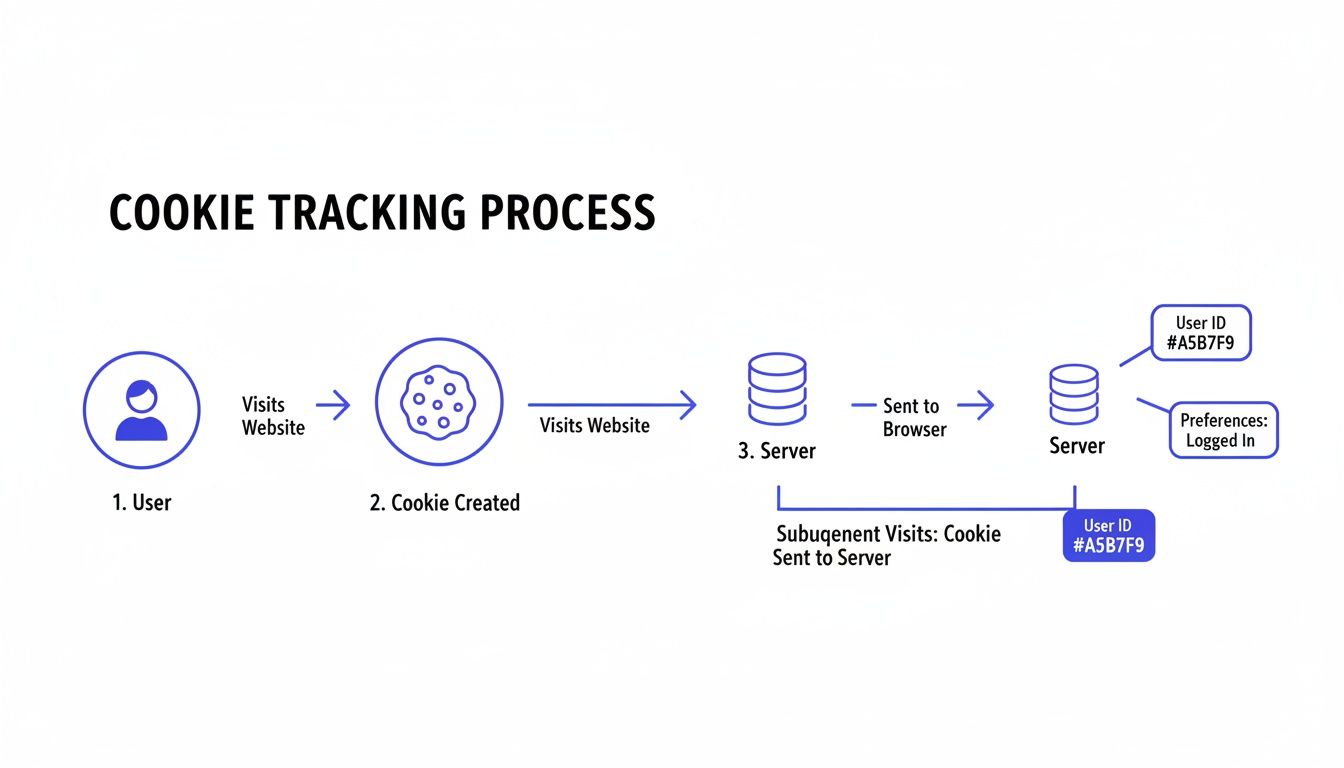
As you can see, this process hinges on a persistent cookie stored on a user's browser, which allows a server to recognize them when they come back. But with major browsers now blocking these trackers, this mechanism is no longer reliable.
Anonymized Hashing: The Modern Analytics Engine
So, if you can't use cookies, how do you count a unique visitor? The answer is a clever technique called anonymized hashing.
Privacy-focused analytics tools like Swetrix use a sophisticated method to create a temporary, unique identifier for each visitor. This identifier is generated by grabbing a few non-personal data points and running them through a one-way hashing algorithm. Think of it like a digital fingerprint that can't be traced back to the person.
Here’s what goes into the mix:
- The visitor's IP address: It’s immediately "salted"—a random string of text is added to it—before being hashed. The original IP is never, ever stored.
- The browser's User-Agent: This gives you general info, like the browser and operating system someone is using.
- The website's domain: This ensures the generated hash is only valid for your website, so the same person can't be tracked on other sites.
These pieces are combined and hashed to create a unique signature for that visitor on that specific day. This signature lets the system tell a new visitor from a returning one within a 24-hour period. After that, the identifier is gone for good.
The real beauty of this method is that it achieves the goal of counting a site unique visitor without storing a single piece of personally identifiable information (PII). The hash is irreversible, meaning you can never reverse-engineer it to find the original data.
Why This Method Puts User Privacy First
The elegance of this approach lies in what it doesn't do. It doesn't drop persistent files on a user's device, it doesn't follow them across different websites, and it certainly doesn't build a long-term profile of their behavior. This makes it fully compliant with strict privacy laws and, just as importantly, meets the expectations of today’s internet users.
This technique gives you the essential data you need—like audience size and engagement trends—without crossing any privacy lines. To really get into the weeds of this new standard, check out our complete guide on privacy-friendly analytics.
Cookieless vs. Cookie-Based Tracking: A Head-to-Head Comparison
To see the real-world benefits, let’s put the two approaches side-by-side. The differences aren't just technical; they reflect two completely different philosophies about data and trust.
| Feature | Traditional Cookie Tracking | Privacy-First Hashing |
|---|---|---|
| Identifier | Persistent cookie file stored on the user's device. | Temporary, anonymous hash generated per visit. |
| Data Stored | Can store personal data and track across sites. | No personal data is ever stored. |
| User Consent | Requires explicit consent via annoying banners. | Often requires no consent banner as no PII is used. |
| Accuracy | Degraded by ad blockers and browser restrictions. | More resilient to ad blockers and browser changes. |
| Privacy Impact | High potential for privacy infringement. | Designed from the ground up to protect privacy. |
This shift isn't just about staying compliant. It's about building a more honest and trustworthy relationship with your audience. When you adopt a privacy-first mindset, you're sending a clear message: you value their trust just as much as you value their traffic. It’s how you get reliable insights to grow your business the right way.
Turning Unique Visitor Data Into Actionable Insights
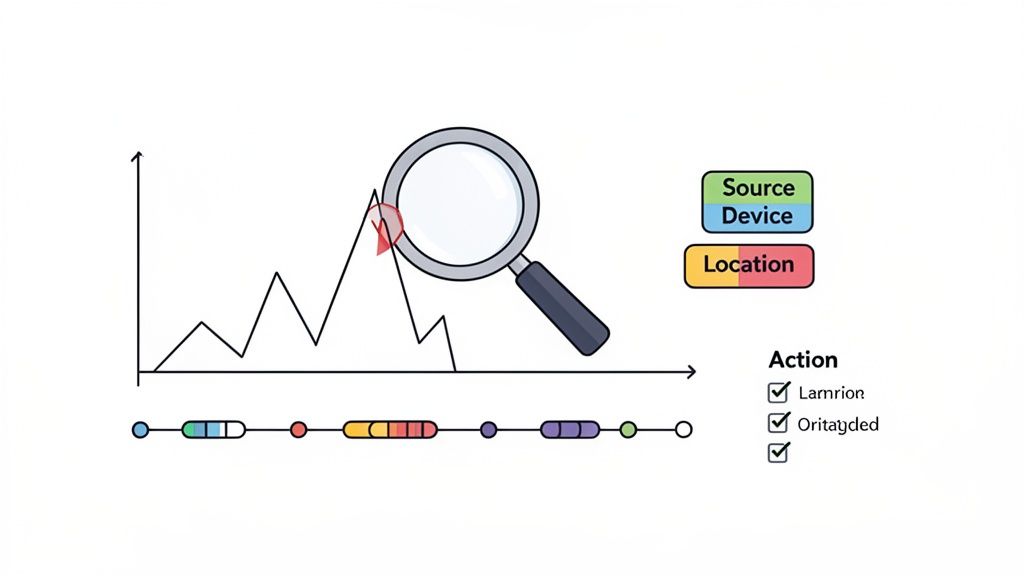
Collecting data on site unique visitors is just the start. Raw numbers on a dashboard don't mean much until you dig in and figure out the story they're telling. This is where you move from just counting people to actually understanding your audience and making smarter decisions.
The first thing to look for is patterns. Is your audience growing steadily month after month? Or are you seeing huge, random spikes followed by crickets? What you really want is sustainable growth—a clear sign that your content and marketing are resonating and building a real following over time.
A sudden, massive surge in unique visitors might look great at first glance, but you have to investigate where it came from. A viral social media post can send a flood of traffic your way, but those visitors often disappear as quickly as they came. Your job is to tell the difference between a fleeting moment of fame and genuine, long-term growth.
Segmenting Your Audience for Deeper Understanding
To find the story behind the numbers, you have to segment your audience. This just means breaking down your total unique visitors into smaller, more focused groups. Doing this helps you see who your visitors are, how they found you, and what they actually care about.
Start by digging into these key segments:
- Traffic Source: Are people finding you through Google (organic search), social media, or direct links? A steady flow of high-quality traffic from search engines is often a great indicator of strong content-market fit.
- Geographic Location: Knowing where your audience is based helps you tailor your content, marketing, and even your products to specific regions.
- Device Type: Is your audience mostly on their phones or sitting at a desktop? If you see a high percentage of mobile visitors, your site's mobile experience isn't just a "nice-to-have"—it's critical.
Getting this specific helps you build a clear profile of your ideal customer. For instance, if you discover that 80% of your new unique visitors are from a particular country and using mobile devices, you know exactly where to focus your attention. For a deeper look at organizing this data, check out how to build an effective web analytics dashboard.
True insight comes from connecting the dots. When you see a jump in unique visitors, try to correlate it with something you did, like launching a new ad campaign or publishing a big piece of content. That direct link between action and result is the bedrock of data-driven marketing.
From Interpretation to Actionable Strategy
Once you understand the "who" and "where," you can start making real strategic moves. Your unique visitor data should directly influence what content you create, where you spend your marketing dollars, and even what features you build next.
Let's say you notice a constant stream of unique visitors landing on a blog post about a very specific problem. That's a huge signal from the market. This single insight can lead you to:
- Create More Related Content: Write more articles, shoot videos, or host a webinar on that topic to position yourself as the go-to expert.
- Develop a Product or Feature: If enough people are searching for a solution, maybe you should build one for them.
- Target Marketing Spend: Run paid ads targeting keywords related to that popular topic to attract an even bigger, highly motivated audience.
The goal is to create a feedback loop: audience behavior informs your strategy, and your strategy attracts more of the right kind of unique visitors.
We're seeing fascinating shifts in visitor patterns with the explosive growth of AI tools. For example, We Are Social noted that ChatGPT.com's traffic, as reported by Semrush, hit a peak of 392 million unique monthly visitors in August 2024. This shows just how quickly new platforms can capture massive audiences, reminding us to always track these surges and understand what's driving them.
Ultimately, analyzing site unique visitors isn’t about just reporting numbers. It’s about asking the right questions, finding the stories hidden in your data, and using those insights to build a stronger, more meaningful connection with your audience.
How Do Your Numbers Stack Up? A Reality Check
It’s easy to get lost in your own analytics. You see a number for your site unique visitors and wonder, "Is that good?" To really understand your performance, you need a little perspective. Seeing how your numbers fit into the grand scheme of the web can ground your strategy and help you appreciate the audience you already have.
When you start looking at the bigger picture, the numbers get mind-bogglingly large. Let's talk about the true giants of the internet. Looking at their traffic isn't about feeling small; it's about understanding the sheer scale of the online world and finding your place in it.
The True Scale of the Web
So, what does "big" really look like? Think about the household names. In August 2025, Google.com saw an incredible 5.66 billion unique monthly visitors. That's a single website reaching over 70% of everyone online, globally. You can dig into these kinds of numbers and see just how they're measured over at Statista's analysis of global web traffic.
Numbers like that don't just put things in perspective; they highlight a major challenge. How do you even begin to track billions of individuals? It shows why traditional cookie-based tracking starts to break down at scale, becoming not just a privacy nightmare but a massive technical problem.
The point isn't to chase Google's numbers. The real takeaway is that even an almost immeasurably small slice of that audience—say, just 0.001%—can represent a life-changing number of customers for most businesses.
Turning Huge Numbers Into a Practical Strategy
Okay, so how does knowing Google's traffic help you on a Tuesday morning? It helps you filter out the noise and focus on what actually matters for your growth. Instead of feeling intimidated, you can use these benchmarks to build a smarter, more realistic plan.
Think of the global internet audience as a massive ocean. You're not trying to boil it; you're just trying to catch the right fish for you.
Set Realistic Goals: Understanding the scale of the web helps you set targets that make sense. Getting your first few hundred or thousand dedicated site unique visitors is a huge milestone worth celebrating.
Zero in on Your Niche: You don't need billions of visitors. You need the right visitors. A small, deeply engaged community is infinitely more valuable than a massive, indifferent crowd.
Value Every Visitor: Each new unique visitor represents a real person who decided to give you their time and attention. That’s a win. Acknowledge and appreciate your growth, whether you're going from 10 to 100 visitors or 1,000 to 10,000.
This mindset shift is key. It helps you stop worrying about vanity metrics and start building effective campaigns that attract the specific people who will love what you do. Your goal is to carve out your own corner of the internet, not get lost trying to conquer the whole thing.
What to Do When Your Visitor Numbers Don't Match
It’s a classic head-scratcher for anyone in web analytics. You pull up your dashboard in one tool, then check another, and the numbers for your site unique visitors are completely different. Your first thought might be that something is broken, but that's rarely the case.
More often than not, this is just a side effect of different tools having different ways of measuring traffic. Think of it like two pollsters asking slightly different questions—they'll get similar, but not identical, results. Understanding why they differ is the key to actually trusting your data.
Why Your Analytics Never Tell the Exact Same Story
The core of the issue usually comes down to the tracking method. One platform might be using old-school cookies that a lot of browsers now block, while a privacy-focused tool like Swetrix might use a more resilient, anonymous hashing technique. Each method captures a slightly different view of your audience, so the final counts will naturally vary.
But the differences go even deeper than that. Several other factors are always at play.
Here are a few of the most common reasons your numbers won't align perfectly:
- Bot Filtering: Every analytics service has its own secret sauce for sniffing out and ignoring traffic from bots and web crawlers. Some are way more aggressive than others, which can have a surprisingly big impact on your final visitor count.
- Session Definitions: What counts as a "session"? Most tools use a 30-minute window of inactivity to end a session, but even tiny differences in how they handle timeouts or renew sessions can ripple through and affect your visitor metrics.
- Ad Blockers and Privacy Tools: A huge chunk of internet users now run software that blocks tracking scripts. If one of your analytics scripts gets blocked but another one doesn't, you’re guaranteed to see a mismatch in the data.
The real goal isn't to force two different tools to show the exact same number—that's a losing battle. What you should be looking for are the trends. If both tools show a consistent spike after you launch a new campaign, they're telling you the same important story, even if the absolute numbers are different.
A Quick Checklist for Validating Your Data
When the numbers feel a bit wild, it's easy to start doubting your entire setup. Instead of going down that rabbit hole, work through a quick, systematic check to find the likely culprit.
- Check Your Tracking Snippet: First things first, is your tracking code actually on every single page? It’s a common mistake to miss a template or a specific landing page, which will definitely lead to undercounting.
- Review Your Filters: Take a look at the filters you've configured. Are you blocking traffic from your office IP? If you're trying to compare two tools, you need to make sure those filters are set up exactly the same in both.
- Remember the Multi-Device User: People browse on their phones, then their laptops, then their tablets. That single person can easily show up as three "unique" visitors. With mobile driving over 141 billion website visits in December 2023 alone, this fragmentation is a huge factor. You can dig into more of these global traffic statistics to see just how split the landscape is.
- Focus on Trends, Not Totals: This is the big one. Stop fixating on the absolute numbers and start looking at the bigger picture. Pull up a month's worth of data. Are the daily and weekly patterns similar across your tools? If the trend lines are moving in the same direction, you can be confident that your data is telling you what you need to know.
Common Questions About Unique Visitors
As you dive deeper into web analytics, a few questions always seem to surface. Let's tackle some of the most common head-scratchers about unique visitors to clear up any confusion and make sure you feel confident reading your data.
Think of this as a quick-fire Q&A to lock in the concepts we’ve talked about.
Why Are My Unique Visitors Lower Than My Sessions?
This is actually a great sign! It means your analytics tool is doing its job correctly. The core reason is simple: one person (a unique visitor) can start multiple sessions.
Imagine a loyal customer visits your e-commerce site on Monday, pops back in on Wednesday, and makes a purchase on Friday. Your analytics will register this as one unique visitor responsible for three separate sessions. This is a crucial distinction. Unique visitors tell you how many people you've reached, while sessions show how often they're coming back.
When you see more sessions than unique visitors, it's often a signal of a healthy, engaged audience. People are finding your site valuable enough to return.
How Do Cookieless Tools Identify a Returning Visitor?
Privacy-focused tools have a clever way of recognizing returning visitors without ever using cookies. They generate a temporary, anonymous fingerprint for each visit.
This is done by taking non-personal data points—like a visitor's IP address (with a random string of text, or "salt," added for security) and their browser's user agent—and combining them. This combined string is then passed through a one-way hashing algorithm, which creates a unique ID for that visit. The original data is immediately discarded, and the hash can't be reverse-engineered. It's a smart, GDPR-compliant way to count a unique visitor within a specific timeframe (usually 24 hours) while completely protecting their privacy.
How Do Ad Blockers and VPNs Affect My Data?
Ad blockers and VPNs can definitely throw a wrench in the works. Many ad blockers are specifically designed to stop tracking scripts from ever loading, which means those visitors simply won't be counted. This can lead to a significant underreporting of your true audience size.
VPNs create a different problem by hiding a user's real IP address. If one person visits your site multiple times using different VPN servers, they might show up as several different unique visitors. While no analytics tool is totally immune, the best approach is to focus on long-term trends instead of getting hung up on perfectly exact daily numbers.
What Is a Good Monthly Growth Rate for Unique Visitors?
Honestly, there’s no single "right" answer. A good growth rate depends entirely on your industry, how long your business has been around, and what you're trying to achieve.
- A new startup trying to make a splash might shoot for an ambitious 15-20% month-over-month growth.
- A well-established company, on the other hand, might see a steady 5-10% growth as a huge win.
The most practical strategy is to benchmark against yourself. Focus on achieving consistent, sustainable growth that you can tie back to your marketing and content efforts. That's a far better measure of success than chasing an arbitrary number.
Ready to measure your audience without compromising their privacy? Swetrix provides the clear, actionable insights you need to grow your business the right way. Start your 14-day free trial today and see what you've been missing.