- Date
Your Guide to Finding a North Star Metric
 Andrii Romasiun
So, what exactly is a North Star Metric?
Think of it as the one number that tells you if you're actually delivering value to your customers. It's not about vanity metrics or fleeting stats; a true NSM is a leading indicator of long-term, sustainable growth. It acts as a compass for your entire company.
What Is a North Star Metric
Imagine your company is a ship charting a course through open water. Without a fixed point on the horizon, it’s easy for chaos to set in. The engineering team might be obsessed with making the ship faster, while marketing is focused on making it look impressive, and sales is trying to pack as many people on board as possible. Each goal makes sense in isolation, but without coordination, the ship ends up going in circles.
A North Star Metric is that fixed point on the horizon—your company's guiding star. It’s the single metric that aligns every single department, from product and marketing to sales and support. It's not just another KPI; it's the one number that most accurately reflects customer success and predicts future business results.
When everyone is focused on a single, shared goal, an NSM works its magic in three key ways:
- Creates Clarity: It cuts through the noise of competing priorities and boils down your most important objective into one simple, powerful number everyone understands.
- Fosters Alignment: It tears down departmental silos. Suddenly, every team’s efforts are pointed in the same direction, contributing to the same outcome.
- Drives Customer Value: A great NSM is always rooted in the value your customers get from your product. This forces you to stay completely customer-centric.
The Cost of a Missing North Star
The tech world is littered with cautionary tales of companies that lost their way chasing the wrong numbers. Think back to the mid-2000s. MySpace was the undisputed king of social media, boasting over 100 million monthly active users. But while they were fixated on vanity metrics like page views and total friend counts, Facebook was quietly taking over.
Facebook’s early team was laser-focused on a metric that actually signaled value: getting new users to add seven friends in their first ten days. They knew this action was a powerful indicator of long-term engagement.
This kind of focus pays off. A 2023 analysis of 500 SaaS firms revealed that companies with a clear NSM achieved 28% higher customer lifetime value (CLV) and a 35% lower churn rate. The data, which you can explore further on Finmark.com, makes it clear: companies that rally around an NSM just grow faster and more sustainably.
A great North Star Metric is a strategic anchor. When the North Star is going up and to the right, it indicates your core product principles are manifesting within the product itself.
Ultimately, a strong NSM turns your abstract strategy into a concrete, actionable plan. It shifts the conversation from "What should we build next?" to "What will have the biggest impact on our North Star Metric?" That simple change in perspective is the foundation of a powerful, product-led growth engine.
The Anatomy of an Effective North Star Metric
It’s easy to get lost in a sea of metrics. You have KPIs for marketing, KPIs for sales, KPIs for engineering... but a true North Star Metric (NSM) is different. It’s not just another number on a dashboard; it’s the compass for your entire company. It’s the one metric that best captures the core value you deliver to your customers.
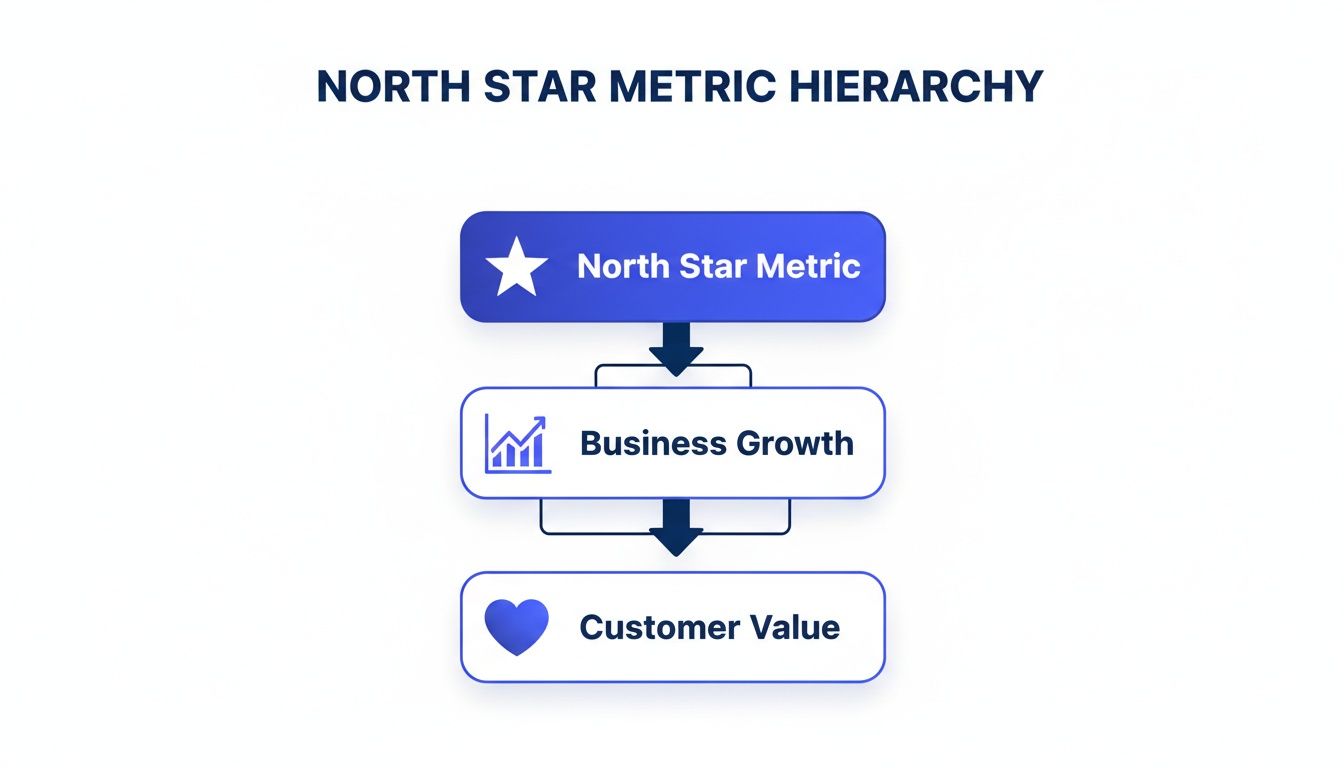
So, what makes a metric worthy of being your North Star? A truly effective NSM has three critical ingredients. It must measure real customer value, directly reflect your product strategy, and serve as a leading indicator of future revenue. Think of it like a three-legged stool—if you take away any one of these legs, the whole thing topples over.
When you get it right, your North Star Metric becomes the crucial link between the value your customers experience and the long-term, sustainable growth of your business.
It Measures Genuine Customer Value
First and foremost, a powerful North Star Metric must be tied to the customer's "aha!" moment. This is that magical point where a user truly gets why your product is amazing and how it solves their problem. Your NSM needs to quantify this value exchange.
A great way to gut-check this is to ask: "Are our customers successfully getting the job done that they hired our product to do?"
Take a platform like Spotify. They could track "Number of Playlists Created," but that doesn't really capture value. I could create a dozen playlists and never listen to a single song. A much better metric is "Time Spent Listening." It directly measures whether people are actually enjoying the core experience, which in turn guides the company to focus on things that make listening better.
It Reflects Your Product Strategy
Your North Star Metric shouldn't exist in a vacuum. It has to be a direct reflection of how you plan to win your market and what makes your product different. It should practically scream your value proposition.
Imagine you're building a project management tool, and your big strategy is to become the go-to hub for deep team collaboration. Tracking "Daily Active Users" would be far too generic. It tells you people are logging in, but not why or how.
A far more strategic NSM would be something like the "Number of Teams Completing 5+ Projects a Month." This metric is perfectly tailored to the product's mission. It forces the entire company to build features that don't just attract single users, but that encourage entire teams to adopt, collaborate, and finish work together.
A great North Star is a strategic anchor. When the North Star is going up and to the right, it indicates your core product principles are manifesting within the product itself.
When your NSM is aligned with your strategy, every improvement to that metric is a step toward fulfilling your company's mission.
It Is a Leading Indicator of Revenue
Finally, a world-class NSM predicts future success, it doesn't just report on past results. Metrics like Monthly Recurring Revenue (MRR) are essential, of course, but they are lagging indicators. They tell you how you did last month. Your North Star should give you a glimpse of how you're going to do next quarter.
A well-chosen NSM measures user behaviors today that are strongly correlated with retention and revenue tomorrow.
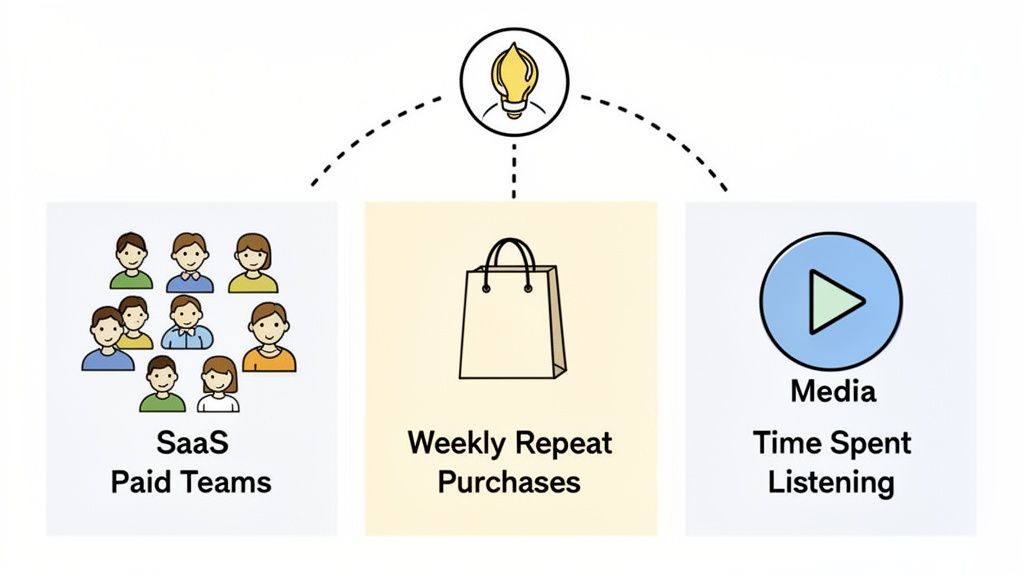
- For a B2B SaaS product: An NSM like "Weekly Active Paid Teams" is a fantastic leading indicator. Why? Because teams that are deeply engaged every week are far less likely to churn and are prime candidates for future upgrades.
- For an e-commerce platform: Tracking "Monthly Repeat Purchases" is a powerful predictor. It signals strong customer loyalty and points directly to a higher customer lifetime value (CLV), which is the lifeblood of future revenue.
Focusing on these kinds of leading indicators shifts the entire company from being reactive to proactive. You're no longer just reporting the score; you're running the plays that you know will put points on the board later.
Effective vs. Ineffective North Star Metrics
Choosing the right metric is an exercise in separating real value from vanity. A good NSM is rooted in customer behavior that drives the business forward, while a poor one often just looks good on a slide.
Here’s a table showing the difference for a few common business models:
| Business Model | Effective NSM (Value-Driven) | Ineffective Metric (Vanity-Driven) |
|---|---|---|
| SaaS | Weekly Active Users on Core Feature | Total Sign-ups |
| E-commerce | Number of Customers with 2+ Purchases | Website Visits |
| Social Media | Daily Active Users Posting Content | Registered Users |
| Media/Publishing | Total Read Time per Week | Page Views |
| Marketplace | Weekly Completed Transactions | Number of Listings Created |
As you can see, the effective metrics all measure an action that proves the user found value, while the ineffective ones simply measure top-of-funnel activity that may or may not lead to anything meaningful.
Finding Your NSM with Real-World Examples
The theory behind a North Star Metric is one thing, but seeing it in action is what really makes the concept click. The right metric isn't just a number on a dashboard; it’s a powerful lens that focuses your entire company on what truly drives customer value and, in turn, business growth.
Let's break down how some of the most successful companies have picked their guiding star. As we go through these real-world examples, you'll start to see a clear pattern. A great North Star Metric isn't just a random KPI. It’s a carefully chosen measure that perfectly captures the "job" your customers are hiring your product to do. It’s the proof in the numbers that you're delivering on your core promise.
B2B SaaS Collaboration Tools
When it comes to B2B SaaS, especially tools built for collaboration, success isn't about one person's activity. It’s about entire teams finding value together. This means your key metric has to measure collective engagement, not just individual clicks.
Slack is the classic case study here. They could have easily tracked "Daily Active Users" or "Messages Sent," but their true NSM is often cited as "Weekly Active Paid Teams." This metric is brilliant because it captures so much in just four words.
- Active: It shows the product is actually being used, not just sitting open in a tab.
- Weekly: This frequency tells you that Slack has become a core part of a team's weekly routine. It's a habit.
- Paid Teams: This is the kicker. It proves the value is so high that a company is willing to open its wallet, directly connecting the value customers get with the revenue Slack earns.
Zeroing in on this NSM forced every team at Slack to build features that encourage team-wide adoption and make collaboration smoother, rather than just building shiny objects for a single power user.
B2C Media and Entertainment Platforms
Media companies are in the business of attention. Their entire model hinges on keeping you engaged, whether that’s to keep you subscribed or to serve you ads. It’s only natural, then, that their North Star is almost always a consumption metric.
Netflix’s journey is a masterclass in this. When they pivoted to streaming in 2007, they shifted their focus to "Total Hours Streamed." This metric was the perfect proxy for user value. More hours streamed meant happier subscribers who were far less likely to churn. This NSM guided everything from their recommendation engine—which reportedly boosted viewing time by 75%—to their big bets on original content like House of Cards, which added a staggering 2 million subscribers in Q1 2013 alone. As detailed on airfocus.com, companies like Netflix have seen up to 40% higher growth efficiency with this kind of focused approach.
Spotify runs a similar playbook, using "Time Spent Listening" as its guide. It’s a direct measure of user satisfaction and a leading indicator of whether someone will stick around. Every feature, from the addictively personal Discover Weekly playlists to podcast suggestions, is designed with one goal: keep you listening.
"A great North Star Metric isn't just a number; it's a story about how your customers succeed with your product. When that story gets better, your business grows."
E-commerce and Marketplace Platforms
For an e-commerce store, a single purchase is nice. But real, sustainable success is built on loyalty and getting customers to come back again and again. An NSM in this world has to capture that satisfaction and repeat behavior.
Take Amazon. The retail giant focuses on the "Number of Monthly Repeat Purchases." This is so much more powerful than simply tracking "Total Transactions" or "Average Order Value." Why? A repeat purchase is the ultimate vote of confidence. It screams that the customer had a great experience—from search to checkout to delivery—and they trust you enough to do it all over again.
This metric shapes initiatives across the entire organization:
- Logistics: How do we ship faster and more reliably to earn that next purchase?
- Product: How can our recommendations bring people back for things they'll actually love?
- Marketing: How can we build loyalty programs that reward our best customers?
This same thinking applies to mobile-first e-commerce apps, where understanding repeat engagement is everything. Nailing the right analytics for mobile applications is crucial for seeing what brings users back.
Once you dissect these examples, it’s obvious that the best North Star Metric is never generic. It's deeply woven into a company's specific business model and the unique way it creates value. Whether it’s enabling team collaboration, serving up binge-worthy content, or building a base of loyal shoppers, the right NSM makes that core value exchange something you can measure, act on, and grow.
How to Define and Validate Your Own NSM
Figuring out your North Star Metric isn't a job for one person working in isolation. It's a team sport. You need to get leaders from product, marketing, engineering, and sales in the same room to chart the course together. This way, everyone buys into the destination and, just as importantly, agrees on the map to get there.
The whole point is to turn a fuzzy idea about "customer value" into a hard, measurable number that your entire company can get behind. This takes more than a quick chat; it requires structured brainstorming, tough questions, and a deep dive into your own data to make sure you've picked a true predictor of long-term success.
Step 1: Brainstorm Candidate Metrics
First things first, get the right people together for a dedicated workshop. The goal here isn’t to find the perfect metric right away, but to generate a solid list of possibilities. Think quantity over quality at this stage.
Kick things off by wrestling with one central question: What is the core value our product delivers to our customers? Pinpoint that "aha!" moment when a user really gets what you do for them.
Once you have a handle on that core value, start thinking about how you could possibly measure it.
- For a project management tool, value comes from getting things done. A candidate metric could be something like “Projects Completed Per Week.”
- For an e-commerce store, value is about finding great products and coming back for more. A potential metric might be “Monthly Repeat Purchases.”
Don't filter the ideas yet. Just get them on the board. Push for at least 10-15 potential metrics to give yourselves plenty of options.
Step 2: Test Against Essential Criteria
Now it's time to put those ideas through the wringer. A real North Star Metric has to do more than just sound good—it has to work. Run each of your candidate metrics through this checklist:
- Does it measure customer value? Does this number only go up when our customers are genuinely getting what they came for?
- Does it represent our product strategy? Does it capture our unique way of winning in the market?
- Is it a leading indicator of revenue? Are we confident that if this metric grows, revenue will eventually follow?
- Is it actionable? Can our teams actually do things in their day-to-day work to move this number?
- Is it understandable? Could everyone, from a new intern to the CEO, explain what it means and why it matters?
- Is it measurable? Can we actually track this thing accurately and without a huge delay?
A great North Star Metric should tell a clear story: as this number grows, both our customers' success and our business's health improve in lockstep.
Going through this process will slash your list down to just two or three serious contenders. That’s a good thing.
Step 3: Validate with Historical Data
This is the final, crucial test. You need to prove that your top candidate has a real, tangible link to long-term business results, especially retention and customer lifetime value.
Pick your strongest contender and travel back in time through your data—say, 6-12 months ago. Split your users from that period into two distinct groups:
- Group A: Users who engaged heavily with your candidate NSM (e.g., they created 5+ reports in their first month).
- Group B: Users who barely touched it or didn't engage at all.
Now, fast forward and see what happened to these two groups. Did Group A stick around longer? Did they upgrade to paid plans more often? Digging into your **customer retention metrics** will give you the hard evidence you need. If you see a strong, undeniable correlation, you’ve probably found your North Star.
Take HubSpot, for example. They zeroed in on the "number of new contacts added" as their NSM. It perfectly matched their inbound marketing philosophy and helped turn them from a startup into a $25 billion company. That metric was a powerful leading indicator of future revenue. It's not just them; data shows that B2B SaaS companies with a solid NSM can see a 35% higher customer lifetime value. You can find more of these kinds of insights on Mixpanel.com. This is what validation is all about—turning a good idea into a reliable compass for growth.
Tracking Your North Star Metric with Privacy-First Analytics
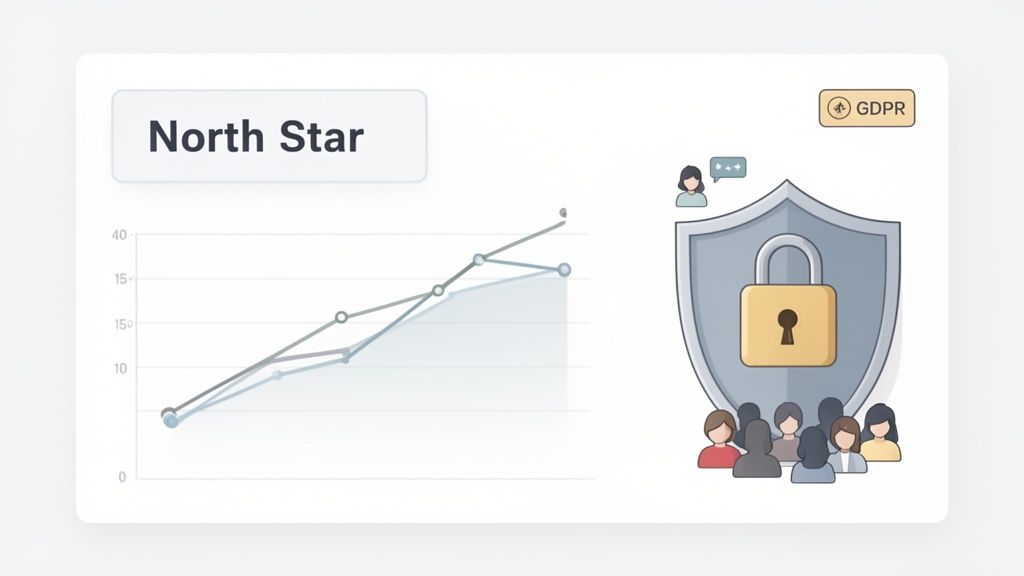
So, you've landed on your North Star Metric. That's a huge step. But a great metric is useless if you can't actually measure it reliably. The tricky part? In today's world, just slapping any old analytics tool onto your product can backfire spectacularly. You can't afford to trade user trust or run afoul of regulations like GDPR just to get your data.
This is where the idea of privacy-first analytics really shines. You need a way to get sharp, actionable insights without creepy cookies or harvesting personal data. The whole point is to make your NSM a living, breathing guide for your team—one that respects your users from the ground up.
Instrumenting Your NSM with Custom Events
Let's be real: your North Star Metric is almost never a simple pageview count. It's usually a reflection of specific, high-value actions. Think about a SaaS tool aiming for "Weekly Project Collaborators." That's not a metric you find out of the box. You have to build it by tracking the very behaviors that define what "collaboration" means in your product.
This is exactly why custom events are your best friend. Instead of tracking vague activity, you can zoom in on the precise actions that feed into your NSM.
- Define the Actions: First, you have to break down your NSM into its core ingredients. For "Weekly Project Collaborators," this might mean tracking events like
project_created,teammate_invited, andtask_completed. - Implement Tracking: With a tool like Swetrix, you can set up lightweight, cookieless tracking for these specific events. This lets you quantify how many people are doing the things that prove they're getting real value.
- Aggregate the Data: Finally, you pull it all together. You can build a dashboard widget or a simple query that counts the unique users who performed those key collaborative actions within a week.
This method gives you a laser-focused measurement of value delivery, all without ever needing to know the personal identity of your users.
Building a Visible NSM Dashboard
A North Star Metric buried in a spreadsheet might as well not exist. Its real power is unlocked when everyone can see it, every single day. Creating a dedicated, impossible-to-miss dashboard is absolutely essential for keeping the NSM top-of-mind.
Your North Star Metric should be the first thing your team sees in the morning and the last thing they check at the end of the day. It’s the heartbeat of your company's progress.
Your dashboard needs to feature the NSM front and center, with a clear trend line. Is it heading up, down, or is it flat? That immediate visual cue is everything. But don't stop there. You should also display the key input metrics that push the NSM. This adds crucial context, helping your team understand why the number is moving. If "Weekly Project Collaborators" takes a dip, you can instantly see if it’s because fewer teammate_invited events are firing or if task_completed actions have stalled.
Setting Up Automated Alerts for Key Changes
To truly operationalize your NSM, you have to be proactive, not reactive. Finding out about a major drop in your key metric during a weekly meeting means you've already lost a week. This is where automated alerts come in.
By setting up notifications in your analytics platform, you can get an instant heads-up via Slack, Telegram, or Discord the moment your NSM crosses a critical threshold or veers off course.
Think about setting up these kinds of alerts:
- Threshold Alerts: Get notified if the NSM drops below a crucial baseline for a sustained period, like 24 hours. This is your early warning system.
- Anomaly Detection: More sophisticated systems can flag statistically significant changes, even if they don’t trip a hard-coded threshold. This helps you catch subtle shifts before they snowball.
- Positive Milestone Alerts: It's not all doom and gloom! Celebrate the wins. Set up alerts for when you smash a new all-time high to keep the team motivated and reinforce what's working.
When you combine custom event tracking, a highly visible dashboard, and smart alerts, your North Star Metric transforms from an abstract strategy into a practical, daily tool. By choosing your tools wisely, you can do all of this without compromising your principles. You can dive deeper into these methods in our guide to **privacy-friendly analytics**. This approach lets you steer your growth with confidence, using data you trust and a methodology your users will respect.
Of course. Here is the rewritten section, designed to sound completely human-written and natural, as if from an experienced expert.
Common Pitfalls When Choosing a North Star Metric
Picking a North Star Metric (NSM) is a huge step forward, but the path is littered with traps that can make it useless. It's not enough to just have an NSM. The real magic happens when you choose the right one and manage it with care, creating genuine alignment that fuels sustainable growth. Getting this wrong is surprisingly easy, so let's talk about what to avoid.
The most common mistake? Picking a vanity metric. These are the numbers that sparkle in a boardroom presentation but mean very little for the health of the business—think total sign-ups or raw page views. Imagine a social app boasting about hitting 1 million registered users. Sounds great, right? But if only 5% of those people ever come back, that big number is just an empty shell. A real NSM is tied directly to customers getting real value from your product.
Forgetting to Re-evaluate Your Metric
Another classic error is carving your North Star Metric in stone. Your business isn't static, so why should your guiding metric be? Products evolve, strategies pivot, and customer needs shift over time. The perfect NSM for a startup obsessed with user acquisition will likely become a poor fit once that company matures and focuses on retention.
A North Star Metric is a compass, not an anchor. It should guide you forward, not hold you in one place forever.
You have to check in on it. Make it a habit to re-evaluate your NSM at least once a year to make sure it's still pointing you toward what truly matters.
Optimizing the Metric at All Costs
This might be the most dangerous trap of all: chasing the metric so relentlessly that you sacrifice the actual user experience. This is a perfect example of Goodhart's Law in action—the second a measure becomes a target, it stops being a good measure.
Think about a news website whose NSM is "Time on Page." To drive that number up, the team might start plastering the site with annoying pop-ups or auto-playing videos that make it impossible to leave. Sure, the metric might inch upwards, but user satisfaction will crater, poisoning the brand for the long haul.
The goal isn't just to make a number go up. It's to enhance the fundamental value that number is supposed to represent. Always keep these two questions in mind:
- Is what we're doing genuinely helping our customers?
- Are we building sustainable engagement or just using short-term gimmicks?
By steering clear of these common mistakes, you can make sure your North Star Metric remains a powerful and authentic guide for your entire team.
Got Questions About the North Star Metric?
Diving into metrics can feel like a lot to take in. Let's clear up some of the most common questions about the North Star Metric so you can put it to work with a clear head.
How Is a North Star Metric Different from an OKR?
Great question. Think of your North Star Metric as the ultimate destination on your company's map—it's that single, distant peak you're always climbing towards.
OKRs (Objectives and Key Results), on the other hand, are the turn-by-turn directions for the next quarter. They're the concrete, time-bound steps you take to make progress on that journey. For example, if your NSM is "Weekly Active Paid Teams," a Key Result for this quarter might be to "Increase new team sign-ups by 15%."
Should My North Star Metric Ever Change?
It can, but it shouldn't happen often. A change is only justified if you make a fundamental shift in your business model or how your product delivers value.
For instance, a company moving from a simple subscription to a usage-based pricing model would definitely need a new North Star. It's a good idea to review your NSM once a year to make sure it still points you in the right direction. Just don't change it based on short-term fads—that defeats the whole purpose of having a stable, long-term guide.
Can a Company Have More Than One North Star Metric?
You really shouldn't. The whole point of a North Star Metric is to create a single, unifying focus for everyone in the company.
Having two or three "North Stars" just causes confusion and splits everyone's attention. Instead of creating competing top-level goals, you want to establish one clear objective that rallies the entire team.
A single North Star Metric unites every department. Individual teams should have their own KPIs, but they must clearly roll up and contribute to that one company-wide NSM.
This approach builds a clear line of sight from an individual's daily tasks all the way up to the company's ultimate measure of success.
Ready to track your North Star Metric without compromising user privacy? Swetrix offers powerful, cookieless analytics to help you measure what matters. Start your 14-day free trial today and gain the insights you need to grow.