- Date
Why Your GDPR Cookie Popup Is Ruining Your Data
 Andrii Romasiun
A visitor clicks a link to your pricing page. Before they read the first headline, a banner blocks the screen. They hit "Reject All". The visitor vanishes from the tracking dashboard. This sequence repeats thousands of times a day. Deploying a GDPR cookie popup degrades user experience and blinds the analytics platform.
Webmasters spend massive budgets driving traffic to content. You optimize ad copy, refine landing pages, and test call-to-action buttons. You then build a digital roadblock demanding a legal decision from every visitor. This barrier prevents marketers from measuring campaign performance.
Marketers face a choice in 2026. Continue fighting plummeting opt-in rates, or drop invasive trackers. Removing these trackers allows site owners to measure traffic without asking for permission.
The Financial Cost of the GDPR Cookie Popup
The Mechanics of a GDPR Cookie Popup
Under European privacy laws, webmasters must ask users for permission before setting optional tracking technologies on a device. A GDPR cookie popup halts the user journey until the visitor chooses a data collection preference.
Open an incognito window. Navigate to the homepage. Count the clicks required to decline tracking. When rejecting trackers takes more effort than accepting them, the site violates current legal standards.
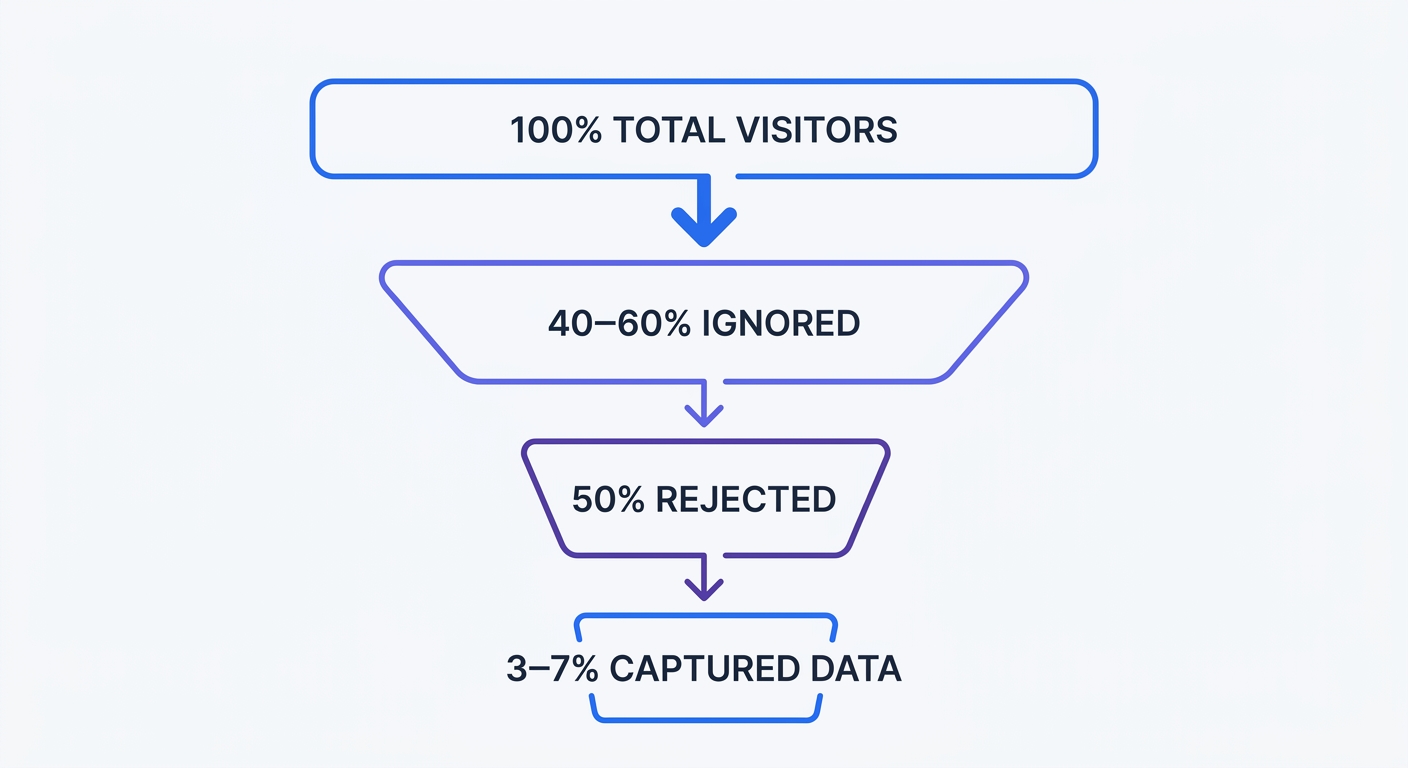
The opt-in framework creates a mathematical bottleneck. A small fraction of internet users want targeted advertisements. The rest tolerate or despise these ads. Forcing a conscious choice upon arrival causes opt-in numbers to collapse. Visitors arrive with a goal to read an article or buy a product. Reviewing third-party vendor lists interrupts the visitor's primary objective.
Check the UTM analytics dashboards. A typical Facebook campaign might show 500 clicks in an ad manager, but a mere 25 land in the analytics platform. The missing 475 users refused the tracking request. Paying for 500 clicks while optimizing ad spend based on 25 data points ruins campaign efficiency.
The 97 Percent Data Vanishing Act
Marketers optimize campaigns using incomplete datasets. Opt-in rates for strictly compliant banners hover between 3 and 7 percent in the EU. These numbers vary by industry, with B2B tech sites seeing higher rejection rates than consumer entertainment blogs. While less restrictive global opt-in rates can average between 43 and 54 percent depending on banner prominence, strict opt-in frameworks see acceptance collapse.
Provide users with equally visible "Accept" and "Reject" buttons. The majority of visitors either actively reject tracking or ignore the prompt by scrolling past the banner or closing the tab. Site owners record zero data for all these individuals.
Calculate the tracking gap this week. Start by pulling total visitor numbers from the web server logs. Compare that raw number against frontend sessions in the analytics dashboard. The difference equals the untracked audience size.
For businesses relying on individual user data, this drop-off eliminates the ability to perform accurate A/B tests. Missing the vast majority of audience behavior prevents teams from achieving statistical significance. Conversion rate optimization efforts become guesswork under these conditions.
The True Cost of Consent Fatigue
Internet users experience exhaustion from endless tracking requests. Researchers detail this phenomenon of privacy fatigue as endless popups create cognitive overload. A 2026 report on the economic impact of EU digital regulations estimates that 1,020 banners confront the average internet user each year. Europeans spend an hour and a half each year clearing these prompts from their screens. High friction drives people away from content. Users click the fastest exit route to escape the interruption. This route involves closing the browser tab.
Focus bounce rate tracking on landing pages featuring prominent consent banners. Run an A/B test on a secondary landing page. Send half the traffic to a page with a consent banner. Direct the other half to a page using cookieless analytics with no banner. Measure the difference in time-on-page.
The interruption causes a noticeable retention drop. Time spent deciphering consent preferences correlates with lower checkout completion rates.
Legal Risks and the Fall of Dark Patterns
Legal Requirements for Cookie Banners
Many site owners assume the law mandates a banner for every website. European regulations require a GDPR cookie popup when a site deploys third-party trackers, stores optional first-party tracking data, or uses persistent identifiers. Running a cookieless platform allows webmasters to skip the requirement.
Audit the current script stack. Identifying external tools loading on a page requires a quick review of the tag manager. Group these tags into mandatory tools and optional pixels. Mandatory tools include payment gateways and shopping cart mechanics. Optional tools include retargeting pixels, heatmaps, and cross-site measurement scripts.
Each optional script requires a consent banner. Delete tags failing to provide a measurable return on investment to reduce legal liability.
2025-2026 Regulations and Fines
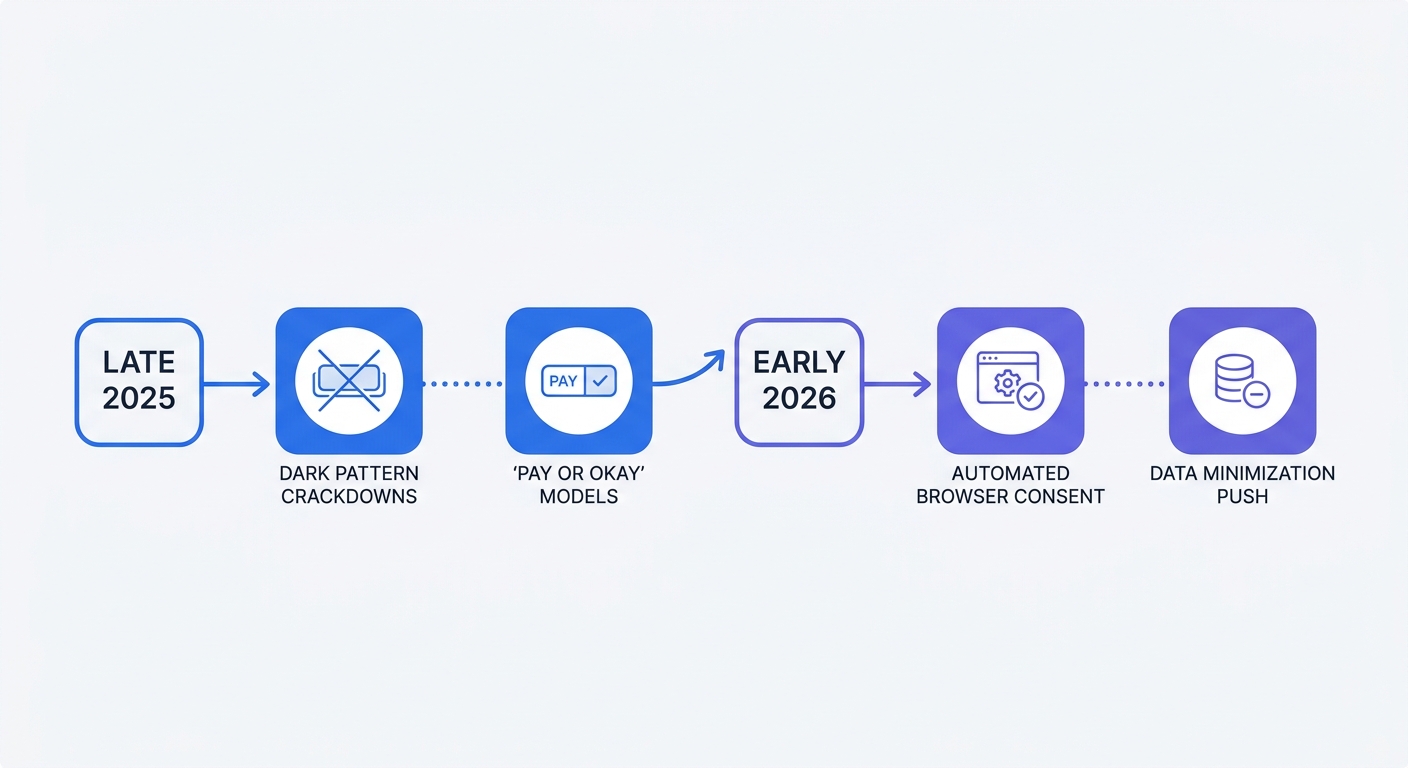
Regulators punish companies manipulating user choices. The French data protection authority fined Condé Nast 750,000 Euros in 2025 for making rejection difficult. Google paid a 325 million Euro fine for pushing users toward acceptance via confusing design choices. Review the banner architecture to ensure rejection takes the same number of clicks as acceptance.
Courts dismantled the "Pay or Okay" model. Publishers attempted to present users with an ultimatum to either accept tracking or pay a monthly subscription fee. Regulators invalidate consent extracted under financial pressure. A report from NOYB confirms users demand a free, tracker-free third option.
Inspect the active banner design today. Equal prominence rules require identical size, shape, and color for both buttons. Webmasters must place these options next to each other. Burying the rejection option inside a secondary settings menu exposes the business to financial penalties.
The European Data Protection Board released a joint opinion in 2026 regarding the Digital Omnibus. Regulators recognize that individual website popups fail to protect privacy while ruining web navigation. The proposed Digital Omnibus would push for browser-level controls, with the legislative proposal (published November 2025) currently under committee review and EDPB/EDPS Joint Opinion 2/2026 (February 2026) expressing non-binding support for this direction. Users will configure browsers to handle tracking preferences via machine-readable signals. Websites must respect these signals instead of deploying bespoke prompts.
How Consent Prompts Destroy Web Analytics Accuracy
Google Analytics and Consent Requirements
Google Analytics 4 typically requires a GDPR cookie popup. The platform uses first-party cookies by default (e.g., ga and _ga*) and cookie usage is configurable — GA4 can also send measurement data without setting cookies (cookieless pings) when consent is denied. GDPR consent requirements depend on your configuration and whether personal data or identifiers are processed. Because GA4 often tracks individual user behavior, European regulators classify the tool as an optional tracker. Authorities mandate affirmative consent prior to activation when processing personal data.
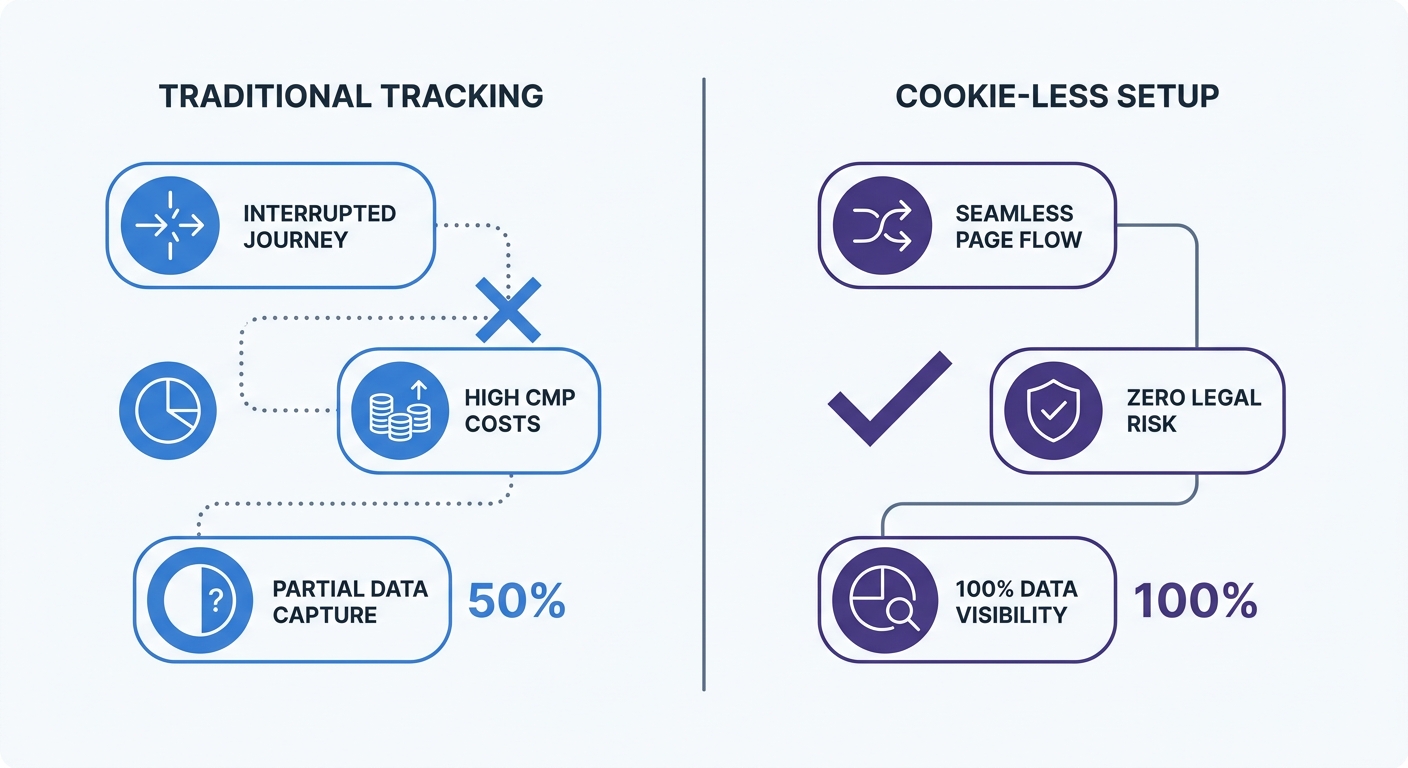
Many businesses seek a Google Analytics alternative to avoid this dependency. Site owners must evaluate the insights extracted from GA4. Decide if cross-site tracking justifies losing half the site traffic data to banner rejections.
Analytics platforms use cookies to stitch together user sessions. A user visits a blog on Monday. That same person returns on Wednesday to complete a purchase. A persistent cookie signals the analytics platform to credit the blog post for assisting the sale.
Consent prompts break this session chain. Rejecting the banner on a second visit severs the tracking connection. The platform records a new, unidentified direct visitor. Analyze the ratio of direct traffic to organic traffic in conversion reports to audit data health. A sudden spike in direct traffic indicates broken session stitching due to consent rejection.
The Impact of Ignored Cookie Banners
Ignoring a banner equals denying consent under strict enforcement guidelines. Visitors scrolling past the popup without clicking a button block the deployment of trackers.
Implement prior consent holds within the codebase. Configure the tag manager to pause all marketing scripts until an affirmative click registers. Firing a Facebook pixel or GA4 tag before the user clicks "Accept" violates regional privacy laws.
Review tag management firing rules today. Compliant triggers require a specific consent event to fire instead of a standard page view initialization.
| Measurement Type | Tracking Method | Data Captured | Requires Consent Popup |
|---|---|---|---|
| Traditional Setup | Persistent Cookies, Cross-site profiles | 3-7% of EU traffic | Yes |
| Basic Analytics | Local Storage, IP Fingerprinting | 3-7% of EU traffic | Yes |
| Privacy-First Setup | Session hashing, Edge processing | May cover a larger proportion of traffic depending on implementation | May reduce need for consent popup depending on implementation and jurisdiction |
The Solution: Cookieless Analytics
Achieving Compliance Without a Cookie Banner
Data minimization forms the foundation of modern compliance. Stop tracking invasive metrics instead of asking users for permission to monitor behavior. Adopt cookieless tracking methodologies to reduce legal liability.
Drop redundant retargeting pixels. Shift advertising budgets toward contextual placements. Move site measurement to a privacy-first platform. Eliminating persistent identifiers removes the legal requirement for a popup.
Delete the Consent Management Platform account. Removing tools like Cookiebot or CookieYes saves money and accelerates page load times. Webmasters upgrade the user experience by stripping the banner code from the site header.
Transitioning to a cookieless setup requires an inventory of current technologies. Site owners cannot delete the banner until removing the scripts that necessitate the prompt. Start by listing every tag inside the Google Tag Manager workspace. Identify the active analytics base. Using Adobe Analytics or Google Analytics requires affirmative consent from visitors. Replace these legacy platforms with open-source alternatives.
Bypassing Data Loss with Swetrix
Track vast majority of site traffic using Swetrix. The platform processes data at the edge without cookies, IP fingerprinting, or cross-site profiling. Swetrix hashes visitor IP addresses with a 24-hour rotating salt. This process creates a temporary identifier for session tracking that vanishes at midnight.
No data moves between websites. Profiles never accumulate in an advertising database. Because this architecture falls under the essential exemptions in European privacy law, this approach may allow some sites to limit use of consent popups, subject to legal basis and local law.
Installing the open-source script captures visitor interactions without interrupting the user journey. Dashboards display traffic volumes, referral sources, and conversion rates. The platform records aggregate trends, page views, and custom events across the audience. Visitors browse the site without clicking through legal disclaimers.
Adopt a privacy-first measurement philosophy. Respecting user attention allows site visitors to consume content without annoyance while dashboards reflect complete traffic datasets.
Start measuring complete traffic volume today. Create a free Swetrix account to bypass the consent banner bottleneck, capture accurate analytics, and restore a frictionless experience for visitors.