- Date
A Practical Guide to GDPR and Consent Compliance
 Andrii Romasiun
Getting GDPR and consent wrong isn't just a compliance hiccup. It's a high-stakes bet that can cost your business millions and, more importantly, the trust of your customers. For any company with an online presence, nailing consent management is fundamental to survival and success in today's market.
Why Ignoring GDPR Consent Is a Costly Mistake

Those massive fines you hear about aren't just scare tactics; they're very real and can be crippling. Regulators have shown time and again they are serious about enforcing the rules, and the numbers don't lie.
By January 2025, the total fines issued under GDPR have climbed to a staggering €5.88 billion. This isn't just one or two huge penalties; it's the result of over 2,200 individual fines handed out over seven years. The headline-grabber was Meta's €1.2 billion fine for unlawfully transferring European user data to the US, a clear breach of data protection and consent principles. You can dig deeper into these significant GDPR penalties to see just how serious regulators are.
These figures show a clear pattern: authorities are actively targeting violations of gdpr and consent. And it’s a mistake to think these fines are only for the big tech giants. Startups and small businesses are just as exposed if their consent practices aren't up to scratch.
The Real Cost Beyond the Fines
The financial hit is bad enough, but the real damage goes much deeper. When you get consent wrong, you erode the single most important asset your business has: customer trust. People are more aware of their privacy rights than ever before, and they reward companies that are transparent and respectful with their data.
"Compliance isn't just about avoiding a penalty. It is a strategic advantage. Mastering GDPR and consent is the first, most critical step toward building a sustainable and respected digital presence."
Think about it from a user's perspective. When they see pre-ticked boxes, vague jargon, or a "reject all" button that's hard to find, they don't just feel annoyed. They feel manipulated. That bad first impression has serious consequences:
- Increased Bounce Rates: If a user doesn't trust your site, they'll leave. Simple as that.
- Damaged Brand Reputation: In the age of social media, news of a privacy screw-up travels fast and can permanently damage how people see your brand.
- Lower Conversion Rates: Why would someone buy from you or sign up for your newsletter if they don't trust you with their email address, let alone their credit card details?
A Strategic Shift in Thinking
Viewing compliance as just another tedious task is a huge mistake. Instead, you need to see it as a core part of a customer-first strategy. For founders, marketers, and developers, implementing gdpr and consent correctly isn't about checking a box. It's an opportunity to build a more honest and durable relationship with your audience.
It’s a clear signal that you respect them and their privacy, which is exactly the kind of thing that builds loyalty and drives sustainable growth.
What Actually Counts as Valid GDPR Consent
Under GDPR, consent isn't some legal checkbox you just need to tick. It’s a genuine agreement you forge with your users. Think of it less like a formality and more like a respectful conversation. A vague nod, silence, or simply continuing to browse your site just doesn't cut it. You need a clear, enthusiastic "yes" before you can process someone's personal data for anything that isn't strictly necessary.
To get that "yes" in a way that’s legally sound, GDPR lays out five core conditions for what makes consent valid. Nailing these is the difference between building real user trust and stumbling into a massive compliance headache. Let's walk through each one.
The Five Pillars of Valid Consent
For consent to hold up under scrutiny, it absolutely has to be:
Freely Given: Your users need a real choice. You can't strong-arm them into agreeing or make access to your service dependent on them saying yes to non-essential tracking. This is why "cookie walls"—the ones that block all content until you click "accept"—are a huge red flag for regulators.
Specific: You can't ask for one giant, all-encompassing permission slip. If you want to use data for analytics, run personalized ads, and send out marketing emails, you need to ask for consent for each of those things separately. It’s all about granularity.
Informed: People have to know exactly what they're agreeing to before they agree. This means you need to explain—in plain, simple language—what data you're collecting, why you need it, and what you're going to do with it. Burying the details in a 50-page privacy policy full of legalese won't work.
Unambiguous: The user has to take a clear, positive action to say yes. Pre-ticked boxes are out. So is assuming consent just because someone scrolled down the page. They have to physically click a button or tick a box to opt in. It has to be an intentional act.
Easily Withdrawable: Users have the right to change their minds, and it needs to be just as easy to take back consent as it was to give it. This usually means having a clear, easy-to-find link or settings panel where they can manage their preferences anytime they want.
Getting a handle on these pillars is vital, especially when you're dealing with tracking technologies. For a closer look at how these rules apply in the real world, our guide on everything you need to know about cookies is a great next step.
Putting Theory into Practice
It’s one thing to understand these rules, but it’s another thing entirely to build them into your website. It’s surprisingly easy for well-meaning businesses to get it wrong and accidentally invalidate their whole consent process. The secret is to put clarity and user control at the very heart of your design.
A compliant consent banner doesn't just ask for a 'yes.' It respects the 'no' by making rejection as simple and straightforward as acceptance. This small design choice speaks volumes about a brand's commitment to user privacy.
To make this super clear, let’s look at what to do versus what to avoid. The table below is a quick way to audit your own practices and see where you stand.
Valid vs Invalid Consent Practices Under GDPR
This table breaks down the do's and don'ts, showing how the GDPR principles translate into real-world design choices. Getting this right can save you from major compliance risks.
| Consent Requirement | Valid Practice (Compliant) | Invalid Practice (Non-Compliant) |
|---|---|---|
| Freely Given | "Accept All" and "Reject All" buttons are equally prominent. Access to the website is not blocked if a user rejects non-essential cookies. | Using a "cookie wall" that denies access to content unless the user accepts tracking, or making the "Reject" button much harder to find. |
| Specific | Users are presented with granular options to consent to different categories of cookies, such as 'Analytics', 'Marketing', and 'Functional'. | A single "Accept" button that bundles consent for all data processing purposes without offering any choice. |
| Informed | The consent banner provides a brief, clear explanation of why data is collected and links to a detailed, easy-to-read privacy policy. | Using vague language like "we use cookies to improve your experience" without explaining what that means or what data is involved. |
| Unambiguous | All checkboxes for non-essential cookies (e.g., analytics, advertising) are unticked by default, requiring the user to actively opt in. | Using pre-ticked checkboxes for non-essential data processing, assuming consent unless the user takes action to opt out. |
| Easily Withdrawable | A persistent, easily visible link or icon (e.g., in the site footer) allows users to access their settings and change their consent preferences at any time. | Forcing users to dig through complex menus or contact support to withdraw their consent. The process is intentionally difficult. |
By sticking to these compliant practices, you're not just following the law. You're building a foundation of trust and showing your users that you genuinely respect their data and their choices.
Consent vs. Legitimate Interest: The Great Debate
One of the thorniest issues in the GDPR world is picking the right legal basis for handling personal data. Think of it like this: you wouldn't use a sledgehammer to hang a picture frame. Using the wrong legal basis is just as clumsy and can lead to some serious compliance headaches. The two options that cause the most confusion are consent and legitimate interest.
At first glance, they might seem like two different roads leading to the same destination. But they're built on completely different foundations. Consent is an active, enthusiastic "yes!" from your user. It’s permission, loud and clear. Legitimate interest, on the other hand, is a balancing act—you have to prove your business need for the data is more important than an individual’s right to privacy.
When Legitimate Interest Makes Sense
Let’s be clear: legitimate interest isn't a get-out-of-jail-free card. It’s designed for activities that are truly necessary for your business to function and that users would reasonably expect. It's a solid choice for background operational tasks that don't really intrude on someone's personal life.
Here are a few classic examples where legitimate interest works well:
- Fraud Prevention: Running checks on transaction data to spot and stop fraud is a clear win-win. It protects you and your customers.
- Network Security: Monitoring network traffic to fend off cyberattacks is essential. Without it, your service would be unstable and insecure.
- Internal Admin: Using employee data for things like payroll or basic internal communications is a standard part of running any organization.
In these situations, the data processing is predictable and necessary, and the privacy impact is minimal. You aren't doing anything surprising or invasive, like building out detailed psychological profiles for ad targeting.
Why Legitimate Interest Is a Risky Bet for Marketing
This is where so many businesses stumble. It’s incredibly tempting to use legitimate interest for things like web analytics, personalized ads, or marketing emails. The internal monologue often goes, "Well, it's in our interest to understand our customers and grow the business, right?"
That argument doesn’t hold up well with regulators.
The moment you start tracking user behavior across your site, dropping cookies to serve targeted ads, or analyzing personal data to create marketing segments, the scales tip dramatically. The user's fundamental right to privacy almost always outweighs your commercial interests in these scenarios.
For any activity involving tracking cookies, detailed analytics, or personalized advertising, explicit and unambiguous consent is nearly always the safer, more defensible legal basis under GDPR.
This simple flowchart breaks down what it takes to get valid consent, which should be your gold standard for any marketing activities.
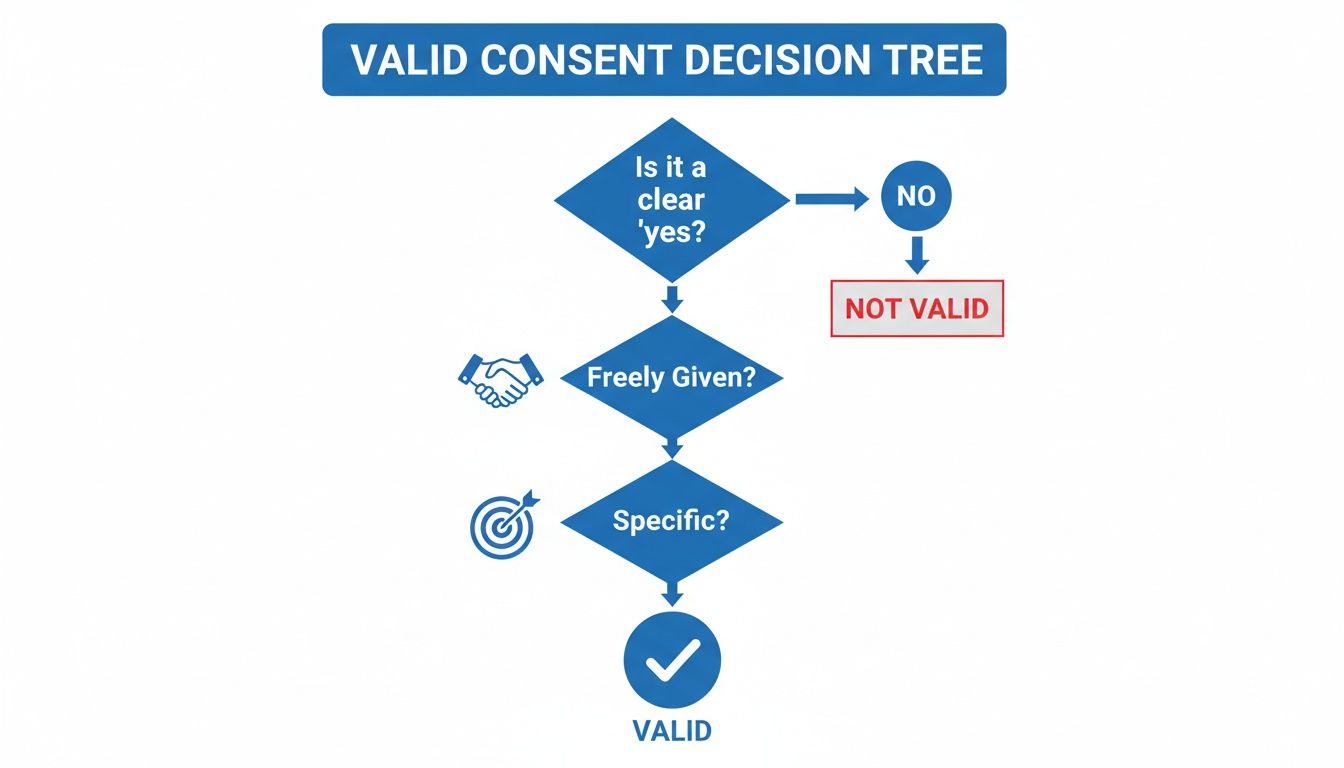
As the visual shows, for consent to be valid, it has to be a freely given and specific "yes." This alone reinforces why it's the right choice when you're tracking user-centric data.
Making the Right Choice: A Simple Framework
Choosing between these two requires some honest reflection. GDPR has been the law of the land since May 25, 2018, yet recent surveys show that about 30% of European businesses are still struggling with compliance. Consent management remains one of the biggest hurdles. This confusion leaves a lot of companies exposed to fines. You can dig into more of the data on these GDPR compliance challenges to see where people get tripped up.
To avoid becoming another statistic, run through this quick checklist before you process personal data:
- Is this absolutely necessary for my core service? If you can deliver your product or service without this piece of data, you should probably be asking for consent.
- Would a user reasonably expect this? Tracking someone’s browsing habits for ad targeting is rarely expected. Using their address to ship a package is.
- What's the privacy impact? The more sensitive the data or invasive the processing, the stronger the argument for getting explicit consent becomes.
- Can I confidently explain and defend this choice? If you’re hesitating, just ask for consent. It's the most transparent and user-friendly approach you can take.
At the end of the day, while legitimate interest certainly has its place, it’s not a shortcut. For the vast majority of marketing and analytics activities that modern businesses rely on, securing valid GDPR and consent isn't just a best practice—it's the only truly compliant path forward.
How Consent Rules Impact Your Web Analytics
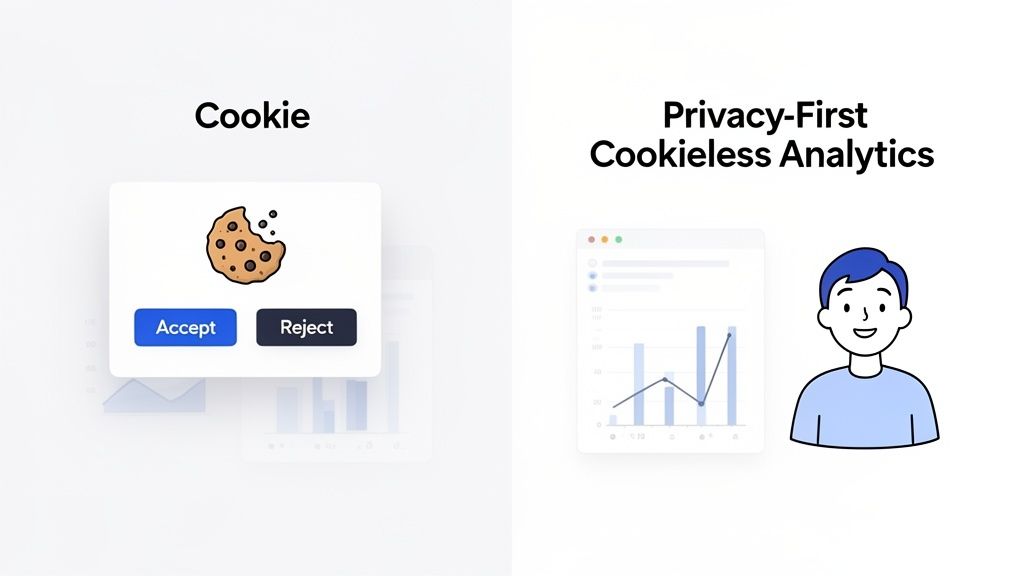
The rules around GDPR and consent aren't just abstract legal concepts—they have a very real, very direct impact on how you measure what’s happening on your website. For years, the default playbook for web analytics was to use cookies and other trackers to get a granular view of user behavior. That entire model is now running headfirst into a wall of privacy regulations.
Here's the problem in a nutshell: when a visitor lands on your site, any script that isn't strictly necessary for the site to function can't run until they give you explicit, opt-in consent. That includes almost all traditional analytics scripts designed to identify an individual user. This means your analytics platform is completely blind to anyone who ignores your consent banner or, more critically, clicks "Reject."
This creates a massive blind spot in your data. If a significant chunk of your visitors opts out of tracking, your reports become skewed and unreliable. Suddenly, you're left making crucial business decisions based on a fraction of the real story.
The Problem with Traditional Cookie-Based Analytics
The old way of doing things forces you into a corner. To get the data you need, you have to interrupt the user's experience with a consent banner—a point of friction that can immediately sour their perception of your brand.
Many businesses then resort to "dark patterns" to try and nudge users toward clicking "Accept." We've all seen them: the "Reject" button is hidden or hard to read, the language is deliberately confusing, or a "cookie wall" blocks all content until you agree.
Regulators are coming down hard on these tactics. GDPR enforcement is no longer a distant threat; authorities have issued over 2,200 fines totaling €5.6 billion and counting. Hot-button issues like "Consent or Pay" models—where users must either pay a fee or agree to tracking—are facing intense legal scrutiny for failing to offer a truly free choice. You can see how fast things are moving in these emerging GDPR compliance trends, with analytics consent being a major flashpoint.
The core issue is simple: when your analytics tool relies on personal data, you are forced to ask for permission in a way that often degrades the user experience and puts your business at legal risk.
It's a constant trade-off between respecting user privacy and getting the insights you need to grow. But what if you didn't have to choose?
The Rise of Privacy-First Cookieless Analytics
Thankfully, a new wave of web analytics tools offers a way out of this dilemma. Cookieless analytics platforms are built from the ground up with GDPR and other privacy laws in mind, completely removing the need for those intrusive consent banners for analytics.
So, how does it work? Instead of tracking individuals, these tools focus on collecting valuable, anonymized, and aggregated data. They don't use cookies, device fingerprinting, or any other method to create persistent profiles of your users.
This approach gives you the essential metrics you need to run your business, including:
- Top-performing pages to see what content is really hitting the mark.
- Traffic sources and referrals to understand your acquisition channels.
- Campaign performance by tracking UTM parameters without tying them to individuals.
- Key metrics like bounce rates, session duration, and real-time visitor counts.
Because these platforms don't collect personal data, the legal requirement for consent simply doesn't apply to your analytics. This means you can finally get a complete and accurate picture of 100% of your website traffic, not just the slice of visitors who happened to click "Accept." For a great breakdown of this modern approach, check out our guide on implementing privacy-friendly analytics.
By making the switch, you're not just solving a major compliance headache. You're also building trust by showing your audience that you genuinely respect their privacy.
Your GDPR Consent Implementation Checklist
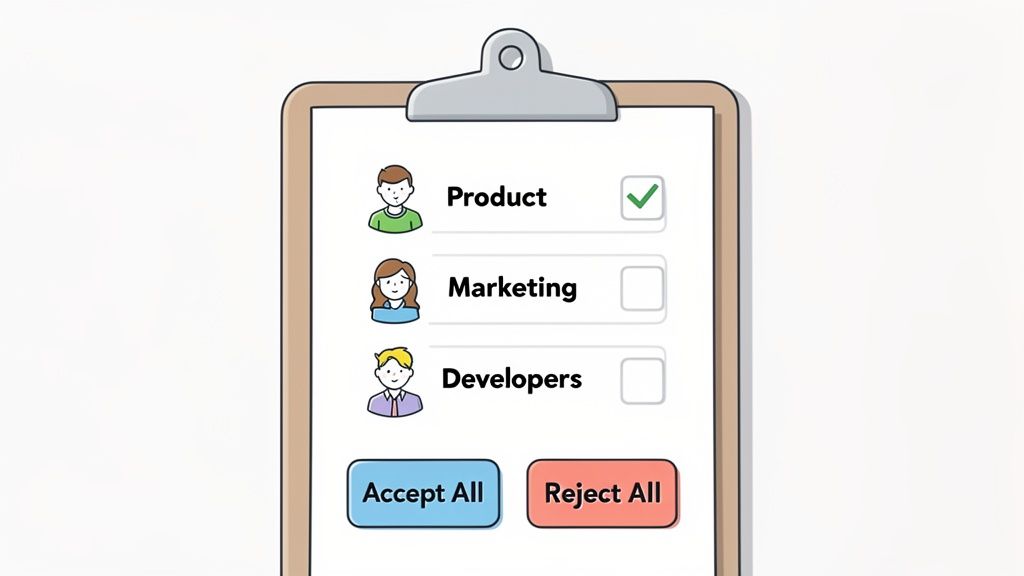
It’s one thing to understand the theory behind GDPR and consent, but actually putting it into practice is a whole different ball game. Getting it right isn't a one-person job; it takes a coordinated effort across your product, marketing, and engineering teams.
This hands-on checklist breaks down what each team needs to own, turning dense legal requirements into a straightforward, manageable workflow. Think of it as your roadmap for either auditing your current setup or building a compliant consent framework from scratch.
For Product Managers and UX Designers
You’re on the hook for designing an experience that’s not just compliant, but also feels good for the user. A well-designed consent flow builds trust right from the get-go. A bad one just creates friction and makes you look shady.
- Design for Equal Prominence: The "Reject All" button can't be a hidden, greyed-out link. It needs to be just as easy to see and click as the "Accept All" button. No dark patterns—don't try to trick people with confusing colors or tiny font sizes.
- Implement Granular Controls: Give users a real choice. A "Customize" or "Settings" option should let them pick and choose which data processing they’re okay with (e.g., Analytics, Marketing). Critically, all non-essential toggles must be off by default.
- Write in Plain Language: Ditch the legalese. Your consent banner needs to be simple, direct, and clear. Tell people why you’re collecting data and what you’ll actually do with it.
- Ensure Easy Withdrawal: Consent isn’t a one-time decision. Users must be able to change their minds easily at any time. A persistent link in your website's footer or a dedicated section in their account settings is the standard way to handle this.
For Marketers and Growth Teams
As a marketer, you're on the front lines of data collection. It's your job to make sure your toolkit respects user choices and that your campaigns are built on a solid foundation of valid consent.
True compliance means getting comfortable with the fact that you won't get everyone's data. The goal is to gather meaningful insights from users who willingly opt in, or to shift to tools that don’t require consent in the first place.
This mindset shift forces you to rethink how you measure success and which tools you depend on.
- Audit Your Marketing Stack: Make a list of every single third-party script and tool running on your site—analytics, ad pixels, heatmaps, you name it. For each one, identify what data it collects and confirm your legal basis for using it.
- Configure Tag Managers Correctly: Your tag management system (like Google Tag Manager) is your best friend here. Set it up to fire scripts based on the user's consent status. This means no marketing or analytics tags should activate until after someone has given you a clear "yes."
- Explore Privacy-First Analytics: Are low opt-in rates tanking your analytics? It might be time to look at a cookieless analytics platform like Swetrix. These tools give you valuable traffic insights without collecting personal data, which often means you don't need consent for your core analytics at all.
- Segment Audiences Based on Consent: When you're building an email list or a marketing campaign, you can only target people who have explicitly agreed to that specific kind of contact. Just because someone signed up for your product doesn’t mean they’ve consented to your marketing newsletter.
For Developers and Engineers
Your role is to build the technical backbone that makes all of this work. You’re the one who connects the user’s choice on the screen to the website’s actual behavior behind the scenes.
- Integrate a Consent Management Platform (CMP): First, choose and implement a solid CMP. This tool will handle the heavy lifting of collecting, storing, and passing consent signals to your other systems. Make sure it plays nicely with your tag manager.
- Block Scripts Before Consent: This is non-negotiable. You have to configure the site so that zero non-essential cookies or tracking scripts load before the user clicks a button on the consent banner.
- Store Consent Securely: You need proof of compliance. Set up a system to log and securely store user consent choices. Each record should be timestamped and detail exactly what the user agreed to.
- Test All User Journeys: Test everything. And then test it again. Verify that rejecting consent actually blocks the scripts. Check that accepting them works as intended. And make sure withdrawing consent revokes permissions correctly. Run these tests across different browsers and devices to catch any inconsistencies.
Building Trust Beyond Mere Compliance
It’s easy to get bogged down in the legal weeds of GDPR and consent, seeing it as just another compliance hurdle to clear. But that’s a shortsighted view. Thinking beyond the risk of fines reveals a massive opportunity: building a brand that people actually trust.
When you make privacy and transparency a priority, you're sending a clear message to your customers—you respect them and their data. This isn't just about avoiding penalties; it's about forging genuine customer loyalty in an era where everyone is (rightfully) skeptical about how their information is used. People who feel respected and in control are far more likely to stick around, buy from you, and even tell their friends.
The New Competitive Edge
Once you cut through the legalese, the core principles of GDPR are pretty simple. Consent has to be a clear, unambiguous "yes." You can't use legitimate interest as a catch-all excuse for marketing analytics. And thankfully, modern cookieless analytics tools provide a way to gather insights without creeping on your users.
These aren't just rules to follow; they are a blueprint for building better digital products.
This is where smart startups and growing businesses can really shine. While bigger, older companies might be stuck with clunky consent banners and shady "dark patterns," you have the chance to lead with honesty. This approach doesn't just keep you on the right side of the law—it solidifies your reputation as a company worth trusting. A great starting point is learning how to track website visitors ethically.
GDPR should not be viewed as a barrier to growth. Instead, it is an invitation to innovate—to build better products and foster more authentic relationships with the people you serve.
Ultimately, this is about shifting your mindset from "have to" to "want to." Treat GDPR and consent not as a burden, but as a framework for building a better business. By putting user privacy first, you're not just complying with regulations; you're investing in a future where your brand is known for its integrity. That’s the kind of trust that pays dividends for years.
Quick-Fire GDPR and Consent Questions
Let's be honest, figuring out the nitty-gritty of GDPR and consent can feel like a maze. To help you find your way, here are some straight-to-the-point answers to the questions we hear most often.
Do I Still Need a Cookie Banner If I Use Privacy-Friendly Analytics?
Probably not, but it depends. The whole point of a cookie banner is to get clear consent before you drop any non-essential trackers that gather personal data. If you’re using a privacy-focused analytics tool, it’s likely designed to give you insights without using cookies or collecting any personally identifiable information (PII).
This smart design means you don't need GDPR consent for your analytics traffic. But—and this is a big but—you’re only in the clear if analytics is the only thing you’re doing. If your site also has embedded YouTube videos, a Facebook pixel, or social sharing buttons, those services almost certainly set cookies. For those, you absolutely still need a compliant consent banner.
Is It Okay to Just Say "We Use Cookies to Improve Your Experience"?
That’s a hard no. That kind of vague, hand-wavy language is exactly what GDPR was designed to stop. Your users’ consent has to be ‘informed,’ which is a legal way of saying you need to be upfront and clear about what you’re doing and why.
You have to spell out the specific reasons you're using cookies—whether it's for analytics, personalizing content, or running ads.
A compliant banner isn't just about clear language. It must also give people real choice, letting them accept or reject different types of cookies. A simple "Accept All" button next to a fuzzy explanation, with no easy way to say no, is a huge compliance red flag.
What’s the Real Difference Between Opt-In and Opt-Out?
This is one of the most fundamental concepts in GDPR, and getting it wrong is a common mistake.
Opt-in requires a user to take a deliberate, positive action to say "yes"—like physically clicking an empty checkbox. This is the gold standard under GDPR. By default, all boxes for non-essential cookies must be unticked.
Opt-out is the opposite, where consent is assumed unless someone takes action to refuse, like unchecking a pre-ticked box. This is explicitly not valid consent under GDPR. The law requires a "clear affirmative act," which means silence, scrolling, or pre-ticked boxes just don't cut it. Your users have to actively agree.
Ready to simplify your analytics and stop worrying about consent banners? Swetrix offers a powerful, privacy-first analytics solution that gives you the insights you need without collecting personal data. Start your free 14-day trial and see the difference.