- Date
Mastering Ecommerce Performance Analytics In A Cookieless World
 Andrii Romasiun
A customer adds a $200 item to their cart, ignores the consent banner, and completes the purchase. Marketers using traditional web analytics see zero revenue. The 2026 tracking environment breaks client-side pixels, leaving ecommerce dashboards with massive data gaps. Store owners waste budget on ads they think are failing. The ads work, but the tracking scripts drop the data before it reaches the dashboard. Fixing this disconnect requires shifting away from legacy web metrics toward modern ecommerce performance analytics.
Why Ecommerce Performance Analytics Is Changing In 2026
Web Analytics vs. Ecommerce Analytics
Marketers use general web analytics to count pageviews, measure session duration, and log geographic locations. Operators use modern ecommerce performance analytics to tie those visits to profit margins, customer lifetime value, and cart abandonment.
Marketers see 500 checkout page visitors on standard traffic dashboards. Operators use performance analytics to identify which traffic source generated the highest lifetime customer value after subtracting shipping costs. Connect the two systems to map the complete buyer journey by tracking raw traffic metrics alongside revenue data. Companies waste resources on visitor spikes if those users cost more to acquire than they spend. Evaluate success by measuring the contribution margin of those visitors instead of celebrating raw organic traffic volume.
The 2026 Tracking Crisis And Data Black Holes
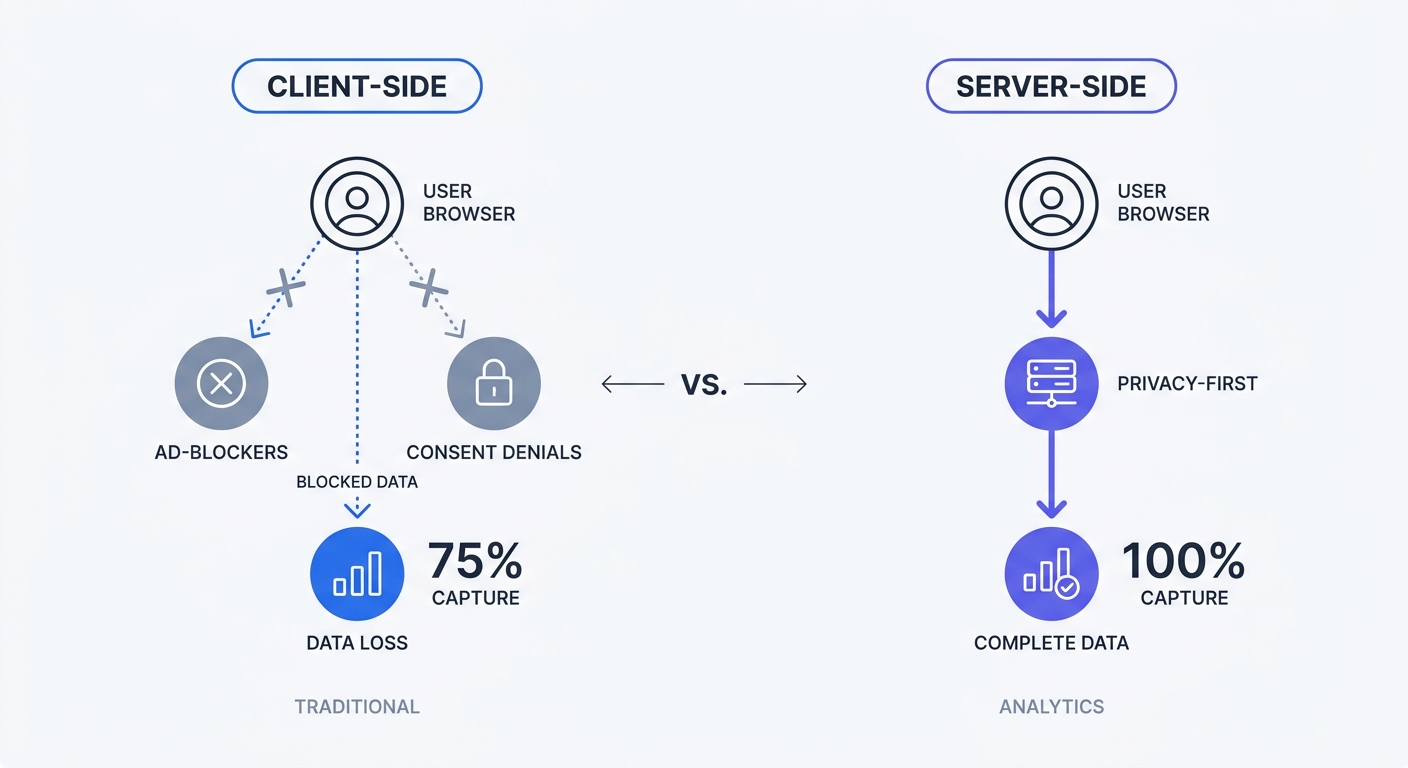
Apple and Mozilla changed the rules for data collection by updating browser default settings. Safari and Firefox block third-party tracking cookies via Intelligent Tracking Prevention. Shoppers run ad-blockers on 31% of desktop browsers, though adoption rates vary by region and demographic. European buyers reject consent banners more than half the time.
Client-side pixels fail under these conditions because the browser stops the script from loading. A user completes a $400 purchase, but the marketing team sees zero revenue on the analytics dashboard. These blocked scripts create data black holes across reporting tools. Up to a third of sales disappear from the attribution dashboard.
Marketing teams make decisions based on incomplete data, cutting profitable ad campaigns when conversions fail to register in the client-side tracker. Rebuild the data pipeline to capture these missing orders. Relying on front-end browser scripts guarantees revenue discrepancies and lost attribution.
Key Benchmarks To Measure Your Store Against
Global Conversion Rates By Industry
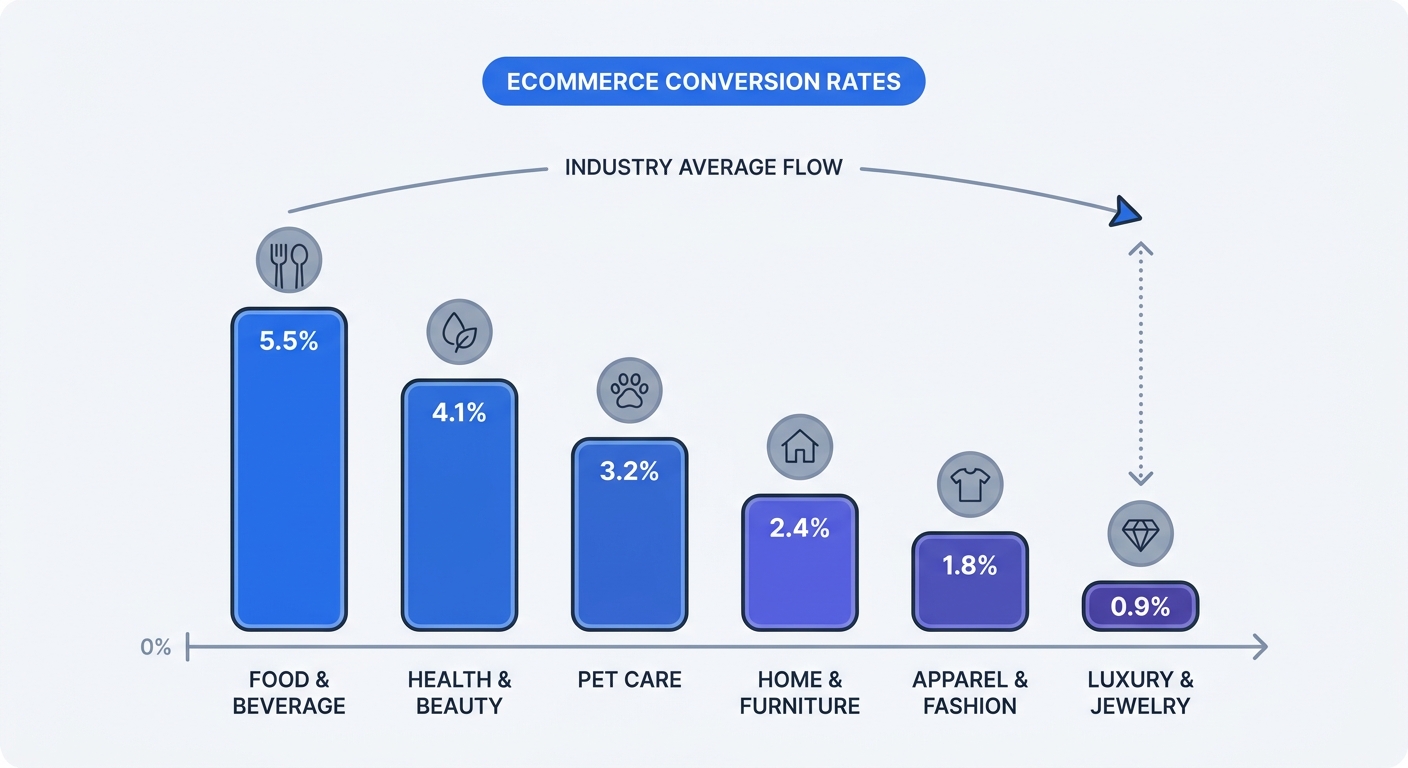
Compare the store against industry baselines to identify systemic issues. Benchmark data from Triple Whale puts the global average ecommerce conversion rate between 1.9% and 2.0%. Shopify stores sit higher at 2.5% to 3.0%.
Rates fluctuate by sector because content drives intent and product categories dictate buying behavior.
| Industry | Average Conversion Rate |
|---|---|
| Food & Beverage | 6.02% - 6.11% |
| Beauty & Personal Care | 5.74% |
| Apparel | 2.50% - 3.00% |
| Luxury & Jewelry | 0.95% - 1.19% |
High price points require longer consideration cycles. A jewelry store converting at 1.1% generates more raw profit than a coffee roaster converting at 4%. Track internal baseline growth over time to measure improvement.
Device type changes the equation. Desktop users convert at 3.2% to 3.9%, while mobile visitors convert between 1.8% and 2.8%. Mobile drives up to 75% of traffic, requiring operators to optimize the mobile checkout flow to close this gap. Make add-to-cart buttons span the width of the phone screen. Support digital wallets like Apple Pay and Google Pay to reduce keystrokes.
Bounce Rates And The Cart Abandonment Crisis
Visitor retention impacts the bottom line before the checkout page loads. The global ecommerce bounce rate averages 48.27%, though top-performing sites push this number down to 20%. Specific sectors face different hurdles. Food and beverage sites see bounce rates exceed 65% due to recipe seekers landing on product pages and leaving.
High bounce rates signal a mismatch between ad creative and the landing page. Users expect specific content, see a different offer, and leave. Review the search terms driving traffic to high-bounce pages in Google Search Console. Update the meta titles and product descriptions to match user intent and lower the exit rate.
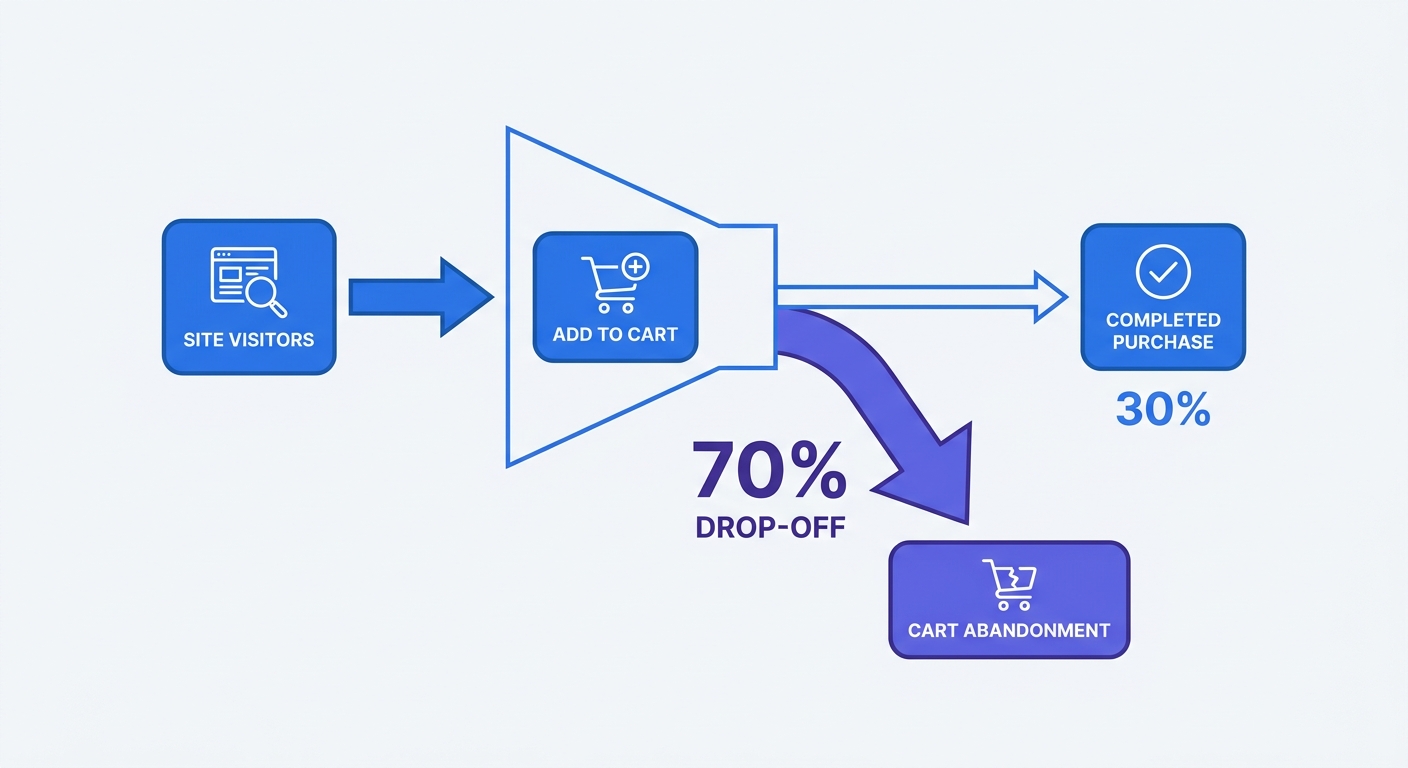
Drop-off accelerates at the cart stage. Cart abandonment accounts for 69.80% of initiated checkouts, though rates vary depending on the device and product category. Ecommerce operators lose $260 billion to this drop-off across the digital economy.
Audit the checkout process to recover these sales. Count the form fields and remove required account creation walls. Offer guest checkout as the default option. Give users upfront shipping costs on the product page to prevent sticker shock on the payment screen.
Overcoming Consent Gaps With Cookieless Tracking
The Problem With Client-Side Pixels And GDPR
Data collection tools carry regulatory risks. GDPR enforcement actions generated over €4.5 billion in fines by the start of 2026. Regulators target improper consent handling and non-compliant third-party data sharing.
Client-side pixels require explicit opt-in. A user lands on the site, triggering a banner that interrupts their session. More than 50% of European visitors click "Decline," keeping the tracking code dormant. Marketing teams lose visibility into that customer journey.
Store owners risk legal liability when they rely on persistent cookies. Operators sacrifice accurate attribution to avoid regulatory fines. Move data processing to the backend to maintain both compliance and visibility.
How Server-Side Tracking Restores Data Accuracy
Transitioning to cookieless tracking recovers 20% to 40% of missed pageviews and conversions. This method bypasses client-side restrictions.
Set up server-side tracking to rebuild this data pipeline. The web server communicates with the analytics API. Browser ad-blockers cannot interfere with this server-to-server connection.
When a customer submits a payment, the ecommerce backend triggers a webhook. This webhook sends the order ID and revenue amount to the analytics endpoint. Marketers attribute the order to the correct traffic source using daily session hashing. This setup creates a clean data stream without touching the user's browser storage.
Session hashing replaces permanent identifiers by combining the IP address and user agent into a temporary alphanumeric string. This hash expires after 24 hours. Store owners measure conversions without storing personal identifiers.
Shifting From ROAS To True Profitability Tracking
Tracking Contribution Margin For True Profitability
Return on Ad Spend measures top-line revenue against marketing costs while ignoring cost of goods sold, payment gateway fees, and shipping expenses. A campaign generating a 3.0 ROAS loses money if product margins sit below 35%.
Top merchants track contribution margin to see the profit remaining after variable costs.
Build a profitability dashboard by exporting order data from the shopping cart platform. Subtract the product cost, fulfillment fee, and customer acquisition cost from the gross revenue. Use this net figure to evaluate campaign performance. Pause ads driving high-volume, low-margin sales in favor of campaigns targeting high-margin product categories.
Calculate CAC-to-margin efficiency to understand acquisition limits. Divide the cost to acquire a customer by the gross margin of their first order. A ratio below 1.0 means the business loses money on the initial acquisition and must rely on repeat purchases to achieve profitability.
Measuring Micro-Conversions And Site Search
Customers take multiple steps before completing a purchase. Track these micro-actions to locate leaks in the funnel.
Monitor "Add to Cart" rates and "Initiate Checkout" events. Store operators seeing an influx of cart additions with zero checkouts should investigate the payment gateway or check for unexpected shipping fees. Fix the friction point to increase the final conversion rate.
Build funnels around internal search behavior. Site search users convert at double or triple the rate of standard visitors due to high purchase intent.
Configure analytics software to record search queries. Review the top ten terms each month and create dedicated landing pages for these popular searches. If users hunt for "waterproof hiking boots," feature those products high up on the homepage navigation to shorten their path to purchase. Eliminate zero-result searches by updating product tags to include common misspellings.
Best Practices For Your Analytics Setup
Eliminating The Reconciliation Tax
Fragmented data forces marketers to perform math by hand. A media buyer sees 50 conversions in Google Ads, 35 orders in the ecommerce backend, and 20 in the legacy analytics dashboard. Teams pay a reconciliation tax in wasted hours trying to match these numbers.
Consolidate tracking tools to establish a single source of truth. Send all server-side conversion events to this central hub. Base budget allocations on these normalized numbers instead of the inflated attribution models from individual ad networks.
Audit the data pipeline each month. Run test transactions using specific UTM parameters to verify the revenue figures match the analytics output down to the cent. If discrepancies appear, check the webhook configuration in the shopping cart software. Configure the platform to filter out duplicate events before they reach the reporting interface.
Operating Without A Cookie Banner
Users experience frustration from cookie banners that break data continuity. Companies using legacy tracking solutions require these banners to comply with international privacy laws.
Ecommerce sites can operate without one. Store owners remove the legal requirement for a consent prompt by deploying a privacy-focused platform that avoids placing persistent cookies on the user device. Engineers configure these platforms to operate without harvesting personal identifiers.
Check current compliance status to understand the requirements for legacy tools. Delete the banner if the tech stack meets privacy standards by default. Visitors enjoy a faster browsing experience, and the marketing team gains access to uninterrupted behavioral data.
Implement an ecommerce analytics framework built for the modern web to bypass tracking restrictions. Reclaim missing conversion data to base business decisions on accurate revenue numbers.
Track ecommerce performance without losing data to ad-blockers or sacrificing user privacy. Start a free trial of Swetrix today to build a cookieless, server-side analytics setup in minutes.