- Date
Ecommerce Data Analytics Software to Boost Your Store's Performance
 Andrii Romasiun
Think of ecommerce data analytics software as the ultimate translator for your online store. It takes all the raw, messy data—clicks, cart additions, sales figures—and turns it into a clear story about what’s working, what isn't, and why. It’s the tool that connects your marketing spend directly to your revenue, showing you exactly how customers find you and what they do once they arrive.
Beyond Pageviews: What Ecommerce Analytics Really Does
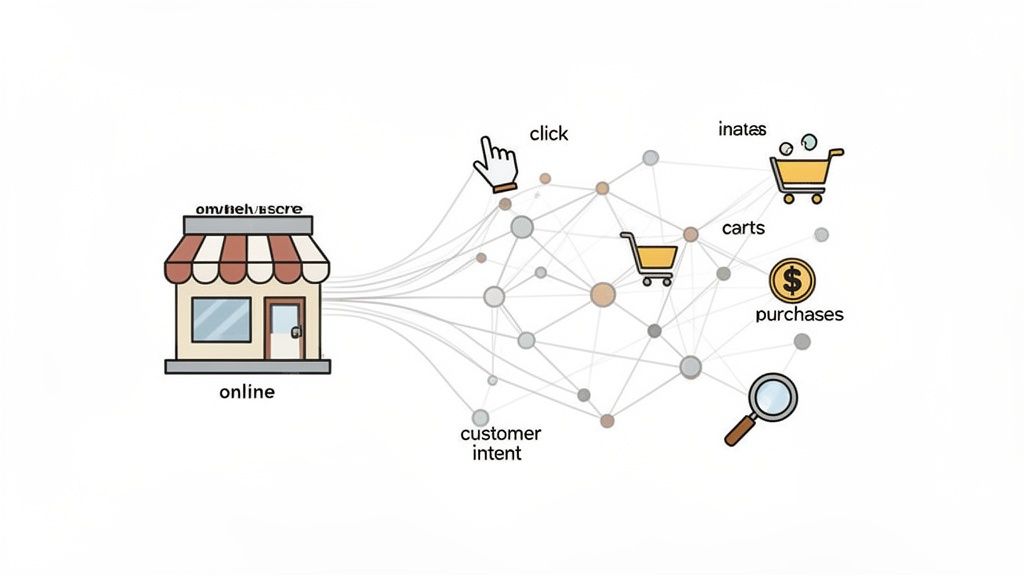
Standard web analytics is great for a bird's-eye view. It tells you how many people visited your site and where they came from. But for an ecommerce business, that’s just the opening chapter. It leaves you wondering about the most important parts of the story.
This is where specialized ecommerce analytics steps in. It’s not about counting visitors; it's about understanding them. These tools are built to answer the questions that directly impact your profitability and growth.
Revealing the Story Behind the Sale
Good ecommerce data analytics software is designed to connect every single user action to a real business outcome. It’s all about getting to the "why" behind the "what," giving you a complete picture of the customer journey from start to finish.
This shift toward deeper, more meaningful data is why the product analytics market—a key part of the ecommerce toolset—is booming. Valued at USD 13.04 billion in 2026, it's expected to surge to USD 25.73 billion by 2031. This growth isn't just about collecting more data; it's about the urgent need for tools that turn that data into a strategic advantage. You can dive into the full product analytics market research to see the trend for yourself.
With the right platform, you can finally uncover critical patterns that were once buried in spreadsheets or lost in generic dashboards.
To give you a clearer picture, this table breaks down the core functions of these platforms and the crucial business questions they help answer.
Key Capabilities of Ecommerce Analytics Software
| Capability | Business Question It Answers |
|---|---|
| Revenue Attribution | "Which marketing channel is actually making me money, not just sending traffic?" |
| Funnel Analysis | "Where in my checkout process are customers giving up and leaving?" |
| Session Analysis | "What did a specific customer do right before they bought or abandoned their cart?" |
| Error Tracking | "Are technical glitches on my site costing me sales?" |
| Payment Gateway Integration | "How many of my sales are being reversed due to refunds or chargebacks?" |
| Custom Event Tracking | "Is the new 'quick add' button I launched actually leading to more sales?" |
Each of these capabilities is a piece of the puzzle, helping you move from guessing to knowing.
Answering Critical Business Questions
At the end of the day, these tools exist to give you straight answers to the toughest questions you face as a store owner. They help you stop wasting money and start making smarter, data-backed decisions.
Here are just a few of the insights you can unlock:
- Which marketing channels deliver the most profitable customers? Forget traffic volume. This shows you which channels bring in high-value, repeat buyers.
- Where are users abandoning their shopping carts? You can pinpoint the exact step in your checkout that’s causing friction and costing you money.
- How does a new feature impact user behavior and conversions? See the real-world impact of site changes on your most important metrics.
- What is the lifetime value of customers acquired from different campaigns? This insight is gold for allocating your marketing budget effectively.
The Core Features That Drive Ecommerce Growth
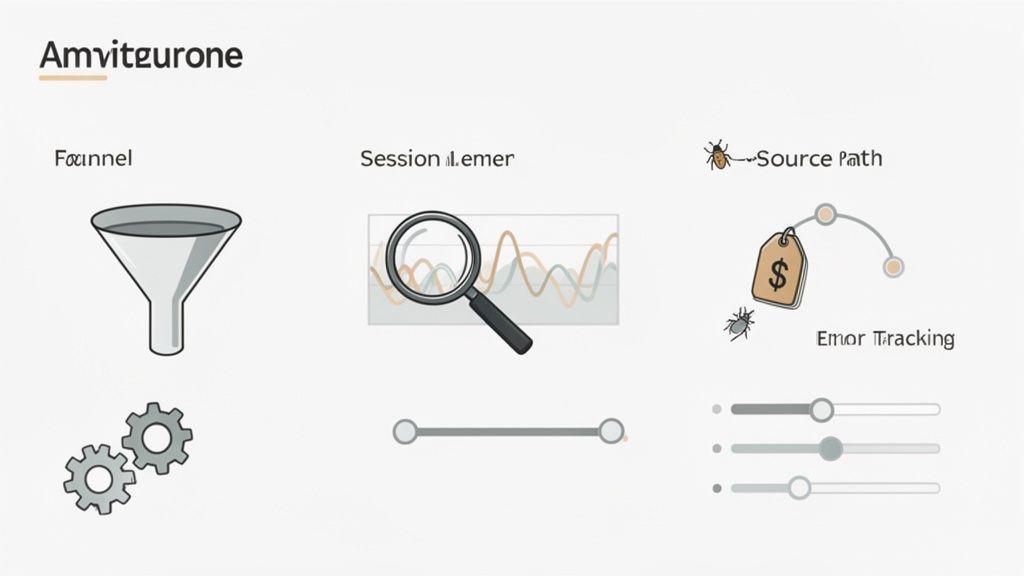
To really get a grip on your store's performance, you have to look past simple traffic numbers. Good ecommerce data analytics software is like a specialized toolkit, where every tool is built to answer a specific, high-stakes business question. When used together, these features turn a flood of raw data into a clear map for growing your business.
Think of your online store as a car. These features are the gauges on the dashboard. They don't just tell you you're moving; they show your speed, engine health, and fuel efficiency. That's what lets you fine-tune the entire journey.
Pinpointing Your Most Valuable Channels
One of the most powerful tools in the box is revenue attribution. This feature acts like a financial detective, tracing every single sale back to where it came from. Did that Instagram ad do the trick? Was it a Google search? Or maybe a link in your weekly newsletter that finally convinced someone to buy?
Without this insight, you’re basically spending your marketing budget in the dark. Revenue attribution lights up the path, showing you which channels bring in not just clicks, but actual, paying customers. This lets you double down on what works and pull back from campaigns that are just wasting money.
By attributing revenue to specific marketing channels and customer interactions, businesses can uncover the true drivers behind sales. These insights are invaluable for allocating marketing spend efficiently, ensuring resources are invested in the channels that yield the highest returns.
This data-first approach takes the guesswork out of your strategy, turning your marketing budget from a line-item expense into a powerful investment in growth.
Mapping the Customer Journey
Next up are conversion funnels, which give you a visual map of the path customers take through your store. This is absolutely critical for figuring out exactly where potential buyers are giving up and leaving. Is it on the product page? The shipping details step? Or right at the very last second before they hit "confirm purchase"?
By seeing this journey laid out, you can spot the friction points that are killing your sales. For instance, a huge drop-off at the payment stage might point to a confusing interface or maybe you're not offering the payment options people actually want.
- Session analysis goes hand-in-hand with funnels, letting you zoom in on what individual users are doing. It’s like watching a screen recording of their visit, showing you every click, scroll, and moment of hesitation.
- Error tracking is your early warning system. It alerts you to technical glitches—like a broken "add to cart" button—that could be silently sabotaging your sales without you ever knowing.
These tools combine to give you a complete, layered view of what people are actually experiencing on your site.
Tracking What Truly Matters
Finally, the best ecommerce analytics platforms give you the power to customize. Integrations with payment processors like Stripe or Paddle are a must-have. They link user behavior directly to financial outcomes like sales, refunds, and chargebacks, creating a single source of truth for your revenue data.
On top of that, custom event tracking allows you to measure any specific interaction on your site. Wondering if that new promotional banner is actually getting clicks? Or if customers are using your new product filter? You can create a custom event to track its performance down to the last detail. This flexibility means you can measure the impact of any change, from a tiny button redesign to a massive site overhaul, and make sure every decision is backed by solid data.
Moving Beyond Traffic: The KPIs That Actually Matter
It's easy to get caught up in website traffic. Seeing those numbers climb is a great feeling, but high traffic alone doesn't pay the bills. The true story of your ecommerce business's health is told through Key Performance Indicators (KPIs) that tie directly to your bottom line. Good ecommerce data analytics software helps you cut through the noise and focus on the numbers that actually drive sustainable growth.
The best way to make sense of all this data is to group it into logical categories. Think of it like a full health checkup for your business—you need to examine different systems to understand the complete picture.
Customer Acquisition Metrics
This first set of KPIs reveals how well you're bringing in new customers and, just as importantly, what it's costing you. They answer one fundamental question: is your marketing spending actually paying off?
- Customer Acquisition Cost (CAC): This is your all-in cost to land one new customer, factoring in all your sales and marketing spend. If your CAC is too high, it'll eat into your profits, making it incredibly difficult to scale your business responsibly.
- Conversion Rate: This is the percentage of visitors who actually do what you want them to do—most often, make a purchase. Lots of traffic with a low conversion rate is a classic sign that something in your sales funnel is broken.
Customer Behavior Metrics
So, you've got them on your site. What happens next? These metrics give you a direct look into how people shop, what they click on, and how effective your store's design and user experience really are. Nailing these is how you make more money from the traffic you already have.
Understanding customer behavior is the foundation of growth. By analyzing what shoppers do, you can optimize everything from product placement to checkout flow, turning casual browsers into loyal buyers.
- Average Order Value (AOV): This simply measures how much the average customer spends per transaction. You can seriously boost your revenue by increasing AOV through smart upsells, cross-sells, or product bundles, all without spending another dime on ads.
- Cart Abandonment Rate: This number shows you how many people add products to their cart but bail before completing the purchase. A high rate is a massive red flag, often pointing to problems like surprise shipping fees or a clunky checkout process.
Customer Retention Metrics
It costs way more to find a new customer than it does to keep one you already have. That's why retention KPIs are the ultimate indicators of your business's long-term health. They show whether you're building a brand with a loyal following or just a leaky bucket.
- Customer Lifetime Value (CLV): This is the big one—it’s the total amount of money you can expect to make from a single customer over their entire time with you. CLV is the ultimate report card on customer loyalty and the sustainability of your business model. For a more detailed breakdown, you can dive into these crucial customer retention metrics.
Keeping a close eye on these KPIs isn't just a good habit; it's what separates the winners from the rest. This shift toward data-driven decisions is fueling a massive industry. The e-commerce software market was valued at USD 6.1 billion in 2023 and is on track to explode to USD 21.97 billion by 2032. That explosive growth is all thanks to the demand for exactly these kinds of insights. You can learn more about the growth of the e-commerce software market and why it matters.
How Privacy-First Analytics Builds Customer Trust
Let's be honest: customers are more skeptical than ever about how their data is being handled. In this environment, privacy isn't just a legal box to tick—it's one of the strongest ways to build real brand loyalty. Shoppers are exhausted by invasive tracking and are deliberately choosing to do business with companies that respect their digital space. Sticking with old-school, aggressive analytics tools can slowly but surely chip away at the trust you've worked so hard to earn.
This is exactly where privacy-first analytics comes in. It’s a complete shift in thinking about how you gather business insights. Instead of tracking individuals with cookies and personal identifiers, this approach focuses on collecting anonymous, aggregated data. The goal is to understand broad trends and user behavior patterns without ever needing to know who a specific person is.
The Advantage of Anonymity
Think of it this way. Traditional analytics is like having a security camera that records every customer's face and follows them aisle by aisle through your store. Privacy-first analytics, on the other hand, is like a store manager simply observing foot traffic. They can see where crowds gather and which product displays are popular, all without identifying a single person.
This method gives you the rich, actionable data you need to grow your business while sending a crystal-clear message to your customers: we respect your privacy. It’s a true win-win that aligns your data strategy with the values of a modern, customer-focused brand.
The move toward privacy isn't some niche trend; it's a massive market-wide demand. As regulations get stricter and consumer awareness grows, the brands that lead with privacy are setting themselves up for long-term success and much stronger customer relationships.
This shift isn't happening in a vacuum; it's being driven by both regulatory pressure and direct consumer demand. Recent research on ecommerce data analytics shows that a staggering 70% of consumers are now demanding better data protection. In response, 60% of marketers are actively prioritizing GDPR-compliant analytics that rely on anonymous data collection instead of cookies. This makes it clear that privacy is no longer just about compliance—it's a serious competitive advantage.
Cookieless Tracking in Practice
So, how does any of this actually work without the cookies that have been the engine of web analytics for decades? The secret lies in modern, cookieless tracking techniques that are both effective and respectful.
- Session-Based Analysis: Instead of trying to build a long-term profile of a user, these tools analyze a single, anonymous session to understand their journey on your site right now.
- Aggregated Metrics: All the data is bundled together to reveal trends, like which pages get the most traffic or where people drop off in the checkout process, without ever singling out an individual's data.
- Compliance by Design: Tools like Swetrix are built from the ground up to comply with major regulations like GDPR and CCPA. This means you don't have to spend your time worrying about navigating a maze of complex legal requirements.
By adopting a privacy-focused approach, you’re doing more than just collecting data. You're making a powerful statement to your customers that you value their trust above all else. This builds a much stronger foundation for lasting loyalty and sustainable growth. You can dive deeper into this topic by reading our guide to privacy-friendly analytics.
Choosing the Right Analytics Software for Your Store
Picking the right analytics software for your e-commerce store is a huge decision. It's not just about ticking off features on a list; it’s about finding a genuine partner that will help you grow. With so many options out there, the trick is to zero in on what truly matters for your business—your budget, your technical setup, and where you see yourself in a few years.
The best way to start is by arming yourself with the right questions. When you talk to vendors, don't just let them run through a sales pitch. Dig deeper and ask them how their platform actually works in the real world. This is how you cut through the marketing fluff and find a tool that’s a real fit.
Evaluating Performance and Speed
Let's get straight to the point: the first question you should ask any vendor is, "How will your tracking script affect my site's performance?" A bloated, slow script is an absolute conversion killer. We're talking about milliseconds making the difference between a sale and a bounce. You need a script that's lightweight and won't drag your page load times down.
This leads to a critical fork in the road for any business: the choice between invasive tracking that erodes trust and a privacy-first approach that builds it.
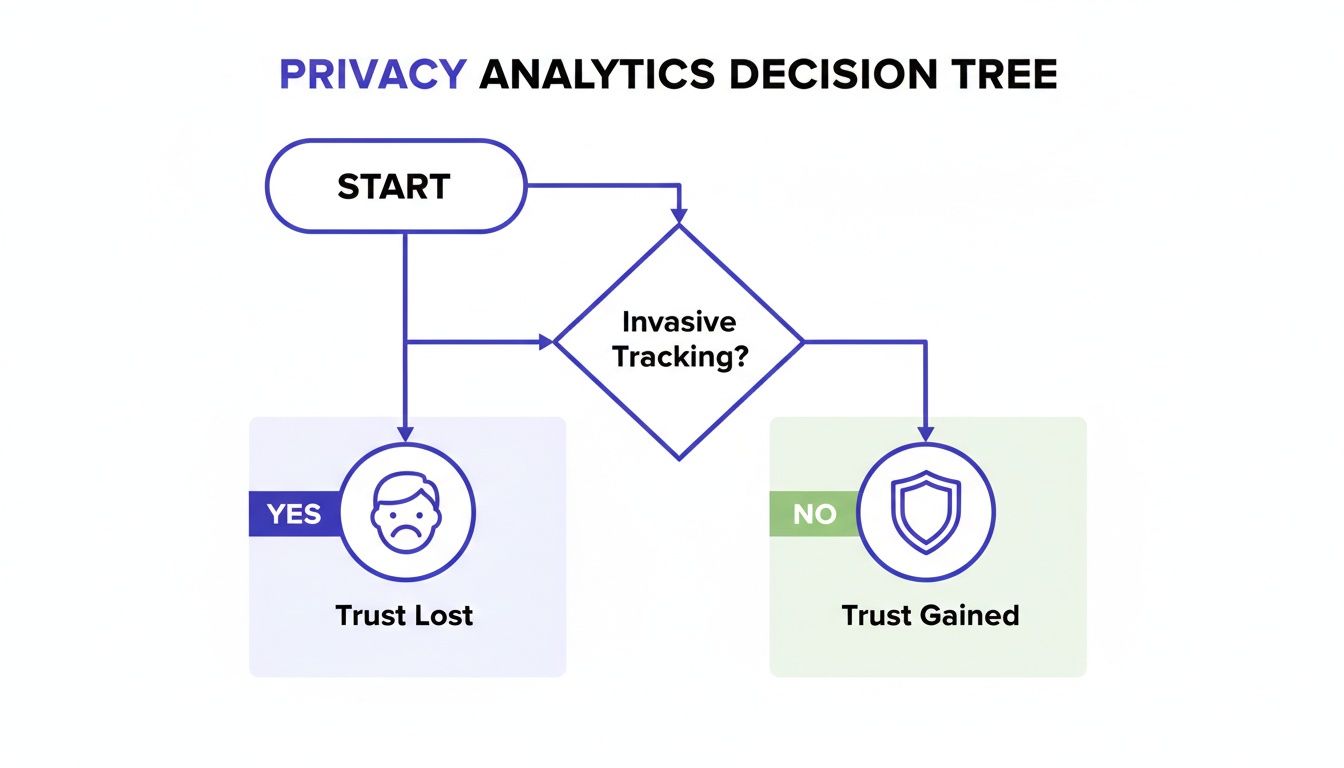
As you can see, chasing every last piece of data with invasive methods is a short-term game. In the long run, customer trust is the most valuable asset you have.
Assessing Data Ownership and Control
Next up: "Who really owns my data, and where is it stored?" This question cuts right to the heart of data control. Many platforms lock you into their cloud, which is easy but gives you less say over your own information.
On the other hand, some tools give you a self-hosting option. This means you run the software on your own servers, giving you total ownership and control over your analytics data.
Self-hosting puts you in the driver's seat. It's the go-to choice for any business that needs to meet strict compliance standards or simply wants to guarantee their data is never, ever shared.
Keeping your data in-house provides a level of security and privacy that cloud-only solutions just can't match.
Understanding Integrations and Flexibility
Your analytics platform can't operate in a vacuum. You need to ask, "How well does your software connect with my existing tools?" Smooth integrations with payment gateways like Stripe or Paddle are non-negotiable for getting accurate revenue numbers.
Beyond that, look for a powerful API. This gives you the freedom to pull data into custom dashboards or pipe it into other BI tools. It’s what makes a platform adaptable enough to grow with you. If you’re weighing your choices, our rundown of the top 10 site analytics tools is a great place to get a broader view.
A Practical Vendor Evaluation Checklist
To make this process easier, I've put together a checklist. Use this framework to compare different vendors head-to-head and see how they stack up on the technical and business fronts.
| Evaluation Criterion | Key Questions to Ask | How Swetrix Addresses It |
|---|---|---|
| Performance | How large is your tracking script? How will it impact my site's load time? | Swetrix uses a tiny, 1.3 KB script that loads asynchronously, ensuring it has virtually no impact on your site's performance or Core Web Vitals. |
| Data Ownership | Do you offer a self-hosting option? Where is my data stored? | Yes, Swetrix offers a fully-featured self-hosting option, giving you 100% data ownership and control. You can host it on your own servers. |
| API & Flexibility | Is there a public API? Can I export my data easily? | Our powerful API lets you programmatically access all your data, build custom reports, and integrate with any other tool in your stack. |
| Pricing Model | How does your pricing scale? Are there any hidden fees or long-term contracts? | Swetrix offers transparent, traffic-based pricing with no hidden costs. You pay for what you use, and you can cancel anytime. |
| Privacy & GDPR | Is your platform GDPR compliant? Do you use cookies or fingerprinting? | Swetrix is cookie-free and fully GDPR, CCPA, and PECR compliant out of the box. We never track PII or use invasive techniques. |
This table isn't just a list; it's a strategic guide. By asking these pointed questions, you force vendors to move beyond buzzwords and provide concrete answers, helping you make a much more informed decision.
Your First Steps: A Practical Implementation Guide
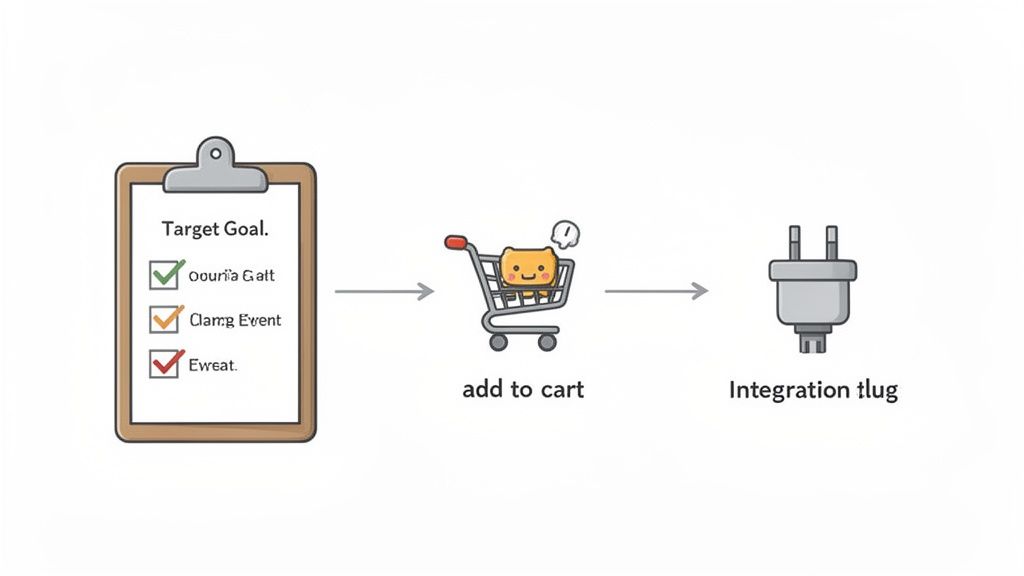
Diving into ecommerce data analytics software can feel like a mountain of a project. The good news? You don't have to climb it all at once. A phased approach is not only more manageable, it's flat-out more effective. Forget trying to measure everything from day one; instead, let's get the fundamentals right. That's how you build a solid foundation for real growth without the overwhelm.
The journey doesn't start with a line of code. It starts with your business goals. Before you track a single click, you have to be crystal clear on what success looks like for your store right now. Are you trying to slash your cart abandonment rate? Get more newsletter signups? Or maybe you just need to figure out which products are actually catching your customers' eyes.
Start with a simple question: "What is the one business problem I want to solve with data this month?" Answering this gives your implementation a clear purpose and prevents you from getting lost in a sea of metrics.
This initial goal becomes your North Star, guiding every decision you make and ensuring your new analytics setup is directly tied to business needs from the get-go.
Building Your Measurement Plan
Once you've locked in your primary goal, it's time to translate it into actions you can actually track. This means pinpointing the key user events that lead to your desired outcome. Think of these as the breadcrumbs your customers leave on their path through your store. A good measurement plan isn't complicated; it's just focused.
Start by listing the top three to five interactions that truly matter.
- Define Core Business Goals: Get specific with a measurable objective. For example, "Increase the conversion rate for first-time visitors by 5%."
- Identify Key User Events: What do people do to reach that goal? This could be anything from viewing a product detail page, using a search filter, or, of course, clicking "Add to Cart."
- Map Out Your Funnel: Now, visualize the ideal path. A classic, simple funnel looks something like this:
Homepage > Product Page > Add to Cart > Checkout > Purchase Confirmation.
The Technical Setup
With your plan in hand, the technical part suddenly becomes much less intimidating. Most modern analytics tools, Swetrix included, make this process pretty painless. Implementation usually just means adding a small tracking script to your website's header—a simple copy-and-paste job.
Once the script is in place, you’ll start configuring your custom events and funnels inside the analytics dashboard. This is where all that planning really pays off. You'll set up tracking for the specific events you identified earlier, like button clicks or form submissions.
By taking this phased approach—goals first, then mapping the user journey, and finally the technical setup—you ensure your ecommerce data analytics software starts delivering valuable, actionable insights from the moment you switch it on.
Got Questions? We’ve Got Answers
If you're still weighing your options, you're not alone. Let's tackle some of the most common questions that pop up when business owners start looking into ecommerce data analytics software.
What’s the Real Difference Between Ecommerce Analytics and Regular Web Analytics?
Think of it this way: regular web analytics is like a store's security camera. It tells you how many people walked in the door, which aisles they visited, and where they spent the most time. It’s useful, but it doesn't tell you who actually bought something.
Ecommerce analytics, on the other hand, is like your point-of-sale system combined with that security camera. It connects every click, every page view, and every marketing channel directly to a dollar amount. It’s built to answer the big questions: Which marketing campaign is actually driving sales? What’s our average order value? Which products are most likely to be purchased together?
While standard analytics shows you traffic, ecommerce analytics shows you revenue.
Can I Still Get Powerful Insights if I Go with a Privacy-First Tool?
Yes, and that’s a common misconception. You don't have to sacrifice deep insights for user privacy. In fact, it's quite the opposite.
Modern, privacy-first tools are specifically engineered to give you the actionable data you need without ever touching personal information or relying on invasive cookies. They work by focusing on aggregated, anonymous trends—things like user flows, conversion funnels, and performance hotspots. You get a crystal-clear picture of what works on your site, all while respecting your customers and staying compliant with laws like the GDPR.
Choosing a privacy-first platform isn't about getting less data; it's about getting smarter data. You're making a strategic choice to build a brand on trust, which is a far more valuable asset for long-term growth than a database full of personal details.
How Big of a Headache Is It to Switch Analytics Platforms?
It’s probably a lot less painful than you imagine. Most modern platforms, including ours, are designed for a quick and simple setup. The technical part usually just involves adding a small tracking script to your website's code—a copy-and-paste job.
The real key to a smooth transition is having a simple plan. Before you switch, just make a note of the key metrics and goals you’re currently tracking. Once the new script is in place, you can easily replicate those goals in the new system. With intuitive interfaces for setting up custom events and funnels, most teams can get up and running in no time.
Ready to see how simple it is to make smarter, data-driven decisions without compromising on privacy? Give Swetrix a try. You can get the insights you need to grow your store, starting today.
Begin your free trial at https://swetrix.com.