- Date
Matomo vs Google Analytics: Which Analytics Tool is Better in 2026?
When evaluating web analytics platforms in 2026, two of the most frequently discussed options are Matomo and Google Analytics. They represent fundamentally different approaches to tracking website visitors, data ownership, and user privacy.
Google Analytics (specifically GA4) remains the dominant industry standard, providing incredibly deep tracking capabilities geared toward advertisers. Matomo, on the other hand, is a privacy-conscious, open-source platform that gives you complete control over your data.
In this detailed comparison, we will examine the strengths and weaknesses of both platforms. Afterwards, we will introduce Swetrix - a modern, lightweight analytics solution that offers the privacy of Matomo combined with the rich feature set of Google Analytics without the unnecessary complexity.
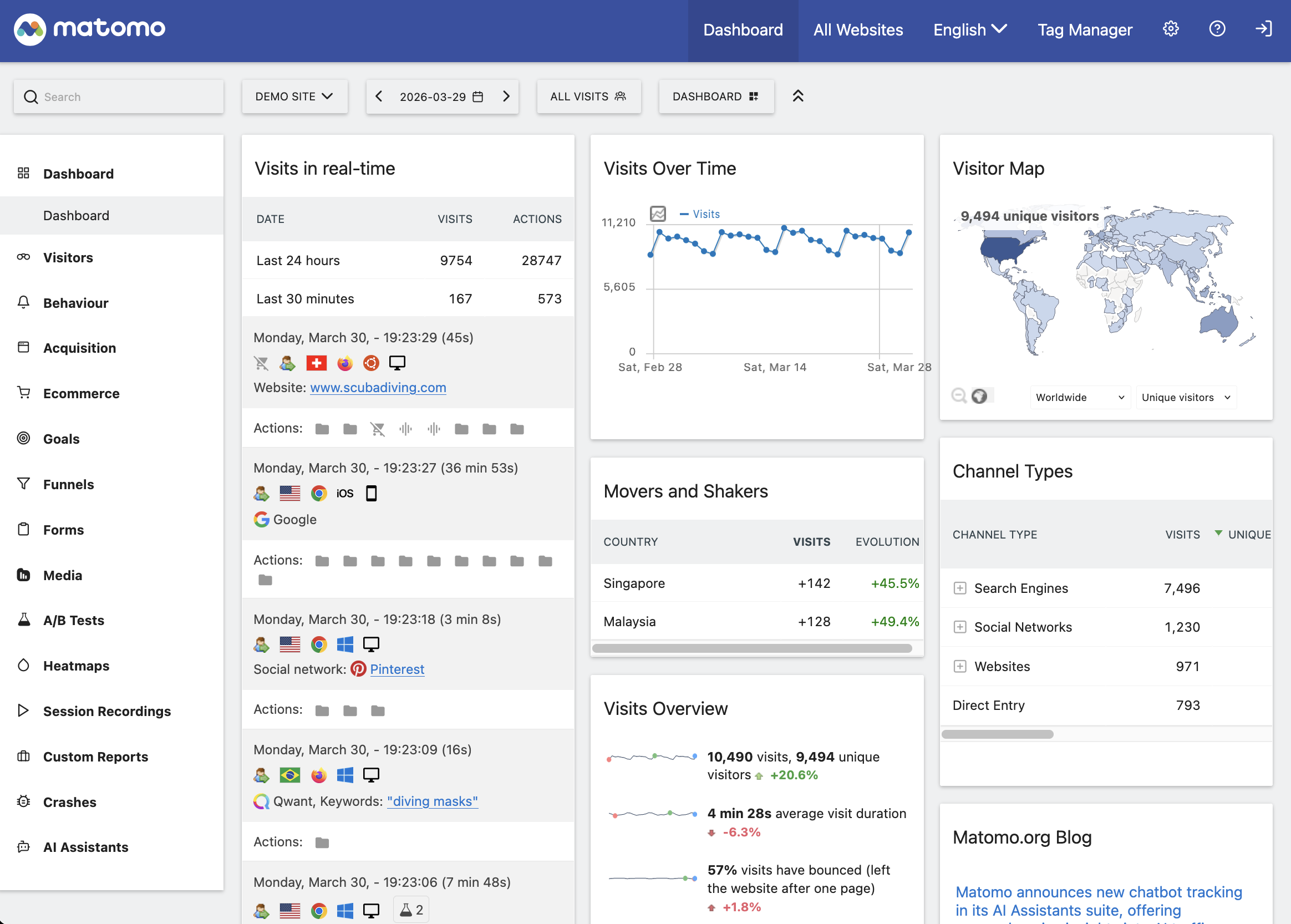
Matomo Overview
Matomo (formerly known as Piwik) has been a staple in the open-source analytics space for over a decade. It was originally built to mimic the classic Google Analytics (Universal Analytics) experience but with a strong emphasis on data sovereignty. Because it is open-source, you can host it on your own servers and retain 100% ownership of your visitor data.
Strengths:
- Data Ownership: You maintain complete control over your data, ensuring it is never used to train third-party advertising algorithms.
- Familiar Interface: For users who miss the old Universal Analytics layout, Matomo provides a similar structure and reporting style.
- Extensive Capabilities: It supports custom event tracking, e-commerce analytics, and goal conversions out of the box.
Cons:
- Hidden Costs: While the core self-hosted version is free, essential modern features like Funnels, User Flow Analysis, and Performance Monitoring require expensive premium plugins.
- Heavy Resource Usage: Matomo is built on an older PHP/MySQL architecture. It requires significant server resources to run smoothly at scale, and its tracking script is quite heavy (over 60 KB).
- Complex Configuration: Achieving true cookie-less, GDPR-compliant tracking requires complex configurations, as it is not strictly cookie-less by default.
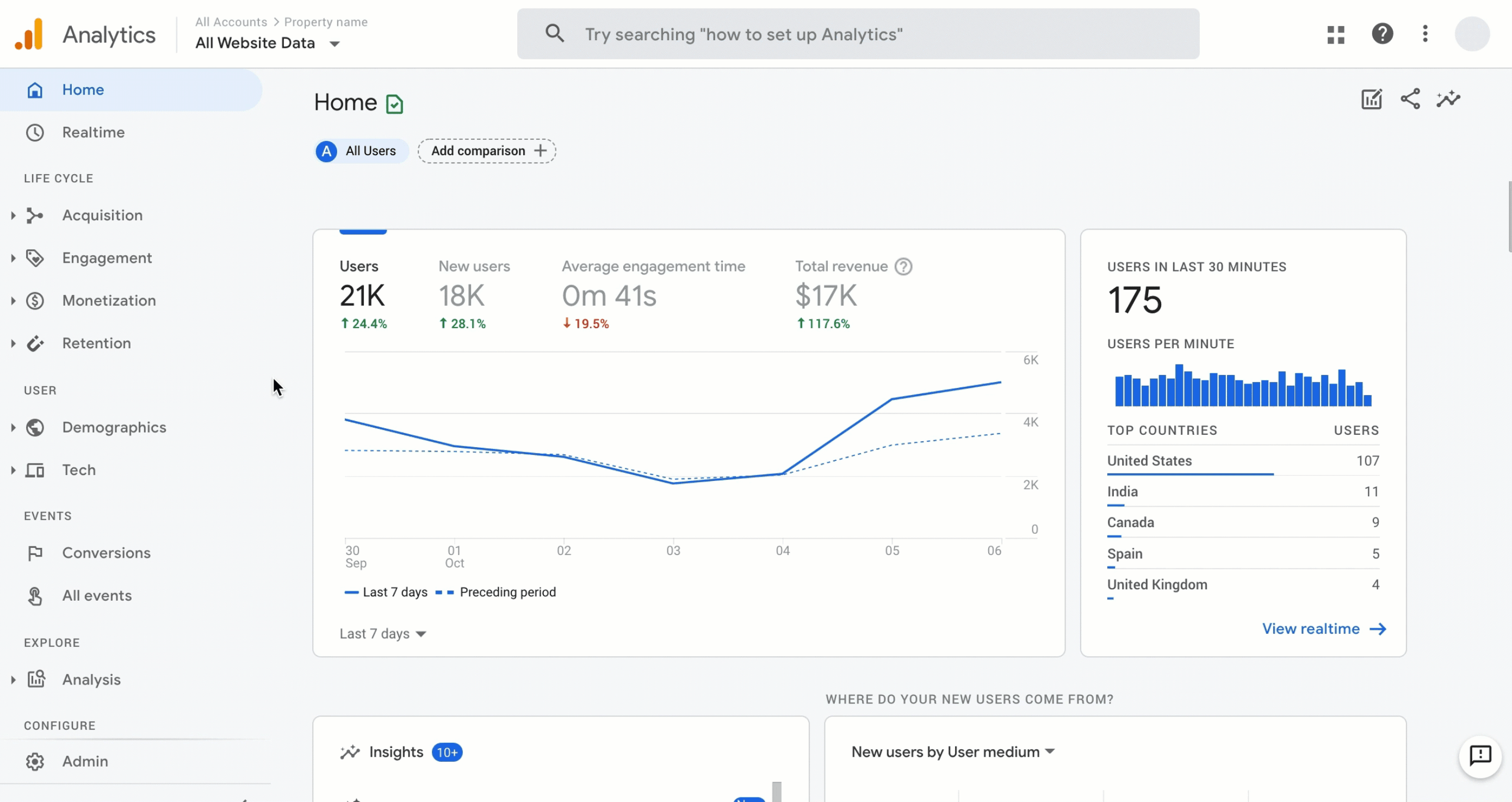
Google Analytics (GA4) Overview
Google Analytics is the default choice for millions of websites worldwide. The transition to GA4 brought a new event-based data model, focusing heavily on predictive insights and deep integrations with Google's advertising ecosystem. It is a highly robust tool for enterprise-level marketing teams.
Strengths:
- Deep Ecosystem Integration: Seamlessly connects with Google Ads, Search Console, and BigQuery.
- Advanced Audience Segmentation: Provides granular details about user demographics, interests, and cross-device behaviors.
- Completely Free: The standard version is free to use regardless of your traffic volume.
Cons:
- Privacy Nightmare: Google Analytics has faced significant legal scrutiny under the GDPR. It relies on cross-site tracking, making it incompatible with a strict privacy-first approach and requiring annoying cookie banners.
- Data Sampling: High-traffic websites suffer from data sampling, meaning GA4 provides estimates rather than 100% accurate visitor counts.
- Steep Learning Curve: The GA4 interface is notoriously difficult to navigate. Simple tasks like checking daily page views often require multiple clicks and custom report generation.
Feature Comparison: Matomo vs Google Analytics (vs Swetrix)
Let's take a closer look at the actual features provided by these platforms. The following table highlights how Matomo and Google Analytics stack up against Swetrix across various categories.
| Feature | Matomo | Google Analytics |  Swetrix Swetrix |
|---|---|---|---|
| Core Features | |||
| Real-time Analytics | |||
| Page views | |||
| Custom Events | |||
| Live visitors count | |||
| UTM Tracking | |||
| Email Reports | |||
| Modern, intuitive UI | |||
| Easy setup | |||
| Device stats (browser, OS) | |||
| Advanced Features | |||
| Performance Monitoring | Paid Plugin / $$$$ | ||
| User Flow Analysis | Paid Plugin / $$$$ | ||
| Funnels | Paid Plugin / $$$$ | ||
| Error Tracking | Paid Plugin / $$$$ | ||
| Heatmaps | Paid Plugin / $$$$ | ||
| Multiple Domains per Site | |||
| Alerts / Notifications | |||
| Growth & Product | |||
| AI Chat | |||
| Goals | |||
| Experiments (A/B tests) | Paid Plugin / $$$$ | (Requires 3rd party) | |
| Feature flags | |||
| User Profiles | |||
| Revenue analytics | (Ecommerce) | ||
| Privacy & Compliance | |||
| Cookie-less by default | |||
| Privacy compliance | (With config) | (Illegal in some EU countries) | |
| Data Ownership | You (100%) | Google (for Ads/AI) | You (100%) |
| Open Source | |||
| Self-hostable | |||
| EU data residency | |||
| Technical & Pricing | |||
| Data Sampling | 0% (None) | Heavy (Data is approximated) | 0% (None) |
| Script size | > 60 KB | 74 KB | ~6 KB |
| API access | |||
| Entry price | €22.00 ( ~$25) | Free* | $19.00 |
| Human customer support | Paid option / $$$$ | ||

Where Both Tools Fall Short
While Matomo and Google Analytics serve their respective audiences well, they both require significant compromises from website owners.
The Complexity Burden
Google Analytics 4 is an enterprise marketing tool that is overkill for most businesses. Finding actionable data requires formal training and hours of custom report building. Matomo suffers from a different kind of complexity. Its interface feels dated and cluttered, with hundreds of sub-menus that can easily overwhelm new users.
Performance and Speed Issues
Both platforms rely on large tracking scripts. Google Analytics weighs in at roughly 74 KB, while Matomo is over 60 KB. Adding these scripts to your website can negatively impact your Core Web Vitals, slowing down your page load times and potentially harming your search engine rankings.
Hidden Costs vs Data Privacy
Google Analytics is free because your data is the product. You pay for the service by feeding Google's advertising network. Matomo respects your data, but it achieves this by charging steep annual fees for essential features like Funnels, Error Tracking, and Performance Monitoring on its self-hosted platform.
A Smarter Alternative: Swetrix
You shouldn't have to choose between user privacy and advanced analytics. Swetrix provides a comprehensive analytics suite that solves the problems inherent in both Matomo and Google Analytics.
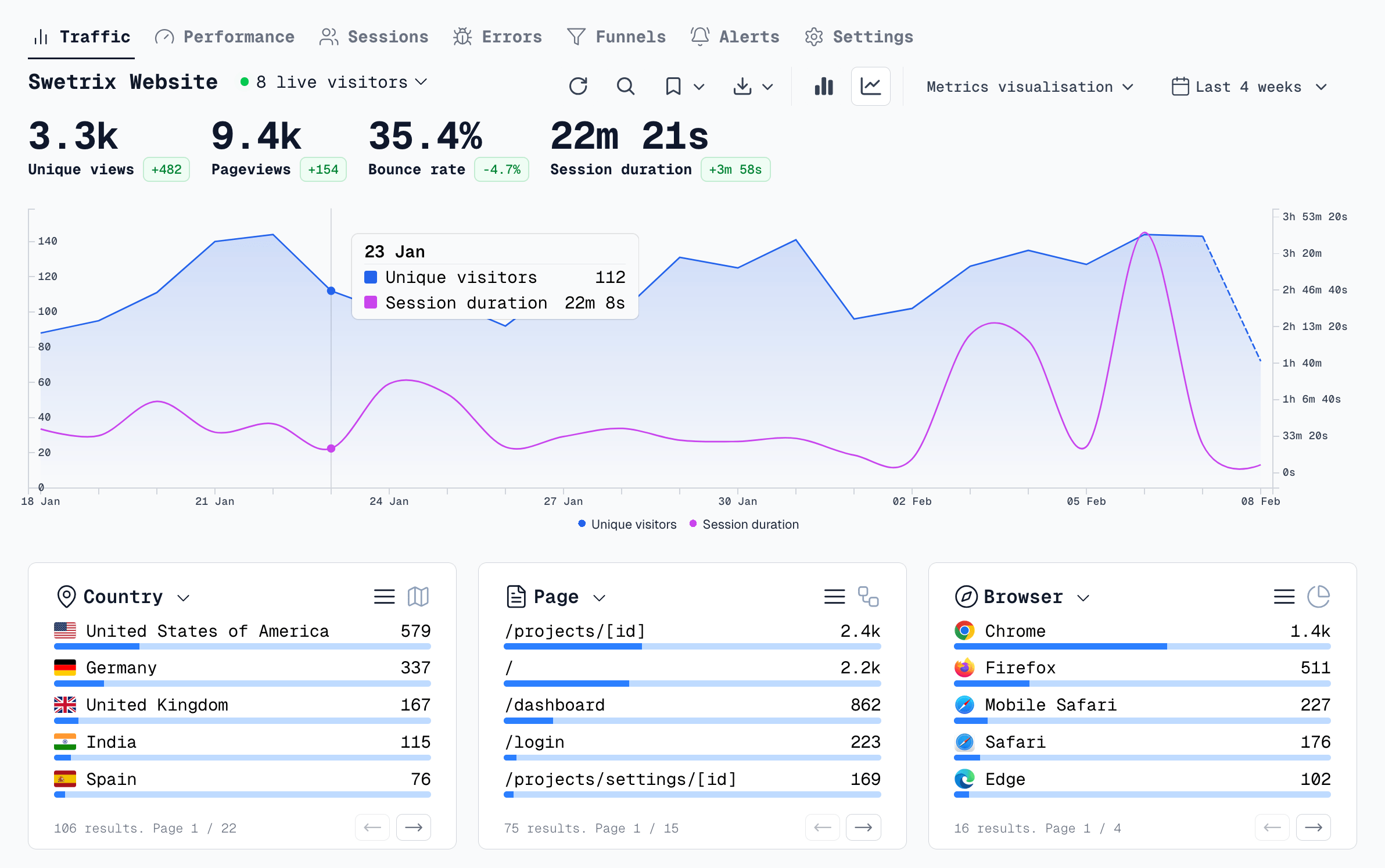
Here is why Swetrix is the definitive choice for modern businesses:
- 100% Accurate, Privacy-First Data: Swetrix is fully cookie-less by default and never samples your data. You get exact visitor counts and behavioral insights without needing intrusive cookie consent banners.
- All-Inclusive Feature Set: Unlike Matomo, Swetrix does not nickel-and-dime you for basic functionality. Advanced tools like Funnels, User Flow Analysis, Error Tracking, and Performance Monitoring are included directly in the core product.
- Built for Growth: Swetrix goes beyond simple page views. It offers a complete growth suite featuring A/B Testing, Feature Flags, and an AI Chat assistant to query your data in plain English.
- Blazing Fast Performance: Built on a modern technology stack (ClickHouse), Swetrix features a tiny tracking script (around 6 KB) that ensures your website remains lightning fast.
If you are tired of the privacy concerns and complexity of Google Analytics, and want a modern, affordable alternative to Matomo's heavy architecture, Swetrix is the ultimate upgrade for your website.
The web analytics your site deserves.
Tired of bloated dashboards, privacy concerns, and data you can't trust? Switch to Swetrix and get simple, powerful analytics that respects your users.