- Date
Fathom Analytics vs PostHog: Which is Better in 2026?
When moving away from Google Analytics, you will quickly discover that the analytics market is divided into two distinct camps. On one side, you have radically simple, privacy-first trackers like Fathom Analytics. On the other, you have incredibly powerful, engineering-focused data platforms like PostHog.
Fathom and PostHog represent complete opposites in almost every way. One is designed to be set up in five minutes and gives you a single dashboard of vanity metrics. The other is a distributed system that acts as an "OS for product analytics," allowing you to build complex SQL queries and analyze massive datasets.
In this guide, we will compare Fathom Analytics and PostHog to help you understand which extreme fits your workflow. Then, we will introduce Swetrix, a platform that sits perfectly in the middle, offering advanced product insights without the setup headaches or unpredictable pricing.
Fathom Analytics Overview
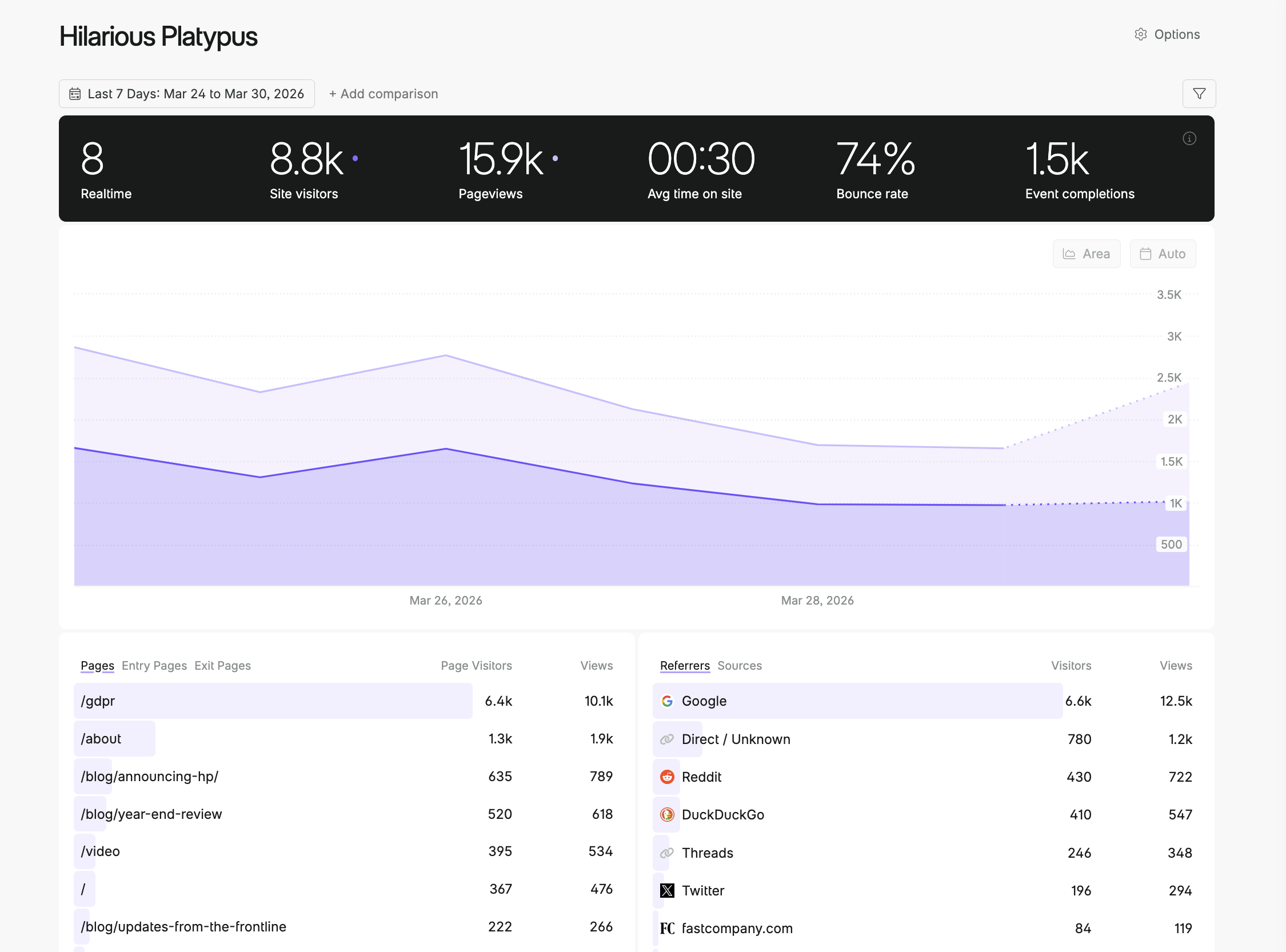
Fathom Analytics is a premium, privacy-focused alternative to Google Analytics that is built entirely around simplicity. It completely abstracts away the complexity of traditional trackers, offering a single, highly optimized dashboard that shows you exactly what is happening on your website at a glance.
It is heavily favored by marketers and agencies due to its strong adblocker bypassing techniques and its "set it and forget it" nature.
Strengths:
- Extreme Simplicity: Very low learning curve; anyone can understand the dashboard in seconds.
- Adblocker Bypass: Built-in custom domain setups help capture traffic that standard scripts miss.
- Privacy-First: 100% cookie-less tracking means no annoying GDPR consent banners are required.
Cons:
- Strictly Basic Analytics: It is a visitor counter. It completely lacks advanced tools like funnels, user flow analysis, or deep audience segmentation.
- Closed-Source: Fathom is proprietary software. You cannot self-host it or inspect its codebase.
PostHog Overview
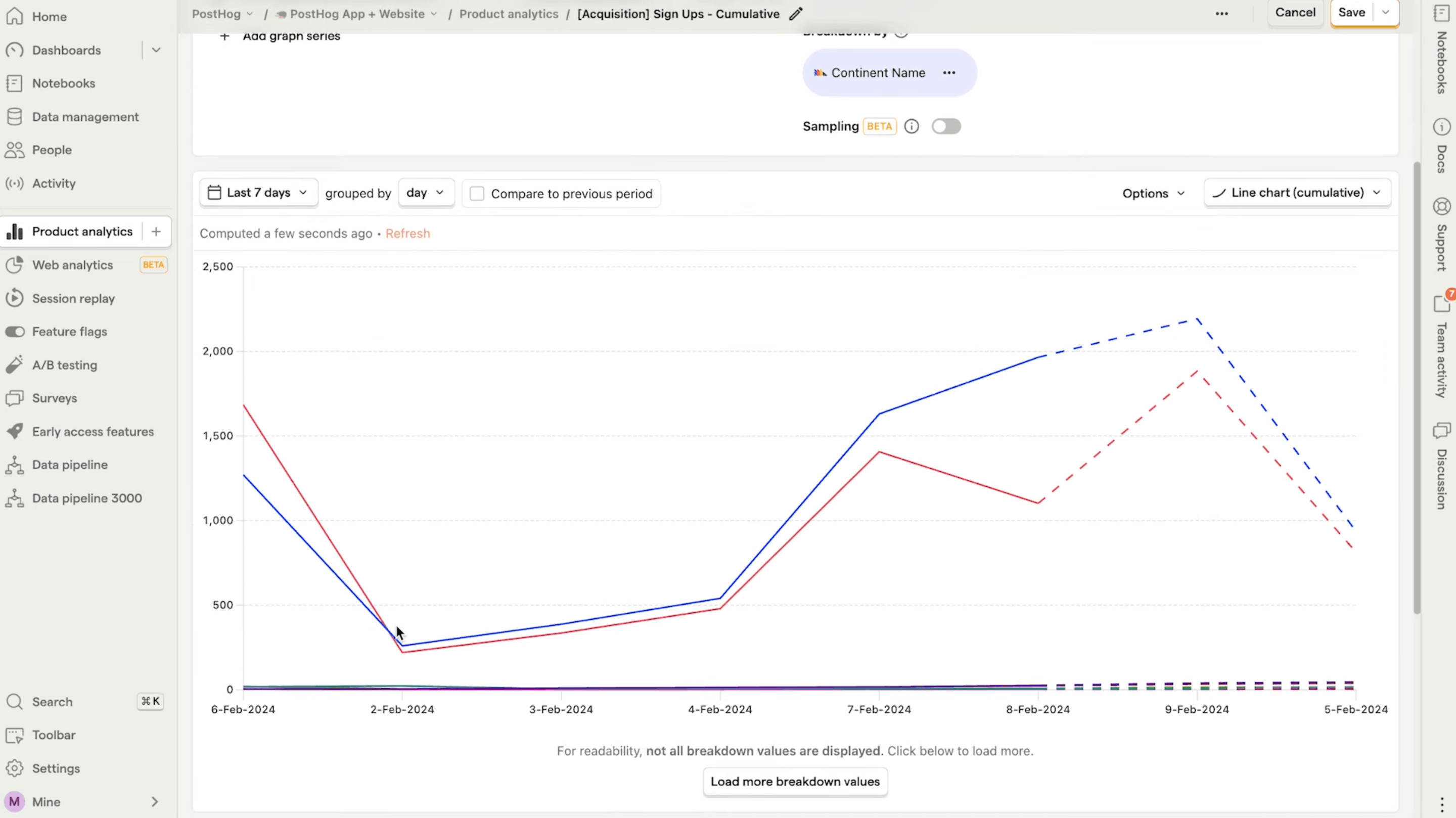
PostHog is a massive, open-source product analytics suite. It goes far beyond simply counting pageviews. It is designed to track individual user journeys across web and mobile apps, offering features like session replay, a data warehouse, A/B testing, and feature flags.
It is primarily built for software engineers and data scientists who want to build highly customized, complex data reports.
Strengths:
- Incredibly Powerful: Features deep product analytics, including session replay and direct SQL access.
- Extensive Growth Suite: Robust A/B testing and feature flag capabilities built directly into the platform.
- Deep User Tracking: Excellent at tracking specific, individual user actions across complex applications.
Cons:
- Steep Learning Curve: Extremely complex to set up. If you just want to see a simple funnel, you might have to spend significant time configuring a custom dashboard.
- Difficult to Self-Host: Running PostHog on your own infrastructure requires managing a complex stack (ClickHouse, Kafka, Redis, Postgres), making it unrealistic for small teams.
- Unpredictable Pricing: Usage-based billing means a sudden spike in traffic or a bot attack could result in a massive, unexpected invoice.
Feature Comparison: Fathom Analytics vs PostHog (vs Swetrix)
Let's look at how the simplest and the most complex tools on the market compare, and how Swetrix perfectly balances both.
| Feature | Fathom Analytics | PostHog |  Swetrix Swetrix |
|---|---|---|---|
| Core Features | |||
| Real-time Analytics | |||
| Custom Events | |||
| Page views | |||
| Live visitors count | |||
| UTM Tracking | |||
| Device stats (browser, OS, type) | |||
| Email Reports | |||
| Geolocation data | Full (Country, State, City) | Full | |
| Advanced Features | |||
| Performance Monitoring (Web Vitals) | |||
| User Flow Analysis | |||
| Error Tracking | |||
| Alerts / Notifications | |||
| Funnels | |||
| Segments | |||
| Custom dashboards | |||
| Multiple Domains per Site | |||
| Growth & Product | |||
| AI Chat | |||
| Goals | |||
| Experiments (A/B tests) | |||
| Feature flags | |||
| User Profiles | |||
| Revenue analytics | |||
| Session recordings | |||
| Heatmaps | |||
| SQL Access | |||
| CAPTCHA | |||
| Security & Access | |||
| Bot filtering | |||
| Two-Factor Authentication (2FA) | |||
| Role-based Access Control | |||
| Shared Dashboards | |||
| Organisations (Teams) | |||
| Privacy & Compliance | |||
| Cookie-less Tracking | |||
| Open Source | (Open Core) | ||
| Easy Self-hosting | |||
| EU data residency | (Optional) | ||
| Technical specifications | |||
| Script size | 6 KB | >30 KB | 6 KB |
| API access | |||
| Bypass adblockers | |||
| Pricing & Support | |||
| Pricing Model | Flat fee | Usage-based | Flat fee |
| Entry price | $15.00 | Free / Pay-as-you-go | $19.00 |
| Customer support | |||

Where Both Tools Miss the Mark
Choosing between Fathom and PostHog often feels like choosing between a tool that is too simple to be useful and a tool that is too complex to manage.
1. Simplicity vs. Complexity
Fathom is too simple for a growing business. If you want to run an A/B test, track JavaScript errors, or visualize user drop-off in a checkout funnel, Fathom cannot help you.
Conversely, PostHog is far too complex for most users. Finding basic traffic statistics requires navigating a dense, engineering-focused UI. It is a tool built by developers, for developers, and its learning curve is massive.
2. The Self-Hosting Headache
Fathom is closed-source, meaning you cannot self-host it at all. PostHog offers an open-source version, but running a production instance requires a dedicated DevOps engineer to manage a heavy, distributed tech stack. Neither tool makes data sovereignty easy.
3. Usage-Based Billing Stress (PostHog)
While Fathom offers predictable flat-rate pricing, PostHog relies on usage-based billing. While they have a free tier, costs can balloon unpredictably as your product scales. A sudden viral traffic spike could lead to a shockingly high bill.
The Ultimate Winner: Swetrix
You shouldn't have to hire a data engineer to understand your analytics, nor should you settle for missing out on powerful growth metrics. Swetrix offers the perfect balance between the two extremes.
Here is why Swetrix is the superior choice:
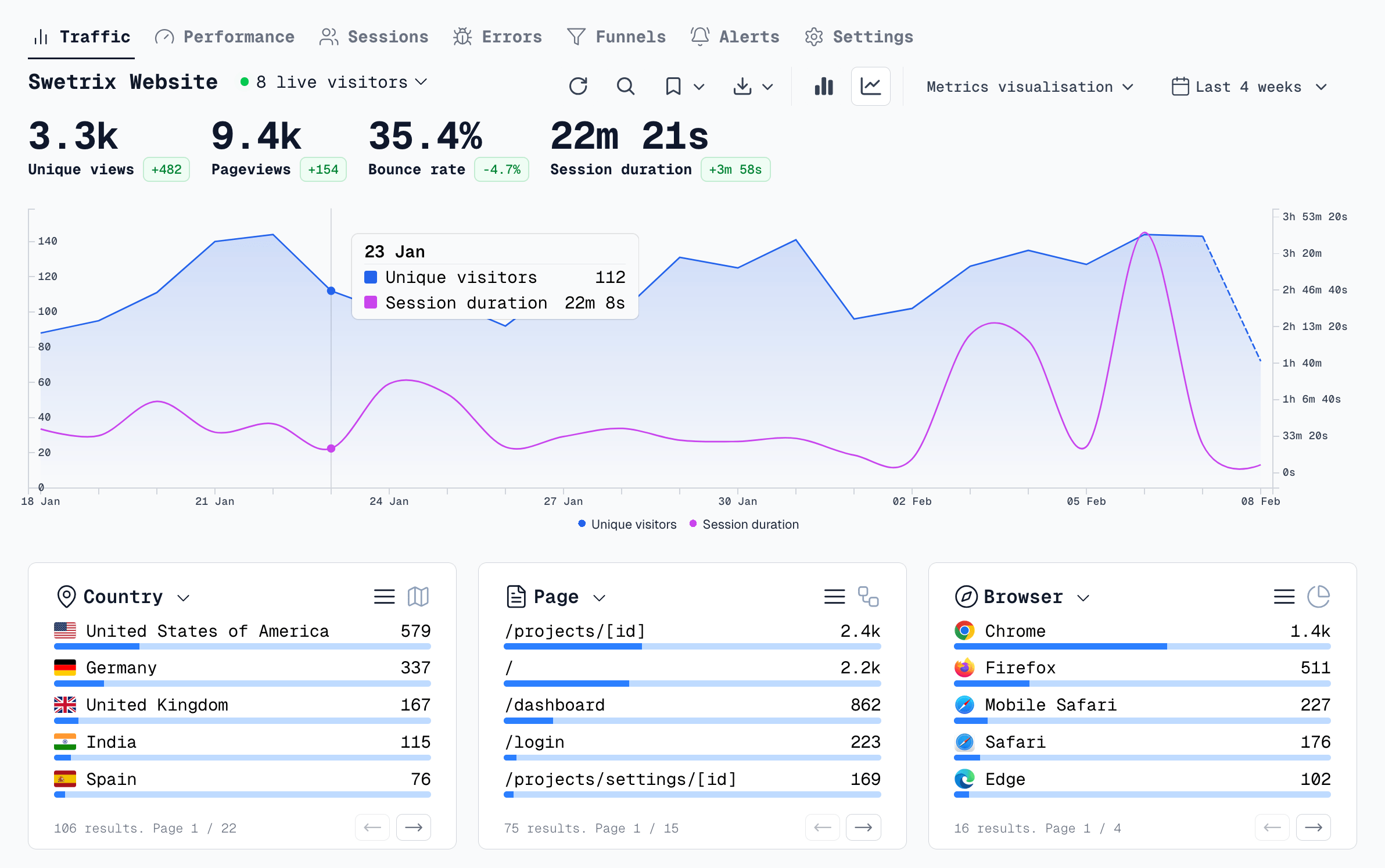
- Powerful Yet Simple: We give you the deep insights you need—like Performance Monitoring, Error Tracking, User Flows, and Funnels—in a beautiful, pre-configured dashboard that anyone can understand instantly. No SQL required.
- Effortless Self-Hosting: Unlike PostHog, Swetrix is extremely lightweight. You can get a fully functional, open-source Swetrix instance running on a modest VPS in about 5 minutes using Docker.
- Predictable Pricing: We offer predictable, flat-rate pricing. You know exactly what you will pay each month, regardless of sudden traffic spikes. We don't punish you for your success.
- Built-In Growth Tools: Swetrix includes A/B testing, Feature Flags, and an AI Chat assistant directly out of the box, allowing you to optimize your site without needing a complex product analytics OS.
If you are a large enterprise data team, PostHog is fantastic. But if you want advanced, actionable analytics that are easy to use, easy to host, and predictably priced, Swetrix is the definitive winner.
The web analytics your site deserves.
Tired of bloated dashboards, privacy concerns, and data you can't trust? Switch to Swetrix and get simple, powerful analytics that respects your users.