- Date
Fathom Analytics vs Plausible: A Detailed Comparison for 2026
If you are looking to replace Google Analytics with a tool that respects user privacy and doesn't require annoying cookie banners, you have almost certainly narrowed your choices down to Fathom Analytics and Plausible.
Both of these platforms are titans in the privacy-first analytics space. They share a core philosophy: website tracking should be simple, lightweight, cookie-less, and fully compliant with global privacy laws like GDPR. However, despite their similarities, they have fundamentally different approaches to software development, data visualization, and feature sets.
In this deep dive, we will compare Fathom Analytics and Plausible to help you decide which one fits your workflow. Then, we will introduce Swetrix - a platform designed to give you the simplicity of both tools without sacrificing the advanced capabilities needed to actually grow your website.
Fathom Analytics Overview
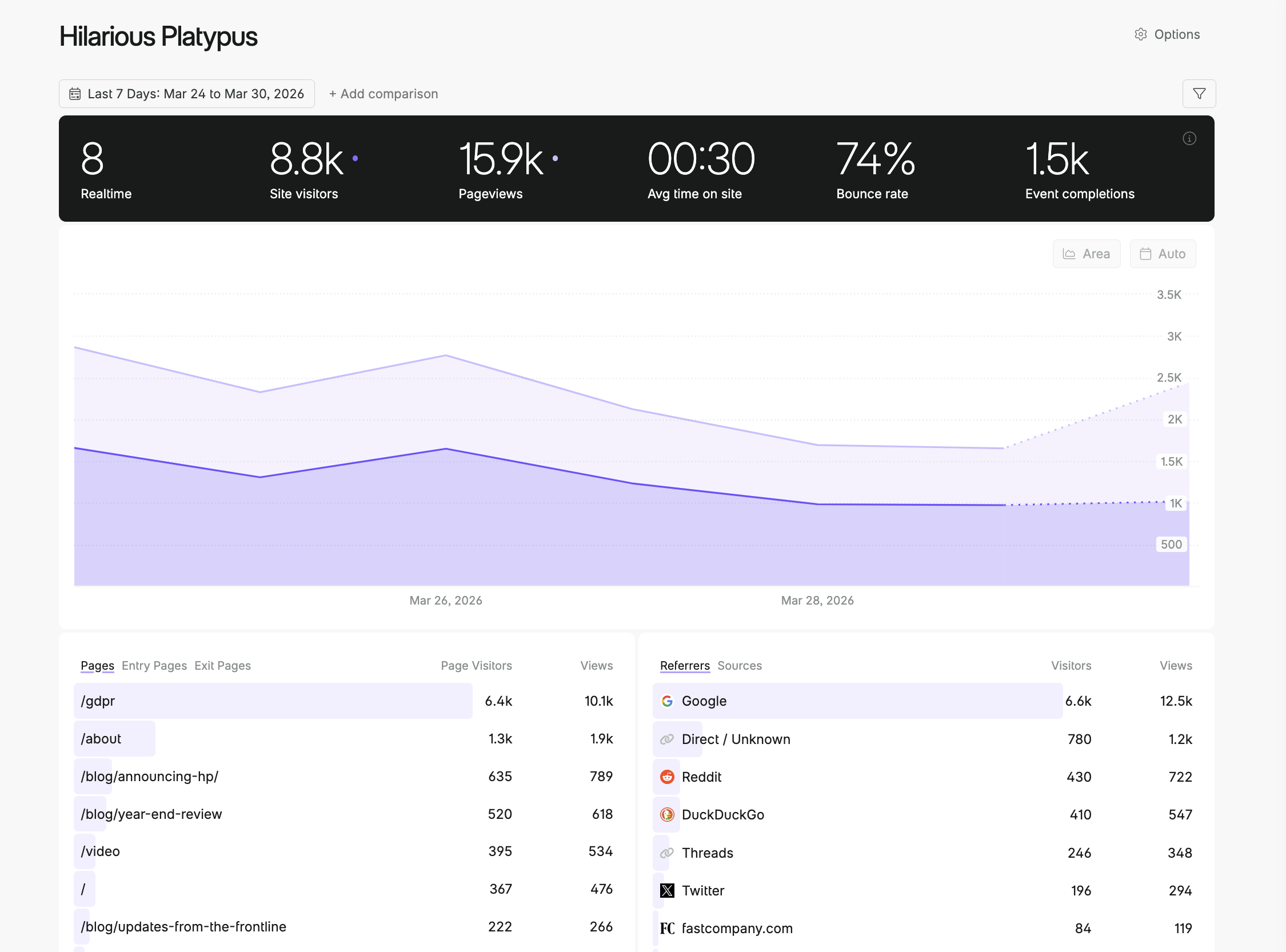
Fathom Analytics positions itself as the reliable, premium choice for professionals and agencies who want zero friction. It delivers a fast, single-page dashboard that shows you exactly what is happening on your site without any complex setup.
One of Fathom's biggest selling points is its approach to data accuracy. By utilizing custom domain routing, Fathom excels at bypassing adblockers, ensuring that you capture traffic data that other standard tracking scripts simply miss.
Strengths:
- Adblocker Bypass: Their custom domain setup allows you to track users who have aggressive adblockers enabled, yielding highly accurate visitor counts.
- Generous Multi-Site Limits: The base pricing tier allows you to track up to 50 different websites, making it a highly economical choice for agencies or prolific creators.
- Rock-Solid Performance: The dashboard handles massive amounts of traffic without slowing down or crashing.
Cons:
- Proprietary and Closed-Source: You must trust Fathom's privacy claims because their codebase is completely closed-source. You cannot audit it or self-host it.
- Missing Funnels: Fathom is strictly a counter. It completely lacks any way to build conversion funnels or track multi-step user journeys.
Plausible Overview
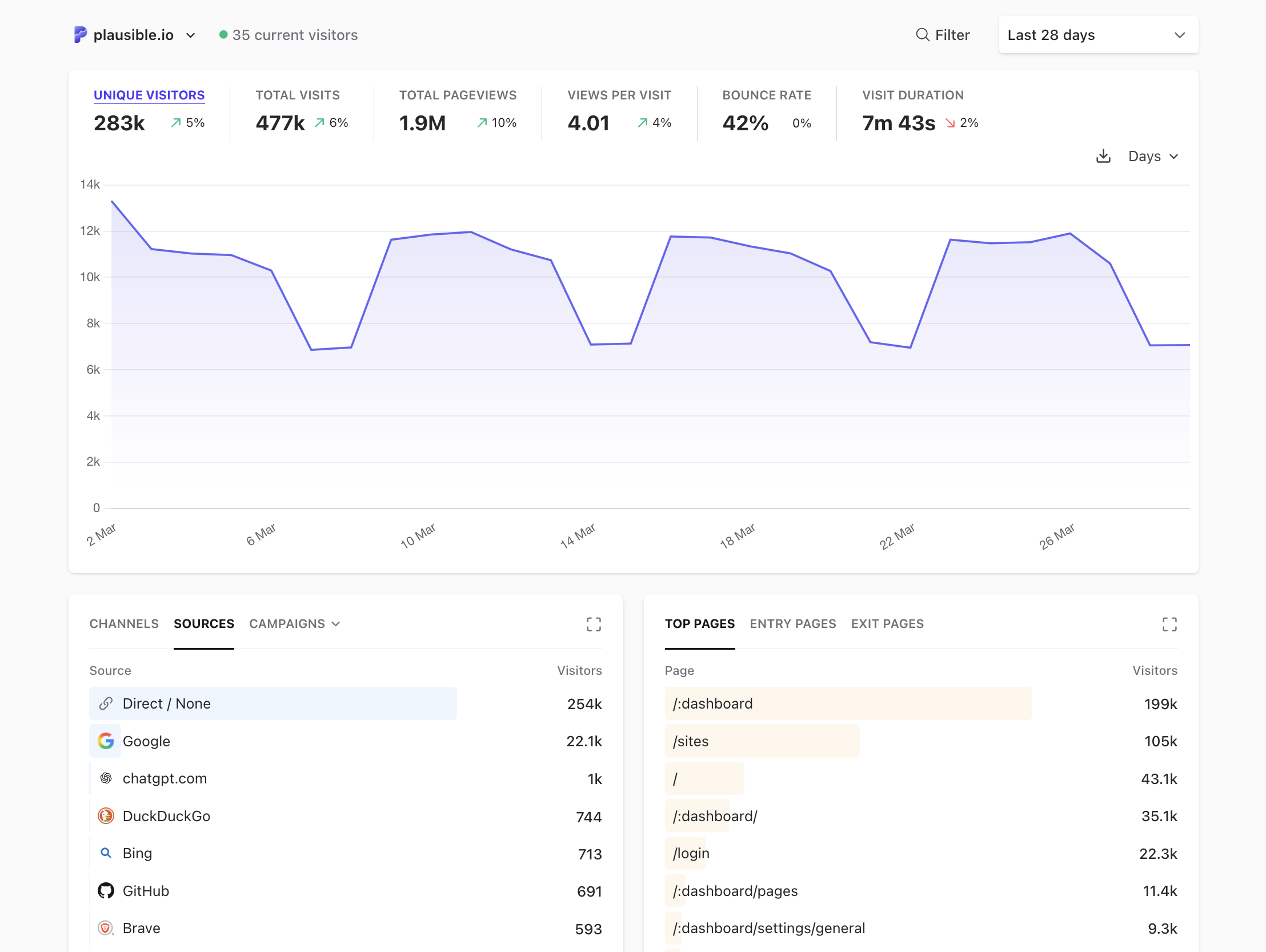
Plausible was built as an open-source rebellion against bloated analytics tools. It is widely loved by developers and privacy advocates because of its commitment to transparency. Like Fathom, Plausible offers a clean, single-page dashboard, but it places a heavy emphasis on remaining as lightweight as possible while staying true to open-source ideals.
While Plausible is beautifully simple, it does include slightly more marketing-focused features than Fathom, such as basic goal tracking and funnel visualization.
Strengths:
- 100% Open-Source: The entire codebase is available on GitHub. You can verify exactly how it works, and if you have the technical skills, you can self-host it.
- Actionable Marketing Tools: Unlike Fathom, Plausible supports basic custom event tracking and simple conversion funnels to help you measure goal completions.
- Intuitive UI: The dashboard is arguably one of the easiest to read in the industry, making it accessible to completely non-technical users.
Cons:
- No Technical Observability: Plausible gives you no insight into how fast your website loads for users or if there are underlying JavaScript errors breaking your site.
- Limited Visual Context: While it has basic funnels, it lacks deeper visual tools like user flow diagrams or interactive geographic maps.
Feature Comparison: Fathom Analytics vs Plausible (vs Swetrix)
Let's look at the hard facts. Here is how Fathom Analytics and Plausible compare across their core features, and how Swetrix bridges the gaps left by both.
| Feature | Fathom Analytics | Plausible |  Swetrix Swetrix |
|---|---|---|---|
| Core Features | |||
| Real-time Analytics | |||
| Custom Events | |||
| Page views | |||
| Live visitors count | |||
| UTM Tracking | |||
| Device stats (browser, OS, type) | |||
| Email Reports | |||
| Geolocation data | Basic | ||
| Advanced Features | |||
| Performance Monitoring (Web Vitals) | |||
| User Flow Analysis | |||
| Error Tracking | |||
| Alerts / Notifications | |||
| Geolocation map visualisation | |||
| Funnels | |||
| Segments | |||
| Multiple Domains per Site | |||
| Growth & Product | |||
| AI Chat | |||
| Goals | |||
| Experiments (A/B tests) | |||
| Feature flags | |||
| User Profiles | |||
| Revenue analytics | |||
| CAPTCHA | |||
| Security & Access | |||
| Bot filtering | |||
| Two-Factor Authentication (2FA) | |||
| Role-based Access Control | |||
| Shared Dashboards | |||
| Organisations (Teams) | |||
| Privacy & Compliance | |||
| Cookie-less Tracking | |||
| Open Source | |||
| Self-hostable | |||
| EU data residency | |||
| Technical specifications | |||
| Script size | 6 KB | 6 KB | 6 KB |
| API access | |||
| Bypass adblockers | |||
| Pricing & Support | |||
| Entry price | $15.00 | $19.00 | $19.00 |
| Customer support | |||

Where Both Tools Fall Short
Choosing between Fathom and Plausible is choosing between two excellent, but ultimately limited, products. If you are actively trying to improve your website's user experience, you will quickly hit a ceiling with both.
1. Blind Spots on Performance and Errors
Your site might have great traffic according to Fathom or Plausible, but what if it is loading incredibly slowly for mobile users, or throwing a JavaScript error when users try to submit a contact form? Neither Plausible nor Fathom will tell you about these technical realities. They completely ignore website performance and error tracking.
2. Lack of In-Depth User Behavior Tools
Plausible offers basic funnels, and Fathom offers none at all. More importantly, neither platform provides User Flow Analysis. When you want to see the exact step-by-step path users take through your site—where they start, where they loop back, and where they finally drop off—you are left guessing.
3. No Built-In Growth Suite
Both tools are great at showing you what has happened in the past. Neither tool helps you change what happens in the future. They both lack modern product tools like A/B Testing, Feature Flags, and an AI-assisted chat to quickly query your data.
The Definitive Winner: Swetrix
You shouldn't have to sacrifice advanced insights just to protect your users' privacy. If you want the simplicity of Fathom and the open-source transparency of Plausible, combined with the power of a modern product analytics suite, Swetrix is the clear winner.
Here is why Swetrix outperforms both tools:
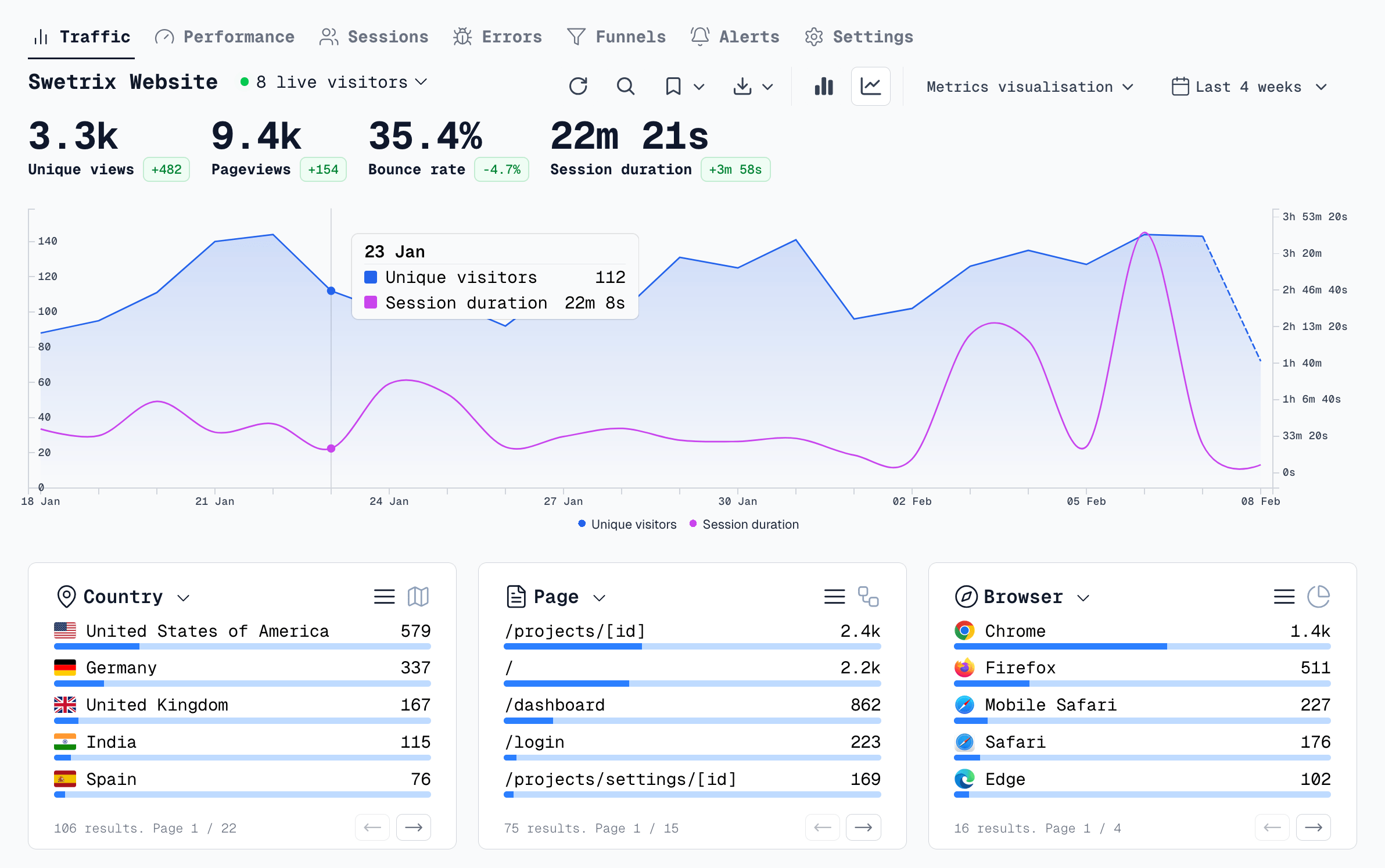
- Complete Observability: Swetrix includes built-in Performance Monitoring (tracking Core Web Vitals) and automated JavaScript Error Tracking. You don't just see who visited; you see if they had a fast, bug-free experience.
- Advanced Visual Insights: Understand your audience instantly with visual User Flow diagrams, custom funnels, and interactive geolocation maps—visualizations that both Fathom and Plausible lack.
- Growth Tools Built-In: Stop paying for separate, expensive A/B testing software. Swetrix includes privacy-friendly Experiments, Feature Flags, and an AI Chat to interact with your data naturally.
- Truly Open Source & Transparent: Like Plausible, Swetrix is fully open-source and self-hostable, guaranteeing data sovereignty. However, Swetrix offers significantly more functionality right out of the box.
If you are serious about growing your website, fixing hidden bugs, and improving conversion rates, Swetrix delivers a complete package that simple traffic counters just cannot match.
The web analytics your site deserves.
Tired of bloated dashboards, privacy concerns, and data you can't trust? Switch to Swetrix and get simple, powerful analytics that respects your users.