- Date
What Is ePrivacy Regulation? A Complete Guide
 Andrii Romasiun
What Is ePrivacy Regulation? A Complete Guide
The European Commission withdrew its proposed ePrivacy Regulation in February 2025 after eight years of negotiations. This means the original 2002 ePrivacy Directive—not a new EU-wide regulation—still governs cookies, tracking, and electronic communications across Europe. If your website uses analytics cookies, consent banners, or email marketing, this legal framework applies to you today.
Most website owners assume GDPR handles all privacy compliance. The ePrivacy Directive sets separate rules for cookies and electronic communications that override GDPR in specific scenarios. A site can comply with GDPR while violating ePrivacy by loading analytics cookies before obtaining consent. The two laws work together, but ePrivacy takes precedence for tracking technologies.
Understanding which law applies to your analytics setup determines whether you need consent banners, how much traffic data you're missing, and what compliance risks you face. This guide explains the current legal framework, shows how ePrivacy differs from GDPR, and provides actionable steps to implement compliant tracking.
What Is the ePrivacy Regulation?
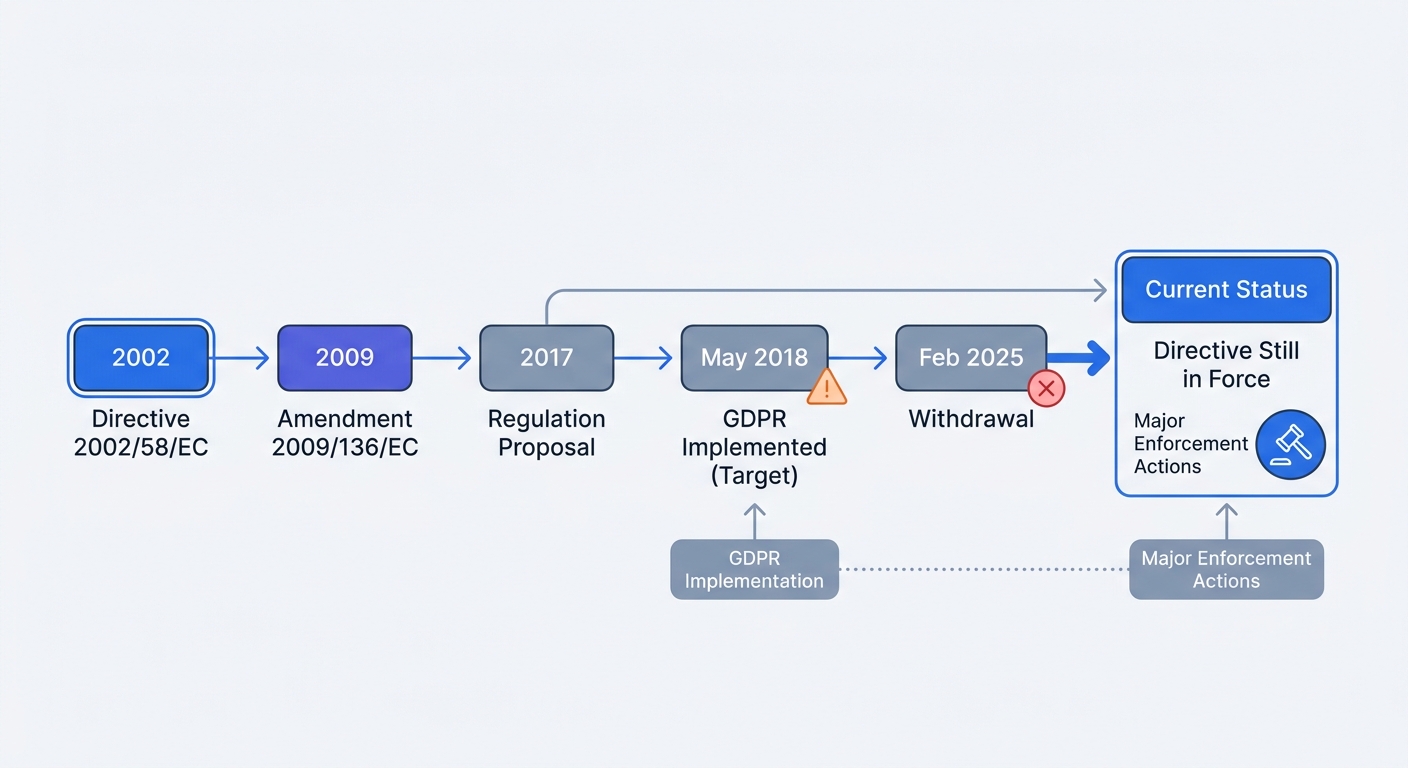
The Original 2002 ePrivacy Directive
The Privacy and Electronic Communications Directive entered force in 2002 to protect the confidentiality of electronic communications. Member states transposed it into national law with varying interpretations. France, Germany, Spain, and Italy each implemented different cookie consent requirements and marketing rules.
The Directive covers cookies, tracking pixels, email marketing, phone calls, and text messages. Article 5(3) requires prior informed consent before storing or accessing information on a user's device, including analytics cookies, advertising trackers, and session identifiers. The 2009 amendment clarified that consent must be explicit for non-essential cookies.
Each EU country enforces its own version of the Directive through national data protection authorities. Germany's TDDDG requires consent for all website analytics. France's CNIL allows privacy-focused analytics without consent if configured to avoid personal data collection. This fragmentation creates compliance complexity for sites operating across multiple jurisdictions.
The Proposed ePrivacy Regulation (2017-2025)
The European Commission proposed the ePrivacy Regulation in January 2017 to replace the Directive with a single EU-wide law. The timing aligned with GDPR's May 2018 implementation date. An EU Regulation applies directly in all member states without requiring national transposition, eliminating the patchwork of different rules.
Negotiations stalled over browser privacy settings, consent mechanisms, and business lobbying. The proposal sat in legislative limbo for eight years while GDPR took effect and reshaped data protection practices. Member states couldn't agree on key provisions around cookies, metadata processing, and electronic marketing restrictions.
The regulation would have imposed penalties up to €20 million or 4% of global annual revenue, matching GDPR's enforcement structure. It included provisions for browser-level consent settings, stricter rules on tracking walls, and expanded protections for electronic communications metadata.
February 2025: Regulation Withdrawal
The Commission approved the withdrawal on July 16, 2025, and published notice in the Official Journal (2025/C 4339, October 6, 2025). The official reason: no foreseeable agreement among legislators and outdated provisions in light of recent legislation like the NIS2 Directive. The withdrawal is documented in the Commission's 2025 Work Programme and available in EUR-Lex's official legislative database.
The original 2002 Directive and its national implementations remain in force. No new EU-wide regulation will replace it in the near term. Any future revised proposal would require years of negotiations.
Check your analytics setup against the Directive's requirements today. If your site loads cookies before obtaining consent, you're violating rules that have been in place since 2002.
How ePrivacy Differs from GDPR
Scope: Communications vs. Personal Data
European privacy law is grounded in Articles 7 and 8 of the Charter of Fundamental Rights, which guarantee respect for private and family life and the protection of personal data. GDPR protects personal data under Article 8 of the EU Charter of Fundamental Rights. ePrivacy protects the confidentiality of communications under Article 7.
GDPR governs any processing of personal data: names, email addresses, IP addresses, cookie identifiers. ePrivacy governs the act of storing or accessing information on a device and the confidentiality of electronic communications. A cookie that contains no personal data still requires consent under ePrivacy because it involves accessing the user's device.
The ePrivacy Directive applies to phone calls, text messages, email, and online communications. GDPR applies when you process personal data from any source. A marketing email falls under both laws: ePrivacy governs whether you can send it, GDPR governs how you handle the recipient's email address.
The Lex Specialis Relationship
ePrivacy functions as lex specialis to GDPR. It addresses specific matters like cookies and electronic marketing while GDPR provides general data protection rules. When both laws apply to the same activity, ePrivacy's specific provisions override GDPR's general requirements.
Loading an analytics cookie requires consent under ePrivacy Article 5(3) before GDPR's lawful basis analysis even begins. The ePrivacy consent requirement is separate from and additional to GDPR's legal basis for processing. A site cannot rely on GDPR's legitimate interest basis to bypass ePrivacy's cookie consent rule.
The proposed regulation described itself as lex specialis to GDPR. The current Directive operates the same way in practice. National courts and data protection authorities apply ePrivacy rules first when both laws govern the same tracking technology.
Practical Differences for Website Owners
ePrivacy requires consent before loading non-essential cookies. GDPR requires a lawful basis for processing personal data collected through those cookies. Both requirements must be satisfied, but ePrivacy's consent gate comes first.
Traditional analytics platforms trigger ePrivacy compliance obligations because they use cookies. The cookies may not contain obvious personal data, but the act of storing them on a user's device requires prior consent. Consent banners exist to satisfy ePrivacy, not GDPR.
Penalties under the ePrivacy Directive are set by national law and therefore vary between Member States; some national regimes have introduced caps comparable to GDPR (e.g., up to €20 million or 4% of global annual turnover), but amounts differ by jurisdiction. GDPR violations can result in penalties up to €20 million or 4% of global annual turnover. In France, the CNIL imposed a €325 million fine on Google in September 2025 for displaying ads in Gmail without valid consent under French implementation of ePrivacy rules. The enforcement risk is real and growing.
What ePrivacy Means for Website Analytics
Cookie Consent Requirements
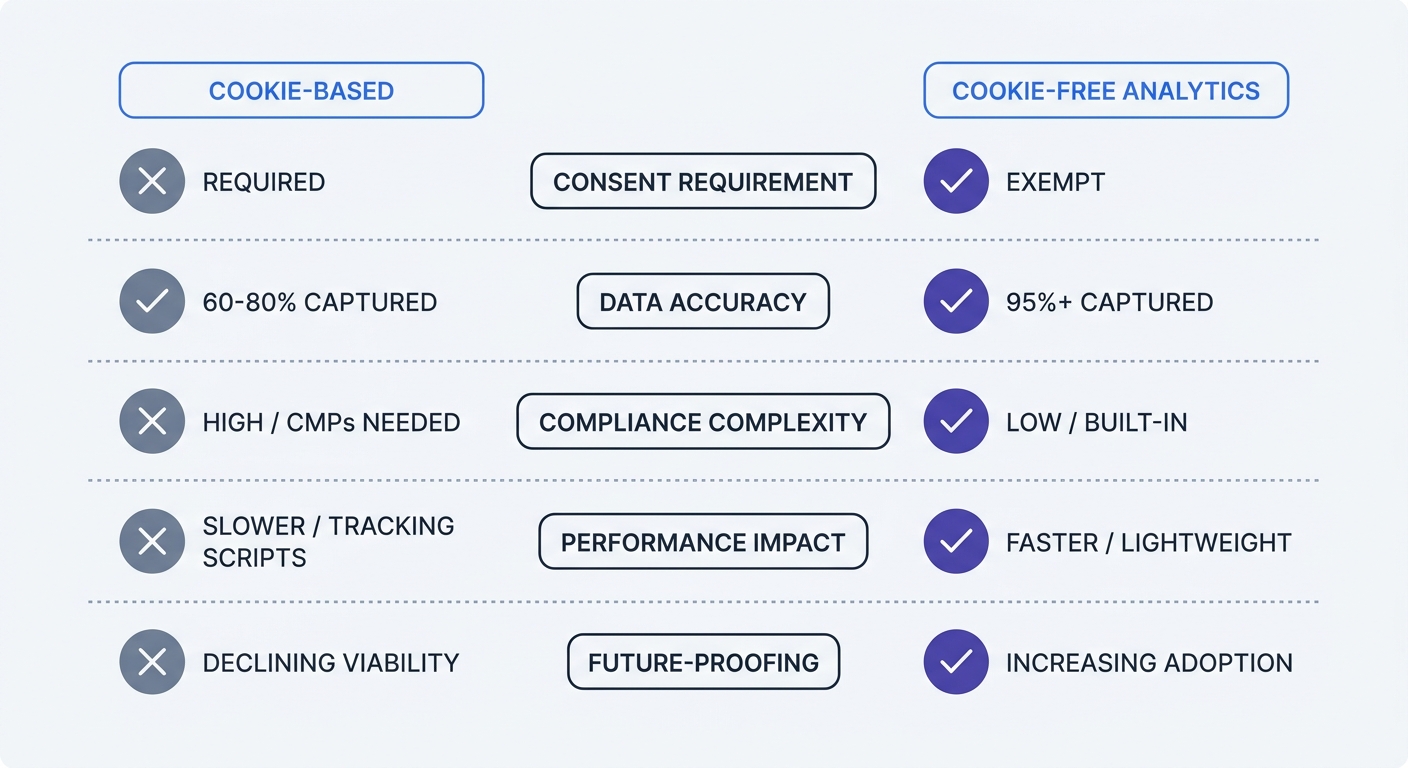
The Directive's Article 5(3) mandates prior informed consent for any cookie that isn't required for service delivery. Analytics cookies fall into the non-essential category. Loading Google Analytics, Matomo with cookies, or Adobe Analytics before obtaining consent violates the law in every EU member state.
Consent must be specific, informed, freely given, and documented. Pre-ticked boxes don't qualify. Consent walls that block access unless users accept cookies may be acceptable only if you offer a cookie-free alternative. The burden of proof for valid consent falls on the website operator.
Many websites remain non-compliant with cookie consent rules. Sites load tracking scripts before the consent banner renders. Others use vague language that doesn't specify which cookies serve which purposes. Both patterns create legal exposure.
The Problem with Traditional Analytics
Cookie-based analytics captures only a fraction of traffic. Around 30% of internet users worldwide use ad-blocking tools , which block analytics cookies. Safari and Firefox block third-party cookies by default. Chrome restricts cross-site tracking.
Traditional analytics platforms undercount traffic by 20-40% due to cookie blocking. The visitors who block cookies often represent your most privacy-conscious and technically sophisticated users. Your reports show a skewed sample, not your full user base.
Consent banners reduce data collection further. The EU average opt-in rate for marketing cookies sits at 46%, declining 8 percentage points over three years . If half your visitors decline analytics cookies and another 30% block them with browser tools, you're measuring perhaps 35% of traffic.
National Implementation Variations
Germany's TDDDG requires consent for all website analytics. Matomo's documentation confirms that German law mandates asking for consent before collecting analytics data, even with privacy-focused tools.
France, Spain, and Italy take a different approach. Their data protection authorities decided that privacy-focused analytics can qualify as "essential" if configured to avoid personal data collection. This exempts properly configured cookieless analytics from consent requirements.
The UK's Data Use and Access Act 2025 amended PECR to permit consent-exempt analytics for statistical purposes about website usage, subject to conditions around data sharing and opt-out availability. This creates a clearer path for privacy-safe analytics in the UK.
Audit which jurisdictions your visitors come from. A site serving German traffic needs consent for any analytics. A site serving French visitors can use cookieless analytics without consent if the implementation meets CNIL guidelines.
Cookie-Free Analytics: The Compliant Solution
How Cookieless Tracking Works
Server-side analytics processes data on your server or the analytics provider's infrastructure instead of running tracking scripts in the user's browser. The visitor's browser sends a page view request to your server. Your server logs the request and forwards anonymized data to the analytics platform.
Session identifiers replace persistent cookies. The platform generates a temporary identifier by hashing the visitor's IP address, user agent string, and a daily rotating salt. This creates a session ID that resets every 24 hours and cannot be used to track individuals across days or sites.
Aggregate analytics focuses on traffic patterns rather than individual user journeys. The platform counts page views, referral sources, and popular content without building user profiles. You see that 1,000 people visited your pricing page without tracking which specific individuals viewed it or what else they did.
Why Privacy-First Analytics Doesn't Need Consent
Cookieless platforms may avoid ePrivacy's consent requirement when configured to avoid storing or accessing information on the user's device. No cookies means no Article 5(3) trigger, provided the implementation does not use other persistent identifiers or device storage mechanisms. The tracking happens server-side using data your server receives in standard HTTP requests.
Whether such platforms collect personal data under GDPR depends on implementation details and applicable jurisdiction. When configured with temporary session hashes that reset daily, cannot be reversed to identify individuals, are not linked to other identifiable data, and are not logged server-side in a way that enables re-identification, such hashes may not qualify as personal data in some jurisdictions. Whether IP addresses constitute personal data and whether they are stored in identifiable form depends on technical implementation (e.g., immediate hashing with non-reversible algorithms, truncation) and legal interpretation. Avoid building user profiles or linking session data across visits.
Several EU data protection authorities have indicated that properly configured privacy-focused analytics may qualify as exempt from consent requirements in their jurisdictions. French, Spanish, and Italian DPAs have ruled that analytics tools avoiding cookies, persistent identifiers, personal data collection, and cross-site tracking may qualify as essential or exempt services. The specific conditions and legal interpretations vary by Member State. Consult legal counsel to determine whether your implementation qualifies for exemption in your target jurisdictions.
Platforms like Swetrix are designed to operate on this model, using lightweight scripts (under 6 kB), avoiding cookies and persistent identifiers, and implementing technical measures to prevent personal data collection. Whether any particular configuration aligns with GDPR, CCPA, and PECR without requiring consent banners depends on implementation details, jurisdictional interpretation, and evolving guidance from data protection authorities. Seek qualified legal advice for your specific use case.
Business Benefits Beyond Compliance
67% of B2B companies now use server-side tracking, reporting an average 41% improvement in data quality over client-side approaches. The data is more accurate because it bypasses browser-based blocking. Server-side processing also improves page load speed by reducing client-side JavaScript execution.
Companies with mature first-party data strategies generate 2.9x more revenue per ad activation and achieve 3.2x better customer retention rates. Privacy-focused marketing delivers 23% better results than traditional tracking-heavy approaches. Privacy is a competitive advantage, not a limitation.
Cookie-free analytics eliminates consent banner friction. Visitors see your content without a blocking popup. Conversion rates improve when you remove barriers between visitors and your product. The business case for privacy-first analytics extends beyond compliance to user experience and data quality.
Compliance Best Practices for 2025 and Beyond
Audit Your Current Analytics Stack
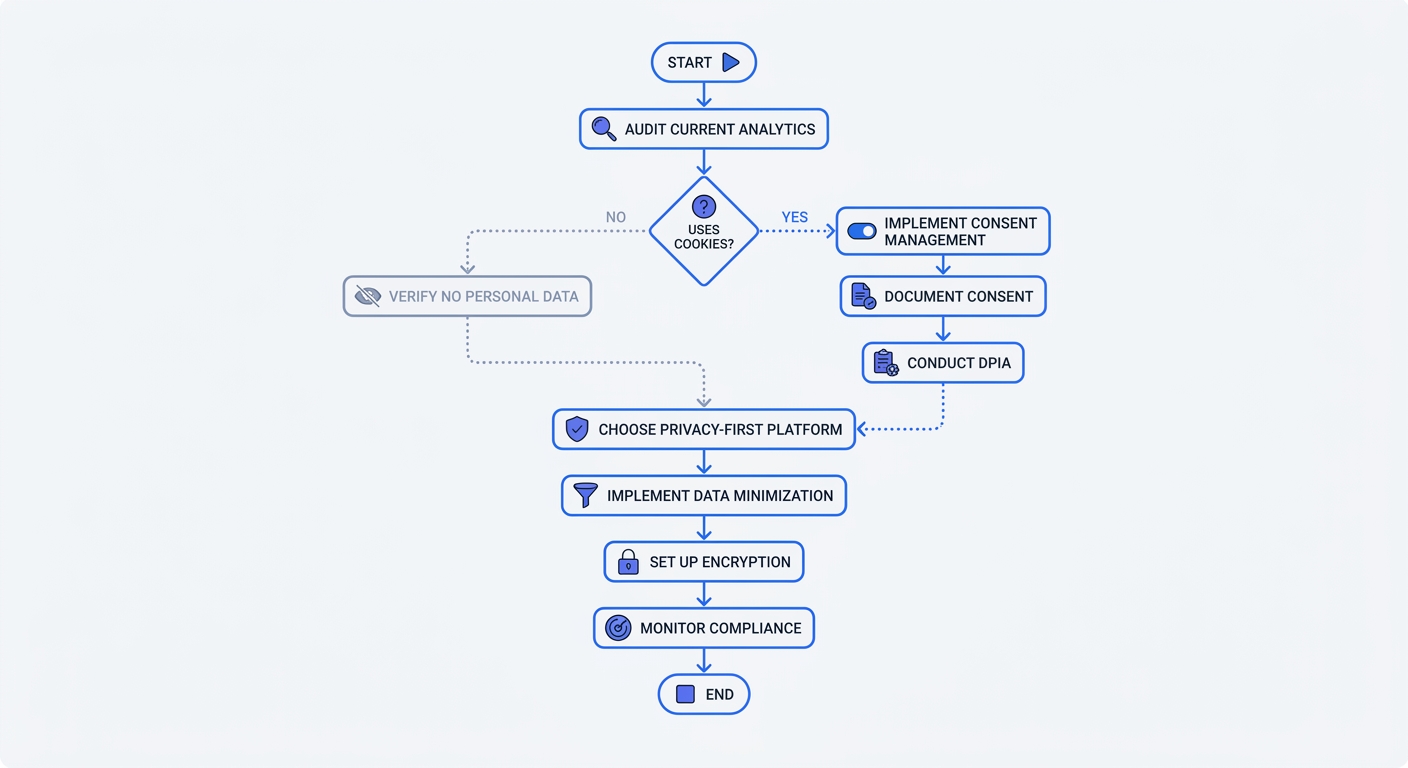
List every analytics tool, tracking pixel, and third-party script on your site. Document what data each tool collects, which cookies it sets, and whether you've obtained consent before loading it. Use your browser's developer tools to inspect cookies and network requests on a fresh page load.
Check whether your analytics platform loads before or after the consent banner. Many sites load tracking scripts in the page head while the consent banner renders later in the body. This sequence violates ePrivacy because cookies are set before consent is obtained.
Review your consent banner implementation. Verify that it specifies which cookies serve which purposes, that consent is granular by category, and that declining cookies doesn't break core site functionality. Test the banner in different browsers and with ad blockers enabled.
Implementing Privacy-Safe Tracking
Choose a platform that doesn't use cookies or collect personal data. Swetrix, Plausible, Fathom, and Simple Analytics all offer cookieless tracking. Matomo can be configured for cookieless operation but requires specific settings to avoid consent requirements.
Configure your chosen platform to anonymize IP addresses. Most privacy-focused platforms do this by default, but verify the setting. Hash or truncate IP addresses before storage, never store them in full.
Implement event-based tracking instead of building user profiles. Track button clicks, form submissions, and video plays as discrete events without linking them to persistent user identifiers. This gives you actionable insights about content performance without creating privacy risks.
Minimize tracking code dependencies. Self-host your analytics script when possible to avoid third-party requests that trigger additional privacy concerns. Keep the tracking code lightweight to maintain fast page load times.
Future-Proofing Your Strategy
The European Parliament expects new ePrivacy legislation in Q3 2027, but negotiations will take years. The regulatory direction is clear: more privacy protection, stricter consent requirements, and expanded restrictions on tracking.
France's CNIL launched a consultation in June 2025 on tracking pixels in emails, potentially requiring explicit consent for email open tracking. The proposal would mandate two separate consents: one for receiving marketing emails and another for tracking pixel deployment. This signals increasing scrutiny of all tracking technologies.
The European Commission's Digital Omnibus package proposes revisions to GDPR and ePrivacy to reduce compliance burdens. The proposal repeals some duplicative security and breach notification requirements but maintains core privacy protections. Expect simplification of overlapping rules, not weakening of privacy principles.
Gartner predicts 90% of marketing measurement will be cookieless by 2027, using server-side tracking, first-party data, and AI modeling. IDC forecasts that 95% of new marketing technology will have privacy-by-design as a core principle. The industry is moving toward privacy-first approaches regardless of regulatory timelines.
Adopt cookieless analytics now. Companies that switched early report cleaner data, simpler compliance stacks, and better user experiences. The transition gets harder as your data history and reporting dependencies grow. Start with a parallel implementation: run your new privacy-focused platform alongside your existing analytics for 30 days, compare the data, then switch completely.
Frequently Asked Questions
Do I Need a Cookie Banner?
Cookie banners are required only for non-essential cookies. If your site uses traditional analytics platforms like Google Analytics, Adobe Analytics, or Matomo with cookies enabled, you need a consent banner before loading those tools.
Cookie-free analytics platforms eliminate the banner requirement. Swetrix, Plausible, and Fathom don't set cookies or collect personal data, so they don't trigger ePrivacy's consent obligation. You can remove your consent banner when you switch to a cookieless platform.
Essential cookies for core functionality (shopping carts, authentication, load balancing) don't require consent. Analytics cookies are never essential because the site functions without them. Marketing and advertising cookies always require consent.
What Are the Penalties for Non-Compliance?
Penalties under the ePrivacy Directive are set by national law and therefore vary between Member States. Some national regimes have introduced caps comparable to GDPR (e.g., up to €20 million or 4% of global annual revenue), but amounts differ by jurisdiction. GDPR violations can result in penalties up to €20 million or 4% of global annual revenue, whichever is higher. National enforcement varies, but major violations draw significant fines.
In France, the CNIL imposed a €325 million fine on Google in September 2025 for Gmail tracking without consent under French implementation of ePrivacy rules. The penalty demonstrates that regulators in some jurisdictions take ePrivacy violations seriously and will enforce against major platforms.
Smaller violations result in warnings, compliance orders, or smaller fines. Data protection authorities prioritize egregious cases and repeat offenders. The enforcement risk increases with company size, data volume, and visibility.
Does ePrivacy Apply to Non-EU Companies?
The Directive applies to any entity processing electronic communications data of EU residents, regardless of where the company is based. The proposed regulation included extraterritorial reach. The current Directive operates the same way in practice.
A US company with a website accessible to EU visitors must comply with ePrivacy rules for those visitors. The law follows the data subject's location, not the company's headquarters. Geolocation-based compliance is possible but complex.
Many companies apply ePrivacy rules globally rather than implementing region-specific tracking. This simplifies compliance and avoids the technical complexity of geolocation-based cookie consent. Privacy-focused analytics works the same way worldwide.
The ePrivacy framework remains complex after the regulation's withdrawal, but the compliance path is clear: eliminate cookies and personal data collection from your analytics stack. Cookie-free platforms provide accurate traffic data without consent banners, legal risk, or user friction.
Swetrix offers a free trial with no credit card required. The platform tracks page views, referral sources, and user behavior without cookies or personal data collection. Set up takes five minutes. Your first 5,000 events per month are free.